This guide explains what these tools actually do, where they deliver real value, and how to evaluate them without getting swept up in hype. You will learn the core categories, the capabilities that matter, and a repeatable process for selecting software that fits your team and goals.
What Are AI Marketing Tools?
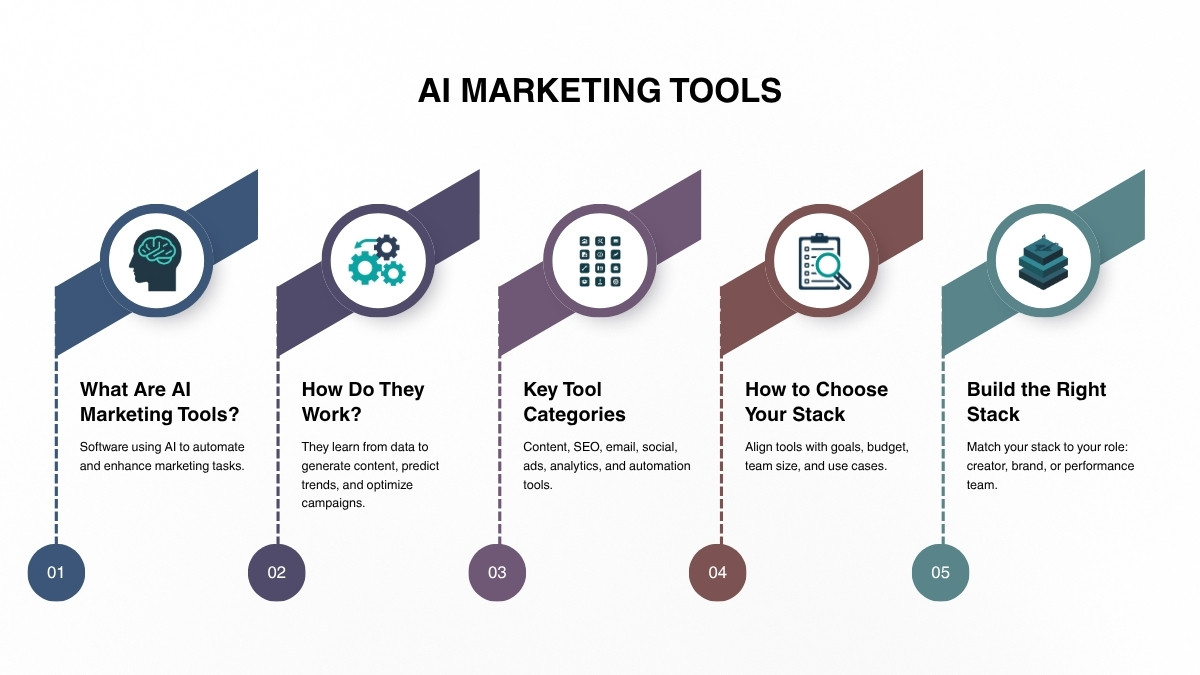
AI marketing tools are software applications that use machine learning, natural language processing, and predictive analytics to handle parts of the marketing workflow. They do not replace your team. They absorb the repetitive, data-heavy, and time-consuming tasks that slow teams down.
Think of them as a layer of automation that sits inside your existing stack. Some tools focus on one narrow job, such as writing ad copy or scoring leads. Others function as broader orchestration platforms that tie together reporting, campaign management, and content production.
What distinguishes these tools from traditional marketing software is their ability to learn from data and produce useful output without explicit step-by-step instructions for every action. Instead of telling a tool exactly what to do, you give it a goal, a dataset, or a rough brief, and it generates options, recommendations, or complete drafts.
Why They Matter Now
Between 2024 and 2026, the pressure on marketing teams has intensified across three dimensions:
- More channels. Brands now need to maintain a presence on search, social, email, paid media, and emerging platforms simultaneously.
- More content formats. Short-form video, long-form articles, interactive assets, newsletters, and community posts all compete for attention.
- Higher personalisation expectations. Audiences expect messaging that reflects their behaviour, preferences, and stage in the buying journey.
AI marketing tools address these pressures by accelerating production, improving consistency, and making personalisation feasible at scale. Teams that adopt them strategically report shorter campaign cycles, more experiments shipped, and better use of the data they already collect.
Where AI Marketing Tools Deliver the Most Impact
Not every marketing task benefits equally from AI. The technology performs best in three specific situations.
1. High-Volume, Repetitive Work
Writing fifty product descriptions, generating twenty headline variations, or turning one webinar into fifteen social posts are all tasks that follow predictable patterns. AI excels at producing these variations quickly and consistently, freeing human writers to focus on strategy, storytelling, and quality control.
2. Data Overload
Marketing generates enormous amounts of performance data across channels, campaigns, and audience segments. Manually interpreting this data is slow and error-prone. AI tools can surface anomalies, identify trends, and generate plain-language summaries that make the numbers actionable.
3. Personalisation at Scale
Personalising emails, product recommendations, or ad creative for thousands of individuals is impossible without automation. AI tools use behavioural data and predictive models to tailor experiences automatically, improving relevance without requiring manual segmentation work.
Where AI does not help is in areas requiring deep judgment, brand nuance, or original creative vision. The best results come from pairing AI output with human review and strategic direction.
Core Categories of AI Marketing Tools
The AI marketing landscape is broad. Understanding the major categories helps you map tools to the specific jobs your team needs to accomplish.
Content and Copywriting Tools
These are the most common entry point for teams new to AI. They help you move from a blank page to a structured draft in minutes rather than hours.
Common use cases:
- Drafting blog posts, landing pages, and product descriptions from a brief or outline
- Generating ad copy and social captions tailored to different platforms
- Repurposing long-form content into shorter assets like emails, social posts, and summaries
- Adjusting tone, reading level, and style to match brand guidelines
Key features to look for:
- Templates for common content formats
- Brand voice training so output consistently matches your style
- SEO-aware guidance on headings, structure, and keyword placement
- Collaboration and approval workflows for editorial teams
Content tools offer visible time savings and are easy to pilot on a single campaign before rolling out more broadly.
Social Media and Scheduling Tools
Social media AI tools handle both creation and distribution. They reduce the manual effort required to maintain a consistent presence across multiple platforms.
Common use cases:
- Brainstorming post ideas and hook angles
- Drafting platform-specific captions and suggesting relevant hashtags
- Scheduling posts at times when your audience is most active
- Monitoring performance and identifying posts worth boosting or repurposing
Key features to look for:
- Unified calendar and queue views across channels
- AI caption suggestions and content remixing options
- Send-time optimisation based on your historical engagement data
- Cross-platform analytics in a single dashboard
These tools are especially valuable for small teams managing LinkedIn, Instagram, TikTok, and other channels without dedicating a full-time social media manager.
Email and Personalisation Tools
Email platforms increasingly embed AI directly into the editor and automation workflows. The goal is relevance: sending fewer, more targeted messages instead of broadcast blasts.
Common use cases:
- Generating subject lines and testing variations
- Drafting nurture sequences and campaign emails
- Personalising content blocks based on segment, behaviour, or lifecycle stage
- Predicting optimal send times and frequency for individual contacts
Key features to look for:
- AI copy assistants integrated into the email builder
- Dynamic content rules that adapt based on user data
- Send-time optimisation models
- Predictive lead and customer scoring
Many CRM and marketing automation vendors now position these AI capabilities as a key differentiator. When evaluating platforms, pay attention to how deeply the AI is integrated versus bolted on.
SEO and Content Optimisation Tools
SEO-focused AI tools help you create content that aligns with search intent and outperforms competing pages.
Common use cases:
- Researching keywords and clustering related queries into topic hubs
- Generating SEO briefs based on what top-ranking pages cover
- Scoring drafts against target keywords and suggesting improvements
- Identifying content gaps and internal linking opportunities
Key features to look for:
- Keyword clustering and difficulty metrics
- Suggested outlines derived from top results and semantic analysis
- Content scores that guide revision priorities
- Integration with your CMS or writing workflow
For content-heavy brands, these tools compress the research-and-briefing phase, which traditionally consumes significant strategist time.
Analytics and Reporting Tools
Analytics-oriented AI tools turn raw data into understandable narratives. They reduce the distance between numbers and decisions.
Common use cases:
- Combining data from multiple channels into unified dashboards
- Generating plain-language summaries and insights
- Detecting anomalies like sudden drops in a key segment
- Forecasting outcomes and suggesting tests
Key features to look for:
- AI-generated commentary layered on top of charts
- Predictive models for conversion, churn, or revenue
- Segmentation and cohort analysis capabilities
- Integrations with existing analytics platforms and data sources
These tools are particularly valuable for marketing leaders and operations teams who need answers quickly without waiting for manual analysis.
Paid Ads and Optimisation Tools
Paid media is one of the most data-intensive areas of marketing, making it a natural fit for AI assistance.
Common use cases:
- Generating numerous ad variants for testing
- Optimising bids and budgets based on performance signals
- Identifying underperforming audiences or placements
- Automating creative refreshes to combat ad fatigue
Key features to look for:
- Creative generation and variant testing
- Budget allocation recommendations
- Performance anomaly alerts
- Integration with major ad platforms like Google Ads and Meta
These tools amplify what native ad platform automation can do, giving you more control and visibility across campaigns.
How AI Marketing Tools Work
Understanding the underlying mechanics helps you evaluate tools more critically and set realistic expectations.
Machine Learning
Machine learning algorithms identify patterns in historical data and use those patterns to make predictions or decisions. In marketing, this powers lead scoring, churn prediction, audience segmentation, and performance forecasting.
Natural Language Processing (NLP)
NLP enables tools to understand and generate human language. It is the technology behind content generation, sentiment analysis, chatbot responses, and plain-language reporting.
Predictive Analytics
Predictive analytics uses statistical models to forecast future outcomes based on past behaviour. Common applications include predicting conversion likelihood, optimal send times, and customer lifetime value.
Generative AI
Generative AI models create new content—text, images, or even video—based on prompts and training data. This is the technology behind most content and creative tools.
Most commercial AI marketing tools combine several of these techniques. A content tool might use NLP to understand your brief, generative AI to draft text, and machine learning to refine output based on your feedback.
How to Choose the Right AI Marketing Stack
Selecting AI marketing tools is not about finding the most impressive demo. It is about matching tools to your specific needs, constraints, and workflows. Use this framework to make decisions.
Step 1: Identify Your Bottlenecks
Start with the problems, not the tools. Ask:
- Where does your team spend the most time on repetitive work?
- Which tasks consistently cause delays or quality issues?
- What data do you collect but fail to use effectively?
- Which channels are underperforming due to lack of resources?
Document specific pain points before looking at any software. This prevents you from being swayed by impressive features that do not solve real problems.
Step 2: Define Success Metrics
For each bottleneck, define what improvement looks like. Examples:
- Reduce content production time from five days to two days per piece
- Increase email open rates by 15% through better subject lines and send times
- Cut reporting time from ten hours to two hours per week
- Double the number of ad variants tested per campaign
Clear metrics make it possible to evaluate whether a tool is actually working after implementation.
Step 3: Map Tools to Workflows
Look at how a potential tool integrates with your existing stack. Key questions:
- Does it connect to your CMS, CRM, or analytics platform?
- Can it work alongside your current tools without creating data silos?
- Does it support collaboration for the team members who will use it?
- What is the learning curve for adoption?
A tool that requires a complete workflow overhaul may deliver features but fail on adoption. Prioritise tools that fit into how your team already works.
Step 4: Run a Pilot
Before committing to a full rollout, test the tool on a limited scope:
- Choose one campaign, one content series, or one channel
- Set a clear time frame, such as 30 to 60 days
- Track the success metrics defined in Step 2
- Gather feedback from the team members actually using the tool
A pilot reveals whether the tool delivers on its promise in your specific context, with your data and your team.
Step 5: Evaluate and Scale
After the pilot, compare results against your baseline. If the tool met or exceeded expectations, plan a phased rollout. If not, reassess. The goal is not to adopt every tool available. It is to build a stack where each piece earns its place through measurable impact.
Building a Balanced Stack
Most teams do not need tools in every category. A balanced stack typically includes:
- One content or copywriting tool to accelerate production
- One SEO tool if organic search is a meaningful channel
- One analytics or reporting tool to make data accessible
- Channel-specific tools only where you invest heavily
Resist the urge to accumulate tools. Each addition creates integration overhead, training requirements, and subscription costs. A focused stack of three to five well-integrated tools often outperforms a sprawling collection of disconnected point solutions.
Common Pitfalls to Avoid
Treating AI Output as Final
AI generates drafts, suggestions, and recommendations. Human review remains essential for accuracy, brand alignment, and quality. Publishing AI content without editorial oversight leads to generic output, factual errors, and brand dilution.
Ignoring Data Quality
AI tools learn from the data you provide. If your CRM is full of outdated contacts or your analytics are misconfigured, the AI will produce poor recommendations. Clean data is a prerequisite for effective AI.
Over-Automating Too Quickly
Automating every workflow at once creates confusion and resistance. Start with one or two high-impact use cases, prove value, and expand gradually.
Choosing Tools Based on Hype
The AI marketing space is crowded with vendors making bold claims. Focus on demonstrated outcomes, customer references, and pilot results rather than feature lists or press coverage.
The Future of AI Marketing Tools
The trajectory is clear: AI capabilities will become standard features in marketing software rather than differentiators. The tools that survive will be those that integrate deeply with workflows, provide transparent reasoning for their recommendations, and give users meaningful control over output.
For marketing teams, the opportunity is not to replace human creativity but to amplify it. The most effective teams will be those that use AI to handle the repetitive and data-heavy work, freeing their people to focus on strategy, storytelling, and genuine audience connection.
AI marketing tools are not a shortcut to success. They are a force multiplier for teams that already have a clear strategy, defined processes, and a commitment to quality. Used well, they help you do more of what works—faster and with greater consistency.