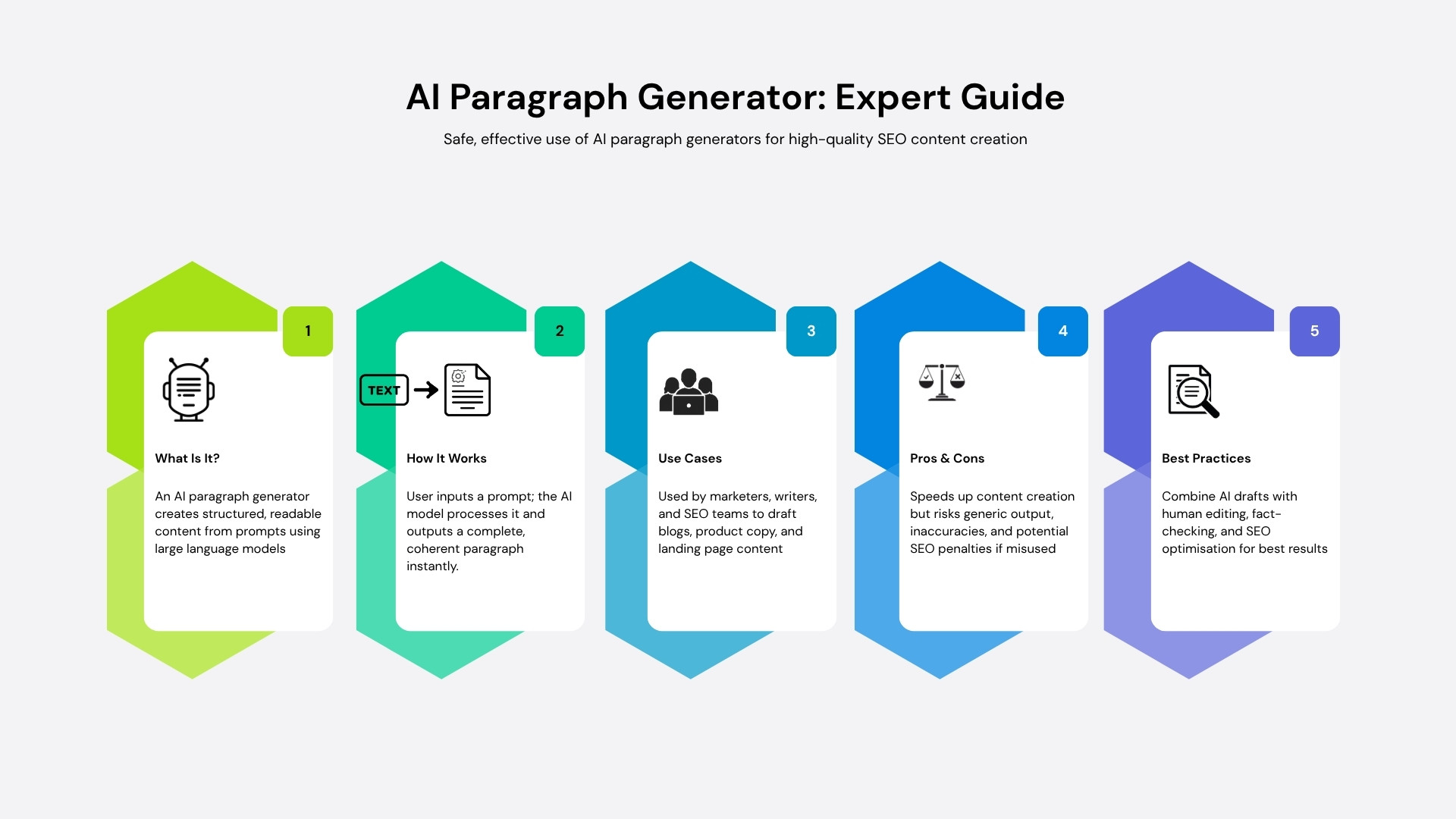
An AI paragraph generator is an AI writing assistant that turns short prompts, keywords, or rough ideas into complete, readable paragraphs. Instead of starting every piece of content from a blank page, you can use an AI paragraph writer to create a first draft in seconds, then shape it with your own expertise and brand voice.
Used well, an AI paragraph generator can speed up your content pipeline, help your team experiment with new angles, and support SEO content production. Used poorly, it can flood your site with generic text, factual errors, and unhelpful content that search engines and readers learn to ignore. This guide from SEOSERVICES1 walks through what these AI content tools do, how they work, where they shine, where they fall short, and how to use them safely in your SEO workflows.

Introduction: What Is an AI Paragraph Generator?
An AI paragraph generator is an AI content generator designed specifically to produce one or more paragraphs of text from a user’s instructions. You provide a short brief usually a sentence or two and the tool returns a coherent paragraph you can refine and publish.
Simple Definition
An AI paragraph generator is an AI writing tool that creates complete paragraphs from short prompts, keywords, or instructions, helping you draft or improve text faster than writing every sentence manually.
In day‑to‑day use, an AI paragraph generator can:
- Expand a bullet point into a full explanation.
- Rewrite a clumsy paragraph into something clearer and more engaging.
- Produce several alternative introductions or conclusions for the same topic.
- Turn a rough idea into something your team can react to and edit.
How It Differs from Other AI Writing Tools
AI paragraph generators sit in the same family as many AI content tools, but they focus on a narrower job.
- AI paragraph generator / AI paragraph writer – Optimised to produce paragraph‑sized chunks of content on demand.
- Article or blog generators – Aim to create long‑form pieces (e.g., full blog posts) from a brief, often with mixed quality.
- Paraphrasing tools – Reword existing text, keeping the original structure and meaning but changing the phrasing.
- Chat‑style AI writing assistants – Multi‑purpose; they can answer questions, brainstorm, and draft content, but often need more steering to produce clean paragraphs.
If your main bottleneck is turning ideas and outlines into solid paragraphs rather than generating entire pages automatically an AI paragraph generator is usually a better fit than a one‑click article generator.
How AI Paragraph Generators Work
AI paragraph generators use large language models (LLMs) to predict and assemble words into sentences that fit your prompt. You don’t need a deep technical background to use them effectively, but understanding the basics helps you write better prompts and avoid common mistakes.
Inputs and Prompts
Every AI paragraph generator starts with your input. That input can be very vague (“Write a paragraph about AI content tools”) or very specific (“Write a 150‑word paragraph explaining how an AI paragraph generator helps a small marketing team create weekly blog content”).
Good prompts typically include:
- Topic – what the paragraph should be about.
- Audience – who will read it (students, marketers, customers, executives).
- Goal – educate, persuade, summarise, compare, or entertain.
- Tone – friendly, formal, expert, neutral, playful.
- Length – short, medium, or a rough word count (e.g., 80–120 words).
- Key phrases – any important terms or SEO keywords to include naturally.
For example:
“Write a 120‑word paragraph for marketers explaining what an AI paragraph generator is, in a clear but non‑technical tone, and mention ‘ai writing assistant’ once.”
The more context you give the AI content generator, the less time your team spends rewriting bad outputs.
How the Model Generates Text
Behind the scenes, AI paragraph generators rely on large language models trained on huge collections of text. In simplified terms:
- The tool encodes your prompt into a format the model can understand.
- The model predicts the next word (or token) that would most likely appear after your prompt, based on patterns it has learned.
- It repeats that prediction step, one token at a time, until it hits a length limit or a natural stopping point.
The model is not retrieving pre‑written paragraphs. It is generating new text by following statistical patterns in language. That’s why it can create fluent, human‑like paragraphs but also why it can sometimes be confidently wrong or overly generic.
Common Features and Settings
Most AI paragraph writers include a similar set of settings and features:
- Length controls – choose between short, medium, or long paragraphs.
- Tone/style options – professional, friendly, technical, casual, etc.
- Templates – specific modes for blog intros, product descriptions, email copy, and more.
- Multi‑language support – generate paragraphs in different languages.
- Variant generation – generate multiple paragraphs from the same prompt so you can pick the best one.
Understanding these options helps your team move beyond “click and hope” into a more intentional workflow that consistently produces usable drafts.

Use Cases for AI Paragraph Generators
AI paragraph generators are versatile, but they’re not universal solutions. Below are common use cases where they can genuinely help your content process alongside notes on where human judgment still matters.
Brainstorming and Drafting New Content
AI paragraph generators are excellent for breaking through the blank‑page barrier.
Examples:
- Blog intros: Your team has an outline for a blog post but struggles to start. An AI writing assistant can create three different introductory paragraphs, which you then refine into a final version.
- Explainer paragraphs: You need a concise explanation of a concept (e.g., “what is technical SEO?”) for a section of a guide. The AI paragraph generator can draft a first pass you sharpen.
- Email or landing page snippets: You want a compelling paragraph above a form or call‑to‑action. AI can propose different angles, which you test and refine.
In all of these cases, the AI content generator’s job is to give you something concrete to edit, not a finished paragraph to copy‑paste.
Rewriting and Expanding Existing Content
Many teams use AI paragraph writers to improve text they already have.
Examples:
- Rewriting clunky sections: A subject matter expert has written a dense paragraph full of jargon. AI can suggest a clearer, more readable version that your editor then polishes.
- Expanding short notes: Your notes from a webinar or meeting include bullet points you want to turn into a paragraph summary. An AI paragraph generator can expand those bullets into a coherent explanation.
- Adapting tone: You have a paragraph that sounds too formal for a social post. AI can rewrite it in a more conversational tone, while you ensure the message stays accurate.
This is especially useful when your subject experts are strong on ideas but short on time or writing experience.
Educational and Personal Use
Students, educators, and general users often experiment with AI paragraph generators for learning and practice.
Examples:
- Simplifying concepts: A student asks an AI paragraph writer to explain a topic in simpler terms before they rewrite it in their own words.
- Practice material: An educator generates sample paragraphs to use in lessons on editing, structure, or style.
- Language learning: Non‑native speakers generate paragraphs in English, then study structure and vocabulary while rewriting them.
In academic settings, it’s important to follow institutional policies on AI use and avoid presenting AI‑generated paragraphs as original, sole‑author work.
SEO Content Support (With Caution)
For SEO content, an AI paragraph generator can be helpful in specific, controlled scenarios:
- Body copy for straightforward topics: Drafting a paragraph about a well‑defined, non‑controversial subject that your SEO team then optimises and fact‑checks.
- Alternate phrasing: Generating multiple versions of a paragraph to find one that best matches search intent and user expectations.
- Supporting paragraphs: Filling in less critical explanatory sections that human editors then refine to align with your overall SEO strategy.
However, AI paragraphs should never be the only step in your SEO content pipeline. Without human guidance, you risk flooding your site with generic or inaccurate content that fails to satisfy users or rank well.

Benefits of Using an AI Paragraph Generator
When used thoughtfully, AI paragraph generators offer real, practical benefits to content creators and SEO teams. The key is to see them as supporting tools, not as shortcuts that replace expertise.
Speed and Productivity
AI paragraph generators can dramatically reduce the time it takes to move from idea to draft.
Benefits for your team include:
- Faster first drafts: Instead of spending 20–30 minutes drafting a paragraph, you might get a workable draft in seconds and spend your time editing.
- Higher throughput: Content writers can handle more tasks in the same amount of time, especially for routine explanatory sections.
- Reduced context‑switching: When an AI writing assistant handles repetitive drafting, humans can stay focused on strategy, research, and high‑level editing.
If your bottleneck is pure writing time, an AI paragraph writer can make a noticeable difference to your content capacity.
Overcoming Writer’s Block
Blank pages slow everyone down, from junior writers to experienced strategists. AI paragraph generators help by:
- Providing a “rough version” you can disagree with, rewrite, or expand.
- Suggesting angles or metaphors you might not have considered on your own.
- Keeping your momentum going when you’re tired or stuck on phrasing.
Often, it’s easier to fix a not‑quite‑right paragraph than to start from nothing. AI gives you that starting point.
Experimenting With Different Angles and Tones
AI paragraph generators are also useful for exploring variations, especially when you’re testing marketing messages or teaching different audiences.
Use them to:
- Compare persuasive vs educational approaches to the same topic.
- Generate versions aimed at beginners vs advanced professionals.
- Try formal vs conversational tone and see which resonates with your audience.
For content teams, these variations can feed A/B tests or serve as internal discussion starters in editorial meetings.
Risks and Limitations
For all their strengths, AI paragraph generators have clear limitations that you ignore at your own risk. Understanding these constraints helps you design safer, more effective workflows.
Quality and Accuracy Issues
AI paragraphs can sound fluent and authoritative while being partially or completely wrong.
Common issues include:
- Incorrect facts or dates – referencing outdated or invented information.
- Misattributed quotes or sources – fabricating citations or mixing up authors.
- Over‑simplification – reducing a complex topic to something misleadingly shallow.
If your content deals with technical, legal, medical, financial, or safety‑critical topics, you must treat AI‑generated paragraphs as unverified drafts, not trusted sources.
Repetitive or Generic Output
Without strong prompts and editing, AI content tools tend to default to:
- Safe, generic phrasing you’ve seen hundreds of times.
- Repetitive sentence structures (“First, X. Second, Y. Finally, Z.”).
- Buzzword‑heavy language that says little (“leverage powerful solutions to drive success”).
Over time, this can make your site feel interchangeable with any other site using the same AI paragraph writer. That’s bad for differentiation, brand recognition, and user engagement.
SEO and Duplicate Content Concerns
AI paragraph generators and other AI content generators raise specific SEO concerns:
- Thin content – paragraphs that technically cover a topic but add no unique insight or value.
- Keyword stuffing – prompts that force the AI to repeat keywords unnaturally, resulting in over‑optimised, awkward text.
- Similarity to existing content – while AI doesn’t copy word‑for‑word, many teams prompt it in similar ways, leading to content that’s structurally and conceptually indistinguishable from competitors’.
Search engines emphasise “helpful content” and user satisfaction. High volumes of generic AI paragraphs even if technically original can still produce weak performance.
Ethical and Policy Considerations
There are also ethical and policy‑related limits to consider:
- Academic and classroom rules – many institutions have clear guidelines about when AI writing assistants may or may not be used.
- Client transparency – in agencies or freelance work, some clients expect to know if AI content tools were involved.
- Bias and representation – AI models can reflect biases present in their training data, affecting how topics or groups are described.
Your organisation should set clear guidelines so everyone on your team understands when AI is acceptable, when it requires disclosure, and when it should be avoided entirely.

Image Description: Split-screen illustration showing benefits on one side and risks on the other, representing the pros and cons of using an AI paragraph generator.
Best Practices for Using AI Paragraph Generators
If your team wants to use an AI paragraph generator responsibly, you need a structured approach especially for SEO content. Think of these best practices as guardrails that keep quality and trust front‑and‑centre.
Set Clear Intent and Prompts
Start with clarity. Before you open any AI content tool, ask:
- What role will this paragraph play in the larger piece?
- What question is it answering for the reader?
- What search intent does it need to match (informational, commercial, navigational)?
- How should the reader feel or what should they understand after reading it?
Then build prompts that reflect those answers. For example:
- Good prompt: “Write a 100‑word paragraph explaining, in simple terms, how an AI paragraph generator helps a small business owner draft website copy faster, in a reassuring and practical tone.”
- Weak prompt: “Write about ai paragraph generator.”
The more specific you are, the less work you create for your editors.
Always Edit and Fact‑Check
Treat AI output like a raw material, not a finished product.
For each AI‑generated paragraph:
- Check accuracy – validate any claims, stats, or named entities.
- Improve clarity – tighten sentences, remove filler, adjust transitions.
- Fix structure – make sure the paragraph fits logically between others.
- Align with SEO – ensure it truly answers the query or supports the section’s goal.
Build a simple editing checklist your team follows consistently. Over time, this becomes second nature.
Maintain Brand Voice and Style
Your brand voice is one of the quickest ways users recognise that content comes from you, not just any AI paragraph writer.
To maintain consistency:
- Provide brief style notes in your prompts (e.g., “Write in a calm, expert tone. Avoid slang and overly dramatic language.”).
- Create internal examples of “our voice vs not our voice” so editors can compare AI outputs to a clear standard.
- Replace generic phrases with your typical wording or examples from your own experience.
The goal is for readers to say, “This sounds like us,” even if AI helped with the first draft.
Combine AI Output With Human Expertise
The most effective setup is a hybrid workflow where AI assists and humans decide.
A simple hybrid process for SEO content might be:
- Strategist or SEO specialist – defines target keyword, search intent, outline, and page goal.
- Writer or editor – drafts key sections by hand and uses an AI paragraph generator for low‑risk explanatory paragraphs or variations.
- Subject matter expert – reviews critical sections for accuracy and depth.
- SEO specialist – checks alignment with on‑page SEO best practices and internal linking.
This way, AI accelerates the work without taking control of the message, strategy, or quality.
When Not to Use AI Paragraph Generators
Equally important is knowing when not to lean on AI content tools:
- High‑stakes topics: medical advice, legal guidance, safety instructions, or anything where errors could cause harm.
- Sensitive brand communications: crisis statements, official policy pages, or critical investor communications.
- Very niche or proprietary topics: areas where public training data is likely thin and your internal knowledge is unique.
In these situations, using an AI paragraph writer even as a starting point can introduce subtle errors or tone issues that are easy to miss but hard to repair.
AI Paragraph Generators and SEO Content
AI paragraph generators can play a role in SEO content, but they need to be embedded into an SEO‑first process rather than used to churn out text for the sake of word count.
Where AI Helps in SEO Content Workflows
A carefully used AI paragraph generator can support SEO content in areas such as:
- Drafting non‑critical explanatory sections – for example, simple definitions in a longer guide that your team then refines and checks.
- Generating alternative phrasings – creating multiple versions of a paragraph to see which best matches search intent or user expectations.
- Creating supporting content – such as FAQ answers or brief summaries that a human editor reviews and aligns with your keyword strategy.
In all these cases, the AI is operating under human direction, not deciding what the page should say or which topics it should cover.
Where Human Writers Are Essential
Human writers (and editors) remain essential for:
- Search intent analysis: deciding what the page needs to cover to satisfy the query.
- Information architecture: structuring the article into logical sections and flows.
- Topic selection and prioritisation: choosing what content to create in the first place.
- Creating unique, experience‑driven content: such as case studies, original research, and opinion pieces.
Search engines increasingly reward content that demonstrates real‑world experience and expertise something an AI paragraph generator cannot invent.
Hybrid Workflow (AI + SEOSERVICES1)
A practical hybrid workflow that SEOSERVICES1 recommends looks like this:
- SEO and content planning – SEOSERVICES1 works with you to define topics, target keywords, and outlines based on search data and your business priorities.
- Drafting with AI support – AI paragraph generators help create first‑pass paragraphs for selected sections under clear prompts.
- Human refinement – SEOSERVICES1’s writers and editors revise AI drafts, add unique examples, incorporate internal knowledge, and ensure brand voice.
- SEO optimisation – on‑page elements, internal links, and alignment with search intent are reviewed and adjusted.
- Quality assurance – final checks for accuracy, originality, and usefulness before anything is published.
In this model, AI paragraph writers are powerful assistants within a tightly controlled, human‑led SEO workflow.
Choosing an AI Paragraph Generator Tool
There are many AI paragraph generators and broader AI writing tools on the market. Instead of chasing brand names, focus on finding an AI content generator that fits your workflow and quality expectations.
Key Features to Look For
When evaluating tools, consider:
- Output quality: Does the text usually make sense, stay on topic, and require only reasonable editing?
- Control: Can you easily set tone, length, and context, or does the tool feel like a black box?
- Reliability: Does it handle a wide range of prompts without breaking down or producing nonsensical text?
- Team usability: Is the interface simple enough for non‑technical colleagues to use with basic training?
A quick internal trial with a few realistic use cases is often the best way to evaluate whether a given AI paragraph writer is workable for your team.
Free vs Paid Tools
Free AI paragraph generators can be great for experimentation or occasional use, but they tend to come with constraints:
- Strict limits on the number of paragraphs or tokens you can generate per day.
- Fewer options for tone, structure, or templates.
- Less control over how your prompts and data are stored and used.
Paid AI content tools usually offer:
- Higher or unlimited usage limits.
- More advanced controls and templates.
- Better support, documentation, and sometimes team collaboration features.
If your team intends to use AI paragraph generators as part of a serious SEO content process, a paid tool plus strong editorial guidelines is usually the safer and more efficient choice.
Integrations, Data Privacy, and Workflow Fit
Finally, look at the bigger picture:
- Integrations: Does the tool connect with your CMS, document tools, or project management system, or will your team spend time copying and pasting?
- Data handling: Does the provider explain how your prompts and outputs are stored? Are there options to limit training on your data if you need that?
- Team governance: Can you set shared prompt templates, style guides, or usage rules so that your writers don’t reinvent the wheel with every paragraph?
Choosing a tool is as much about supporting the way your team works as it is about the quality of the AI’s output.
How SEOSERVICES1 Uses AI Paragraph Generators Responsibly
SEOSERVICES1 works with clients who want the efficiency benefits of AI paragraph generators without compromising on SEO performance, brand quality, or long‑term safety.
Our Workflow for SEO Content
A typical AI‑assisted content project with SEOSERVICES1 looks like this:
- Discovery and planning
- Understand your goals, audience, and current content performance.
- Define a content roadmap and SEO strategy aligned with your business priorities.
- Briefing and outlining
- Create detailed briefs and outlines for each page or article, including target keywords, search intent, and key messages.
- Drafting with AI support
- Use AI paragraph generators selectively for low‑risk explanatory sections or variations.
- Keep prompts structured and consistent with your brand and SEO goals.
- Human copywriting and editing
- Writers refine AI drafts or write critical sections manually.
- Editors ensure clarity, accuracy, voice, and depth meet your standards.
- SEO optimisation
- Align headings, meta tags, internal links, and paragraph content with best practices.
- Check that each page provides unique value in your niche.
- Review and iteration
- Incorporate your feedback as subject matter experts.
- Update and improve content over time based on performance data.
In this workflow, AI paragraph tools help your team move faster, but SEOSERVICES1’s human expertise remains responsible for the final result.
Quality Control and Editorial Standards
To protect your brand and SEO performance, SEOSERVICES1:
- Never publishes unedited AI‑generated paragraphs.
- Fact‑checks claims and ensures any real‑world examples are accurate and appropriate.
- Adjusts AI‑created text to match your established tone, terminology, and audience.
- Uses AI paragraph generators in line with a clear internal policy focused on user value and search guidelines.
This approach balances innovation with caution, which is crucial as AI tools and search engine expectations continue to evolve.
Examples of AI‑Assisted SEO Content Projects
Here are a few example scenarios where SEOSERVICES1 might use an AI paragraph writer:
- Global SaaS company: Using AI to draft first‑pass explanations of generic concepts (e.g., “what is cloud storage?”), then having SEOSERVICES1 writers weave in the client’s unique positioning and examples.
- E‑commerce brand: Generating alternative paragraph variations for product category descriptions, then testing which versions lead to better engagement and refining those manually.
- B2B service provider: Supporting a busy in‑house marketing team by drafting supporting paragraphs from their bullet‑point notes, then editing those into polished case studies and service pages.
In each case, AI assists with volume and speed, while humans ensure that every paragraph is worth publishing.
FAQ About AI Paragraph Generators
Is it safe to use AI paragraphs for SEO?
It can be safe to use AI‑generated paragraphs in SEO content if you treat them as drafts and apply careful human editing, fact‑checking, and optimisation. The final text should be accurate, useful, and aligned with search intent not just generic filler created to hit a word count.
Will AI‑generated content be penalized?
Search engines are primarily concerned with quality, relevance, and user value, not the tool you used. AI‑generated content is unlikely to be penalized just for being AI‑generated, but thin, misleading, or manipulative content whether written by a human or an AI can hurt your performance.
How much editing do I need to do?
Plan to review every AI‑generated paragraph before it goes live. At minimum, you should verify facts, adjust tone, check that the paragraph fits its context, and ensure it supports your SEO strategy. For important pages, a deeper edit by an experienced writer or editor is advisable.
Can AI replace human writers?
For serious SEO content and brand‑critical communication, AI should be seen as an assistant, not a replacement. AI paragraph generators can speed up routine drafting, but they cannot replace human judgment, experience, or strategic thinking. A hybrid approach AI‑assisted, human‑led is where most teams see the best results.
Are AI paragraph generators detectable?
Some tools claim to detect AI‑generated text, but detection is imperfect and can change as models evolve. Rather than focusing on “beating detection,” focus on producing content that clearly provides value, is well‑edited, and reflects real expertise. That’s what search engines and users care about.
Is using an AI paragraph generator plagiarism?
AI paragraph generators create new text, but you are still responsible for how you use it. If you ask AI to write about specific sources, ideas, or research, you must still cite those sources correctly. You should also avoid prompting AI to mimic specific articles or authors too closely, as that can create ethical and legal issues.
Are free AI paragraph generators good enough for professional work?
Free tools can be useful for quick tests or small tasks. However, for ongoing professional SEO content, you typically get better results by combining a reliable AI content tool (often paid) with a strong editorial process and SEO services oversight. Free tools’ limitations in control and usage can become bottlenecks at scale.
How does SEOSERVICES1 use AI paragraph generators in client projects?
SEOSERVICES1 uses AI paragraph generators as drafting tools inside a human‑driven SEO content workflow. AI may help create first drafts for certain paragraphs, but SEOSERVICES1’s strategists, writers, and editors remain responsible for accuracy, voice, structure, and SEO performance. AI never replaces the planning, review, and optimisation steps.
If your team wants to integrate AI paragraph generators into your SEO content process without risking quality or long‑term performance, SEOSERVICES1 can help design a hybrid workflow that makes AI a strength not a liability for your content strategy.