AI is no longer something that sits quietly in the background of marketing. It is starting to shape how brands think, write, choose, and deliver messages to real people. In the journal Evaluating the Effectiveness of AI-Powered Content Creation and Curation in Marketing, the authors show that AI-powered content creation and curation can improve marketing effectiveness, audience engagement, personalization, and conversions, while still requiring human oversight for quality and ethics. That combination makes the topic especially relevant today, because it reflects something many marketers already feel: the work is changing, and the way we connect with audiences is changing with it.
What makes this discussion compelling is that it is not just about efficiency. Yes, AI can help marketers work faster. Yes, it can reduce repetitive effort. But the real story is deeper than that. It is about whether marketing can become more responsive, more relevant, and more emotionally aware without losing the human touch that makes people trust a brand in the first place.
What AI-powered content creation means
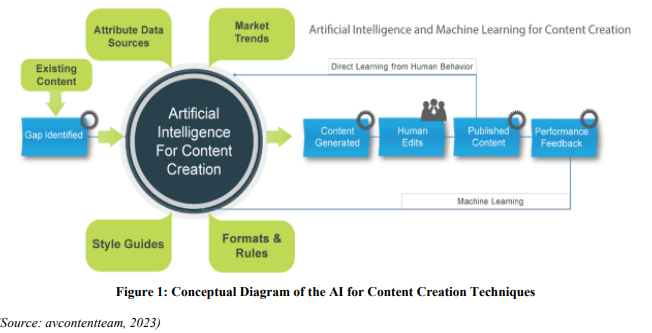
AI-powered content creation is, at its simplest, a way to make content work smarter. Instead of building every piece manually from the ground up, marketers can use AI tools to help create, sort, and refine content more efficiently. That does not mean AI replaces the creative process entirely. Rather, it becomes a support system that helps marketers move with more speed and precision.
The journal discusses tools and methods such as predictive analytics, natural language processing, machine learning, neural networks, deep learning architectures, sentiment analysis, and text mining. Those terms may sound highly technical, but the idea behind them is quite practical. These tools help marketers understand patterns, detect audience reactions, and shape messages that are more likely to connect. In other words, AI is not just producing content. It is helping content become more strategic.
This matters because modern marketing is no longer about simply publishing more. It is about publishing better. Audiences are overloaded with information, and they can quickly ignore anything that feels random, repetitive, or irrelevant. AI helps reduce that problem by making content creation more informed and more adaptive.
Why AI improves marketing performance
The journal’s main finding is straightforward but powerful: AI improves marketing effectiveness, audience engagement, and content personalization. That matters because these are the three things marketers care about most when content has to perform in the real world.
Marketing effectiveness is about whether the message actually does its job. Audience engagement is about whether people pay attention, interact, and respond. Content personalization is about whether the message feels relevant to the person receiving it. The journal suggests that AI can strengthen all three at the same time.
It also states that predictive analytics and AI-driven targeting can improve lead generation and conversion outcomes. That means AI is not only helping people notice content, but also helping move them further along the customer journey. In practice, this can feel like a huge advantage. Instead of guessing what a target audience wants, marketers can use AI-supported insights to shape messages that are more aligned with behavior, interest, and timing.
Another important point from the journal is that AI-generated and AI-curated content can adapt in real time based on consumer behavior and feedback. This is one of the reasons AI feels so different from older marketing tools. It does not have to stay static. It can respond. It can shift. It can stay relevant while audience preferences continue to evolve. For marketers, that kind of flexibility can be the difference between being noticed and being forgotten.
Data points from the journal
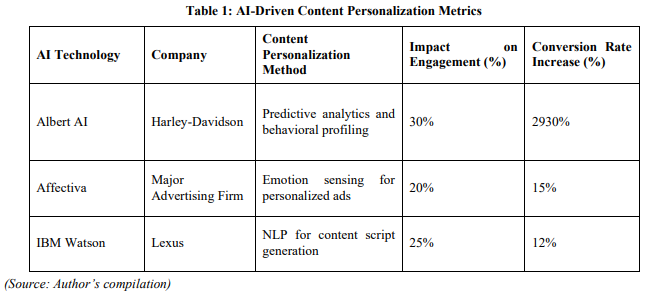
The paper includes several concrete performance examples that can work well in a blog post. Albert AI is reported to have increased leads by 2,930%, with a 30% engagement improvement and a 2,930% conversion rate increase. Affectiva is associated with a 20% impact on engagement and a 15% conversion rate increase, while IBM Watson is associated with a 25% impact on engagement and a 12% conversion rate increase. The paper also reports that AI-powered creation can produce 100 ads in 30 minutes, compared with 2 days for human-driven creation.
These examples are striking because they show both speed and impact. The speed part is easy to understand: AI can drastically reduce the time needed to create large volumes of content. But the impact part is what makes the discussion more meaningful. Faster production would not matter much if the content did not perform. According to the journal, these tools are linked to stronger engagement and conversion outcomes, which is why they are so important in marketing discussions.
At the same time, the numbers also remind us that AI is not merely a convenience tool. It is being used in ways that can affect business results in a very direct way. That is why marketers are paying attention. When a tool can help produce more content faster and support better performance, it naturally becomes part of the strategic conversation.
AI content curation in practice
One of the strongest ideas in the journal is that AI content curation matters just as much as content creation. In many conversations, people focus on the generation side of AI, but the paper reminds us that what gets selected, filtered, and delivered is just as important.
The journal treats AI content curation as a key part of marketing performance, not just a supporting function. It highlights that AI can support real-time personalization and more relevant curation, which helps marketers match content more closely with audience behavior. That is a big deal in a world where relevance often determines whether someone keeps reading, clicks through, or moves on.
For readers, this makes AI content curation feel practical and useful rather than abstract. It is not just a technical feature in the background. It is part of the experience people actually receive. If a brand can show the right message to the right person at the right time, the content becomes more than content. It becomes a better conversation.
Why human oversight still matters
Even with all these strengths, the journal does not treat AI as a full replacement for people. That is one of its most important points. The study warns about overdependence, privacy issues, algorithmic bias, and a lack of emotional depth compared with human-created content.
This matters because marketing is not only about reaching people. It is also about understanding them. AI can recognize patterns, but it does not experience emotion the way humans do. It can optimize messages, but it cannot fully sense cultural nuance, moral sensitivity, or the emotional texture of a moment. That is why the paper says brands should combine AI automation with a human touch so messaging does not become generic or emotionally weak.
That balance is easy to overlook when teams get excited about speed and scale. But without human review, content can become technically polished yet emotionally flat. It may check every box and still leave people unmoved. Human oversight helps prevent that. It gives content its warmth, judgment, and sense of context.
Practical takeaways for marketers
For marketers, the journal’s findings point toward a more efficient and adaptive workflow. AI can help produce content faster, support stronger personalization, improve engagement, and contribute to better conversion outcomes. That alone makes it attractive for teams working under pressure to do more with less.
But the most useful takeaway is not simply that AI is fast. It is that AI works best when it is used thoughtfully. Ethical concerns and creative quality still need human review before publication. If marketers treat AI as a shortcut without oversight, they risk losing trust. If they treat it as a partner, they can create content that is both efficient and meaningful.
A practical way to think about it is this: AI can help build the structure, but humans still shape the soul of the message. That is where the strongest content usually lives.
Conclusion
The journal shows that AI-powered content creation in marketing can strengthen speed, scalability, personalization, engagement, and conversions. Those are valuable gains on their own. But the deeper message is even more important: AI is most effective when it works alongside human creativity, emotional nuance, and privacy protection.
That is why this topic feels so timely. Marketing is moving toward a future where machines help shape the process, but people still shape the meaning. Brands that understand this balance are more likely to create content that feels both smart and human. And in the end, that is what audiences respond to most.
FAQ Section
What is AI-powered content creation in marketing?
It is the use of AI tools to help produce and curate marketing content more efficiently.
How does AI improve content personalization?
The journal says AI can adapt content in real time based on consumer behavior and feedback.
Does AI help with conversions?
Yes. The paper reports improvements in lead generation and conversion outcomes, including examples from Albert AI, Affectiva, and IBM Watson.
Is AI better than human content creation?
Not entirely. The paper shows that AI is strong in speed and scalability, but human creativity and emotional depth still matter.
What are the risks of using AI in marketing content?
The journal highlights privacy issues, algorithmic bias, overdependence, and reduced emotional nuance as key risks.
Reference
Balakrishnan, S., Anbu, A., Suganya, A., & Jasbar Jaya Singh L. (2025). Evaluating the effectiveness of AI-powered content creation and curation in marketing. Advances in Consumer Research, 2(3), 519–524.