Search has changed. If your team is still measuring SEO success only through rankings and organic clicks, there is a good chance you are already missing a portion of how your brand gets discovered.
The best llm seo software today needs to do more than monitor keywords. It needs to support semantic SEO, strengthen entity clarity, track how your brand appears in AI-generated answers, and fit into the workflows your team will actually use.
This guide compares the leading platforms across the dimensions that matter most for SEO managers, agencies, SaaS teams, and in-house marketing leaders. Whether you need an all-in-one SEO suite or a focused AI visibility tool, this page gives you a clear, honest framework for making the right call.
If your team is already investing in SEO services or technical improvements, choosing the right software connects those efforts to AI visibility, smarter content operations, and a clearer path to performance.
What Is LLM SEO Software?
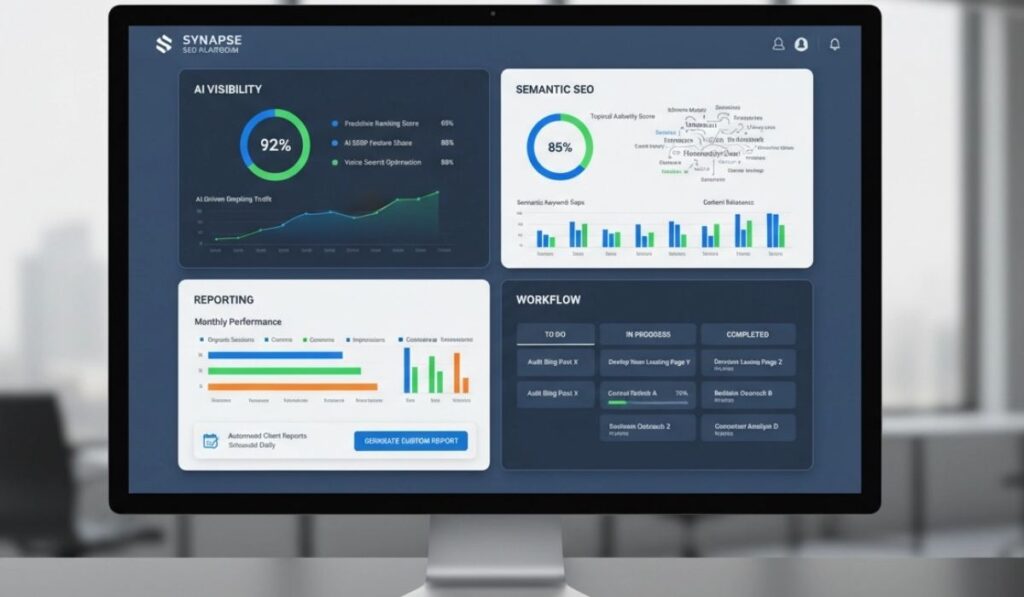
LLM SEO software is the category of tools built to help teams improve visibility in AI-driven search environments, platforms that generate summaries, citations, and direct answers instead of only returning a ranked list of links.
In practice, this category overlaps with generative engine optimization and answer engine optimization. The underlying goal is the same: make your content easier for machines to interpret, trust, and surface across AI search experiences.
That means good software in this category goes well beyond keyword tracking. It helps teams improve topic coverage, strengthen entity relationships, support structured content workflows, and measure whether the brand appears in AI-generated responses.
Some platforms start from a traditional SEO foundation and add AI features on top. Others are purpose-built for citation tracking and AI visibility from the ground up. That is exactly why buyers need a thoughtful comparison rather than a simple list of tools.
Why LLM SEO Software Matters
The old SEO stack was built around rankings, click-through rates, and conversions from standard search results. That model is still important. But it is no longer the whole picture.
Today, commercial buyers research products, compare vendors, and validate decisions inside AI-assisted experiences. Discovery can now happen in Google AI Overviews, ChatGPT responses, and other answer surfaces before a click ever reaches your website.
The problem is not that AI search is taking over. The problem is that many teams have no visibility into how they perform there.
Software selection should support both traditional SEO and AI search optimization. A team that only tracks rankings may miss significant visibility signals. A team that only monitors AI mentions may overlook the technical and content foundations that make those mentions more likely to appear.
For teams working with SEOSERVICES1, software selection is always treated as part of a broader operating model, not a replacement for strategy, expertise, or execution.
How AI Search Is Changing SEO Software
Here is the reassuring part: Google has been clear that standard SEO practices still form the foundation for AI search eligibility.
Google’s official AI features guidance confirms that sites do not need a separate technical standard to qualify for AI features in Search. The same principles around helpful, crawlable, high-quality content still apply.
But that does not mean your software stays the same. It means the best platforms now need to connect traditional SEO workflows with AI-specific reporting, entity coverage, topic depth, and content structures that support machine understanding.
Google’s documentation on AI Overviews frames the feature as a way to help users find information faster and more easily. That raises the value of pages that answer questions concisely, support claims well, and demonstrate trust.
In short: AI search is not replacing SEO. It is raising the bar for what good SEO software needs to measure and support.
Key Features to Look For
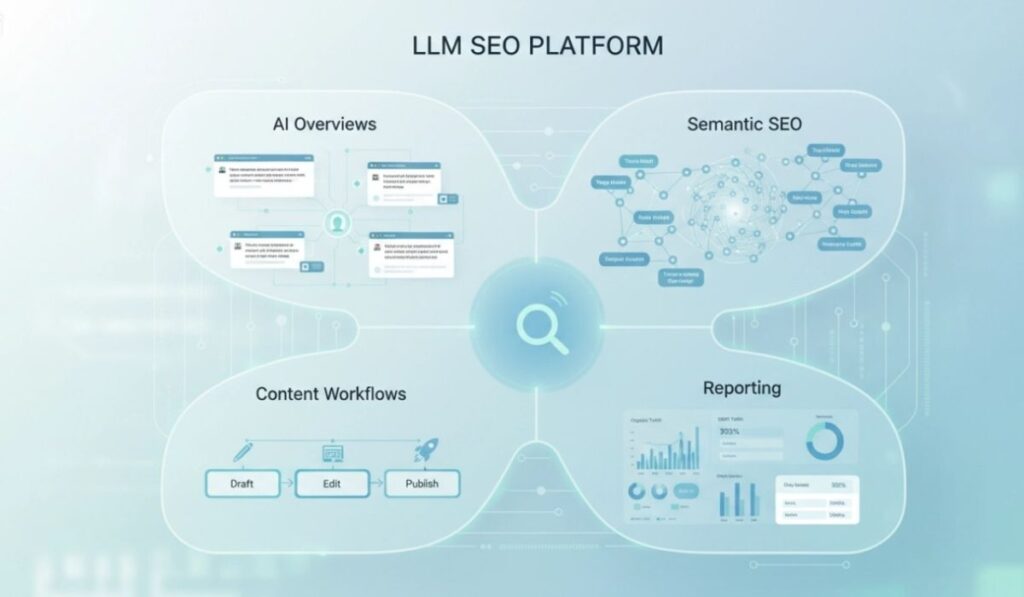
When evaluating the best llm seo software, these are the features worth comparing:
- AI visibility tracking — Monitor brand presence across Google AI Overviews, ChatGPT, Bing, and other AI-assisted search surfaces.
- Semantic SEO support — Entity mapping, topic coverage analysis, and intent alignment.
- Content workflow tools — Briefs, optimization guidance, topic clustering, and editorial planning.
- Internal linking and content intelligence — Features that improve crawl paths, topic depth, and semantic clarity.
- Reporting and analytics — Connecting AI visibility with organic search performance and business outcomes.
- Buyer-friendly design — Transparent pricing, live demos, and onboarding that reduces friction.
The strongest tools answer three operational questions at once: What content should we build? How well does our content cover the topic? Where is our brand appearing in AI-assisted search results?
Semantic SEO and Entity Optimization
Semantic SEO builds relevance around meaning, relationships, and search intent, not only keyword repetition. That means covering topics completely, connecting related subtopics, and making it easier for both search engines and language models to understand your brand’s role within a knowledge space.
Learn more about how this works in ClickRank’s semantic SEO guide.
Entity SEO strengthens this further. When your site consistently connects your brand to the right topics, services, and use cases, it improves content clarity for both search systems and AI models.
For most software buyers, the best platform is not the one with the longest feature list. It is the one that helps your team improve content quality, topic depth, structured relevance, and operational consistency over time.
A strong semantic SEO workflow typically includes:
- Topic maps for coverage planning
- Entity-focused content briefs
- Search intent mapping by funnel stage
- Structured data support
- Internal linking logic that reinforces topic clusters
If your team needs strategic help to operationalize this process, SEOSERVICES1 can align the software stack with content production, technical SEO, and buyer-focused page design.
AI Visibility Tracking
AI visibility tracking is one of the clearest reasons this software category exists in 2026. Multiple tool roundups now classify monitoring brand presence in ChatGPT responses, Google AI experiences, and other LLM-driven environments as a distinct category, not just a nice-to-have add-on to rank tracking.
Specialized AI visibility tools are most useful when your team needs to:
- Confirm whether your brand appears in AI-generated answers
- Identify which prompts or topics trigger brand mentions
- Track how competitors appear in the same AI responses
- Measure whether citation presence changes over time
All-in-one suites can still be valuable, particularly for organizations that want one platform for technical SEO, keyword research, and content operations. But if AI visibility is a board-level or client-facing KPI, a focused platform typically provides better depth for monitoring and reporting.
Google AI Overviews and Answer Engine Optimization
Answer engine optimization is not about gaming AI summaries. It is about creating well-structured, trustworthy content that can be understood and referenced across different search surfaces.
Google’s public guidance on AI features reinforces that AI visibility in Search follows the same core quality principles that support organic rankings. Google’s AI Overviews documentation further explains that the feature is designed to help users get to information faster, which increases the value of pages that answer clearly, support claims with evidence, and connect context with detail.
Good LLM SEO software should help your team improve:
- Search intent alignment at the page level
- Content structure and scannability
- Entity clarity
- Citation-worthy supporting detail
- Topic completeness across related pages
Answer engine optimization and GEO optimization work best when treated as workflow upgrades built into your editorial process, not separate channels to manage on the side.
Content Workflow and Topic Clustering
A strong content workflow separates average SEO teams from high-performing ones. Building topical authority and semantic relevance is nearly impossible when your editorial process is scattered, keyword-by-keyword, and disconnected from a broader content architecture.
Topical authority tools now focus on clustering, gap analysis, content briefs, and related-topic planning, which makes them directly relevant to AI search readiness as well as organic growth. See Link-Assistant’s topical authority tools guide for a current overview of the tools shaping this space.
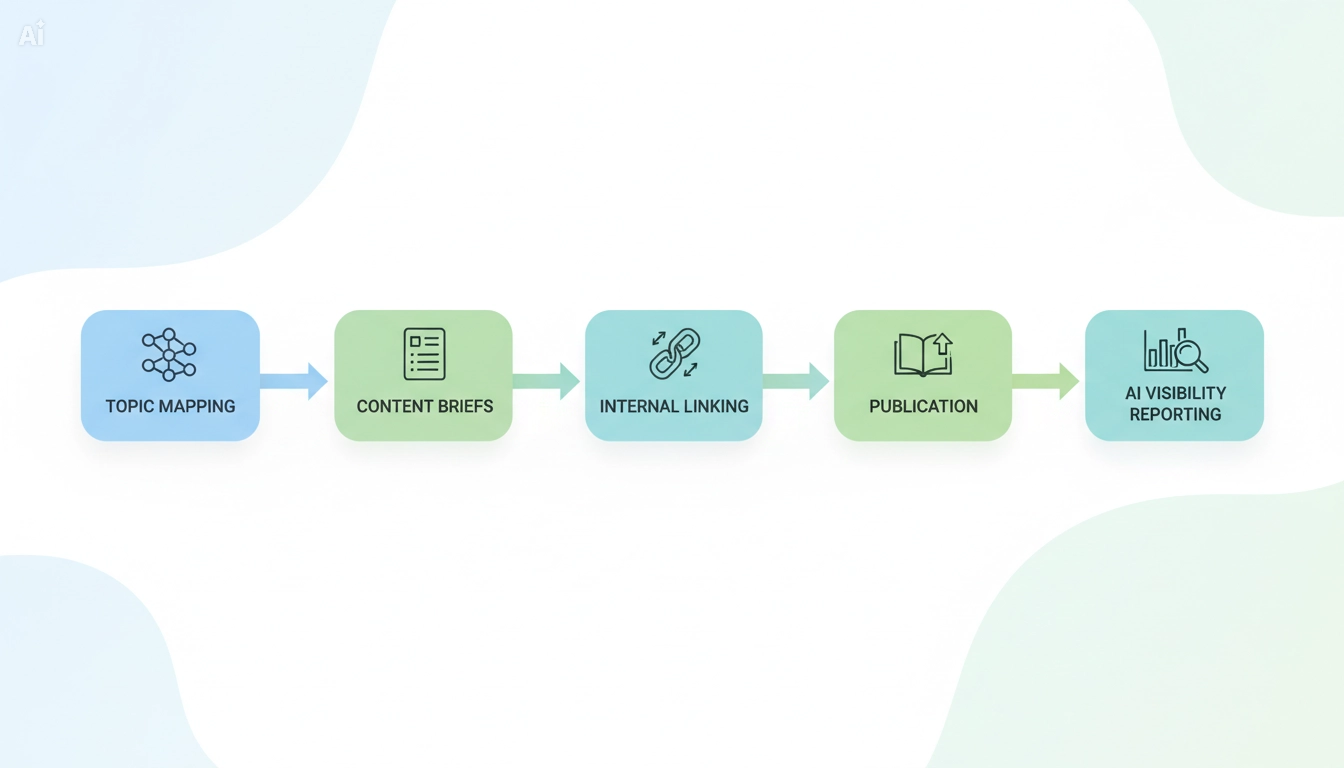
A scalable workflow typically looks like this:
- Build a topic map around core commercial themes
- Group supporting subtopics by search intent
- Create content briefs with entity and context guidance
- Publish cluster pages with strong internal linking
- Track both organic and AI visibility over time
Software accelerates research and execution. But content strategy still requires editorial judgment, technical oversight, and clear conversion goals. That is where SEOSERVICES1 fits, connecting the software layer to real business outcomes.
Internal Linking and Content Intelligence
Internal linking reinforces topical authority, distributes page-level signals, and improves crawl paths. In an AI search environment, clear internal linking also defines how pages connect conceptually, which supports semantic clarity across a topic cluster.
Good content intelligence tools help teams identify:
- Missing subtopics within a cluster
- Weak or thin supporting pages
- Overlapping intent between pages
- Opportunities to connect commercial and informational content
- Sections that need stronger entity signals or supporting evidence
For buyer-focused pages, internal linking should guide readers naturally from learning to action. A visitor exploring semantic SEO should be able to reach a relevant technical SEO service, a useful SEO audit resource, or a broader SEO strategy overview without friction.
Reporting, Analytics, and Performance Tracking
Reporting is often where teams discover whether their software is actually working. A good platform connects rankings, page performance, content coverage, AI visibility, and competitive movement into one coherent reporting story.
That usually means combining platform data with Google Search Console, Google Analytics, and business-level metrics. The software does not replace your analytics stack, it gives your team better insight into where AI search and traditional search overlap in practice.
Useful reporting views include:
- Topic cluster performance by section
- AI visibility segmented by prompt or query theme
- Competitor share-of-voice in AI answers
- Content decay and freshness alerts
- Conversion contribution from high-intent pages
For many in-house teams, this is where specialized AI visibility software earns its monthly cost. If a platform cannot help your team explain results clearly to leadership or clients, long-term adoption becomes difficult to sustain.
Best LLM SEO Software Comparison
The right platform depends on whether your priority is all-in-one SEO management, specialized AI citation tracking, content optimization, or enterprise-grade reporting. Third-party roundups consistently show that broad SEO suites and focused AI visibility tools serve different use cases, and that distinction is the most important factor in a buying decision. See the LLM SEO tool roundup from LLM Clicks for a current market overview.
| Tool | Best Fit | Strengths | Watch-outs |
|---|---|---|---|
| Otterly AI | Teams prioritizing AI citation monitoring | Focused on tracking brand presence in AI responses | May need to pair with broader SEO tools for full workflow coverage |
| Semrush | Teams that want broad SEO with AI expansion | Strong for multi-channel SEO operations | AI-specific depth may be lighter than specialist platforms |
| Surfer SEO | Content teams focused on optimization and briefs | Useful for content workflows, on-page guidance, and editorial planning | Not positioned primarily as an AI visibility platform |
| Profound | Enterprise brands monitoring AI answer presence | Strong for advanced reporting and brand visibility in LLM-generated answers | Better suited to larger teams with enterprise reporting needs |
No single platform wins for every team. A founder-led SaaS, an agency, and an enterprise marketing team can each need a completely different combination of features, reporting depth, and workflow support.
Best Software by Use Case
Use-case matching is more practical than picking one winner. Hands-on reviews and comparative roundups point to a consistent divide between specialist tools and broader suites, which is how most serious buyers should approach evaluation. See Neuron Expert’s 2026 LLM SEO tool review for tested breakdowns across common use cases.
Best for SEO Agencies
Agencies need flexible reporting, multi-client workflows, and a blend of broad SEO operations with newer AI visibility capabilities. Platforms that support both traditional and AI search reporting tend to fit best here.
Best for Content Teams
Editorial teams typically benefit most from platforms that improve brief quality, content optimization, clustering workflows, and overall production speed. Content intelligence and semantic coverage usually outweigh enterprise analytics in this context.
Best for Enterprise Brands
Enterprise buyers tend to need stronger governance, clearer reporting, and better oversight of brand presence in AI-generated answers. Specialized AI visibility monitoring tools often justify their cost when AI citation visibility is a board-level KPI.
Best for Lean In-House Teams
Smaller in-house teams get more value from software that reduces friction. Straightforward onboarding, practical reporting, and strong workflow support beat feature-heavy platforms that require months to implement.
How to Choose the Right Tool
The buying decision starts with your operating model, not the vendor’s feature page.
Ask these questions before committing:
- Do we need a full SEO suite or a specialized AI visibility platform?
- Is our biggest gap in research, content production, internal linking, or reporting?
- Do we need AI citation tracking as a client-facing or leadership-level KPI?
- Will the tool build topical authority, or only report on outcomes after the fact?
- Can our team realistically adopt this platform within the first 30 to 60 days?
A strong buying process also includes:
- A live demo focused on your actual use case
- A real walkthrough using your existing content or campaigns
- Sample reporting views your team would present internally
- Pricing clarity across seats, plans, and renewal terms
- A check on how the tool fits your existing stack
For teams that want strategic guidance before choosing a platform, SEOSERVICES1 can act as the layer between tool selection, technical SEO, semantic content planning, and revenue-focused execution.
Pricing Considerations
Pricing in this category varies because the products solve different problems at different scales. Some are focused AI visibility point solutions. Others bundle keyword research, content optimization, and full SEO operations into one platform. See this LLM SEO pricing comparison for a detailed breakdown of how tools compare on cost and market fit.
When evaluating cost, compare:
- Feature depth for your real use case, not the full feature list
- Number of user seats and reporting limits
- Whether the platform can replace a tool you are already paying for
- How quickly your team can operationalize it after onboarding
- Whether it produces clearer decisions, not just more dashboards
The cheapest option is rarely the lowest-cost option. A platform that improves workflow efficiency, helps your team prioritize the right content, and provides clearer AI search visibility can produce more operational value than a lower-priced tool that sits underused.
Frequently Asked Questions
What is LLM SEO software?
LLM SEO software is a category of tools that helps teams improve visibility in AI-assisted search experiences and answer engines. It supports content optimization, semantic relevance, entity clarity, and AI citation tracking. Learn how Google’s AI Overviews connects to standard SEO and content quality principles.
Why does LLM SEO software matter?
Because discovery increasingly happens inside AI-generated answers and summaries, not only through standard ranked results. Topic coverage, structured content, and citation visibility are now core requirements for modern SEO workflows.
What features should I look for in AI SEO software?
Look for AI visibility tracking, semantic SEO support, topic clustering, content optimization workflows, internal linking guidance, and reporting that connects AI and organic performance. The right balance depends on whether you need a specialist tool or an all-in-one suite.
Can LLM SEO software improve AI visibility?
It can help your team identify content gaps, strengthen topic coverage, and monitor where your brand appears in AI systems. However, software alone does not guarantee citations or rankings. Google’s guidance still centers on high-quality, helpful, well-structured content as the foundation.
How do I choose the best LLM SEO software?
Start with your use case, reporting requirements, and workflow maturity. Compare specialists against broader suites, validate feature depth through a demo, and confirm the tool fits how your team actually produces and measures content.
Why choose SEOSERVICES1?
SEOSERVICES1 is the right fit for teams who want software decisions connected to real SEO outcomes, not just tool access. The value is in combining semantic SEO, technical SEO, content strategy, and buyer-focused execution into a system that actually moves the needle.
Conclusion
The best llm seo software is not the one with the most features or the most aggressive marketing. It is the one that fits how your team works, supports AI visibility, and builds on the foundations of semantic SEO rather than replacing them with shallow automation.
For most buyers, that means evaluating platforms through the lenses of content intelligence, entity optimization, reporting clarity, and buyer fit, and being realistic about whether you need a focused specialist tool or a broader suite.
If you want to compete in AI search without losing sight of conversions and revenue, use software as part of a broader operating system. Pair the right platform with strong technical SEO, clear content architecture, and a strategic partner like SEOSERVICES1 to turn AI visibility into consistent business pipeline.