SEO is not dead in 2026—it’s evolving. The playbook that worked during 2018–2023 (keyword stuffing, aggressive link building, exact-match anchor text) has lost its power. But modern SEO—built on AI visibility, genuine brand authority, and presence across multiple platforms—is actually more effective now than it’s ever been.
Let’s be straightforward. You’re looking for a clear answer, not marketing fluff. This piece gives you that answer right up front, then walks through what actually shifted in early 2026, which tactics still move the needle, which ones have become obsolete, and what you should do differently starting today.
Key Takeaways
SEO still works in 2026—but the focus has shifted from traffic alone to visibility across multiple surfaces
AI Overviews now dominate informational search results, fundamentally changing how users discover content
Zero-click search continues climbing, which means fewer visitors click through when AI provides direct answers
E-E-A-T is non-negotiable—Experience, Expertise, Authoritativeness, and Trustworthiness are now core ranking signals
GEO and AEO are essential new layers for appearing in AI-generated responses beyond traditional search results
You need presence beyond Google: TikTok, YouTube, and Reddit now surface directly in search results
Seven adaptation strategies will keep you competitive: SXO, GEO, AEO, topical authority, brand signals, original research, and multi-platform optimization
The Bottom Line: SEO Isn’t Dying—It’s Transforming
SEO isn’t dying. It’s evolving and evolving and evolving. The fundamental shift? We’ve moved from blue-link SEO (ranking on Google’s traditional search results page) to AI-era SEO (appearing in AI Overviews, ChatGPT responses, Perplexity citations, and Gemini answers).
This isn’t just semantics. When AI systems provide answers directly, your visibility depends on being cited by those systems—not just ranking in the traditional blue links below.
What “Evolving” Actually Means in 2026
When experts say SEO is “evolving,” they’re describing a real shift in where visibility happens. Success isn’t just about ranking on Google anymore. It’s about being discoverable across multiple surfaces—Google Search, AI Overviews, ChatGPT, Perplexity, TikTok search, YouTube search, and even Reddit discussions that show up in search results.
Modern SEO in 2026 encompasses:
GEO (Generative Engine Optimization): Structuring content so AI systems like Google AI Overviews can easily extract and cite your information
AEO (Answer Engine Optimization): Formatting content as clear answers to questions, since AI systems respond to query-based searches
SXO (Search Everywhere Optimization): Optimizing presence across Google, AI tools, social platforms, and video sites simultaneously
Brand authority: Building a recognizable, trusted brand that AI systems naturally reference when generating answers
Original research: Creating unique data, surveys, and insights that others (including AI systems) cite as authoritative sources
Old SEO vs Modern SEO: Quick Comparison
Old SEO (2018–2023) was about hitting keyword targets and getting blue links. Modern SEO (2024–2026) is about establishing entity authority, matching search intent precisely, and maintaining visibility across all discovery surfaces.
What Actually Changed in Q1–Q2 2026
Here’s the concrete data on what shifted in the first half of 2026. These aren’t theories—they’re measurable changes affecting how search works right now.
Google Still Dominates with 79.1% Market Share
As of March 2026, Google holds 79.1% of the global online search market. Despite all the AI disruption and new search interfaces, Google remains the primary discovery surface. But here’s what’s different: AI Overviews now sit on top of traditional results, fundamentally changing how users interact with search. Many users get their answer without scrolling past the AI summary.
AI Overviews Are Now Common for Informational Queries
AI Overviews appear for a significant percentage of informational queries in 2026. While exact coverage varies by topic and query type, AI Overviews now dominate results for “how to,” “what is,” definition-based searches, and comparison queries. If you’re creating content for informational intent, you’re competing for AI citation, not just blue-link ranking.
Zero-Click Search Keeps Growing
Zero-click search has increased year-over-year from 2024 to 2026. This isn’t speculation—when AI Overviews provide direct answers, users often get what they need without clicking through to websites. For content creators, this means traditional traffic metrics alone no longer tell the full story of success.
Organic CTR Dropped for Informational Queries
Organic click-through rate for informational queries with AI Overviews dropped significantly in 2026. The pattern is clear: if AI gives users the answer they need upfront, they’re less likely to visit external websites. This shifts the value proposition from pure traffic to brand visibility and authority.
70% of Internet Time Happens on Mobile
70% of internet time occurs on mobile devices in 2026. If your site isn’t mobile-optimized with fast Core Web Vitals scores, you’re actively losing visibility. Google’s mobile-first indexing means your mobile performance directly determines your rankings.
Reddit Now Appears in 97.5% of Product Review Queries
97.5% of product review queries show Reddit results on Google. This isn’t a fluke—it reflects how Google’s algorithm now prioritizes authentic community discussions. Reddit marketing isn’t just social media anymore; it’s a legitimate SEO strategy that directly influences search visibility.
Despite all the changes, these SEO fundamentals still deliver measurable results in 2026.
E-E-A-T and Brand Authority: Experience, Expertise, Authoritativeness, and Trustworthiness are now critical ranking factors. AI systems consistently cite brands they recognize and trust, making brand building a search strategy
High-Quality, Original Content: Unique insights and original research consistently outperform generic, AI-generated content. AI systems prefer citing unique data because it’s verifiable and authoritative
Core Web Vitals: Google’s performance targets are explicit: INP≤200ms, LCP≤2.5s, CLS
Structured Data and Schema Markup: FAQ schema, HowTo schema, and Article schema help AI systems understand content structure and extract information for citations
Multi-Platform Presence: TikTok SEO, YouTube SEO, and Reddit marketing now drive measurable search visibility. These platforms appear directly in Google results
Topical Authority: Covering a topic comprehensively across multiple pages signals genuine expertise to both Google’s algorithms and AI systems
Intent-First Content: Matching search intent (informational, commercial, navigational) remains the foundation of effective SEO. Content that misses intent rarely ranks well
What No Longer Works in 2026
These tactics worked in the past, but they don’t deliver results anymore. Continuing to use them wastes resources that could be spent on modern strategies.
Keyword Density and Stuffing: Repeating exact-match keywords is outdated. Modern algorithms understand conversational language and semantic meaning, making keyword stuffing counterproductive
Exact-Match Anchor Text: Mass exact-match linking no longer moves rankings. Google’s algorithms now detect and devalue manipulative anchor patterns
Mass Link Building: Building hundreds of low-quality backlinks doesn’t work. Quality over quantity is the rule now—authoritative links from relevant sources carry far more weight
Thin Content at Scale: Publishing大量 low-value content actively hurts rankings. Google’s helpful content update and spam systems penalize thin, unoriginal content aggressively
Traffic-Only Focus: Chasing traffic without building visibility or conversion is obsolete. In the AI era, being cited matters more than pure click volume
Generic AI Content: Unedited AI-generated content without original insights fails to rank. AI systems and Google both recognize and deprioritize unoriginal, generic content
Ignoring Mobile: Non-mobile-optimized sites lose rankings steadily. With 70% of traffic on mobile, this is no longer optional
Old SEO (2018–2023) vs Modern SEO (2024–2026)
Old SEO (2018–2023)
Modern SEO (2024–2026)
Keyword density focus
Conversational keywords + search intent
Exact-match anchor text
Natural, varied anchor text patterns
Mass link building campaigns
Quality backlinks + brand signals
Google-only optimization
Multi-platform (TikTok, YouTube, Reddit)
Traffic-focused metrics
Visibility-focused metrics (AI citations)
Thin content at scale
Original research + deep expertise
Ignoring E-E-A-T signals
E-E-A-T critical for ranking
No structured data implementation
Schema markup essential
Desktop-first design approach
Mobile-first design (70% traffic)
Blue-link only focus
AI Overview + multi-surface visibility
7 Strategies to Thrive in the AI Era
These 7 strategies will help your business adapt and remain competitive in 2026’s search landscape. Each one addresses a specific shift in how search and discovery work now.
1. Search Everywhere Optimization (SXO)
SXO means optimizing for search across all platforms, not just Google. Your audience doesn’t search only on Google—they search on TikTok, YouTube, Reddit, Amazon, and within apps. SXO ensures you’re visible wherever discovery happens.
How to implement SXO effectively:
Identify which platforms your specific audience uses most (TikTok for younger demographics, YouTube for tutorials, Reddit for discussions)
Optimize content titles, descriptions, and tags for each platform’s unique search algorithm
Create platform-specific content formats (short, engaging videos for TikTok; comprehensive long-form videos for YouTube with transcripts)
Track visibility metrics across all platforms using platform-native analytics, not just Google Search Console
2. Generative Engine Optimization (GEO)
GEO means optimizing content specifically for AI-generated answers like Google AI Overviews, ChatGPT, Perplexity, and Gemini. These systems generate responses by extracting information from web content, so your content needs to be structured for extraction.
How to implement GEO effectively:
Use clear, direct definitions for important concepts (AI systems extract these definitions easily)
Add structured data (FAQ schema, HowTo schema, Article schema) to help AI parse your content
Create original research and proprietary data that AI systems naturally cite as authoritative sources
Build entity authority by mentioning named brands, tools, and frameworks with specific context
3. Answer Engine Optimization (AEO)
AEO means optimizing specifically for question-based AI responses. AI systems answer questions directly, so your content should be formatted as clear answers to common questions in your field.
How to implement AEO effectively:
Write FAQ sections with direct 1–2 sentence answers that AI can extract
Use question headers (e.g., “What is SEO?” instead of “SEO Definition”) to match query patterns
Answer questions in the first paragraph, not buried 500+ words into the content
Use bullet lists and numbered steps for easy extraction by AI systems
Topical authority means covering a topic comprehensively across multiple pages. AI systems and Google both recognize brands that demonstrate deep expertise on a topic through comprehensive coverage.
How to build topical authority effectively:
Create a content hub for your core topic with a pillar page and supporting cluster content
Write 10+ pages covering subtopics in depth, not surface-level overviews
Link pages together strategically to show topic relationships and hierarchy
Update content quarterly to maintain freshness signals and accuracy
5. Brand Signal Amplification
Brand signals (branded search volume, mentions, reviews) are now documented ranking factors. AI systems consistently cite brands they recognize, making brand building a direct search strategy.
How to amplify brand signals effectively:
Build branded search through targeted marketing campaigns that drive people to search your brand name
Get featured in industry publications (Entrepreneur, Economic Times, HubSpot) for third-party authority
Collect reviews on Google, Yelp, and industry-specific platforms to build trust signals
Create shareable original research that others cite, generating natural brand mentions
6. Original Research and Data
Original research (surveys, data analysis, case studies) gets cited by AI systems far more than generic content. AI systems prefer unique, verifiable data over recycled information.
How to create citable original research effectively:
Run surveys (e.g., “2026 SEO Practitioner Survey of 100 professionals”) with real data
Analyze public data sets and publish findings with original charts and visualizations
Document case studies with named brands and specific, verifiable metrics
Publish data visuals (charts, tables, infographics) that others reference and link to
7. Multi-Platform SEO (TikTok, YouTube, Reddit)
Multi-platform SEO means optimizing for TikTok search, YouTube search, and Reddit discussions. These platforms now appear directly in Google search results, making them essential for comprehensive search visibility.
How to implement multi-platform SEO effectively:
TikTok SEO: Use keywords in video titles, descriptions, and captions; create short, engaging videos (15–60 seconds) with clear hooks
YouTube SEO: Optimize video titles, descriptions, and tags; create long-form content with full transcripts for searchability
Reddit marketing: Participate authentically in relevant communities; answer questions helpfully; avoid spammy self-promotion that gets downvoted
Technical GEO: Schema Markup for AI Citation
Schema markup is the “language AI” uses to understand your content structure. Adding structured data helps AI systems parse your content accurately and cite it correctly. Without schema, AI has to guess your content structure.
FAQ Schema Example
{
 "@context": "https://schema.org",
 "@type": "FAQPage",
 "mainEntity": [
 {
 "@type": "Question",
 "name": "Is SEO dead in 2026?",
 "acceptedAnswer": {
 "@type": "Answer",
 "text": "SEO is not dead in 2026—it's evolving. Traditional SEO tactics are dead, but modern SEO focused on AI visibility is stronger."
 }
 }
 ]
}
HowTo Schema Example
{
 "@context": "https://schema.org",
 "@type": "HowTo",
 "name": "How to Optimize for AI Overviews",
 "step": [
 {
 "@type": "HowToStep",
 "text": "Add FAQ schema to your content"
 },
 {
 "@type": "HowToStep",
 "text": "Write direct 1–2 sentence answers"
 },
 {
 "@type": "HowToStep",
 "text": "Create original research and data"
 }
 ]
}
Article Schema Example
{
 "@context": "https://schema.org",
 "@type": "Article",
 "headline": "Is SEO Dead or Evolving in 2026?",
 "author": {
 "@type": "Organization",
 "name": "SEOSERVICES1"
 },
 "datePublished": "2026-06-05"
}
Case Study: How Lantern by SoFi Achieved +561% Organic Traffic
Lantern by SoFi achieved +561% organic traffic and +1,164% position 1–3 rankings using SEO strategies that remain effective in 2026. This isn’t theoretical—these are real results from a documented case study.
The Challenge
Lantern needed to increase organic visibility for financial education content without relying on paid advertising budgets. They needed sustainable, long-term search visibility.
The Strategy
Published 800+ high-quality content pieces covering financial education subtopics comprehensively
Focused intensely on E-E-A-T (expert writers with credentials, original insights, transparent methodology)
Optimized for Core Web Vitals (INP≤200ms, LCP≤2.5s, CLS<0.1) to meet Google’s performance standards
Added structured data (FAQ schema, HowTo schema) to help search engines understand content
Built topical authority across financial education subtopics through comprehensive coverage
The Results
+561% organic traffic within the measured period
+1,164% increase in position 1–3 rankings for target keywords
800+ content pieces published and maintained
Featured in AI Overviews for financial education queries
Note: This case study is from 2024, but the underlying strategies remain valid and effective in 2026. The principles of E-E-A-T, topical authority, and technical optimization don’t expire.
New SEO KPIs for 2026: What to Track
Traditional SEO KPIs (organic traffic, keyword rankings) no longer tell the complete story. In 2026, you need to track these new metrics that reflect AI-era visibility.
AI Citation Frequency: How often your brand or content is cited by AI Overviews, ChatGPT, Perplexity when answering questions
Share of AI Voice: Percentage of AI-generated answers in your category that include your brand or content
Generative Appearance Score: Emerging metric measuring visibility in AI-generated results across multiple platforms
Branded Search Volume: Increase in searches including your brand name, indicating growing authority
Multi-Platform Visibility: Visibility across TikTok, YouTube, Reddit, not just Google Search Console data
SEO is not dead in 2026—it’s evolving. Traditional SEO tactics are dead, but modern SEO focused on AI visibility is stronger and more effective.
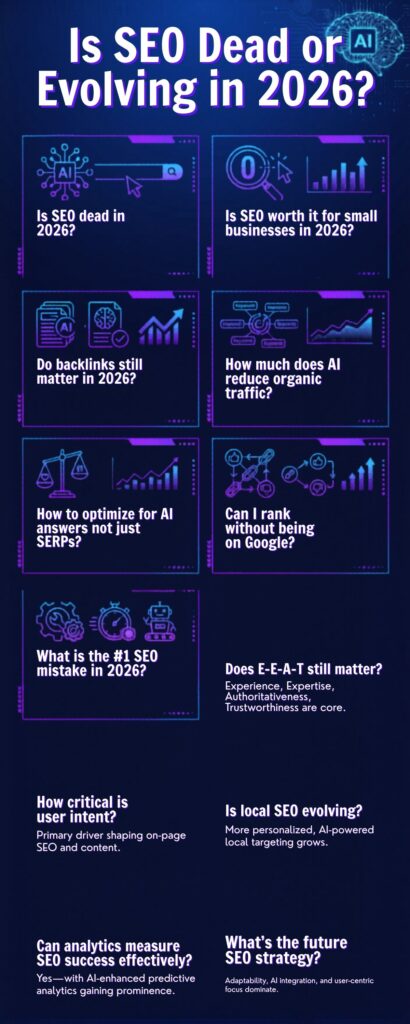
FAQ 2: Do backlinks still matter in 2026?
Yes, quality backlinks from authoritative sources still matter significantly. However, brand signals (branded search volume, mentions, reviews) are now more critical than backlink quantity alone.
FAQ 3: How to optimize for AI answers not just SERPs?
Add FAQ schema, write direct 1–2 sentence answers, create original research with verifiable data, and build entity authority by mentioning named brands and tools with context.
FAQ 4: What replaces traditional SEO strategies?
Traditional SEO is enhanced by Search Everywhere Optimization (SXO), Generative Engine Optimization (GEO), and Answer Engine Optimization (AEO) working together.
FAQ 5: Is SEO worth it for small businesses in 2026?
Yes, SEO is absolutely worth it for small businesses, but focus on visibility (AI citations, brand mentions) rather than just traffic. Start with E-E-A-T, topical authority, and multi-platform presence.
FAQ 6: How much does AI reduce organic traffic?
Organic CTR for informational queries with AI Overviews dropped significantly in 2026. Exact reduction percentages vary by query type, but zero-click search is clearly increasing year-over-year.
FAQ 7: Can I rank without being on Google?
Yes, you can rank on TikTok search, YouTube search, Reddit, Amazon search, and app store search. Multi-platform SEO is essential in 2026 since these appear in Google results.
FAQ 8: What is the #1 SEO mistake in 2026?
The #1 SEO mistake is focusing only on traffic (Google blue links) without building visibility (AI citations, brand signals, multi-platform presence). This outdated approach misses the AI-era reality.
FAQ 9: How to measure SEO success now?
Track AI citation frequency, share of AI voice, generative appearance score, branded search volume growth, and multi-platform visibility—not just traditional organic traffic metrics.
FAQ 10: Will AI replace SEOs completely?
AI will transform SEO jobs, not replace practitioners completely. SEOs will evolve to focus on GEO, AEO, brand authority building, and multi-platform optimization strategies.
FAQ 11: What content type gets cited by AI most?
Original research, data-backed statistics with specific numbers, case studies with named brands and metrics, and clear definitions get cited by AI systems most frequently.
FAQ 12: How long will SEO exist?
SEO will exist as long as search and information discovery exist. It’s evolving, not dying, and will continue adapting to AI, new platforms, and changing user behavior indefinitely.
Top 5 SEO Mistakes to Avoid in 2026
Focusing only on traffic metrics: Ignoring AI visibility and brand signals means missing the main shift in how search works
Still using keyword density: Stuffing keywords instead of writing naturally for humans and semantic understanding
Ignoring structured data entirely: Not adding FAQ, HowTo, or Article schema when it helps AI parse your content
Publishing generic AI content unedited: Using AI-generated content without original insights, expertise, or human review
Optimizing for Google only: Missing TikTok, YouTube, and Reddit opportunities that now drive search visibility
What to Do Next: Your Action Plan
SEO is not dead in 2026—it’s evolving rapidly. Businesses that adapt by shifting from traffic-focused to visibility-focused SEO, building genuine brand authority, and optimizing across multiple platforms will remain competitive.
Your 5-step action plan to start today:
Audit your current SEO immediately: Check if you’re still using outdated tactics like keyword density or exact-match anchors. If yes, stop using them now and shift to modern approaches.
Add structured data systematically: Implement FAQ schema, HowTo schema, and Article schema on key pages. This directly helps AI systems parse and cite your content accurately.
Create original research this quarter: Run a survey or analyze public data to publish unique findings. AI systems cite original data far more than generic content.
Build multi-platform presence actively: Optimize for TikTok, YouTube, and Reddit search. These platforms now appear directly in Google results and drive real visibility.
Track new KPIs consistently: Monitor AI citation frequency, share of AI voice, and branded search volume growth—not just organic traffic, which is becoming less meaningful.
If you want to adapt your SEO strategy for 2026’s evolving landscape, SEOSERVICES1 can help you implement modern SEO, GEO, AEO, and multi-platform optimization strategies effectively.
Senior Search Strategist specializing in SEO, AEO, and Generative Engine Optimization (GEO). With over a decade of experience, Rick helps brands and applications (ASO) maximize their visibility across traditional search engines, AI answer engines, and app stores.