B2B SEO content creation services in Australia are about more than getting found on Google they’re about turning the right kind of visibility into qualified opportunities your sales team actually wants. In a country where many buying committees do most of their research before they ever book a call, the content that appears in search often decides whether you’re shortlisted or silently ruled out.
This page is written for Australian B2B founders, CEOs, CMOs, marketing and demand gen leaders, and SEO/content managers who want a straight, detailed explanation of what B2B SEO content creation services involve, how SEOSERVICES1 delivers them, and how you can judge whether we’re the right fit for your business.

What Are B2B SEO Content Creation Services in Australia?
B2B SEO content creation services in Australia bring SEO strategy and content production under one roof so that your best‑fit buyers can find you, understand you, and trust you through search. Put simply, it’s a structured way to plan and create SEO‑optimised content that supports B2B sales cycles, instead of just inflating traffic dashboards.
Simple definition for Australian B2B buyers
In practical day‑to‑day terms, B2B SEO content creation services usually mean:
- Understanding how your ideal accounts search for problems, categories, and vendors.
- Designing a content strategy that aligns with those searches at awareness, consideration, and decision stages.
- Producing and optimising tangible assets like blog posts, solution pages, industry pages, and case studies.
- Tracking how those assets perform and iterating so they keep generating qualified leads and pipeline over time.
For Australian companies, this work also needs to respect local nuances everything from .com.au domains and regional competition to the way domestic buyers combine local and global search results when they’re building a shortlist.
How B2B SEO content differs from generic SEO and copywriting
B2B SEO content creation sits in a different category to “someone to fix our SEO” or “a copywriter to write blogs”. It lives at the intersection of:
- SEO research and search intent mapping for B2B topics.
- A clear understanding of B2B buyer journeys and buying committees.
- Subject‑matter‑aware writing that can withstand scrutiny from both technical and commercial stakeholders.
- Ongoing optimisation informed by how content actually performs, not just how it reads.
Generic SEO work might stop at improving speed, metadata, and a handful of keywords. Generic copywriting might produce surface‑level content that never appears in search. B2B SEO content creation services aim to ensure the content your buyers encounter when they search is both discoverable and convincing, and that it lines up with how your sales team wants to have the conversation.
Why B2B SEO Content Matters for Australian Businesses
B2B SEO content matters because it creates a direct, measurable link between organic visibility and pipeline. When most B2B buying journeys begin with search and involve multiple internal stakeholders, the structure and quality of your SEO content strongly influence both who finds you and what they conclude about you.
How Australian B2B buyers research online
In practice, a typical Australian B2B buyer journey often looks like this:
- Someone in the business starts with broad searches definitions, “what is” content, and high‑level frameworks to frame the problem and gather vocabulary.
- As options become clearer, the team searches for specific solution types, product categories, and comparison terms that help them narrow down vendors.
- Closer to decision, they look for concrete proof: case studies, implementation details, pricing logic, and signals that you’ve delivered results for similar organisations in comparable markets.
This is rarely a linear path and almost never driven by just one person. Different stakeholders dip into search at different moments. If your content doesn’t appear at those moments or appears but feels flimsy, generic, or dated you’re more likely to be filtered out before sales ever gets involved, even if your underlying offer is strong.
From rankings to leads, pipeline, and revenue
Rankings and raw traffic still matter, but in B2B they’re only part of the picture. Over time, B2B SEO content programs are judged on:
- The volume of relevant organic sessions from priority industries and account types.
- The number and quality of form fills, demo requests, and content downloads originating from organic channels.
- Sales‑accepted leads and opportunities that can be traced back to, or strongly influenced by, SEO content.
- The extent to which educated prospects move through the funnel faster and with fewer objections after reading your content.
Seen from that perspective, B2B SEO content creation services are really about building a library of assets that support revenue, not just pageviews. The question is less “Are we ranking for X?” and more “Is our content meaningfully helping us win the deals we care about?”
Our B2B SEO Content Creation Services
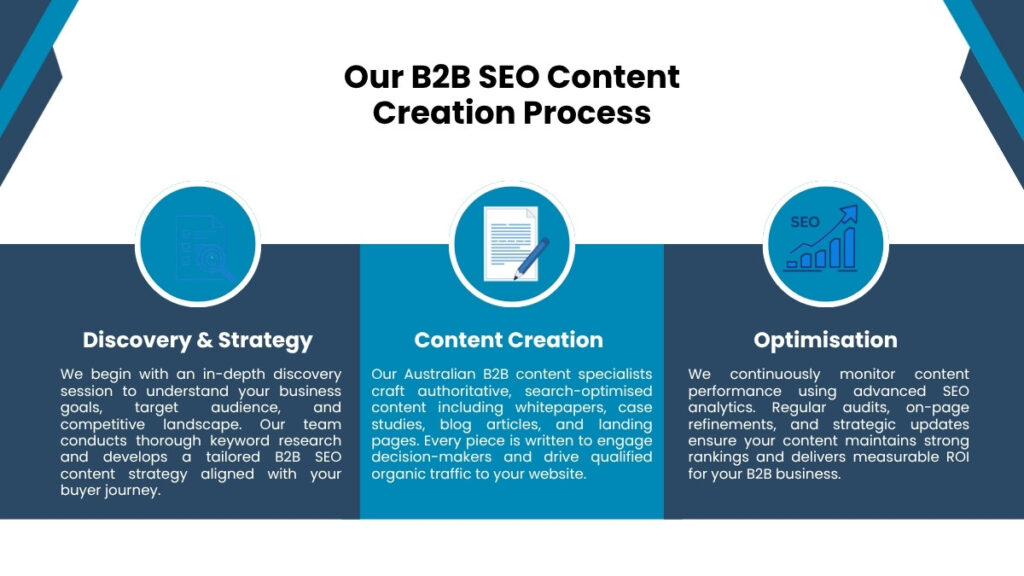
SEOSERVICES1’s B2B SEO content creation services are designed for Australian organisations that want a partner to own both the thinking and the doing. The aim is to create a content engine that feeds your pipeline consistently, rather than a run of isolated campaigns that peak and fade.
At a high level, our services cover:
- B2B SEO strategy and keyword research.
- Content planning and topic clusters.
- SEO content production tailored to B2B audiences.
- On‑page optimisation and continuous improvement.
Strategy and keyword research
Every engagement starts with a strategy phase because context matters. We look at:
- Your business model, commercial priorities, and revenue targets.
- The markets, segments, and regions you’re targeting within Australia and, if relevant, beyond.
- How your website and content are performing today, including what’s working and what’s holding you back.
From there we:
- Conduct keyword and topic research rooted in real B2B problems, use cases, and solution categories.
- Group those terms into clusters that can sustain pillar content and supporting pieces over time.
- Prioritise opportunities by business value, competitive difficulty, and realistic time to impact.
This approach ensures we aren’t just chasing vanity keywords but focusing on searches that are genuinely likely to produce qualified conversations for your sales team.
Content planning and topic clusters
Once we know where the opportunities sit, we turn that insight into a practical plan:
- A content calendar for the first 3–6 months that shows which pieces we’ll create, when, and why.
- Topic clusters that connect big “pillar” assets with related articles, guides, and supporting resources.
- Recommendations to upgrade or consolidate existing content that’s confusing buyers or under‑performing in search.
Typically, that plan includes a mix of:
- Pillar guides and resource hubs that anchor whole themes.
- Core solution and industry pages that speak directly to key segments.
- Comparison and “alternative to” content that addresses head‑to‑head evaluation.
- Supporting blog posts and thought‑leadership pieces that build depth in chosen topics.
- Case studies and stories that bring your claims to life with real scenarios.
The goal is to create coverage that feels deliberate and cohesive, rather than a patchwork of unconnected posts.
SEO content production for B2B audiences
With a clear plan, we move into production. The content we write is designed to:
- Match the target keywords and intents identified in the strategy phase.
- Communicate credibly with technical, operational, and commercial stakeholders in a buying committee.
- Reflect your brand voice, positioning, and preferred messaging hierarchy.
Typical deliverables include:
- Blog articles that give precise, practical answers to the questions your buyers are typing into search.
- Solution and service pages that frame your offering in terms of risk reduction, ROI, and ease of adoption.
- Industry pages that show you understand sector‑specific regulation, constraints, and jargon.
- Case studies that combine narrative, process detail, and measurable outcomes.
Along the way, we ensure structure and SEO basics titles, headings, internal links, meta descriptions are handled properly so that content is easy for both humans and search engines to interpret.
On‑page optimisation and ongoing improvements
Publishing content is not the finish line; it’s the start of a feedback loop. We:
- Optimise existing content around agreed priority keywords and intents.
- Strengthen internal linking so related pieces reinforce each other and help users navigate.
- Recommend schema and structured elements where they can clarify meaning or eligibility for rich results.
- Monitor performance, and then refresh content as products, markets, and search results evolve.
This continuous improvement mindset helps keep your content relevant and visible, especially as search experiences and AI‑driven summaries shift over time.
B2B SEO Content Types Across the Funnel
B2B SEO content is most powerful when it’s designed around the buyer journey from the outset. Different content types play different roles; understanding that mix ensures you’re not over‑serving one stage while neglecting another.
Awareness content (blogs, guides, industry explainers)
Awareness content gives early‑stage researchers language and structure. Common examples include:
- Blog posts such as “What is [Concept]?” or “Why [Problem] matters for Australian [Industry] organisations”.
- Industry explainer pieces that unpack regulatory changes, technology trends, or market shifts.
- Introductory guides that walk a reader through a complex topic step by step.
This content:
- Builds visibility around early‑stage, problem‑framing searches.
- Establishes your brand as a helpful voice rather than a hard seller.
- Provides raw material for newsletters, social posts, and nurture flows.
Consideration content (solution pages, comparison pages, resource hubs)
Consideration content helps buyers understand and compare solution paths. It typically includes:
- Solution pages that explain how your approach works and for whom it’s best suited.
- Comparison pages that highlight differences between your solution and internal development, status quo, or named competitors.
- Resource hubs that gather all relevant content for a given topic, role, or industry in one place.
These assets:
- Clarify where you sit in the market and how you differ from alternatives.
- Support conversations between evaluators, influencers, and budget holders.
- Often serve as key landing pages for both organic and paid acquisition.
Decision content (case studies, implementation guides, FAQ content)
Decision content gives buying committees the confidence to commit. Typical formats include:
- Case studies that describe client type, problem, approach, and outcomes in concrete terms.
- Implementation or onboarding guides that show what happens after the contract is signed.
- Detailed FAQ content that tackles common concerns about risk, timelines, integration, and support.
Decision‑stage content:
- Equips champions with stories and evidence they can share internally.
- Reduces friction by answering questions before they escalate into objections.
- Sets realistic expectations that benefit both your team and your new customers.
Mapping content to your B2B buyer journey
A simple way to line this up is to connect each content type to a funnel stage and a core metric:
| Content type | Funnel stage | Primary KPI |
|---|---|---|
| Educational blog | Awareness | Qualified organic sessions |
| Industry explainer | Awareness | New users from target segments |
| Solution page | Consideration | Demo requests / contact forms |
| Comparison page | Consideration | Time on page, return visits, MQLs |
| Industry page | Consideration | Vertical‑specific leads |
| Case study | Decision | Opportunity conversion / win rate |
| Implementation guide | Decision | Sales cycle speed, onboarding fit |
| FAQ content | Decision | Reduced objections, support tickets |
At SEOSERVICES1, we use this kind of mapping as a working tool: it helps decide what to create first, how to brief content, and how to measure whether a particular piece is doing its job.
How Our B2B SEO Content Process Works
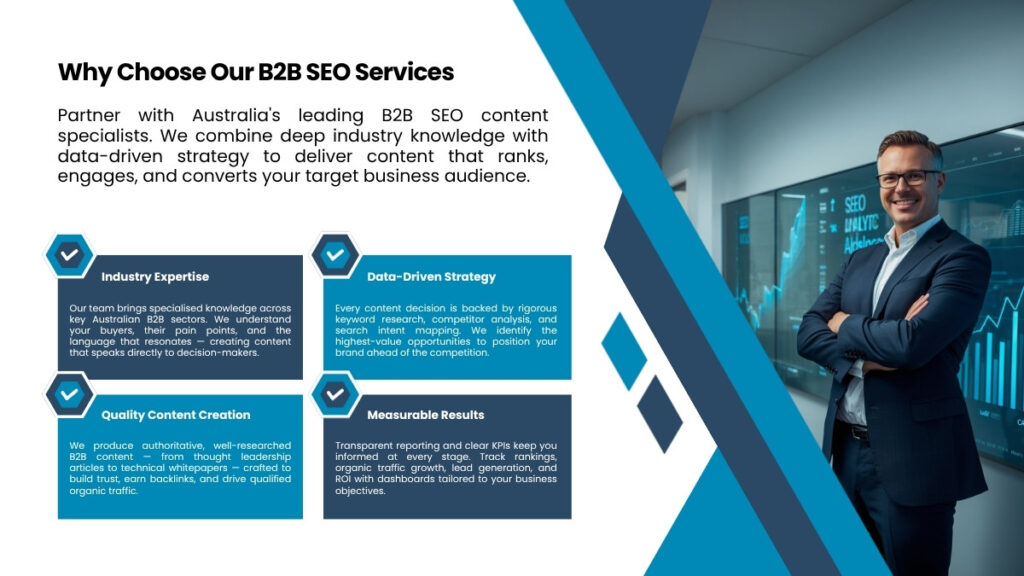
A transparent process makes it easier for marketing and sales leaders to get on board and stay aligned. Our typical B2B SEO content process consists of four core phases, with room to adapt around your internal realities.
Discovery and B2B SEO audit
We start by getting a clear picture of where you are now and where you’re trying to go. That usually involves:
- Reviewing your site structure, content inventory, and analytics data.
- Identifying strengths, gaps, and friction points in your current organic performance.
- Checking that foundational technical SEO elements are in place so content isn’t sabotaged by avoidable issues.
- Talking with stakeholders often marketing, sales, and product about goals, constraints, and what “good” looks like internally.
By the end of this phase, we know which problems content can realistically solve and which may require broader changes.
Strategy, roadmap, and content calendar
Next, we translate those findings into a plan you can align around:
- Defining SEO and content objectives that tie back to pipeline or lead quality, not just traffic.
- Building a keyword and topic map that reflects those objectives and your priority segments.
- Ranking content ideas by potential impact and effort, so you can see the trade‑offs.
- Creating a content calendar that outlines what will be produced, in what order, and for which audience.
This roadmap becomes a shared reference between your team and ours; it’s also what you can use to explain the plan internally to executives and stakeholders.
Content creation and SME collaboration
Strong B2B content hinges on real expertise. To extract that expertise efficiently, we:
- Plan short, focused sessions with subject‑matter experts and sales reps to capture their insights.
- Use existing artefacts presentations, proposals, technical documents as raw material.
- Convert those inputs into outlines and drafts that follow the agreed strategy and structure.
- Set up review cycles that respect your team’s time, whether that’s asynchronous comments, scheduled review meetings, or a mix of both.
The aim is to build content that genuinely reflects your organisation’s experience and point of view, without bogging your experts down in the mechanics of writing.
Optimisation, measurement, and continuous improvement
Once content is live, we treat each piece as a working asset. Over time we:
- Monitor performance in analytics tools and search consoles, looking at visibility, engagement, and conversion metrics.
- Adjust on‑page elements titles, headings, CTAs, internal links when we see opportunities to improve alignment with search intent or user behaviour.
- Consolidate overlapping or outdated content and refresh key pages so they remain current with product, market, and search changes.
- Report on which pieces are influencing leads and pipeline, so we can refine the roadmap and decide what to create next.
In a world where search results and AI‑driven experiences continue to evolve, this continuous improvement loop keeps your content aligned with both buyers and platforms rather than locked in a snapshot from a year ago.
Pricing & Engagement Models
Numbers will always matter, but the structure of the engagement often has just as much impact on whether B2B SEO content succeeds. We focus on models that allow for strategic continuity while giving you enough flexibility to adjust as you learn.
Pilot projects for B2B SEO content
For teams exploring SEO content as a more serious growth driver, pilot projects offer a controlled way to test impact. A typical pilot might include:
- A targeted discovery and strategy phase for one product line, vertical, or region.
- A defined set of deliverables, such as a new pillar page, a cluster of supporting articles, and an updated solution page.
- A three‑month window to create, publish, and start measuring results.
Pilots suit organisations that want to validate collaboration fit, internal processes, and early outcomes before committing to a broader program.
Ongoing retainers and hybrid models
Once SEO content is established as a core channel, ongoing retainers or hybrid arrangements usually make more sense. These might include:
- A monthly or quarterly allocation of strategy and content production hours.
- Regular optimisation and reporting baked into the scope.
- Flexibility to shift emphasis between products, industries, or markets as priorities change.
Hybrid models are common in B2B: we might handle strategy, high‑impact content, and optimisation, while your internal writers tackle supporting pieces using our briefs. This lets both teams work to their strengths.
How we scope B2B SEO content engagements
Whatever model you choose, scoping tends to follow similar principles:
- We clarify what success should look like over the next 6–12 months often framed in terms of qualified leads, opportunities, or pipeline from organic.
- We estimate the volume and mix of content assets needed to support those goals.
- We factor in the level of stakeholder and SME involvement required, so we don’t oversell what your team can realistically support.
The result is a scope you can explain internally and measure against over time, rather than a vague promise to “do more content”.
Results, Case Studies & Client Stories
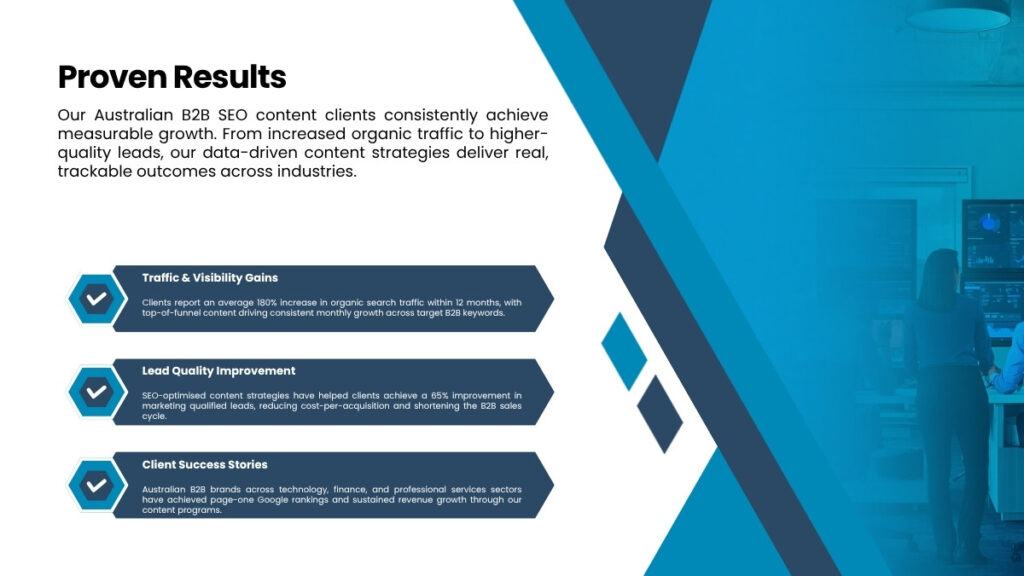
It’s easier to evaluate B2B SEO content creation when you can see how it plays out in real organisations. While details vary, certain patterns show up repeatedly in Australian B2B contexts.
Australian B2B examples and outcomes
- Industrial manufacturer targeting Australian and regional customers
- Situation: most organic traffic came from brand terms and a handful of legacy product pages; sales wanted more inbound interest from specific industries and regions.
- Content approach: developed industry‑specific solution pages, refreshed key product pages with clearer value propositions, and rolled out a series of articles tackling technical questions buyers commonly asked sales engineers.
- Results: increased organic visits from priority industries and a noticeable lift in inbound enquiries that referenced specific content pieces during initial calls.
- Australian SaaS company expanding across APAC
- Situation: strong referral and outbound channels but limited organic presence beyond branded searches; marketing wanted search to contribute more consistently to pipeline.
- Content approach: created use‑case pages, comparison content against incumbent tools, and integration pages aligned with key ecosystem partners, all optimised for search and re‑usable by sales.
- Results: higher rankings on category and problem‑based terms, more demo requests from target segments, and anecdotal feedback from sales that prospects were “coming in better informed” after engaging with multiple pieces of content.
What success looks like for B2B SEO content
When a B2B SEO content program is working, you tend to see patterns like:
- A growing share of organic traffic coming from non‑branded, high‑intent queries.
- Increased pipeline and opportunities that can be linked back to specific content journeys.
- Sales and customer‑facing teams actively using content in conversations, sequences, and onboarding.
- Marketing treating SEO content as a backbone asset they can repurpose for other channels, rather than as an isolated silo.
The exact metrics will depend on your starting point and category, but the underlying theme is consistent: content becomes part of how you acquire and convert customers, not just a marketing output.
Why Partner with SEOSERVICES1 for B2B SEO Content in Australia
Choosing a B2B SEO content partner is a strategic decision it affects how your brand shows up in search, how your story is told, and how your internal teams experience collaboration. The right partner should bring structure, experience, and flexibility, not just more words.
B2B and Australian market focus
SEOSERVICES1 focuses on B2B organisations that need to communicate clearly with sophisticated buyers. That typically includes:
- Australian SaaS and software companies selling into domestic and international markets.
- Professional services and consulting firms with considered, multi‑stakeholder buying cycles.
- Industrial and manufacturing businesses with technical products and complex decision processes.
Because our work is anchored in the Australian B2B environment, recommendations and examples are grounded in the realities of those sectors regulation, competition, and the way local buyers evaluate vendors rather than lifted from generic global playbooks.
Content, SEO, and AI‑ready approach
B2B SEO content now has to perform both in traditional search results and in newer AI‑driven experiences. While we treat AI as a practical consideration rather than a buzzword, we do design content with:
- Clean structures definitions, headings, lists, and FAQs that help search engines and AI systems understand what you offer and when to surface it.
- Answer‑friendly sections that increase the odds of your content being quoted or summarised in AI responses and featured snippets.
- Human‑led, AI‑assisted workflows that preserve your voice and accuracy while making research and drafting more efficient.
This helps ensure that the content you invest in is discoverable and useful, regardless of how your buyers access information.
How we support your internal teams
We approach B2B SEO content as a partnership with your internal marketing, sales, and subject‑matter experts. In practice, that means:
- Providing clear frameworks, roadmaps, and reports your leaders can use to keep everyone aligned.
- Taking on as much of the heavy lifting as makes sense for your capacity and budget.
- Building repeatable processes that make future content projects faster and less stressful.
If you’d like to see how this might work for your organisation, a straightforward next step is to visit the SEOSERVICES1 homepage and organise a conversation with our team about your current situation and goals.

FAQs about B2B SEO Content Creation Services in Australia
1. What are B2B SEO content creation services in Australia?
B2B SEO content creation services in Australia help business‑to‑business companies research, plan, write, and optimise content that attracts and converts the right buyers through search. They combine SEO strategy, keyword and intent research, content planning, and expert writing so your website becomes a reliable source of qualified leads and opportunities rather than just a static company profile.
2. Who are these services best suited for?
These services are best suited for:
- Australian B2B organisations with multi‑step sales cycles or higher‑value deals, where each new customer matters.
- Teams that want organic search to be a dependable part of their go‑to‑market strategy, not just a “nice to have”.
- Companies prepared to invest in sustained content quality and consistency, rather than one‑off pieces.
3. What types of SEO content do you create for B2B businesses?
We typically produce a blend of:
- Blog posts and thought‑leadership articles addressing key questions, pain points, and trends.
- Solution and service pages tailored to specific offerings, segments, or industries.
- Industry and vertical pages that speak to the realities of different sectors.
- Comparison and “alternative to” pages that help buyers evaluate options.
- Case studies and customer stories that bring real‑world outcomes to life.
- Resource hubs, FAQs, and implementation guides that support deeper evaluation and onboarding.
4. How long does it take to see results from B2B SEO content?
Actual timelines vary, but as a general rule of thumb:
- Early signs such as improved impressions, rankings on priority queries, and higher‑quality visits often appear within 3–4 months.
- More substantial effects on lead volume and pipeline typically emerge between 6 and 12 months, especially in competitive B2B categories.
Because B2B SEO content compounds over time, we encourage clients to view it as a medium‑term program rather than a quick campaign.
5. Do you handle both SEO strategy and content writing?
Yes. SEOSERVICES1 can own the full B2B SEO content lifecycle, including:
- SEO strategy, keyword and intent research.
- Content planning, topic clusters, and prioritisation.
- Content creation and on‑page optimisation.
- Ongoing measurement, reporting, and refinement.
If you already have in‑house writers or existing agency relationships, we can also operate in a hybrid model where we provide strategy, briefs, and editorial leadership while others handle part of the writing.
6. How do you work with our internal marketing and sales teams?
We typically:
- Align with marketing leadership on objectives, reporting cadence, and decision rights.
- Involve sales and subject‑matter experts early, to capture the questions and objections they hear most often.
- Build review and approval processes that fit your culture whether that’s structured meetings, annotated drafts, or async feedback loops.
- Create content in formats that are easy for sales to reuse in sequences, presentations, and follow‑up communications.
The details are tailored during discovery, so the collaboration feels manageable and valuable for your team.
7. Can you work with existing content and internal writers?
Absolutely. Many Australian B2B organisations already have a sizable content footprint. In those cases, we can:
- Audit and optimise existing content for search performance and funnel fit.
- Provide structured SEO‑aligned briefs and outlines for your writers.
- Reserve our time for high‑impact or complex pieces while your internal team produces additional content.
The idea is to increase the return on what you’ve already invested in, while filling in strategic gaps.
8. Do you only work with Australian companies?
Our primary focus is Australian B2B organisations, but many of those companies sell into APAC and other global markets. We design content strategies that start from the realities of Australian markets regulation, competition, and audience behaviour and extend into other geographies with appropriate localisation and positioning.
9. How is B2B SEO content different from generic content marketing?
B2B SEO content is a focused subset of content marketing. It:
- Starts with search behaviour and specific intents tied to your product or service.
- Is designed to be discovered and used by buying committees, not just individual readers.
- Aligns tightly with SEO fundamentals, analytics, and measurable outcomes like MQLs, SQLs, and pipeline.
Generic content marketing may emphasise reach, impressions, or engagement across channels. B2B SEO content keeps those metrics in view but ultimately judges success by contribution to qualified pipeline and revenue.
10. How do you measure success for B2B SEO content?
We look at performance on several levels, including:
- Organic visibility for priority topics and keywords.
- Engagement indicators such as time on page, depth of visit, and returning visitors.
- Conversion events linked to content, including form fills, demo requests, and asset downloads.
- Influence on pipeline and revenue, where your data and attribution setup allow.
These signals inform what we keep, what we improve, and what we build next.
11. What role does AI play in your B2B SEO content creation?
AI is one of the tools we use, not the driver of the strategy. We employ it for tasks like:
- Speeding up research and summarising background material.
- Exploring alternative angles or structures for a piece.
- Supporting internal QA with consistency checks.
However, humans stay firmly in charge of:
- Understanding your positioning and differentiation.
- Running interviews and making sense of expert input.
- Crafting final drafts, making judgment calls, and ensuring accuracy.
This balance helps us gain efficiency without sacrificing trust and nuance.
12. What’s the first step if we want to explore working with SEOSERVICES1?
The first step is simple: have a conversation. You can start by visiting the SEOSERVICES1 homepage and sharing a short overview of your current situation, goals, and timelines. From there, we’ll suggest whether a focused audit, a pilot, or a full B2B SEO content program is the most sensible starting point for your organisation.