If you run a business in Glasgow, you have probably noticed that when you search for things like “plumber near me”, “dentist Glasgow West End”, or “Italian restaurant Merchant City”, Google does not just show a list of websites. It shows a map, three highlighted businesses in a “local pack”, and then more local listings underneath. Those results are where your next customers are making decisions.
Local SEO Glasgow is the discipline of making sure your business is one of the options people see and trust in those local results. It brings together your Google Business Profile (GBP), your website, your reviews, your citations, and your local authority so that when someone in Glasgow is ready to book, you are not hidden on page two.
This guide is written for Glasgow business owners, managers, and in‑house marketers who want a grounded, evidence-aware view of how local business seo services works in 2026, what a realistic local SEO Glasgow plan looks like, and when it makes sense to bring in a specialist partner to handle the heavy lifting.
Image Description: Glasgow city centre skyline symbolising the local market where businesses compete for visibility in Google’s local results.
What Do We Mean by “Local SEO Glasgow”?
Local SEO Glasgow is about being visible for local searches made in and around the city, especially on Google Search and Google Maps. When someone in G1 searches “solicitor Glasgow city centre” or a family in G41 searches “kids dentist near me”, Google has to decide which businesses to show. Local SEO is the work you do to become one of those results and to stay there.
Google itself describes local ranking in terms of three main factors: relevance, distance, and prominence. Local SEO Glasgow takes those abstract ideas and translates them into concrete actions you can take.
Relevance is about how closely your business matches what the searcher is looking for. In practice, this means choosing the right category, describing your services clearly, and publishing content that matches the way Glaswegians search.
Distance is about how close your business is to the person searching. You cannot move the city around you, but you can be honest and precise about your address and service areas, and you can structure your content around the areas where you realistically operate.
Prominence covers how well-known and trusted your business appears online. Reviews, local links, consistent citations, and media coverage all contribute to this.
In a city like Glasgow, where there can be ten plumbers or five dental practices within a relatively small radius, these local signals are often the difference between being a name people see daily and being an invisible line in a directory.
Local vs General SEO in the Glasgow Context
It is easy to mix up local SEO and general SEO because both involve “ranking in Google”. The difference is in what you are trying to rank and who you are trying to reach.
General SEO tends to focus on ranking informational or commercial pages for broad phrases that might not mention a city at all for example, “how to fix a leaking tap” or “best accounting software”.
Local SEO Glasgow is laser-focused on people in or near Glasgow who want to buy or book now. It is about “boiler repair Glasgow South Side”, “SEO consultant Glasgow”, or “hair salon near Merchant City”, where the intent is local and often immediate.
If your business model depends on visits, local appointments, site visits, or local call‑outs think trades, clinics, gyms, salons, restaurants, legal and financial services local SEO Glasgow is the part of search that most closely matches your revenue. General SEO can still matter, but it usually comes second.
Why Local SEO Matters for Glasgow Businesses in 2026
By 2026, local search behaviour is no longer a trend it is the norm. People reach for their phone when they need something nearby, whether they are at home in Dennistoun, working in the city centre, or meeting friends in the West End. Multiple industry studies over recent years have shown patterns that translate directly to Glasgow.
Most consumers now use search engines to find information about local businesses before they decide who to contact.
Many users click on the map pack or map results, especially on mobile, because it immediately shows distance, opening hours, and ratings.
A significant share of people say they will not consider a local business with very poor ratings or almost no reviews, even if it is nearby.
Put simply, your Google presence is now your first shopfront, even if you have a physical frontage on a main road.
Consider a few typical Glasgow scenarios:
A tenant in a tenement flat in Partick discovers a leak at 10pm. They search “emergency plumber Glasgow” and choose one of the first few results in the map pack. They do not scroll through ten pages of websites.
Parents in Shawlands look for a new dentist. They search “family dentist Glasgow South Side”, compare the ratings and recent reviews of the top three listings, and call the one that looks both nearby and well‑reviewed.
A group heading to an event at the Hydro searches for “Italian restaurant Glasgow city centre” and checks the map to see which options are within walking distance and open at the right time.
If your local SEO Glasgow fundamentals are poor, you simply do not enter these conversations. Your website might exist, but it rarely gets a chance to convince anyone because they never see it.
What Actually Drives Local SEO Glasgow Rankings?
While Google does not publish a full formula, its own documentation and repeated industry research give us a clear enough picture of what tends to move the dial for local rankings. Knowing these factors helps you prioritise tasks instead of chasing the latest “hack”.
Core Local Ranking Factors in Plain English
Here is a practical summary of the main factors and what they mean for a Glasgow business in 2026:
Factor
Impact Level
Effort Level
What It Means in Glasgow
Google Business Profile (GBP)
Very High
Medium
Without a fully verified, complete GBP, your chances of appearing in the map pack or Maps are slim.
Distance (Proximity)
High
Not controllable
A café in Merchant City is more likely to show for city-centre searches than a café on the outskirts proximity still matters.
Relevance (Categories, content)
High
Medium
Choosing the right categories and describing your services using the language your customers use is non‑negotiable.
Prominence (Reviews, links)
High
Medium–High
Businesses with a larger volume of high‑quality reviews, better average ratings, and reputable local links tend to outrank weaker profiles.
NAP consistency & citations
Medium
Medium
Consistent name, address, and phone number across directories help search engines confirm your legitimacy.
On-page local content
Medium–High
Medium–High
Well-structured service and neighbourhood pages give Google clear signals about what you do and where.
User behaviour
Medium–High
Medium
If people click your listing, call you, ask for directions, and stay on your site, it tells Google your result is a good answer.
Technical health
Medium
Medium
A fast, mobile-friendly site that Google can crawl properly supports everything else you do.
A strong local SEO Glasgow campaign usually improves multiple factors at once. For example, adding better service pages not only helps relevance, but also supports user behaviour metrics because visitors find what they need more quickly.
A 90‑Day Local SEO Glasgow Plan You Can Actually Use
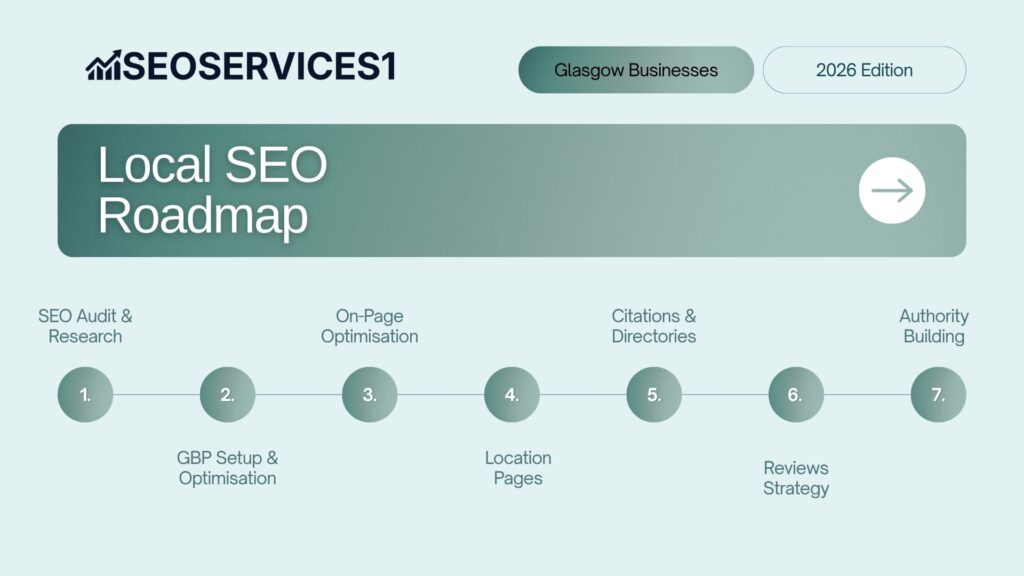
Local SEO can feel overwhelming if you treat it as one massive project. Breaking it into a 90‑day plan gives you clear short-term targets while keeping sight of the long-term goal. Below is a structure that can be adapted for many Glasgow businesses; you can follow it yourself or use it to evaluate potential partners.
Weeks 1–4: Fix the Fundamentals
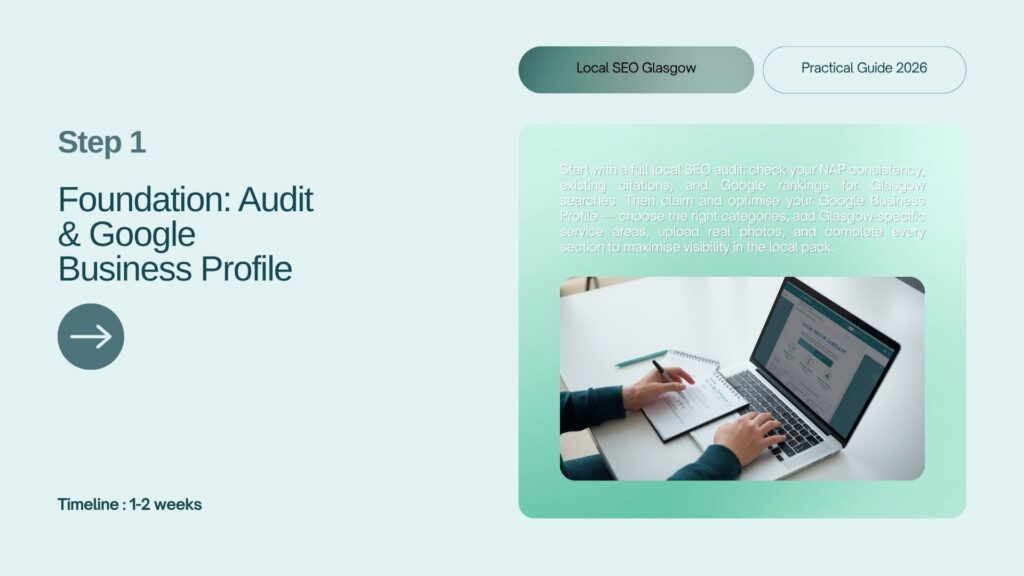
The first month is about accuracy, completeness, and basic visibility. Many Glasgow businesses skip this and wonder why advanced tactics do not work.
Claim and verify your GBP Ensure your Google Business Profile is under your control, verified, and not sitting in some old agency account. Verification steps depend on your category and Google’s current rules, but you cannot afford to leave this hanging.
Standardise your NAP across the web Decide exactly how your business name, address, and phone number should appear and then use that version everywhere. If your website says “Unit 4, 10 Main Street” but your GBP says “4/10 Main St.” and directories show a different phone number, you are creating confusion that can be avoided.
Complete your GBP information properly Fill in your description, opening hours (including bank holidays), services, and applicable attributes such as parking, accessibility, or online booking. Accurate information directly influences what is shown in search and Maps.
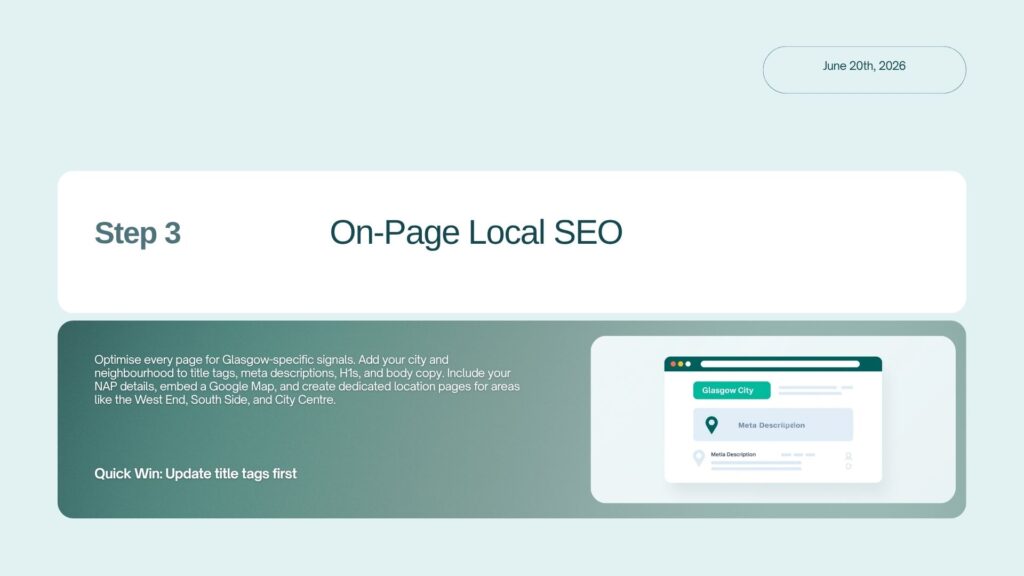
Align your website with your GBP Your core service pages should use the same language as your profile and clearly state that you operate in Glasgow. A “Dentist in Glasgow West End” page should not read like a generic UK dental page with no place names.
Refresh your photos and media Upload images that genuinely reflect your business now, not ten years ago. For trades, that might mean photos of your vans, team, and real jobs in neighbourhoods like Partick or Shawlands. For clinics and salons, internal shots that give a reassuring, current impression are vital.
These steps often surface outdated addresses, old phone numbers, and missing information that quietly block your local visibility.
Weeks 5–8: Build Credibility and Local Relevance
Once your basic presence is clean and complete, you move into building trust signals and demonstrating where in Glasgow you actually work.
Make reviews part of your process Put a simple review process in place: train staff to ask satisfied customers for a review at a natural moment, follow up with a short message including a direct link to your Google review page, and explain that feedback helps other people in Glasgow choose reputable local providers.
Aim for steady review growth A regular flow of new reviews say, a handful per month usually does more for trust than an occasional burst. It also signals that your business is active.
Audit and refine your citations Use your master NAP to check major directories and platforms for inconsistencies, correct outdated or duplicate listings, and add your business to carefully chosen UK and Glasgow directories that really matter for your audience and sector.
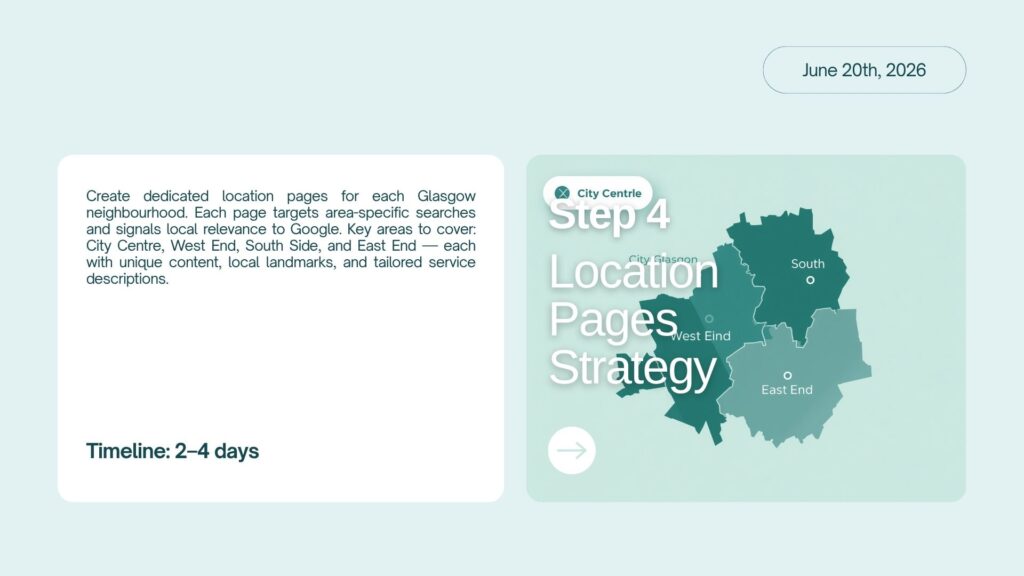
Create or enhance neighbourhood pages If you consistently serve certain areas, make that explicit. For example, a plumbing company might create pages for “Boiler Repairs in Glasgow South Side” and “Emergency Plumber in Glasgow East End”, while a law firm might have “Family Law Solicitor in Glasgow city centre” and “Conveyancing Solicitor in Glasgow West End”. Each page should mention the districts you cover and answer questions people in those areas typically ask.
At this point, you often see a rise in map impressions and profile actions as Google and potential customers both gain more confidence in who you are and where you work.
Weeks 9–12: Build Authority and Tune Performance
The third month builds on the foundation and trust you have already created, shifting more into authority and optimisation.
Strengthen local relationships and links Look at the communities you already interact with sports clubs, schools, charities, business networks and explore whether those relationships can be reflected online with a mention and link. A sponsorship of a South Side youth team or an event in the West End can double as a real-world contribution and a signal of local prominence.
Publish content that answers real questions Use the conversations you have with customers as a source of content ideas. For example, a Glasgow electrician could write about common electrical issues in tenement flats, or a restaurant near the Hydro could create a guide on where to eat before and after events.
Review performance and refine Look at GBP Insights to see which searches trigger your listing, what actions people take, and from which areas. Combine that with website analytics to identify which pages are performing well and which need work. Adjust titles, meta descriptions, headings, and calls to action where engagement is weak.
Plan beyond 90 days By now you should have a clearer sense of your competitive position. If leading competitors in your niche and area have many more reviews, more neighbourhood coverage, or stronger links, create a realistic plan to close those gaps over the next 6–12 months.
If you reach this stage and find the ongoing work difficult to maintain alongside running your business, that is often the right moment to bring in a specialist partner who can manage the ongoing tasks while you keep ownership of the bigger picture.
Image Description: A simple 90-day timeline graphic illustrating three phases of a local SEO Glasgow campaign: foundations, trust building, and authority/optimisation.
Making the Most of Your Google Business Profile in Glasgow
Your Google Business Profile is often the first and sometimes the only thing people see before they decide whether to contact you. Complete, accurate information and regular attention improve your chances of showing up for relevant local searches.
Getting Categories and Service Areas Right
Choosing categories might seem like a small task, but it heavily influences which searches you appear for.
Pick a primary category that best matches your main service. A dental practice that mostly provides general treatment should not choose a narrow cosmetic category as its primary.
Add secondary categories only where they genuinely reflect services you provide, such as “Emergency plumber” or “Cosmetic dentist”.
For service-area businesses like trades, define realistic service areas that match where you actually travel. Claiming the entire UK from a base in Glasgow does not align with how local results are designed.
These decisions help Google understand which searches you are a good fit for and which ones you are not.
Using Photos, Posts, and Messaging to Show You’re Active
People are naturally wary of outdated or sparse profiles. You can counter that by:
Uploading photos that show your premises and team as they look now no stock images, and no heavily edited shots that feel unreal.
Posting occasional updates about seasonal services (for example, “boiler checks before winter in Glasgow”), changes to hours, or practical tips.
Turning on messaging if you can respond quickly. In many Glasgow neighbourhoods, younger audiences in particular prefer messaging over phone calls for first contact.
These small touches reassure potential customers that your business is active and paying attention.
Keeping Opening Hours and Details Accurate
Many local frustration stories start with “Google said they were open, but they weren’t.” To avoid joining that list:
Keep your standard hours updated and adjust them when your business changes pattern.
Use special hours for bank holidays, events, or any unusual closures.
Accurate hours help both users and Google; they also reduce the risk of negative reviews from people who feel misled.
Reviews and Reputation: What Glasgow Customers See Before They Call
Reviews have moved from “nice to have” to “expected”. Many people rely on review counts, average ratings, and review recency when choosing local providers. That behaviour plays out in Glasgow too, particularly in sectors like healthcare, trades, hospitality, and personal services.
Setting Review Targets Based on Reality, Not Guesswork
A realistic review target starts with understanding your competitive landscape:
Search for your service and area such as “plumber Glasgow South Side” or “dentist Glasgow West End” and note the review counts and ratings of the top three results.
Look at the dates of their recent reviews. A business with 50 reviews, most of them ancient, is not necessarily stronger than one with 30 but a consistent stream of new feedback.
If leading competitors have 80–150 reviews and ratings above 4.5, a target of “get to 10 reviews” is simply a first step, not an end goal. You can build towards those numbers over time, but you need to recognise the gap.
Building Reviews in a Way That Lasts
Sustainable review generation usually involves simple changes rather than complex software:
Train staff to recognise when a customer is clearly happy and to ask whether they would be willing to leave a review.
Make leaving a review easy provide direct links, small reminder cards, or follow-up messages.
Normalise review requests so customers do not feel singled out; explain that feedback helps other people in Glasgow choose reputable local providers.
The key is consistency. A few new reviews each month over a year quickly add up.
Responding to Reviews as Part of Your Brand
Potential customers in Glasgow often read a few reviews and the owner responses before deciding whether to get in touch. Use that to your advantage:
Reply to positive reviews with specific details when possible, such as referencing the type of job or area you served.
For negative reviews, respond calmly, acknowledge any valid points, and explain what actions you are taking. Avoid public arguments; invite the reviewer to continue the conversation privately where appropriate.
This shows you are attentive and care about service quality, which can be as persuasive as the rating itself.
Citations, NAP, and Directories: Making Your Business Easy to Trust
Citations mentions of your business name, address, and phone number across the web help search engines cross-check that your business really exists where you say it does. They are not glamorous, but they are part of the foundation of local SEO Glasgow.
Creating a Clean Master Record
Before you touch any directories, put together a short internal document with:
Your business name exactly as you want it to appear.
Your full address, including building or unit details, area, “Glasgow”, and postcode.
Your main phone number, preferably a local Glasgow number.
Your main email and website URL.
This becomes your reference for everything else.
Choosing Directories That Matter
Rather than signing up to every directory you can find, focus on a shortlist that aligns with your sector and audience:
Major platforms like Google Business Profile, Bing Places, Apple Maps, and Facebook.
Reputable UK directories and sector platforms your customers recognise.
Local Glasgow or Scottish sites run by legitimate organisations, such as business associations or sector bodies.
A smaller, high-quality set of citations that all agree is far more useful than a long list of low-quality ones with conflicting data.
Maintaining Citations Over Time
Your information will change at some point: a move, a number change, or a rebrand. When it does, keep a simple checklist of where you need to update details. Running a quick citation audit once or twice a year keeps your footprint clean and avoids confusion between old and new information.
Local Content and Neighbourhood Pages: Showing Where You Work and How You Help
Your website is the place where you can be as specific as you need to be. Local content and neighbourhood pages turn “yes, we work in Glasgow” into “we regularly help people like you in this part of Glasgow with this type of problem”.
Balancing City-Wide and Neighbourhood Coverage
A healthy local content structure for Glasgow often includes:
City-wide service pages explaining what you offer across Glasgow such as “Roofing Services in Glasgow”, “Family Dentistry in Glasgow”, or “SEO Services for Glasgow Businesses”.
Neighbourhood pages for areas where you actively want to win work, including:
City Centre and Merchant City
West End (Hillhead, Partick, Kelvinbridge)
South Side (Shawlands, Pollokshields, Giffnock)
East End (Dennistoun, Parkhead)
Each neighbourhood page should describe the types of jobs or clients you commonly serve there, refer naturally to local landmarks, street types, or housing stock where relevant, and explain any logistical details customers care about, like travel times, parking, or access.
Sector-Specific Examples for Glasgow
Different sectors need different emphasis. For example:
Trades: Emphasise response times, types of properties you work in (tenements vs new builds), and coverage across specific neighbourhoods.
Healthcare and wellness: Highlight proximity to public transport, accessibility features, and the types of patients you serve (families, students, office workers).
Hospitality: Focus on location relative to key venues (Hydro, theatres, shopping streets), booking policies, and typical visit patterns (before/after events).
By articulating these details, you make it easier for readers to see themselves in your examples and for Google to connect you to relevant local queries.
Using Blogs and FAQs for Questions You Hear Every Week
Your blog and FAQ sections can mirror the real conversations you have with customers. Examples might include:
“How much should I budget for boiler replacement in Glasgow?”
“What documents do I need to bring to my first appointment at our Glasgow law firm?”
“How far in advance should I book for a Saturday evening in our Glasgow restaurant?”
These pieces of content are not just for SEO. They help customers arrive better informed, reduce repetitive phone calls, and demonstrate your expertise.
Building Local Links and Community Presence in Glasgow
Links remain a core signal of authority in search. In local SEO Glasgow, the most valuable links tend to come from people and organisations that already matter in your real-world community.
Turning Community Involvement into Signals of Authority
Many Glasgow businesses quietly support local life already. You might provide raffle prizes for school fairs, sponsor a five-a-side team, or host events. When those activities are reflected online on school websites, club pages, or local media they create local mentions and links that reinforce your prominence.
Examples include:
A gym in the West End sponsoring a student sports club at the University of Glasgow.
A trades business in the South Side supporting a charity event and being listed as a partner with a link.
A restaurant near the city centre working with a local food blogger on a Glasgow‑focused review or guide.
These are natural, human relationships that outweigh cheap, irrelevant links from faraway sites.
Earning Local Media and Blog Mentions
If you publish genuinely helpful content or run interesting projects, local journalists and bloggers may be open to covering them. Think along the lines of:
Seasonal safety guides, such as “Winter boiler checks for older Glasgow properties”.
Community initiatives like free workshops, charity days, or open evenings.
Original mini‑studies about your sector in Glasgow, such as appointment trends or common customer questions.
When those stories are published with clear references to your business, they contribute to your online prominence while also reaching local audiences.
Staying Away from Risky Link Tactics
While there is no shortage of offers promising hundreds of “SEO links”, most generic link schemes are risky. For a Glasgow business whose primary income depends on local visibility, being removed or penalised would be far more damaging than any short-term gain. Stick to links that make sense in the real world and that you would be comfortable explaining to a regulator or customer.
Measuring Local SEO Success and Return on Investment in Glasgow
Local SEO is an investment that compounds over time rather than a quick one-off fix. To decide whether it is working, you need a simple set of metrics that tie back to visibility, engagement, and revenue.
Key Metrics to Watch
Most Glasgow businesses can start with four main groups:
Visibility: how often your GBP and local pages appear in relevant searches and map results.
Engagement: how many calls, website clicks, direction requests, and messages come from your GBP.
Website performance: how many visitors land on your local landing pages, how long they stay, and how many complete a desired action.
Leads and revenue: how many of those actions turn into paying customers and what those customers are worth on average.
You do not need a complex reporting setup to begin with; a simple monthly summary often provides enough insight to make good decisions.
Businesses fixing serious basic issues unverified profiles, wrong numbers, incomplete pages often see early movement within 4–8 weeks, sometimes sooner in under-served niches.
Building strong, competitive presence in the map pack for crowded queries usually takes several months, especially where established competitors already have many more reviews and stronger link profiles.
This is why local SEO Glasgow is best viewed as an ongoing programme. Short bursts of activity followed by long periods of neglect tend to produce equally short-lived results.
Choosing the Right Local SEO Glasgow Model and Budget
How you handle local SEO depends on your resources and appetite for learning. There is no single correct answer, but there are predictable trade-offs.
Comparing DIY, Freelancers, Agencies, and Specialists
The table below summarises typical options for Glasgow SMEs:
Option
Typical Monthly Cost Range*
Time Needed From You
Best For
Pros
Cons
DIY
Low direct cost
High
Micro businesses with very limited budgets and owners willing to learn SEO
Maximum control; you learn every step
High time demand; easy to miss critical tasks
Freelancer
Low–Medium
Medium
Small firms needing help with execution but able to set direction
Flexible; can be cost‑effective for focused tasks
Skills vary; may not cover strategy, content, and reporting end‑to‑end
General digital agency
Medium–High
Low–Medium
Businesses wanting SEO plus wider marketing support (web, ads, email)
One team managing multiple channels
Local SEO may compete with other priorities internally
Specialist local SEO partner
Medium
Low–Medium
Service businesses serious about map-pack visibility and local lead generation
Deep focus on local SEO; structured frameworks and clear reporting
Requires ongoing investment and collaborative input
*These ranges are indicative. Actual numbers vary with sector, competition, and scope.
What “Sustainable” Investment Looks Like
In practice, a sustainable local SEO Glasgow programme usually includes:
Continuous GBP management and optimisation.
Ongoing review generation and responses.
Regular citation checks and updates.
Periodic production of new local content and refinement of existing pages.
Ongoing monitoring, analysis, and adjustments based on what the data shows.
If your budget only covers a one-off setup, your results will likely decay over time as competitors continue to invest.
What You Need to Bring as a Client
Whatever model you choose, your involvement matters. You will typically be asked to:
Provide accurate information about your services, service areas, and any changes.
Support review collection by asking customers and reinforcing processes internally.
Maintain service quality and operational responsiveness so that the leads local SEO generates are not wasted.
If you want to keep strategic control but avoid the day-to-day complexity, working with a specialist gives you a structured, Glasgow-specific programme while leaving you free to focus on delivering your core service.
Local SEO Glasgow and the Rise of AI-Powered Answers
Search results are no longer just “ten blue links plus a map”. Many queries now trigger AI-generated summaries or answer-style boxes at the top of the page. Those systems still rely on content they can parse and trust.
For Glasgow businesses, this shift creates both risk and opportunity:
If your content is vague, thin, or poorly structured, AI systems are less likely to use it when composing answers.
If your content is clear, well-organised, and specific to Glasgow, it has a better chance of being referenced indirectly in AI summaries, especially for queries where local providers matter.
To align your local SEO Glasgow content with this reality:
Write definition-style openings for major sections, so that each one answers a specific question in one or two sentences.
Use headings that mirror real questions your customers ask, especially in your FAQ section.
Keep key facts explicit: what local SEO is, which factors matter most, what timelines are realistic, and which service models exist.
Use structured formats tables, numbered lists, bullet points for comparisons and workflows.
This approach helps your human readers and improves the chances that AI systems treat your content as a reliable, citable source when they need to explain “local seo glasgow” to others.
Frequently Asked Questions: Local SEO Glasgow
What is local SEO Glasgow and how is it different from general SEO?
Local SEO Glasgow focuses on helping your business appear in local search results and Google Maps for people in and around Glasgow, especially in the map pack. General SEO aims at ranking pages for broader, often national searches. For a Glasgow plumber, dentist, restaurant, or solicitor, local SEO is usually the most direct way to reach customers who are ready to contact a provider nearby.
How long does local SEO take to show results in Glasgow?
If your profiles and site are in poor shape when you start, you can often see early improvements in visibility and enquiries within 4–8 weeks once your GBP, citations, and core content are fixed. Strong, stable map-pack positions in competitive areas like the city centre or West End typically take several months of consistent reviews, content, and optimisation, especially in crowded niches.
How much does local SEO typically cost in Glasgow?
Costs vary based on your sector, competition, and how much you outsource. Very small businesses sometimes start with DIY effort and minimal tools. Many Glasgow SMEs find a sustainable level with a specialist partner where local SEO is treated as an ongoing monthly investment rather than a one-off project. The key is to ensure your budget covers continuous improvement not just a one-time setup.
Do I need a physical address in Glasgow to rank in local search?
You need a legitimate business presence within the area you want to rank for typically a physical address for bricks-and-mortar businesses or a service-area setup for trades and mobile services. You do not need a city-centre high-street shop to appear in Glasgow results, but you do need to comply with platform guidelines and accurately reflect where you operate.
Can I rank across multiple Glasgow areas from one location?
Yes, many service businesses rank in multiple Glasgow areas from a single base, especially if they clearly cover those neighbourhoods and build strong relevance and prominence. Well-optimised GBP categories, accurate service areas, targeted neighbourhood pages, and genuine reviews from customers in various districts all help you appear beyond your immediate postcode.
How many reviews do I need to compete in the Glasgow map pack?
There is no fixed number, but your goal should be to match or exceed the review volume and rating of leading businesses in your specific category and area. In many Glasgow niches, businesses in the top 3 may have dozens or even hundreds of reviews and a rating comfortably above 4.0. Focus on steadily building high-quality reviews rather than chasing a specific number overnight.
Is local SEO worth it for very small Glasgow businesses?
For many small Glasgow businesses such as independent trades, small clinics, salons, and cafés local SEO is often one of the most efficient ways to generate new enquiries. Customers are actively searching for nearby providers, and appearing in the map pack can produce more phone calls and walk-ins than many traditional advertising channels if you manage it properly.
What will I need to do, and what will a specialist handle?
You will provide accurate information, help implement internal changes (like review processes), and ensure your team can respond quickly to new leads. A specialist partner can handle the research, GBP optimisation, citation work, content planning, link outreach guidance, and reporting, while guiding you on actions that require your direct involvement.
How do I track ROI from local SEO in Glasgow?
Track leads and conversions coming from search: calls from your GBP, contact form submissions, online bookings, and, where realistic, in-person visits. Combine this with revenue estimates for typical jobs or bookings, and compare to your local SEO spend over time. Patterns over several months are more meaningful than week-by-week fluctuations.
Should I run Google Ads as well as local SEO in Glasgow?
For many businesses, a mixed approach works well. Local SEO builds long-term visibility and trust, while local Google Ads can deliver additional leads quickly in key areas or during busy seasons. If budget is limited, it may make sense to prioritise strengthening your local SEO foundations first, then layer paid campaigns on top once you can clearly measure results.