Local SEO in Sheffield is about being visible at the exact moment people in the city are looking for what you do. When someone searches “emergency plumber Sheffield” on their phone or “accountant near me” from an office in the city centre, Google quietly decides which handful of businesses to put in front of them. If you are not in that shortlist, you are missing out on enquiries every day, even if your team, pricing, and service are excellent.
At SEOSERVICES1, we use a structured but practical framework for local SEO in Sheffield. We combine work on your Google Business Profile, your website, reviews, and wider local signals so Google can confidently recommend you when nearby people search. This page walks through what local SEO really involves, why it matters specifically in Sheffield, and how our approach is geared towards generating more local enquiries—not just nicer graphs in a report.
Image Description: Conceptual map of Sheffield with pins indicating local businesses visible in search.
What is local SEO in Sheffield?
A simple definition for Sheffield businesses
Local SEO in Sheffield is the process of improving your online presence so that people in and around the city can easily find and choose your business when they search on Google. Instead of fighting for national visibility on broad, highly competitive phrases, local SEO focuses on searches that have a clear local intent—searches that either include the place name “Sheffield” or are made by people whose device location is in or near the city.
In practical terms, local SEO means making it very easy for Google to understand three things: who your business is, what services you deliver, and which parts of Sheffield and South Yorkshire you actually cover. When those signals line up consistently across your website, your Google Business Profile (GBP), and trusted directories, you are far more likely to appear when someone nearby searches for your service—whether they type “boiler repair Sheffield” or simply “boiler repair” from a house in S2.
How local SEO shows up in Google for Sheffield
When someone in Sheffield looks for a local product or service, the Google results page typically follows a familiar pattern:
A map pack: a small map with three highlighted local businesses, each showing a star rating, opening hours, and quick buttons such as “call”, “website”, and “directions”.
Local organic results: traditional website listings underneath the map, often belonging to businesses with pages clearly targeted at Sheffield or South Yorkshire.
A Google Business Profile panel: on some devices or brand searches, a prominent information box on the side showing photos, address, reviews, and contact details.
Effective local SEO in Sheffield aims to:
Get your business into the map pack for your priority search terms and then steadily move you higher within those three spots.
Turn your GBP into a strong, trustworthy first impression, with accurate data, up‑to‑date photos, and recent reviews.
Make sure your website clearly communicates that you serve customers in Sheffield (and specific neighbourhoods) rather than presenting you as a generic, location‑less company.
For many Sheffield businesses—especially those in services, hospitality, and local retail—these local search elements are now the main way new customers discover them. If you do not show here, those potential customers often never reach your site at all.
Why local SEO matters for Sheffield businesses
How your customers actually search locally
If you think about your own habits, you probably already use Google for most local needs. You might search for “electrician in Hillsborough”, “dentist in Crookes”, or “gym near Kelham Island” and then make a decision based on the first page of results. You quickly scan ratings, distance, and opening times, and you pick one of the options that looks professional and convenient.
Your own customers behave the same way. A large share of these local searches happen on mobiles and lead to action within a short time—people click to call, request directions, or visit a website within minutes. That means:
If you appear prominently and look trustworthy, you have a realistic chance of winning that enquiry.
If you are hidden further down the results, most people will never scroll far enough to see you.
If your details look incomplete, inconsistent, or neglected, searchers are likely to click on a competitor instead.
Local SEO makes sure you are not only present but also appealing and up‑to‑date when people in Sheffield are actively looking for what you offer.
Typical outcomes from effective local SEO
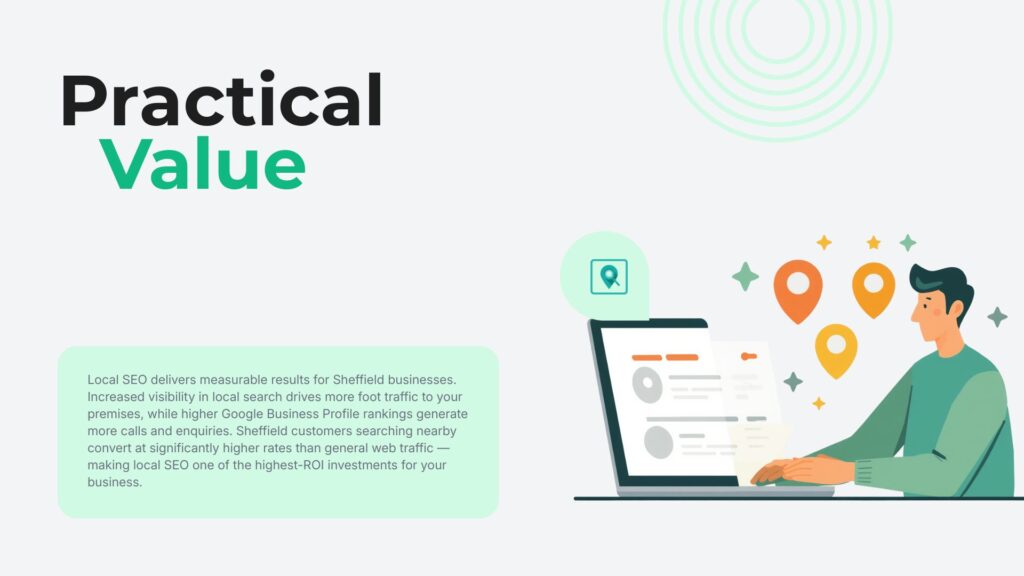
When local SEO work is carried out methodically and allowed to run over several months, Sheffield businesses usually see patterns like:
Higher visibility in the right places – your GBP shows up for a wider range of relevant local queries, and impressions from people in Sheffield increase.
More local actions – calls, website clicks, and direction requests rise because your listing answers immediate questions (who, what, where, when) clearly.
Improved local rankings – you move from being buried beyond page one to appearing where people actually click, particularly in the map pack.
More qualified leads – enquiries come from people explicitly looking for your service in your catchment area, which usually translates into a better conversion rate.
The exact numbers depend on your starting point and competition level, but the direction of travel is consistent: clearer local signals lead to more local visibility, which leads to more local enquiries.
Our Sheffield local SEO framework
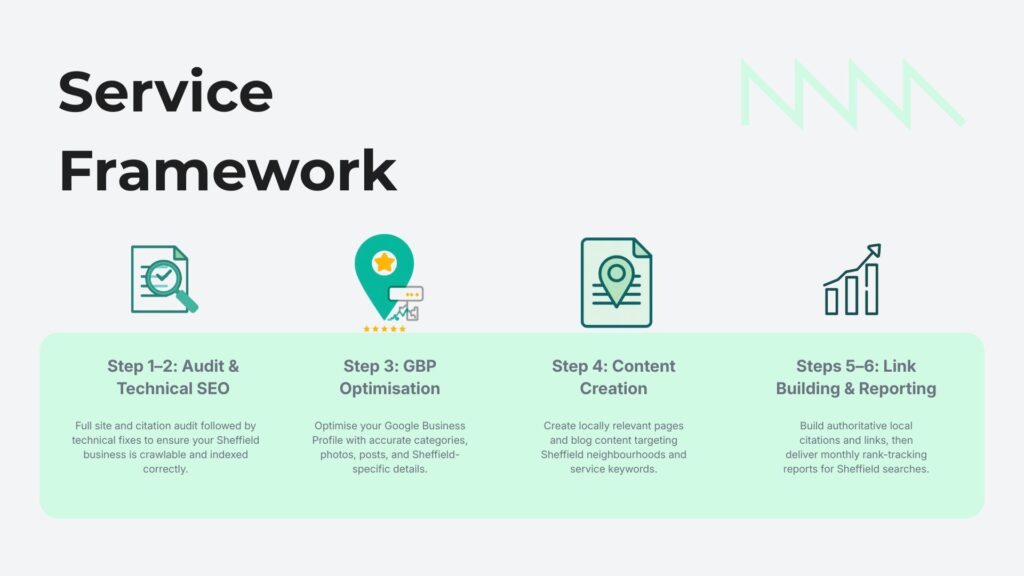
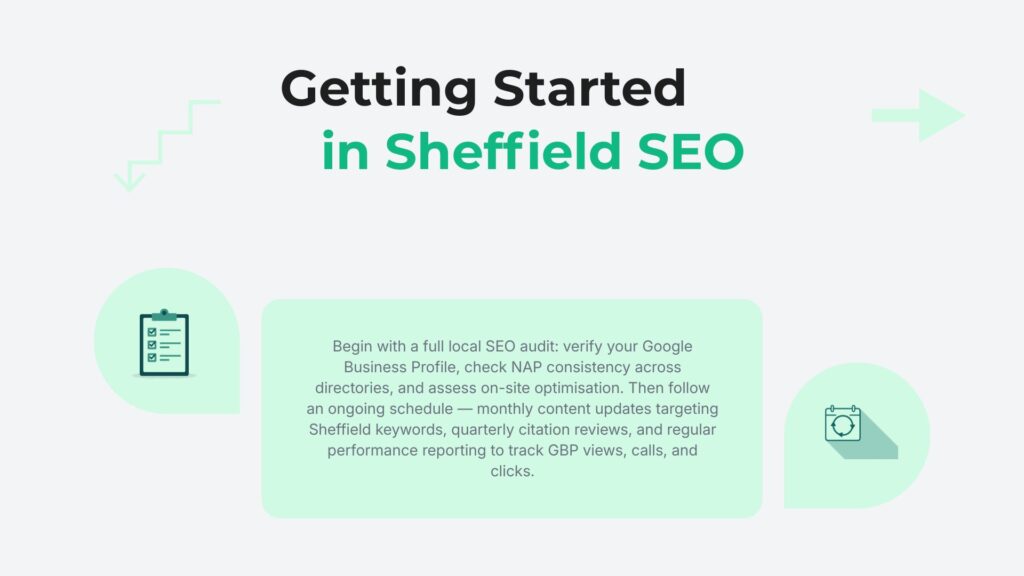
Our Sheffield local SEO framework is a six‑step process designed to be transparent, repeatable, and practical. You always know what we are doing, why we are doing it, and what we are watching in the data.
Step 1 – Audit your current local visibility
Every project starts with a focused local SEO audit. We need to see what Google and potential customers see right now. This usually includes:
Checking how often you appear in local search and Google Maps for the key Sheffield phrases that matter to you.
Reviewing your Google Business Profile for completeness, category accuracy, photo quality, and alignment with your real‑world offer.
Assessing your website for local signals, overall content quality, and technical issues that might be holding you back.
Mapping your citations—where your business is listed—and spotting inconsistencies in your name, address, and phone (NAP) data.
Examining your review profile: how many reviews you have, what your rating looks like, and how recent your last feedback is.
For example, we might find a Hillsborough‑based electrician whose GBP uses the wrong primary category, whose website rarely mentions Sheffield, and whose old phone number still appears on several directories. This kind of snapshot makes it very clear where to start for the biggest early impact.
Step 2 – Optimise your Google Business Profile
Your Google Business Profile often attracts more impressions than your own homepage, especially on mobile devices. If it is neglected, you are probably losing easy wins.
We focus on:
Ensuring your name, address, phone, opening hours, and service areas are accurate and consistent with your website.
Selecting relevant primary and secondary categories so Google understands exactly what you do.
Writing a concise, Sheffield‑aware business description that explains your services in straightforward language.
Adding well‑chosen photos that show your premises, team, and work clearly rather than relying on generic stock images.
Using appropriate attributes (such as accessibility, online appointments, or takeaway) and guiding you on whether posts and updates will help.
Take a café just off Division Street as an example. Once its GBP shows accurate hours, real interior and food photos, menu links, and clear information about booking, it becomes significantly more attractive in the map pack—often leading to more clicks and footfall.
Step 3 – Fix citations and NAP consistency
Google cross‑checks your business information across many sources. If your address is written differently across sites, or your phone number changed and was never updated, that inconsistency can weaken your local signal and confuse customers.
To fix this, we:
Identify high‑value directories and listings for your sector and for UK and Sheffield businesses more generally.
Standardise your NAP details so your business name, address, and phone number are presented in the same way everywhere.
Update, merge, or remove older listings that reference old addresses, old names, or old numbers.
After this clean‑up, your presence across the web supports what your GBP and website say instead of contradicting them. This gives search engines and potential customers more confidence that your information is correct.
Step 4 – Improve on‑page SEO for local intent
Your website remains the core piece of your online presence. It must be both persuasive to human readers and clear to search engines that you serve the Sheffield area.
We typically:
Refine key service pages so they explain, in plain English, what you do and who you serve in Sheffield and nearby areas.
Adjust title tags and meta descriptions to reflect both the service and the locality (for example, “Commercial Cleaners in Sheffield – [Brand]”).
Create or enhance location pages if you cover multiple neighbourhoods such as Crookes, Ecclesall, Woodseats, or areas around South Yorkshire.
Improve internal linking so visitors and search engines can easily move between related services, case studies, and local pages.
A firm of accountants, for instance, might move from a single “Our Services” page to a set of clearly written pages for Sheffield SMEs, contractors, and start‑ups. Each page can include local examples and scenarios that prospective clients recognise.
Step 5 – Build local content and links
Once the foundations are in place, we turn to building your authority and relevance within Sheffield. This is where your business starts to stand out rather than simply “meet the basics”.
This often involves:
Creating helpful, locally focused content that answers questions your Sheffield customers genuinely ask—such as “How to choose a builder in Sheffield for a terraced house renovation” or “What Sheffield landlords need to check before winter”.
Writing location‑specific content if you serve multiple districts or surrounding towns (for example, “Plumbing services in Crookes and Broomhill” or “Garden design in Dore and Totley”).
Seeking sensible opportunities to earn local links, such as sponsoring a local youth team, contributing to a community newsletter, or collaborating on content with complementary businesses.
Over time, this activity builds a picture of a business that is active, engaged, and part of the local ecosystem, which can strengthen both visibility and trust.
Step 6 – Track, report, and refine
Local SEO is not a “set and forget” task. Once work is in motion, we monitor the data and adapt.
We track:
Trends in GBP impressions, clicks, calls, and direction requests, with attention to key days and times.
Movement in local rankings for agreed Sheffield keywords that actually matter to your pipeline.
Changes in organic traffic and enquiries from your local landing pages.
You receive regular updates in plain language, not just screenshots. We explain what the numbers show, how they connect to the work we are doing, and what we are going to focus on next. Over time, this feedback loop helps us refine your local SEO so it continues to support your business goals.
Key components of our local SEO service
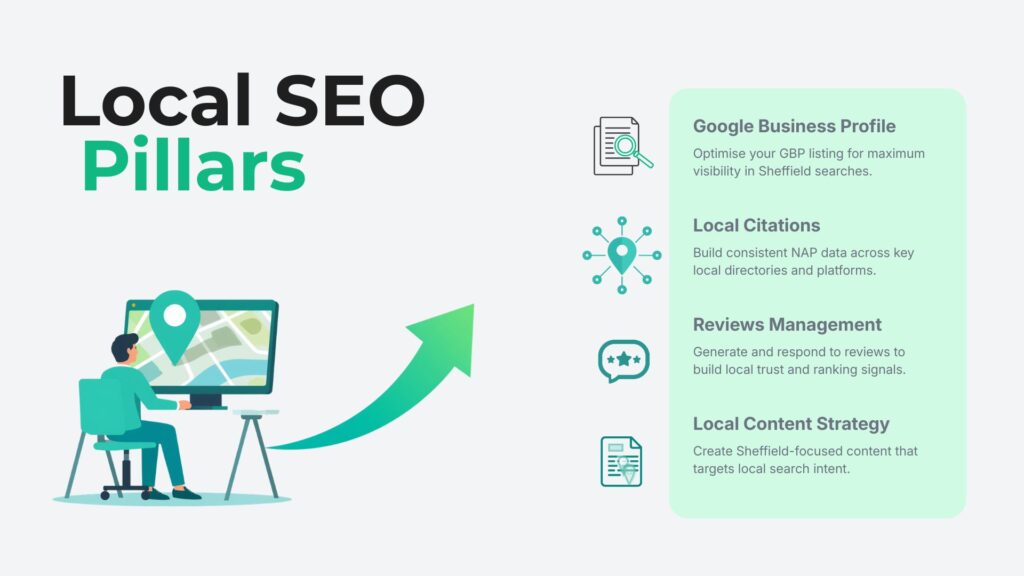
Google Business Profile optimisation
Optimising your Google Business Profile is one of the most direct ways to influence how you appear in local search and on Google Maps. For many Sheffield businesses, the GBP is the first and sometimes only touchpoint a new customer sees.
We make sure your profile:
Is fully completed with accurate, up‑to‑date information that matches your website and offline reality.
Highlights your most important services and the areas you cover in and around Sheffield.
Uses categories and attributes thoughtfully so Google understands your offering without confusion.
Is supported by a realistic, compliant approach to review generation and response rather than leaving feedback to chance.
For a Sheffield plumbing company, this might mean clarifying whether they handle emergencies 24/7, updating service areas to include specific postcodes, and using photos that show real local work. These changes can lead to more relevant calls and fewer time‑wasting enquiries from outside your area or outside your service scope.
On‑page optimisation for Sheffield service and location pages
Your service and location pages need to answer two basic questions almost instantly: “Is this what I need?” and “Do they serve my area?”. If a visitor cannot answer both, they will likely hit the back button.
We typically:
Rewrite or adjust headlines to be specific and benefit‑focused—such as “Roof Repairs in Sheffield and South Yorkshire” rather than something vague like “Quality Roofing Solutions”.
Place clear calls‑to‑action at natural points on the page, inviting people to “Call our Sheffield team today” or “Request a quote in Sheffield”.
Use structured subheadings, bullet points, and short paragraphs so people scanning on a phone can quickly get the gist.
Ensure that contact details, phone numbers, forms, and maps are easy to find and consistent with your GBP.
The result is a set of pages that both reassure potential customers and make it easier for Google to match your site with local search intent.
Citations and directory management
Citations might not generate excitement, but they do build credibility. They are a key part of the background signals Google uses to cross‑check your details.
Our work here involves:
Listing or updating your business on carefully chosen national and local directories that are relevant to your sector and location.
Ensuring each listing is complete, accurate, and reflects your current branding and contact details.
Maintaining a simple record of where you are listed so changes (like a new phone number or move of premises) can be rolled out properly later.
Rather than chasing hundreds of low‑value listings, we focus on a manageable set that genuinely strengthens your online footprint and supports consistency.
Reviews and reputation management
Reviews are both social proof and a ranking factor. Many people in Sheffield will check your star rating and skim a few recent comments before deciding whether to call.
We help you to:
Build simple, repeatable prompts into your customer journey, so happy customers are politely encouraged to leave honest reviews.
Respond to feedback—especially less positive reviews—in a measured, professional way that reassures readers you take issues seriously.
Use selected reviews on your website to reinforce your claims on key pages, where appropriate and allowed.
As the volume and recency of your reviews improve, you can often see corresponding uplifts in both click‑through rates and conversion, because more people feel confident choosing you from search results.
Sheffield‑focused content strategy and blogging
Local content allows you to demonstrate that you understand your customers’ context—not just generic industry issues.
You might, for example, publish:
A guide from a heating engineer on “Preparing your Sheffield home for winter”, referencing common property types and typical problems in the area.
An article from a city‑centre gym on “How to choose a Sheffield gym if you commute by train”, aimed at workers around Sheffield station.
A piece from a family solicitor explaining how certain processes work in local courts, written in language normal residents can understand.
This content does more than attract traffic. It positions your business as a knowledgeable local expert and gives prospective customers a chance to build trust before they ever make contact.
Local link building and partnerships
Links from relevant local websites act like recommendations from within the community. They can help both your SEO and your brand visibility.
We usually explore opportunities such as:
Supporting local events, charities, or community projects that credit supporters on their websites or social media.
Appearing in genuinely useful “best of Sheffield” or “local business” guides where inclusion is based on relevance and quality.
Co‑creating content or resources with complementary local businesses—for example, a joint guide produced by a builder and an interior designer.
The aim is to create a modest but meaningful network of high‑quality local links rather than chasing raw numbers.
Tracking, reporting, and KPIs
Without measurement, it is impossible to know which parts of your local SEO are working and which need more attention.
Common local SEO KPIs we track include:
GBP visibility and actions – how often people see your profile and whether they click, call, or request directions.
Local keyword rankings – where you appear for agreed Sheffield terms with clear commercial intent.
Organic conversions – actual enquiries, bookings, or sales that you can attribute to local search traffic.
Our reports are written so non‑technical business owners can understand them at a glance. We highlight what has changed, what we have done, and what we recommend next, so the link between SEO work and business outcomes stays clear.
Local SEO playbooks for Sheffield industries
Trades and home services in Sheffield
For trades and home services—plumbers, builders, electricians, roofers, locksmiths, and similar businesses—many searches are time‑sensitive. Someone with a burst pipe in S7 is not going to spend an hour comparing options; they will contact one of the first providers who looks capable and trustworthy.
A typical local SEO playbook for these businesses includes:
A complete and accurate GBP showing service hours (including emergency availability if relevant) and service areas in Sheffield.
Reviews that mention reliability, punctuality, clear pricing, and tidy work—exactly the details worried homeowners look for.
Dedicated service pages for emergency call‑outs and planned jobs, written in plain language for Sheffield homeowners and landlords rather than trade jargon.
Practical blog content on recurring local issues, such as damp in stone terraces or insulation concerns in older properties common to parts of Sheffield.
This combination helps you appear at the moment of need and gives potential customers enough confidence to pick up the phone.
Professional services (solicitors, accountants, consultants)
Professional services involve higher‑value decisions and often longer decision cycles. Prospective clients might speak to several firms or seek recommendations before choosing.
An effective local SEO plan for these sectors usually involves:
Detailed service pages that spell out exactly what you do, who you serve in Sheffield, and how your process works from first contact to outcome.
GBP details that highlight your specific practice areas or specialisms, rather than listing only a generic category.
Articles, FAQs, or guides that address common questions from Sheffield businesses and residents, such as regional employment concerns or local tax considerations.
Case‑style content (anonymised where necessary) that shows the types of problems you solve and the results you achieve for clients in the area.
This type of content and optimisation helps you stand out from firms that rely solely on brand name or generic messaging.
Hospitality, leisure, and local attractions
For cafés, restaurants, bars, gyms, and attractions, many local searches are spontaneous. People search “brunch near me” or “gym near Kelham Island” and make a decision minutes later.
A strong local SEO playbook for hospitality and leisure typically:
Ensures GBP details are complete and accurate, with appealing photos, menus or timetables, and up‑to‑date opening times.
Encourages visitors to leave recent reviews that mention specific experiences—such as atmosphere, service, or standout dishes.
Publishes content tied to local events and venues, like match‑day offers near Bramall Lane or pre‑theatre menus close to the Crucible.
Makes parking information, accessibility details, and booking links easy to find online so there is no friction between finding you and visiting you.
Executed well, this can make you the obvious choice when people look for places to go in particular parts of the city.
Healthcare and clinics
Clinics, dentists, therapists, and other healthcare providers operate in a context where trust and clarity are absolutely crucial. Patients often feel anxious and want to understand what will happen before they make contact.
Local SEO priorities in this space often include:
Accurate GBP information showing services, accessibility, and clear contact routes (phone and online).
Practitioner and service pages written in reassuring, non‑technical language, explaining what different treatments involve.
Supportive content that guides patients through what to expect at appointments, how to prepare, and what local facilities are like (parking, public transport links, etc.).
Careful handling of reviews and testimonials that respects sector guidelines and patient confidentiality while still demonstrating positive experiences.
This approach helps to build digital trust, making it easier for new patients in Sheffield to choose your clinic with confidence.
Results, timelines, and pricing logic
How long local SEO typically takes in Sheffield
Local SEO should be viewed as a phased, compounding effort rather than a one‑off project. You are usually competing against businesses that have been building their online footprint for years.
In broad terms:
The first 1–2 months are typically spent laying foundations—performing audits, tightening your GBP, fixing data inconsistencies, and making initial on‑page improvements.
Over the next 2–3 months, you can often see clearer signals, such as increases in GBP views, more clicks, and early movement in rankings for certain Sheffield terms.
From around 3–6+ months and beyond, as content, reviews, and local links mature, improvements in visibility, traffic, and enquiries tend to become more consistent and noticeable.
Highly competitive niches and multi‑location operations may require more sustained effort to reach and maintain strong positions. Smaller, niche, or tightly localised businesses may move faster if they start from a solid base.
What success looks like: KPIs and benchmarks
The table below summarises common local SEO KPIs and how they might realistically evolve over time. These are patterns to expect, not promises of specific numbers.
Table: Local SEO KPIs and typical timelines
KPI
What it measures
Short term (0–3 months)
Medium term (3–6+ months)
GBP views
How often your profile is seen in search/maps
Gradual uplift as profile and categories improve
Stronger, more stable visibility for key searches
Website clicks from GBP
People clicking through to your site
Early increase as listing becomes more appealing
Clear upward trend as trust and relevance grow
Calls and messages
Direct enquiries via GBP
Noticeable lifts at peak times (e.g. Mondays, evenings)
More consistent enquiry flow across the month
Direction requests
People planning to visit your location
Small rise for physical locations once details are clear
Higher and more frequent signals for destination venues
Local keyword rankings
Positions for target Sheffield keywords
Movement from low or non‑visible positions into view
Improved positions with less volatility
Organic conversions (forms, bookings)
Enquiries and actions from search traffic
Early upticks on strongest pages
More predictable lead generation from local search
How we structure local SEO pricing
Local SEO pricing should match the scope and intensity of work needed, not just sit in pre‑boxed tiers. When we talk about investment with Sheffield businesses, we consider:
Your starting point—whether we are fixing underlying issues or building on an already solid base.
The number of locations you operate from and the range of services you want to promote locally.
How competitive your niche is in Sheffield and across South Yorkshire.
What you already have in place (such as content, reviews, or prior SEO work) and what has to be created from scratch.
To illustrate how levels of service might differ in practice, here is an example of inclusion levels (for context, not fixed packages):
Full audit, GBP, citations, on‑page improvements, review support
Improving rankings and enquiry volume
Growth
Multi‑location or high‑competition
Everything in Core plus content strategy, local links, deeper reporting
Expanding reach and defending strong positions
Instead of forcing you into a generic “bronze/silver/gold” package, we prefer to discuss your goals and constraints first, then recommend a level of ongoing work that makes sense for your situation.
Image Description: Conceptual table comparing starter, core, and growth local SEO service levels for Sheffield businesses.
Sheffield local SEO case studies and proof
Example 1 – Sheffield trades business
A small trades business based in a Sheffield suburb relied mostly on recommendations and sporadic advertising. Their GBP had an old phone number, no photos, and very few reviews. They rarely appeared when people searched for their main services in their own postcode.
After we:
Completed and corrected their GBP, including service areas and contact details,
Cleaned up older directory listings that still showed outdated information, and
Rewrote their key service pages to reference the Sheffield neighbourhoods they most wanted to work in,
they saw a steady change rather than a sudden spike: more map impressions for relevant terms, more calls coming from the areas they were targeting, and fewer low‑value enquiries from outside their preferred radius.
Example 2 – Professional services firm
A professional services firm in Sheffield city centre had invested heavily in a polished website, but their local visibility was weak. They ranked for their brand name but rarely showed up when people searched for their services in Sheffield.
We:
Clarified their GBP categories and description to emphasise their main specialisms and local focus.
Updated key pages so they clearly addressed common scenarios faced by Sheffield SMEs and local professionals.
Added useful resources answering questions that prospective clients frequently asked during consultations.
Within a few months, they reported more enquiries where people said they “found us while searching for a firm in Sheffield”, and the mix of leads shifted towards local businesses who were a better fit for their services.
Example 3 – Hospitality or leisure business
A hospitality venue near a busy Sheffield nightlife area enjoyed strong word‑of‑mouth but had inconsistent information across online platforms and very few recent reviews.
By:
Updating GBP details with accurate opening times, appealing photos, and reliable booking links,
Encouraging visitors to leave specific, up‑to‑date reviews, and
Ensuring their website clearly described their location relative to well‑known local landmarks,
they saw more “near me” discovery searches converting into actual visits and bookings. In particular, weekends and event nights became noticeably busier as online visibility caught up with their offline reputation.
These simplified examples show the kinds of gains that can come from a structured, locally focused SEO programme.
How to choose the right local SEO company in Sheffield
Practical checks before you hire
Choosing a local SEO company in Sheffield should feel like choosing any other trusted adviser. You should leave initial conversations with more clarity, not more jargon. Before you commit, ask potential partners for:
A straightforward description of their local SEO process and a clear explanation of how it would apply to your specific business.
Evidence—such as anonymised case snapshots or general results—of working with other Sheffield or regional clients.
A breakdown of what they will actually do each month and what they will expect from you in return.
An example of the reports you will receive, so you can see whether they focus on meaningful outcomes or just vanity metrics.
If you ask these questions and still feel unsure about what will happen after you sign, it is a sign to proceed carefully.
Red flags to avoid (and why)
Certain promises and behaviours should make you pause. Be cautious of any provider who:
Guarantees specific rankings—such as “number one in a week”—for competitive local terms.
Avoids explaining their methods or hides behind “secret strategies” rather than open discussion.
Talks almost exclusively about rankings and traffic, with little mention of leads, bookings, or revenue.
Suggests tactics that feel dishonest or risky, such as posting fake reviews or stuffing keywords unnaturally into content.
Local SEO is about building sustainable visibility and trust over time. Shortcuts might create a short‑term bump, but they can damage your brand or cause problems with search engines later.
Questions to ask a potential SEO partner
A few targeted questions can reveal a lot about whether a provider is a good fit:
How do you approach local SEO differently from general or national SEO campaigns?
What would the first 90 days of a local SEO project for my Sheffield business look like?
Which metrics would you pay most attention to when judging whether our local SEO is working?
How do you stay up to date with changes in local search and adapt your approach when things shift?
Look for structured, thoughtful answers that connect SEO activities to real business results, not just technical jargon or vague assurances.
FAQs about local SEO in Sheffield
Results and timelines
How long does local SEO take to work in Sheffield? Most Sheffield businesses begin to see early signals—such as more GBP views, more clicks, or small ranking movements—within a couple of months once foundational work is complete. More noticeable and stable improvements in visibility and enquiries typically emerge over a 3–6+ month period, especially in sectors where competition is strong.
When will I see more calls or enquiries from Google? If your current presence is weak or inconsistent, you may notice extra calls and enquiries soon after your GBP and key pages are brought up to scratch. That said, sustained, month‑on‑month growth usually takes several months of consistent optimisation, content, and review activity.
Pricing and budgeting
How much should my Sheffield business budget for local SEO? There is no single figure that suits every business, because needs vary widely. A single‑location, niche service might need a different level of investment compared to a multi‑branch firm in a highly competitive space. Many businesses treat local SEO as a core marketing line, similar to advertising or ongoing promotional activity, rather than a one‑off spend.
Do I need a long‑term contract for local SEO? Local SEO works best when both you and your provider commit to a medium‑term timeline, but that does not always require a rigid long‑term contract. The important thing is that everyone is clear from the start that meaningful results take time and that short‑term “tests” may not show the full picture.
DIY vs managed local SEO
Can I do local SEO myself, or do I need an agency? You can certainly manage some aspects of local SEO yourself—for example, keeping your GBP up to date, adding new photos, and asking happy customers for reviews. However, in‑depth audits, technical fixes, content strategy, and detailed reporting require time and expertise. Many business owners find it more realistic to handle the basics in‑house and work with an agency for the heavier lifting.
What can I realistically handle in‑house, and what should I outsource? Most businesses can handle tasks such as updating opening hours, posting occasional photos, and replying to reviews. Activities like diagnosing website issues, planning and producing content, managing citations at scale, or designing a full local SEO strategy are more complex and usually more efficient when outsourced to specialists.
Table: DIY vs managed vs hybrid local SEO
Approach
Who it suits
Pros
Cons
Typical commitment
DIY
Very small businesses with time to learn
Low direct cost, full control
Steep learning curve, easy to miss key steps
Ongoing personal time investment
Managed
Businesses wanting expert handling
Specialist skills, structured process
Higher direct cost than DIY
Ongoing agency fee
Hybrid
Businesses with in‑house capacity
Mix of internal knowledge and external support
Requires coordination but can be efficient
Shared time and budget commitment
Process and reporting
What does your local SEO process look like from month to month? After the initial audit and set‑up, monthly work usually combines on‑page improvements, content creation or refinement, citation management, review support, and interpretation of performance data. The balance of these tasks shifts over time as we identify which levers are producing the strongest results for your particular business.
How do you report on local SEO results and KPIs? We provide regular reports written with business owners in mind. They highlight changes in GBP activity, priority rankings, and enquiry levels, summarise the work carried out in that period, and outline the plan for the upcoming period. This keeps you focused on outcomes rather than getting lost in technical detail.
Sheffield‑specific questions
Does local SEO work differently in Sheffield compared to other cities? The core principles of local SEO are consistent across locations, but how you apply them depends on the local environment. Factors such as Sheffield’s mix of neighbourhoods, commuting patterns, and the concentration of competitors in certain areas all influence how we prioritise tactics and choose which areas to emphasise in your strategy.
Can local SEO help if most of my customers are in specific parts of Sheffield or South Yorkshire? Yes. We can tailor your GBP, on‑site content, and local content strategy towards particular neighbourhoods or sub‑regions—whether that is the city centre, suburbs like Hillsborough, Woodhouse, and Walkley, or nearby towns in South Yorkshire—so you attract more of the customers who are actually within your preferred travel or delivery radius.
If you would like to see how this local SEO framework could be applied to your own business in Sheffield, you can contact the SEOSERVICES1 team for an initial conversation. We will look at your current visibility, talk through your goals, and outline a realistic, step‑by‑step plan to help you show up more often for the local customers who are already searching for what you offer.