When someone searches for “best seo firms uk”, they are usually not looking for a single, universally perfect agency. They are trying to find a handful of credible options that can actually move the needle for a business like theirs, within a budget they can sustain, and in a way that fits how they like to work. In practice, “best” is about consistent performance plus the right fit, not about one agency winning a popularity contest for everyone in the country.
If you look closely at agencies that appear again and again in UK‑wide rankings and independent directories, certain patterns repeat. These firms tend to have several years of trading behind them, a steady flow of verified reviews, recognisable case studies, and some external validation in the form of awards or editorial “top agency” mentions. Good “best of” lists simply make these signals easier to spot. Your job is to interpret them and decide which of those firms are best for your context, rather than chasing a single, abstract winner.
A clear definition of “best SEO firm” in the UK
For this guide, a “best” SEO firm in the UK is one that can show, with evidence rather than slogans, that it:
Has a track record of improving organic visibility, traffic, and conversions for broadly comparable UK organisations.
Backs that record up with independent reviews over time, detailed case studies, and credible client examples (named or anonymised where needed).
Has been operating long enough for a pattern to emerge typically several years, not a few months of noise.
Works to a clear process it is willing to explain, from discovery and auditing through to implementation and ongoing optimisation.
Sets measured expectations about results and timeframes, and refuses to guarantee exact rankings for competitive terms.
Once you adopt this working definition, “best seo firms uk” becomes a practical checklist you can apply to each agency you consider, rather than a vague label you have to take on trust.
Key criteria that top UK SEO firms share
Although no two agencies are identical, most genuinely strong UK SEO firms tend to share a common foundation:
Relevant experience and specialisation They can talk cogently about multi‑month or multi‑year engagements with organisations similar to yours in size, complexity, or sector. Their portfolio includes situations that sound familiar: flat organic revenue, risky migrations, local visibility problems, or the need to support offline sales.
Evidence and credibility They have a sensible volume of independent reviews spread over multiple years, not a sudden spike of five‑star feedback that all appeared in the same week. Case studies explain where a client started, what was changed, and what impact that work had, ideally including directional figures or percentage lifts. There are clear external trust signals: inclusion in UK “best agency” lists, sector‑specific awards, platform certifications, or long‑standing partnerships.
Strategy and process They start by asking questions about your goals, margins, sales cycles, and current marketing efforts instead of pushing a one‑size‑fits‑all package. Their process separates diagnosis, strategy, and ongoing optimisation, so they are not simply “doing stuff” without a plan. They can adapt their approach for different models ecommerce, lead‑gen B2B, multi‑location services without pretending everything is identical.
Transparency and alignment They accept that SEO is influenced by factors outside their control and talk in terms of likely ranges and scenarios rather than certainties. Their scopes, contracts, and pricing models are written in language non‑lawyers can understand, with clear success measures and boundaries.
Communication and culture fit You know who will run your account and whether you will speak to senior people regularly, not only during the sales pitch. Reporting connects activities to business metrics leads, revenue, lifetime value rather than only keyword graphs and jargon.
The remainder of this guide builds on these criteria so you can understand the UK market, cut through marketing noise, and decide which firms are genuinely “best” for your business.
Overview of the UK SEO firm landscape
The UK SEO market is both mature and busy. New shops launch every year, some long‑standing agencies expand into broader digital services, and others quietly shut their doors. Many of the agencies that show up in “best seo firms uk” lists work with clients across the UK regardless of where their own offices are based.
This depth of choice is a positive thing, but it also means two agencies can look similar at first glance while being very different under the surface serving different types of clients, using different engagement models, and sitting at very different price points. A basic understanding of how the market is structured will help you navigate all of this with more confidence.
How the UK SEO market is structured
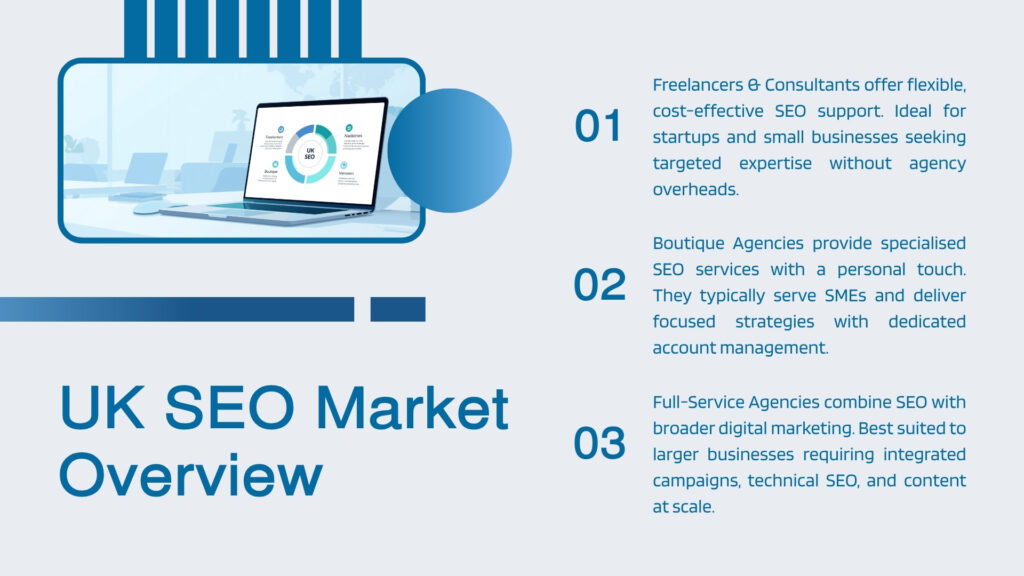
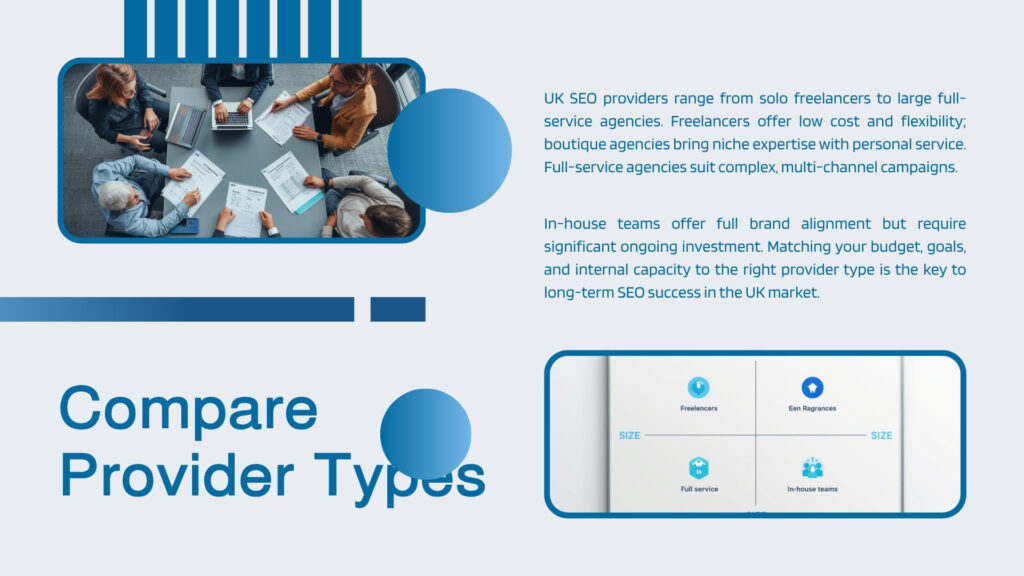
Broadly, UK SEO providers tend to fall into a few overlapping categories:
Freelancers and micro‑consultancies Often built around one senior practitioner, sometimes with a small supporting cast. Typically work with a limited number of clients at any given time and may specialise in technical audits, content strategy, or local SEO.
Boutique and specialist SEO agencies Small to mid‑sized teams that concentrate on SEO and closely related disciplines like content marketing, digital PR, and CRO. Often organise around a handful of verticals (for instance, ecommerce, SaaS, or professional services) or recurring challenges such as migrations and international expansion.
Full‑service and integrated digital agencies Larger, more layered organisations that offer SEO alongside PPC, paid social, creative, development, and sometimes offline channels. Typically engaged by brands that want one lead agency to orchestrate multiple channels under a single strategy.
In‑house teams and hybrid approaches Many mid‑market and enterprise companies hire internal SEO and digital specialists but still bring in agencies for audits, strategy, and large projects.
Different types of firms dominate different slices of the market. A freelancer with a strong word‑of‑mouth reputation might never appear on national leaderboards but still be the “best” choice for a micro‑business. A full‑service agency with dozens of staff could be ideal for a national retailer yet overkill for a local services firm. Recognising these nuances makes “best seo firms uk” a more useful search, not a confusing one.
Where rankings and directories fit into your research
UK‑wide rankings, curated lists, and review‑driven directories can play a valuable role at the start of your search:
They surface agencies that have already met certain thresholds, such as minimum review counts, numbers of completed projects, or verified clients.
They often display data such as average ratings, review volumes, years active, minimum project sizes, and percentages of focus on SEO versus other services.
Editorial round‑ups highlight agencies with particular strengths robust technical teams, standout campaigns, or sector‑specific expertise.
However, no list or directory knows your business as well as you do. A firm that looks impressive on paper may be a poor fit if, for example, they tend to work with large, multi‑market brands while you run a single‑site operation, or if their minimum monthly retainer is far beyond your budget. The sections that follow will show you how to treat rankings and directories as a source of names and data, not as a definitive answer.
Types of SEO firms in the UK (and which suits you)
Seeing “best seo firms uk” in a search result is one thing; deciding which type of firm should actually be on your shortlist is another. Each category of provider has its own strengths, weaknesses, and trade‑offs.
Freelancers and micro‑consultancies
Freelancers and micro‑consultancies can be an excellent fit when:
Your budget is relatively limited, but you still want a senior‑level practitioner involved.
You have at least some internal capacity perhaps a marketer or developer who can handle implementation once given a clear plan.
You want a direct relationship with the person doing the work rather than an account team that changes over time.
These providers rarely dominate national “best agency” lists because those lists tend to emphasise larger firms with more reviews and bigger marketing footprints. Yet for a single‑location clinic, a small online retailer, or a niche B2B service, the “best” choice might well be a sharp consultant who understands your space and can work alongside you in a flexible way.
Boutique and specialist SEO agencies
Boutique agencies sit between solo practitioners and large integrated groups. They typically:
Employ a small, multi‑disciplinary team covering technical SEO, content, digital PR, analytics, and strategy.
Build deep experience in specific verticals for example, B2B lead generation, D2C brands, or professional services.
Take on enough clients to maintain variety and resilience, but not so many that individual accounts become nameless line items.
For many SMEs and mid‑market organisations, a specialist boutique ends up being the “best” option: big enough to execute properly, focused enough to stay close to your business, and experienced enough to spot patterns quickly.
Full‑service and integrated digital agencies
Full‑service agencies tend to make sense when:
You want SEO to sit inside a wider, co‑ordinated strategy that includes PPC, paid social, email, and creative.
You prefer dealing with one lead partner, even if they bring in external specialists, rather than managing multiple suppliers yourself.
Your budgets and ambitions justify the overhead of a larger agency structure.
These agencies often appear in “top digital agency” awards and also crop up in “best seo firms uk” articles when search is one of their core strengths. Retainers and project sizes are usually higher, reflecting their overheads and the breadth of services they bundle alongside SEO.
Which type is likely best for your business
Deciding which type of firm is “best” for you means weighing up several factors:
Scale and ambition A micro business taking its first serious steps into SEO may not need, or be able to fully utilise, a 50‑person integrated agency. A fast‑growing national brand might quickly outstrip the capacity of a solo consultant working around other commitments.
Complexity of your SEO situation If your main challenge is solid technical foundations and improved local visibility, a small specialist might be ideal. If you are dealing with complex migrations, multiple language versions, or intertwined offline and online channels, you may need deeper, broader expertise.
Internal resources If you already have marketers, content people, and developers in‑house, you may benefit more from strategic direction than from heavy external implementation. If your internal team is small and stretched, an agency that can provide end‑to‑end execution may ultimately deliver better value.
Table: Types of SEO firms in the UK
Firm type
Typical size
Best for
Pros
Cons
Freelancer / micro‑consultancy
1–2 people
Very small budgets, early‑stage businesses
Direct access to senior expertise, flexible
Limited capacity, reliance on one or two individuals
Boutique SEO agency
5–30 people
SMEs and mid‑market brands
Specialist focus, good balance of scale and service
May not cover every channel in‑house
Full‑service digital agency
30+ people
Larger brands, multi‑channel campaigns
Integrated approach across channels, more resources
More layers, potentially higher minimum budgets
In‑house / hybrid team
Varies
Companies with ongoing, complex SEO needs
Deep business knowledge, long‑term continuity
Requires recruitment, management, and ongoing investment
How to shortlist the best SEO firms for your business
Shortlisting is where “best seo firms uk” turns into a practical task list. Instead of passively absorbing rankings, you actively build a long list, then narrow it down using your own criteria and evidence. A simple, repeatable process makes this manageable.
Step 1 – Use rankings and directories as a starting pool
Start by putting together a long list of candidates using:
Updated UK SEO agency rankings and editorial “top agency” articles for the current year.
Independent directories where agencies have verified profiles, client reviews, and basic budget information.
Recommendations from peers, networking groups, or industry events, especially where those recommendations include specifics about results and working relationships.
As you scan these sources, pay attention to agencies that:
Appear in more than one independent ranking or editorial list.
Have a solid spread of reviews across several years, not just a burst of feedback in a single month.
Describe clients and case studies that look similar in scale and complexity to your own organisation.
Step 2 – Apply clear criteria to filter your list
Once you have a long list, begin removing agencies that are clearly not suitable by applying a basic filter:
Budget alignment Note typical minimum project sizes or retainers where they are visible. If your working assumption is around £3,000 a month, a firm positioning itself with minimums at £15,000 is probably not the right starting point and vice versa.
Sector and model experience Give preference to agencies that have worked with your type of business B2B services, ecommerce, local multi‑site, or SaaS so you are not paying them to learn the basics of your model from scratch.
Engagement style Decide whether you are looking for a longer‑term partnership, a defined project, or a mix. Some firms primarily work on long‑term retainers; others specialise in audits and shorter engagements.
Practicalities of collaboration Consider whether you need regular in‑person sessions or whether fully remote work is acceptable. Also think about time zones if any part of the team is outside the UK.
Applying this filter should leave you with a list that feels realistic: firms you could imagine partnering with in practice, not just in theory.
Step 3 – Check evidence: reviews, case studies, and awards
With a tighter list, shift the focus from “who looks interesting” to “who can demonstrate they deliver”. Concentrate on:
Reviews Look at both the star rating and the substance of reviews. Do clients mention specific improvements more qualified leads, better conversion, stronger revenue over a decent period of time? Check whether reviews cover different types of work (strategy, implementation, ongoing support), not only one‑off audits.
Case studies Prioritise case studies that follow a clear “before, during, after” structure, giving a sense of starting point, actions taken, and results. Be cautious of case studies that include only flattering quotes but no detail about what changed or why.
Awards and external recognition Awards for campaign effectiveness, search marketing, or digital excellence can be useful signals when you are choosing between similar agencies. Inclusion in respected “best seo firms uk” style articles or sector‑specific lists can support your view, especially when combined with other evidence.
Firms that combine solid reviews, convincing case studies, and some external recognition give you more to go on than those relying purely on their own claims.
Step 4 – Narrow down to a manageable shortlist
The final step is to compress your candidates into a shortlist of three to five agencies you will speak with in detail. When choosing that shortlist, aim for a spread such as:
One or two boutique agencies with clear experience in your sector or business model.
A firm that brings a more integrated, multi‑channel perspective if you anticipate running several channels.
Agencies whose communication style and tone based on their website and early emails feel like a good cultural fit for your team.
A small, carefully chosen shortlist makes it much easier to compare proposals meaningfully and reduces the risk of getting stuck at the decision stage.
How to compare proposals from UK SEO firms
Once proposals begin arriving from your shortlisted agencies, the challenge shifts from “who should we talk to?” to “who has set out the best plan for achieving our goals?”. Because each agency structures their proposals differently, you need a consistent way to compare them.
What a good UK SEO proposal should include
When reviewing proposals from agencies that might appear in “best seo firms uk” searches, look for:
A clear reflection of your goals and constraints The proposal should show that the agency has understood your current situation, performance, and business priorities rather than simply restating your brief.
A logical, phased strategy There should be a clear outline of phases such as discovery, auditing, prioritised recommendations, implementation, and ongoing optimisation, with a realistic sense of timescales.
A concrete breakdown of activities Expect to see specific references to technical SEO, on‑page optimisation, content, authority building (such as digital PR or link acquisition), and measurement.
A measurement and reporting plan Strong proposals explain how progress will be tracked and reported, and how SEO metrics will be linked to commercial outcomes.
Transparent scope and pricing It should be obvious what is included in the retainer or project fee, what is explicitly excluded, and how additional work would be quoted.
If any of these elements are missing, ask for clarification before you try to compare that proposal directly with others.
Comparing scope, pricing, and deliverables
To make comparisons more objective:
Build a simple internal scoring grid List criteria such as “understanding of our business”, “strategic approach”, “depth of activity”, “transparency”, “evidence of past results”, and “cost”, then give each a weight.
Score each proposal against the same grid This levels the playing field when one proposal is highly designed and another is plain, helping you focus on substance.
Look for alignment between scope and price If a proposal is significantly cheaper than the others, check carefully whether key activities have been removed or heavily reduced.
Consider the balance between strategy and delivery Some firms lean heavily into strategy and rely on your team for execution; others include more implementation in their fee. Choose the mix that fits your resources.
This framework helps you move beyond gut feel and ensures the “best” proposal is the one that aligns with your context and goals, not simply the one with the most impressive design.
Assessing culture fit and communication style
Finally, look at how each agency interacts with you during the proposal stage:
Responsiveness Do they answer questions promptly and thoughtfully, or do you find yourself chasing for basic information?
Clarity Are explanations pitched at a level your stakeholders can understand, or are they hiding behind jargon?
Integrity and flexibility Are they willing to say “no” when something is unrealistic, and are they open to reasonable adjustments to the scope?
Since SEO engagements often last many months, the way an agency communicates before you sign is usually a good indicator of how they will behave afterwards.
Typical costs, retainers, and contracts with top UK SEO firms
SEO is almost always a mid‑ to long‑term effort. Most firms that realistically belong in a “best seo firms uk” conversation work on retainers or structured projects over several months rather than one‑off quick fixes. Understanding typical cost and contract patterns in the UK will help you recognise fair offers and spot those that are out of step with the market.
Common budget bands and what they usually include
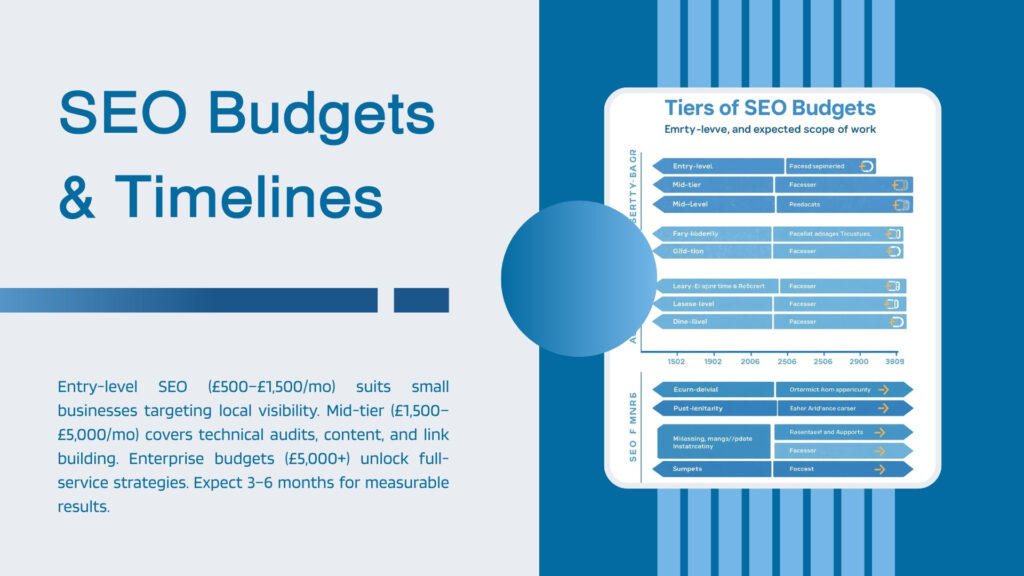
While there is no single rate card for the whole UK, it is useful to think in terms of broad monthly budget bands:
Monthly budget band
Typical client profile
Example scope
Typical firm type
Under ~£2,000
Very small businesses, early‑stage ventures
Limited scope: light consulting or focused tasks
Freelancer / micro‑consultancy
£2,000–£5,000
SMEs, local or regional brands
Core SEO retainer: technical, content, reporting
Boutique SEO agency
£5,000–£10,000
Growth‑focused mid‑market brands
Broader strategy and execution, multi‑site support
Specialist or larger agencies
£10,000+
Enterprise / complex multi‑market operations
Comprehensive programmes, multi‑channel alignment
Larger or specialist agencies
These ranges are indicative, not prescriptive. For example, a mid‑market business might start near the lower end of the £5,000–£10,000 band for a single market, then invest more as additional markets, product lines, or channels come into scope.
Typical contract lengths and review points
Most serious UK SEO engagements follow a phased contract pattern:
Initial commitment Commonly 3–6 months to allow for thorough auditing, foundational fixes, and early optimisation.
Ongoing relationship Frequently structured in 6–12 month cycles, with agreed review points where strategy and scope can be adjusted.
Notice and exit Notice periods are often between one and three months, giving both sides time to plan handovers and transitions.
Be cautious about signing very long, inflexible contracts at the outset, particularly if there is no defined point at which you can step back and formally review performance and fit.
How to align your budget with realistic outcomes
To align money and expectations:
Translate your goals into something measurable For example, “increase qualified enquiries from organic search by 30%” or “grow online revenue from SEO by a certain amount over 12 months”.
Ask agencies what is realistic at your budget level A good firm will talk about trade‑offs what they would prioritise, what is likely achievable in phase one, and what might need to wait for later phases.
Treat budget conversations as part of your due diligence Agencies that promise very large gains for very small budgets without explaining how are waving a red flag. Those that explain constraints calmly are usually more trustworthy.
When budget, scope, and outcomes are all discussed honestly, both sides have a better chance of making the relationship work.
Red flags and mistakes to avoid when choosing an SEO firm
Even within the pool of agencies that show up under “best seo firms uk”, standards, methods, and ethics can vary. Recognising common red flags and pitfalls helps you avoid costly mistakes.
Promises and guarantees that should worry you
Some pitches should immediately prompt caution:
Guaranteed top‑three or number‑one rankings for specific keywords within very short timeframes.
Refusal to explain, even at a high level, the kinds of tactics the agency intends to use.
Heavy emphasis on vanity metrics such as impression counts or non‑commercial keywords without linking them to leads or revenue.
Reputable agencies talk in terms of probability, scenarios, and risk management. They understand that search performance depends on many factors beyond their direct control.
Process and reporting red flags
Keep an eye out for warning signs in how an agency proposes to work day‑to‑day:
Generic, heavily templated proposals If the document could be sent to almost any company with a couple of name changes, it suggests the agency has not really engaged with your specific situation.
Opaque or unhelpful reporting Monthly reports that are little more than long lists of metrics, with no explanation of what is going well or needs attention, make it hard to steer the strategy.
Limited collaboration Agencies that appear reluctant to involve your team in planning, share access to key tools, or co‑ordinate with your other partners can be difficult to manage long‑term.
You should expect clarity on what is being done, why it matters, and what is planned next, even if you are not an SEO specialist yourself.
Commercial traps and misalignments
Commercial issues can undermine even technically competent work:
Contracts that heavily favour one side Extremely long commitments with no interim review points, or punitive exit clauses, are warning signs, especially for a first engagement.
Offers that look too good to be true Pricing that is dramatically below typical market bands for the same scope often means corners will be cut or the scope is much thinner than it appears.
Confusion over asset ownership If it is not clear who will own content, landing pages, or analytics configurations at the end of a contract, you risk being locked in or losing key assets when you leave.
Reading proposals and contracts carefully and asking direct questions where something is unclear can save you from painful surprises later.
Where SEOSERVICES1 fits in the UK SEO landscape
SEOSERVICES1 positions itself as a thoughtful, evidence‑led partner for UK organisations that want SEO to play a serious role in their marketing mix. The aim is not to claim to be the single “number one” among all “best seo firms uk”, but to be a strong, sensible option for businesses whose needs, budgets, and expectations align with how we operate.
How SEOSERVICES1 aligns with top‑firm criteria
Against the criteria outlined earlier, SEOSERVICES1 focuses on:
Strategy grounded in data and context Spending time to understand your goals, customer journeys, and existing performance, and using that to shape a tailored plan.
A clear, documented process Outlining stages such as discovery, auditing, prioritisation, implementation, and ongoing optimisation so you know what is happening and why.
Honest budget and scope conversations Discussing what is realistic at different investment levels, what can be phased, and where expectations may need adjusting.
Reporting that connects activity to business outcomes Presenting results in terms your leadership team recognises, such as leads, revenue, or pipeline, alongside the SEO metrics that sit underneath.
Those are the hallmarks of agencies that deserve to be in a “best seo firms uk” conversation. For some buyers, SEOSERVICES1 will therefore be a natural shortlist candidate.
When SEOSERVICES1 is (and is not) the right choice
SEOSERVICES1 is likely to be a good fit if you:
Run an SME or mid‑market organisation and want to treat SEO as a strategic, ongoing channel rather than a short‑term experiment.
Value clear reasoning, structured planning, and an ability to explain recommendations in plain language to non‑specialist stakeholders.
Are prepared to share information and collaborate, so the strategy can adapt as results and markets evolve.
SEOSERVICES1 may not be the best fit if:
Your current budget is closer to the lowest band described earlier and you mainly need occasional advice rather than an ongoing programme.
You require a hyper‑focused sector specialist in an extremely narrow niche where another firm has already shown deep experience.
If, after working through this guide, you feel SEOSERVICES1 might be worth including in your shortlist, you can review the homepage at https://seoservices1.com/ and see whether our approach and services align with what you are looking for.
FAQs about choosing the best SEO firms UK
Cost and contract questions
How much does a top UK SEO firm typically cost per month? For most SMEs and mid‑market organisations, serious engagements with top UK SEO firms typically start at a few thousand pounds per month and increase from there depending on scope, markets, and complexity. Enterprise‑level programmes or multi‑country campaigns can sit significantly higher. What matters is that the price, the work proposed, and your goals all line up cheap, underscoped work can be more expensive in the long run if it fails to deliver.
Do I need to sign a long‑term contract with a UK SEO firm? You will almost always be asked to commit to an initial period often three to six months because SEO needs time for foundational changes to show effect. After that, many firms prefer rolling contracts with agreed notice periods and regular review milestones, so both sides can assess whether the partnership is working. Be cautious about signing very long, inflexible contracts before you have seen how the agency performs for you in practice.
How can I budget for SEO if I am not sure what I need yet? Start by defining, in business terms, what you want SEO to achieve: more qualified enquiries, better ecommerce revenue, support for a rebrand, or expansion into new markets. Share these aims with potential agencies and ask them to outline phased options such as an initial diagnostic and foundational phase followed by a broader programme if the early work goes well. This lets you test the partnership and scale investment based on evidence rather than committing everything up front.
Timelines and results questions
How long before I see results from a top UK SEO firm? If your site has obvious technical or content issues, you may see improvements in crawl health, indexation, or rankings for certain terms within the first few months. More substantial, reliable gains in organic traffic, lead volume, or revenue tend to build over a 6–12 month horizon and continue beyond that with sustained effort. The starting point and competitiveness of your market make a big difference, which is why reputable agencies talk about ranges and scenarios rather than fixed numbers.
What kind of results should I realistically expect in the first 6–12 months? Realistic expectations might include improved visibility for a wider set of relevant terms, stronger performance from key landing pages, and clearer attribution of leads or sales to organic search. You should be able to see, in your analytics and reports, how specific pieces of work such as technical fixes, new content, or authority‑building efforts contribute to these improvements, even if not every target is fully met in that timeframe.
In‑house vs agency questions
Should I hire an in‑house SEO or work with an agency? If you have ongoing, varied SEO needs and enough work to justify one or more full‑time roles, hiring in‑house can give you deep knowledge of your brand, products, and internal systems. Agencies, meanwhile, bring broader experience, exposure to many different industries, and the ability to provide a wider mix of skills from technical SEO and analytics to content and digital PR. Many UK organisations end up using both, with in‑house staff owning direction and agencies providing specialist or scalable support.
Can I combine a small in‑house team with a UK SEO firm? Yes, and it is often a powerful model. An in‑house marketer or digital lead might own overall strategy, stakeholder management, and internal priorities, while the agency brings specialist expertise, additional capacity, and structured processes. Clarity on who is responsible for what audits, implementation, content, PR, reporting plus regular joint planning sessions, helps ensure both sides work in lockstep rather than duplicating effort.
Comparing and switching SEO firms
What should I look for in an SEO proposal from a UK firm? You should look for a proposal that reflects your situation accurately, sets out a coherent plan, and explains how success will be measured. It should clarify what will happen in the first 90 days, which activities will come later, and how the agency will communicate progress. If you finish reading and still cannot describe in simple terms what they would actually do and why, you probably need more detail before you can make a fair decision.
How do I compare proposals that are structured very differently? Create a simple comparison table for yourself listing criteria such as understanding of your business, strength of strategy, depth of activity, evidence of past results, communication plan, and cost. Score each proposal against those criteria, using the same scale. This helps you see beyond flashy design or dense technical language and focus on which plan best aligns with your needs and constraints.
When is it time to switch SEO firms? It may be time to consider switching if, after a fair period and clear communication, you still do not understand what work is being done, reports feel disconnected from your goals, or there has been little or no progress on agreed priorities. Before you move, raise those concerns explicitly and give your current agency a chance to respond and adjust. If things still do not improve, looking for a new partner armed with the criteria and processes in this guide can be the right next step.