Across Australia, more of your customers discover you through search than ever before, but ranking well now depends heavily on the quality and volume of your content not just technical SEO tweaks. At the same time, building a full in‑house content team is expensive, risky, and slow, especially for agencies and growing businesses. Outsource SEO content creation services offer a middle path: you retain strategic control, while a specialist team plans, writes, and optimises the content that keeps your pipeline moving.
This guide is for Australian digital agencies, SMEs, eCommerce brands, service businesses, and startups who want their content to work harder without turning into a recruitment agency. It explains what outsourced SEO content creation means in the Australian context, what services and deliverables you should expect, how outsourcing compares with in‑house teams and freelancers, and how to manage quality, risk, and results when you bring in a partner like SEOSERVICES1.
Quick Answers About Outsourcing SEO Content in Australia
If you need to explain the idea of outsourced SEO content to a director, founder, or client in under two minutes, this section gives you ready‑made talking points.
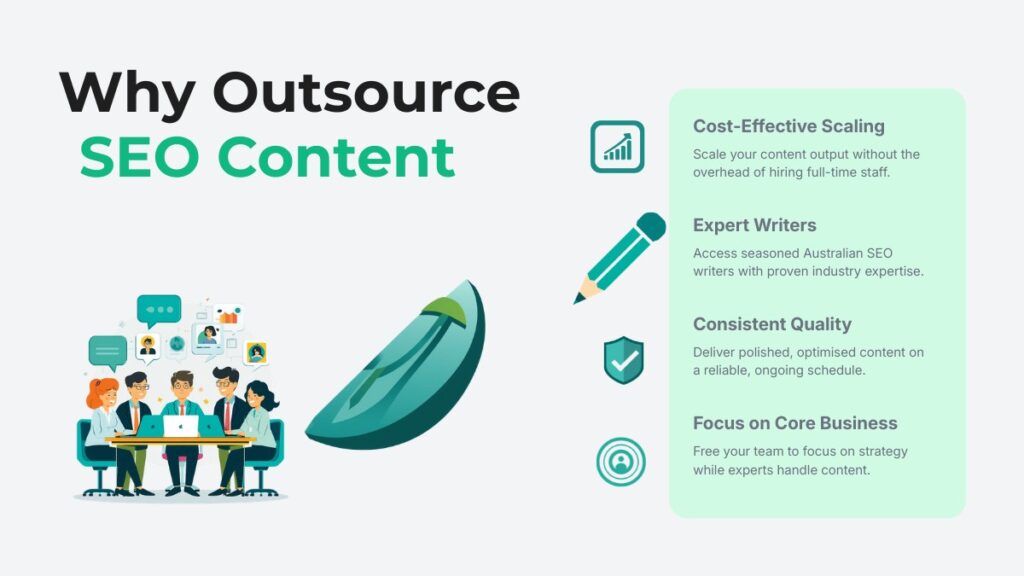
- What is outsourced SEO content creation? It is the arrangement where an external team handles the research, planning, writing, editing, and SEO optimisation for your content blog posts, landing pages, product descriptions, location pages while you stay in charge of priorities and approvals. In Australia, this often means working with a provider familiar with local search patterns, competition, and Australian English.
- Who is it best suited for? Australian agencies that need extra hands without adding full‑time salaries, SMEs and service businesses that cannot justify a dedicated content team, and eCommerce brands with more URLs than their in‑house marketers can reasonably optimise.
- What is normally included? At a minimum: topic and keyword research, content briefs, SEO‑friendly copy, meta titles and descriptions, basic internal link suggestions, editing, and a defined revision process. Better providers also help with content calendars and performance review.
- How does pricing usually work? Most Australian‑focused providers use a blend of per‑piece or project pricing for finite tasks (e.g., 10 suburb pages) and monthly retainers for ongoing content programs. The real driver of cost is complexity and depth, not just word count.
- How does SEOSERVICES1 handle Australian clients? We work in Australian time zones, write in Australian English, and adapt to your workflows. Agencies can plug us in as a white‑label execution team; brands can rely on us as a long‑term extension of their marketing or SEO function, with clear reporting and feedback loops.
What Outsourced SEO Content Creation Means for Australian Businesses
Outsourcing SEO content rarely means “just sending topics to a writer.” In a mature market like Australia where many SEO agencies already highlight content as a core strength outsourcing usually involves a strategic partnership. You bring knowledge of your brand, product, and customers; your partner brings a repeatable process for turning that knowledge into search‑ready content at scale.
How Outsourced SEO Content Differs from Generic Copywriting
Generic copywriting often produces content that reads well but is invisible in search. Outsourced SEO content aims to be both findable and persuasive. The differences show up in several areas:
- Starting point: Instead of “what do we want to say?”, the starting question is “what are our ideal Australian customers already searching for, and what do they need to know to move forward?”.
- Structure: Content is built around headings, sub‑topics, and questions that mirror how people search and how search engines parse information.
- Optimisation: On‑page factors like title tags, meta descriptions, internal linking, and readability are considered from the beginning, not bolted on at the end.
- Role in the funnel: Each piece is mapped to a funnel stage top‑of‑funnel education, mid‑funnel evaluation, or bottom‑funnel conversion rather than being created in isolation.
In practice, that might mean designing an article around “how to choose a family lawyer in Melbourne” with clear sections covering fees, accreditation, and next steps, instead of a generic “We are experienced lawyers” page that never addresses what the searcher actually wanted.
What White-Label SEO Content Means for Agencies
For Australian agencies, white‑label SEO content is often the quiet engine behind growth. You sell an SEO or digital package that includes content; a specialist partner delivers that content to your standards and under your brand. Clients see a single team; behind the scenes, you have turned fixed headcount into variable capacity.
Consider a Canberra‑based SEO agency managing campaigns for 20 clients across professional services and trades. Their strategists are strong, but they only have one in‑house writer. Without a partner, they either:
- limit how many content‑heavy retainers they can take on, or
- burn out their writer and risk quality drops.
By bringing in SEOSERVICES1 as a white‑label content team, they can keep strategy in‑house and send us structured briefs or high‑level goals for each client. We then handle research, drafting, and optimisation, and deliver content inside their systems. From the client’s perspective, the agency simply “got faster and more consistent.”
Who Our Outsourced SEO Content Services Are For
Different types of Australian organisations outsource content for different reasons. The common thread is that they want better, more consistent SEO content than they can produce on their own without ballooning fixed costs.
Australian Digital Agencies and SEO Shops
Agencies typically sit in one of two situations: they either have strong SEO strategists who need more execution capacity, or they have excellent account managers who need a structured content arm behind them. Outsourced SEO content can support both.
With SEOSERVICES1 as a partner, an agency can:
- add SEO content to existing retainers without reworking their entire staffing model;
- test new verticals say, moving from local trades into healthcare by tapping writers with relevant experience instead of recruiting from scratch;
- smooth out peaks and troughs in demand by scaling retainer volume up and down, rather than hiring and downsizing.
This is particularly useful in Australia, where many agencies juggle seasonal work (retail cycles, financial year campaigns) and need to ramp content quickly.
Australian SMEs and Local Service Businesses
For SMEs and local service providers, the main constraint is usually time, not awareness. A business owner in Newcastle or Hobart might know they “should be blogging” and “need suburb pages,” but every week is consumed by operations and customer work.
Outsourcing SEO content allows these businesses to:
- turn recurring phone questions (“How much does X cost in Victoria?”, “Do you service Y suburb?”) into evergreen content that brings in leads;
- build a consistent library of posts and FAQs without needing to become SEO or copywriting experts themselves;
- gradually create a content moat against competitors who only have basic brochure sites.
A typical pattern: a local business starts with a project to rebuild core service and location pages, then moves to a small monthly content retainer as they see results.
Australian eCommerce and Online Retailers
In eCommerce, organic search performance is directly tied to how well your category and product pages are written and structured. Australian shoppers compare multiple stores before buying; lightweight or duplicated product descriptions make that hard.
An outsourced SEO content team can help by:
- identifying product lines where better descriptions would have the biggest impact on margin or conversion;
- rewriting those descriptions to clearly explain benefits, usage, and fit, not just specs;
- building category pages and buying guides that capture high‑intent queries, like “best hiking jackets for winter in Sydney” or “how to choose the right mattress size in Australia.”
Often, one internal eCommerce or marketing manager sets priorities, while outsourced writers handle the production at scale.
Multi-Location and Franchise Brands in Australia
Multi‑location brands and franchises have a special challenge: searchers want reassurance that you really operate in their suburb or city, not just in generic terms. That usually means dozens or hundreds of local pages.
With an outsourced SEO content partner, these brands can:
- create templates for location pages that respect brand guidelines while flexing for local details;
- roll out batches of those pages, starting with highest‑priority states or regions;
- update the network’s content as services, hours, or regulatory details change state by state.
In practice, this turns a “someday project” into a defined rollout that might take a quarter or two instead of dragging on for years.
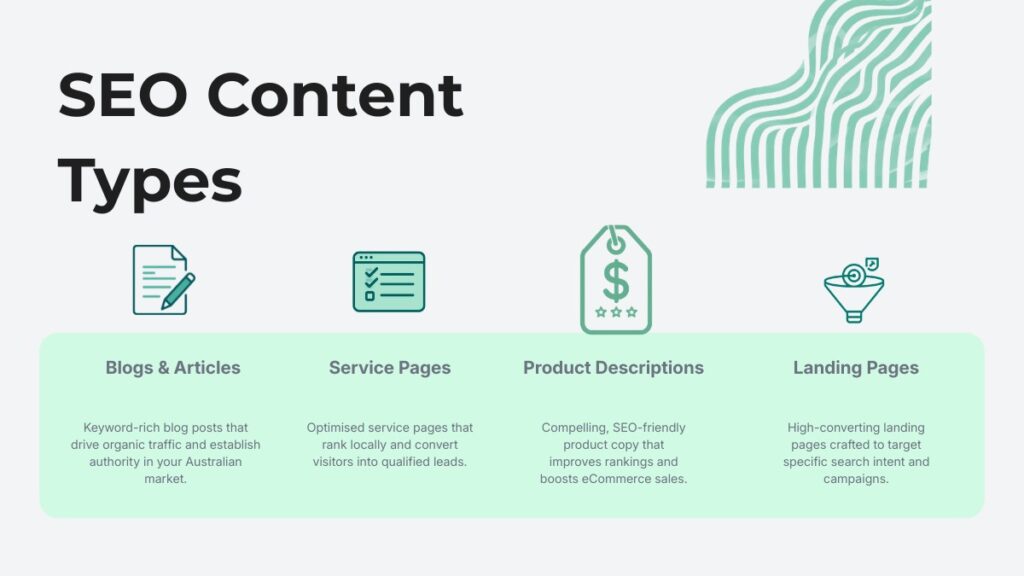
Types of SEO Content We Create for Australian Clients
Outsourced SEO content is at its most effective when it covers the full journey: from early research to post‑purchase questions. SEOSERVICES1 focuses on the formats Australians most often encounter when they search.
Blog Posts and Articles
Blogs and articles help you show up when people are still exploring their options or trying to understand a problem. They also provide internal linking opportunities to your higher‑intent pages.
- A regional accounting firm might publish articles about “common GST mistakes for small businesses in Australia” or “how to prepare for EOFY.”
- A SaaS provider might publish “checklists” and “frameworks” that match specific search terms used by Australian teams.
- A landscaping business in Melbourne might answer seasonal questions like “When is the best time to plant X in Victoria?”
We design these posts not just to get clicks, but to naturally lead readers toward your services or key offers.
Service and Location Pages
For service businesses, these pages are often the highest‑value assets on the site. A well‑structured page for “emergency dentist Parramatta” or “NDIS plan management in Perth” can generate enquiries daily for years.
Our service and location pages typically include:
- a concise introduction that confirms the reader is in the right place;
- details on services in plain language (no jargon where it isn’t needed);
- local references or considerations where relevant (e.g., state regulations, travel fees, service areas);
- clear calls‑to‑action and FAQs based on real enquiries.
Product and Category Descriptions for eCommerce
Search engines and customers read product pages differently, but both respond well to clarity and relevance. Thin or generic descriptions tend to underperform on both fronts.
We help eCommerce teams by:
- designing product description templates that cover key decision points (use, fit, materials, warranties) in a consistent way;
- integrating relevant keyword phrases naturally, including AU‑specific modifiers when appropriate (sizes, standards, shipping context);
- writing category introductions that orient shoppers and make it easier for Google to understand what the page is about.
SEO-Optimised Website Copy and Landing Pages
Your homepage, “about” page, and core product/service pages are often the first thing a prospective client or customer sees after clicking from search. They need to satisfy both curiosity and search intent.
SEOSERVICES1 creates or rewrites these pages so that:
- headlines and sub‑headings align with what Australian searchers actually type, where it makes sense;
- copy is skimmable for busy users but still includes the details required to make a decision;
- internal links gently guide readers toward deeper content or conversion points.
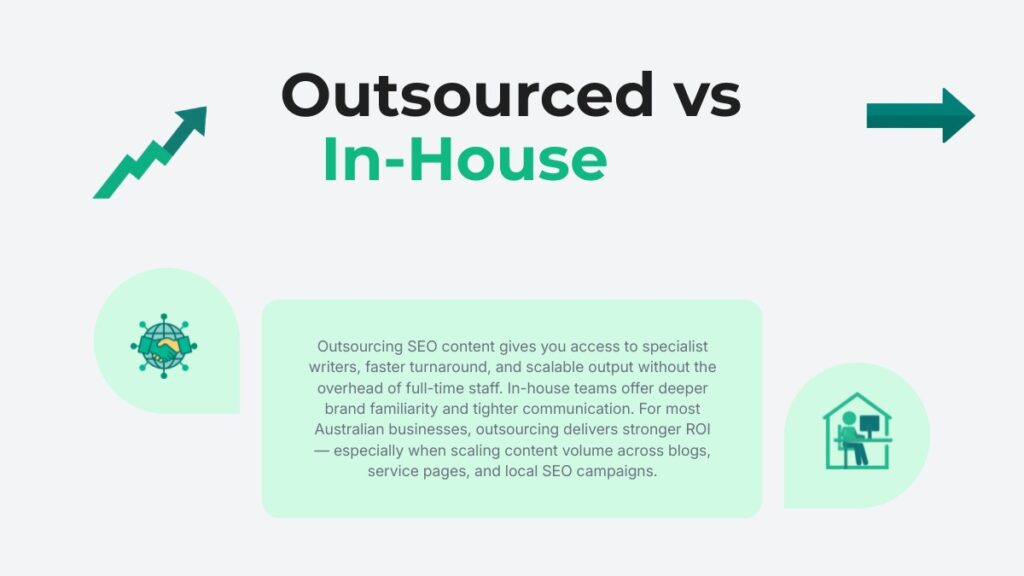
Image Description: Infographic-style diagram showing blogs, service pages, product descriptions, and landing pages connected to a central SEO strategy hub, representing outsourced SEO content types.
Our Outsourced SEO Content Process (Step by Step)
A solid process is what separates “we know a writer” from “we have a reliable content program.” Our workflow is built around clarity, ownership, and continuous improvement.
Onboarding and Content Briefing
Every engagement starts by aligning on where you are and where you need to go. In practice, that means:
- reviewing your current site, analytics, and any prior SEO work;
- asking how leads currently find you (word of mouth, ads, search, directories) to understand the role content should play;
- capturing your brand voice through real examples and a short workshop, not just a one‑pager of adjectives.
For agencies, we also review client‑specific processes approval cycles, brand rules, and report formats so we slot in without adding friction.
Keyword and Topic Research for Australian Search
Once we understand your goals and audience, we map that to how people search in Australia.
- We analyse search queries by city, state, and nationally, so content for “Sydney SEO services” doesn’t look like “regional NSW SEO services.”
- We group related keywords into themes so you aren’t writing ten near‑duplicate pieces on the same idea.
- We align topics with commercial value for instance, prioritising keywords tied to core services and high‑margin products.
The result is a prioritised content roadmap, usually broken into realistic monthly or quarterly phases, so you can see what will be delivered and when.
Drafting, Editing and SEO Optimisation
With briefs approved, our writing and editing team gets to work. We treat each content item as part of a system, not an isolated task.
- Writers follow the brief and style guide to produce drafts that answer the target search intent in depth but remain approachable.
- Editors review drafts for tone, flow, and clarity, and confirm that key SEO elements are present and used naturally.
- We make note of any recurring questions or gaps that emerge from writing (for example, missing explanations on your site), and flag them as future content opportunities.
This is also the stage where we ensure internal linking suggestions are practical, not theoretical pointing to real pages that exist and will support your overall SEO strategy.
Quality Assurance, AI and Plagiarism Checks
Before content is handed over, it goes through a final quality and risk check.
- We scan for potential duplication, especially on product and service pages where similar offerings can lead to unintentional overlap.
- We verify that any factual details (like regulations, processes, or industry terms) are correct for Australia, not copied from US‑centric resources.
- We apply our internal guidelines for AI usage, ensuring that any AI‑assisted elements have been properly human‑edited and aligned to your brand.
For agencies, this QA layer reduces the time your strategists need to spend “fixing” content before it goes to clients.
Delivery, Feedback and Revisions
Delivery is not the end of the process; it is where the partnership matures.
- Content is delivered with clear labels (topic, target keyword, funnel stage, priority) so you can see how each piece fits into the big picture.
- We invite focused feedback on voice, depth, and structure things that meaningfully affect future work rather than endless micro‑edits.
- We update your style guide and work patterns based on that feedback, which gradually reduces how much you need to review to feel confident.
Over a few cycles, this feedback loop turns your outsourced content program into something that feels close to an internal team just without the HR overhead.
Outsourcing vs In-House SEO Content in Australia
Every Australian business eventually asks, “Should we just hire someone?” The right answer depends on scale, complexity, and how quickly you need to see progress.
| Factor | Outsourced with SEOSERVICES1 | In‑House Hire |
|---|---|---|
| Up‑front cost | No recruitment or onboarding fees with recruitment agencies; you start with a scoped engagement. | Advertising, interview time, onboarding, and often external recruiter fees. |
| Monthly cost profile | Variable based on the package or retainer; can be increased or decreased over time. | Fixed salary plus super, leave, and overhead, regardless of fluctuations in workload. |
| Time to ramp | Weeks from onboarding to first pieces going live. | Months to hire, embed in the business, and build a content system around the person. |
| Skill coverage | Access to multiple writers, editors, and SEOs with different strengths. | One person’s skill set; more hires needed to cover strategy, writing, and editing at depth. |
| Scalability | Retainer size can grow or shrink as your budget and goals change. | Scaling up means more hires; scaling down can be difficult and disruptive. |
| Management overhead | SEOSERVICES1 manages the content team and workflow; you focus on direction and approvals. | Requires ongoing performance management, training, and process design. |
Cost and Time Comparisons
For a typical Australian SME, the cost of a full‑time experienced SEO content specialist salary, super, tools can be significantly higher than a modest monthly content retainer. For agencies, the decision often comes down to whether they have enough stable, long‑term demand to justify employees versus flexible outsourced capacity that can scale up and down.
Scalability and Flexibility
Outsourcing is particularly attractive when your content needs are spiky. A retailer gearing up for major sale events, or an agency onboarding multiple clients in Q1, might need double or triple their usual content volume for a short period. An outsourced partner can absorb that spike more easily than a small in‑house team.
When to Start with Outsourcing vs When to Hire
A practical rule of thumb in Australia is:
- If you are just starting with SEO content: outsource to build your foundational assets and test what works.
- If content is consistently driving growth: consider a hybrid model where an in‑house strategist or content lead owns direction, and outsourced writers execute.
- If you have a large, complex product or service footprint: you may eventually want a core internal content team, but outsourced specialists can still fill gaps and handle large campaigns.
Quality, Brand Voice, and Confidentiality
No matter how strong the promises, most objections to outsourcing revolve around these three questions: “Will it sound like us?”, “Can we trust them with sensitive information?”, and “Will the quality be consistent over time?”. Addressing these is central to any long‑term partnership.
Brand Voice Frameworks and Style Guides
We treat brand voice like a set of practical rules rather than a vague aspiration. This often involves:
- collecting examples of content you love (from your site and others) and identifying what makes it “you”;
- defining how formal/informal you want to be, how you talk about customers (clients, patients, guests, etc.), and how you handle industry jargon;
- documenting these decisions in a short, usable guide that writers and editors can apply daily.
For agencies, we maintain separate voice profiles for individual clients, so each brand feels distinct even when our team is writing across multiple accounts.
NDAs, IP Ownership and Data Security
Australian businesses are rightly cautious about how their information is handled. To keep things simple and safe:
- we sign NDAs where needed, especially in agency and enterprise environments;
- we clarify that once content is approved and paid for, it is your intellectual property to use, modify, and repurpose;
- we use commonly accepted tools (like shared drives and collaboration platforms) with sensible access controls, not ad‑hoc file‑sharing setups.
These safeguards reduce friction with your legal and compliance teams and give you confidence in long‑term collaboration.
Avoiding Over-Reliance on Low-Quality AI Content
The reality is that AI writing tools are widely available in Australia, and many businesses experiment with them. The risk comes when AI is left unsupervised or used as a shortcut instead of a helper.
SEOSERVICES1’s stance is that AI can assist with speed but should never replace human judgment, especially for brands that care about reputation and long‑term SEO. That means:
- no “set and forget” AI content; writers remain accountable for the final words;
- clear editorial checks to remove generic or repetitive wording that AI tools tend to generate;
- ongoing review of how AI is used so we stay aligned with evolving search and content quality expectations.
Pricing Models for Outsourced SEO Content in Australia
Pricing is one of the first questions Australian decision‑makers ask, but numbers only make sense when you understand what is behind them. Here’s how to think about common models.
Per-Piece and Project-Based Pricing
Per‑piece and project pricing works well when you have a clearly defined body of work. For example:
- a set of 10 new suburb pages for a tradie business;
- a bundle of 30 product descriptions for a new eCommerce range;
- a sequence of four long‑form guides to support a specific campaign.
These engagements are often used as pilots: you can see how the provider works, how well they match your voice, and how smoothly the process runs before deciding whether to move into an ongoing retainer.
Retainer and Monthly Content Packages
Once you need ongoing SEO content monthly blog posts, regular landing page updates, rolling product copy improvements a retainer usually makes more sense. It allows:
- your provider to plan ahead and allocate the right specialists;
- you to build content momentum that aligns with how search performance compounds over time;
- smoother budgeting and internal approvals because the cost is predictable.
Agencies often build the cost of a content retainer into their SEO or digital marketing packages for clients, framing it as “always‑on” SEO content rather than ad‑hoc work.
How to Compare Quotes and Value
When you compare proposals from different Australian providers, ask each one the same questions so you are not comparing apples and oranges:
- “Who does the work junior writers, senior writers, editors, SEOs and how are they involved?”
- “What is included besides writing research, on‑page SEO, editing, revisions, reporting?”
- “How do you measure success and report back on what’s working?”
- “What happens if we need to adjust volume up or down mid‑engagement?”
Sometimes a higher‑priced provider delivers more strategic value and better outcomes; sometimes a lower price indicates missing steps that will fall back on your team to handle.
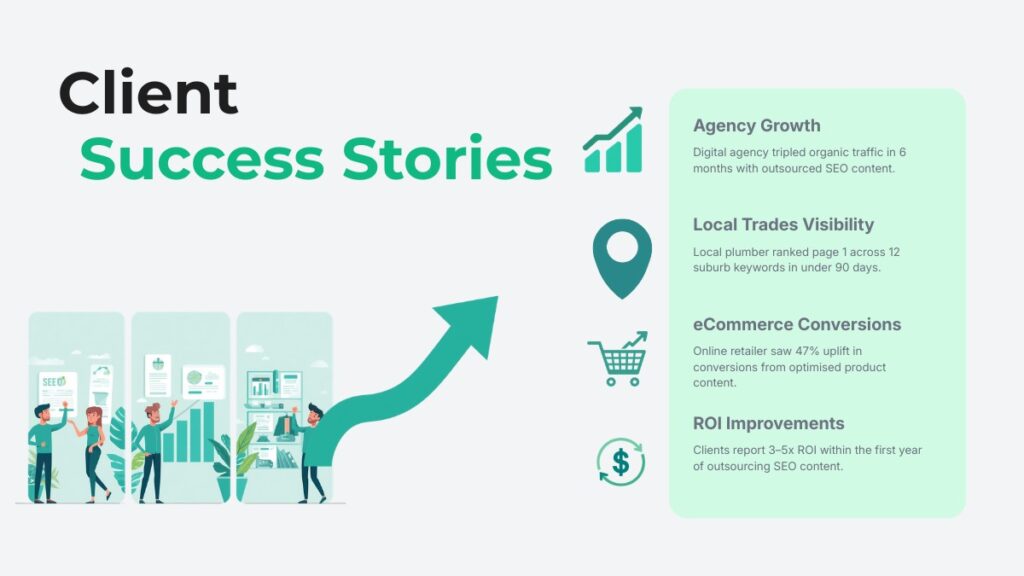
Real-World Examples of Outsourced SEO Content for Australian Businesses
To illustrate how outsourced SEO content plays out on the ground, here are three short scenarios reflecting common situations in the Australian market.
Agency White-Label SEO Content Example
A digital agency in Sydney specialises in SEO and paid search. They have strong strategists, but their sole writer is overwhelmed. Turnaround times stretch, and strategists are pulled into writing, which reduces billable strategy work.
The agency engages SEOSERVICES1 on a white‑label retainer. Over three months, we:
- take on production of blog posts, service pages, and occasional long‑form guides for six key clients;
- align on weekly check‑ins and shared dashboards showing topics, status, and delivery dates;
- gradually refine style guides for each client based on feedback.
Outcomes: the agency improves on‑time delivery rates, their strategists regain time for high‑value work, and they feel comfortable pitching SEO content more aggressively in sales conversations because they know they have reliable capacity.
SME Local SEO Content Example
A Brisbane‑based plumbing business wants to grow beyond one suburb but has a basic five‑page site. They have tried DIY blog posts, but nothing has been published in months.
Working with SEOSERVICES1, they:
- identify target suburbs and service combinations that matter most;
- commission a batch of location pages plus a series of blog posts around safety, maintenance, and common problems;
- set up simple tracking for calls and forms coming from organic search and specific pages.
Within a few months, they notice more calls from newly targeted suburbs and can see which pages contribute most, helping them decide where to invest next (for example, in additional content or local ads).
eCommerce SEO Content Example
An Australian online retailer selling home office furniture sees strong paid performance but modest organic revenue growth. Product descriptions are short, and category pages have almost no copy.
SEOSERVICES1 works with their marketing lead to:
- prioritise key categories like “ergonomic office chairs” and “standing desks” based on revenue and search data;
- rewrite category introductions and dozens of product descriptions with better detail and natural keyword integration;
- create educational content such as “how to set up an ergonomic home office in Australia” that links into those categories.
Over subsequent quarters, they track improved organic rankings for priority categories and longer time on page both useful signals for both SEO and conversion.
SEO and AI Search: Creating Content Built for Google and AI Answers
In Australia, as elsewhere, search results increasingly blend traditional web listings with AI‑generated summaries and rich snippets. To stay visible, your content needs to be structured for people and machines.
Structuring Content for Traditional Search and AI Results
We structure content with extractability in mind, which benefits both users and modern search experiences.
- Key definitions are written in one or two clean sentences and placed near the top of sections.
- Headings and sub‑headings map closely to searcher questions, making it easier for search engines to match your content to queries.
- Tables and bullet lists are used for comparisons and checklists, which AI systems and snippet features can parse easily.
- The FAQ section uses clear question–answer pairs with direct, concise responses that can stand alone.
This doesn’t just help with AI; it also makes your content easier to scan for busy human readers on mobile devices.
How SEOSERVICES1 Uses AI Responsibly in Content Production
AI now touches almost every part of digital marketing, and content is no exception. Our philosophy is to use AI where it adds value and avoid it where it undermines trust or performance.
- We might use AI tools to summarise long source material or explore alternative angles, especially in complex B2B topics.
- We do not rely on AI to write full articles or pages unsupervised; human writers and editors always control the final wording.
- We regularly review how AI‑assisted workflows impact quality and update our internal practices so they stay aligned with your expectations and evolving search standards.
For Australian businesses, this approach means you benefit from efficiencies without sacrificing the nuance and authenticity your audience expects.
Why Australian Agencies and Brands Partner with SEOSERVICES1
There are many ways to get words on a page; SEOSERVICES1 focuses on building content systems that support long‑term SEO performance and commercial outcomes for Australian organisations.
- Local understanding with global best practices: We work comfortably in Australian time zones and industries while drawing on proven SEO content frameworks.
- SEO‑native content, not just copy: Strategy, research, and on‑page optimisation underpin everything we write.
- Flexible engagement models: White‑label partnerships for agencies, ongoing retainers for brands, and scoped projects when you need a defined body of work.
- Collaborative process: We treat feedback as a critical input, not a nuisance, and refine our output as we learn more about your brand and customers.
If you are considering outsourced SEO content creation services in Australia and want to explore how a structured partnership could work for your agency or business, you can learn more about SEOSERVICES1 on our homepage and related service pages, or reach out to discuss a pilot engagement.
FAQs About Outsourcing SEO Content in Australia
What exactly does “outsourced SEO content creation” include?
Typically, it covers topic and keyword research, content planning, writing, editing, SEO optimisation of on‑page elements (titles, metas, headings), and at least one revision cycle. With SEOSERVICES1, it can also include content calendars, internal link suggestions, and periodic performance reviews so we’re not just producing content but learning from results.
Do you write in Australian English and localise content for our city or state?
Yes. Australian English is our default, and we incorporate local cues state regulations, common local terms, relevant suburbs or regions where appropriate. For location‑based content, we work with you to ensure each page feels genuinely local rather than a find‑and‑replace version of a generic template.
Can you work white-label for our agency and sign NDAs?
We do this regularly. We can join your project tools, follow your templates, and align with your reporting cycles. NDAs are standard in many of our agency partnerships, and we are comfortable operating completely behind the scenes if you prefer.
How do you maintain our brand voice across multiple writers?
We build a brand‑specific style guide for every client and keep it updated with each round of feedback. Writers and editors use this guide when drafting and reviewing, and we periodically review live content to check that voice and tone are still on track, especially as you update your own brand or messaging.
Do you use AI to create SEO content, and how do you ensure quality and originality?
AI is one of the tools we use, but never the only one. Human writers and editors are responsible for the final content, and we use plagiarism checks and internal review to protect originality. We also encourage clients to tell us about their own AI policies so we can align our process with your internal standards.
What does your typical process look like from brief to final content?
We start with a roadmap, confirm priorities for each period, then research and draft the content. After editing and QA, we deliver content with context (keywords, suggested internal links, funnel stage), collect your feedback, and apply revisions. That feedback flows into future briefs and style guidelines, making the process smoother over time.
How quickly can you turn around SEO content, and what are your revision policies?
Turnaround depends on scope and complexity, but for ongoing work we usually operate in weekly or fortnightly cycles so you get a steady flow of content rather than big spikes. We include at least one round of reasonable revisions as standard, and we’re happy to clarify expectations around what counts as minor tweaks versus major scope changes upfront.
How do you price outsourced SEO content for Australian businesses?
We generally recommend project pricing for clearly defined bodies of work and retainers for ongoing programs. Pricing reflects research depth, content type, and volume rather than a flat per‑word rate. During an initial conversation, we discuss your goals, current content state, and budget to propose a model that makes sense.
Can you provide examples of SEO content you’ve created for Australian businesses?
Yes. Once we understand your industry and goals, we can share anonymised examples of similar projects whether that’s agency white‑label work, local service business content, or eCommerce descriptions and guides. These samples help you assess depth, tone, and structure before you commit.
If you are weighing whether to outsource SEO content creation services in Australia, or deciding between providers, use this guide as a checklist. A good partner should be able to explain their process, show how they handle quality and risk, and work with you to build a content program that fits where your organisation is today and where you want it to be in the next few years.