A content marketing strategy is the overarching game plan for how your content will turn strangers into customers and customers into long‑term advocates, not just a backlog of blog ideas. It connects the dots between your business targets, your buyers’ questions, your SEO priorities, your channels, and the resources you actually have to execute.
In 2026, this kind of strategic clarity is no longer optional. Content marketing has matured into a major global investment area, with budgets growing steadily toward the end of the decade, and leadership teams increasingly ask, “What are we getting back from all this content?” A well‑constructed content marketing strategy gives you a credible answer: it shows why you’re creating content, how it supports pipeline and revenue, and how you’ll adapt as markets, algorithms, and buyer behaviour evolve.
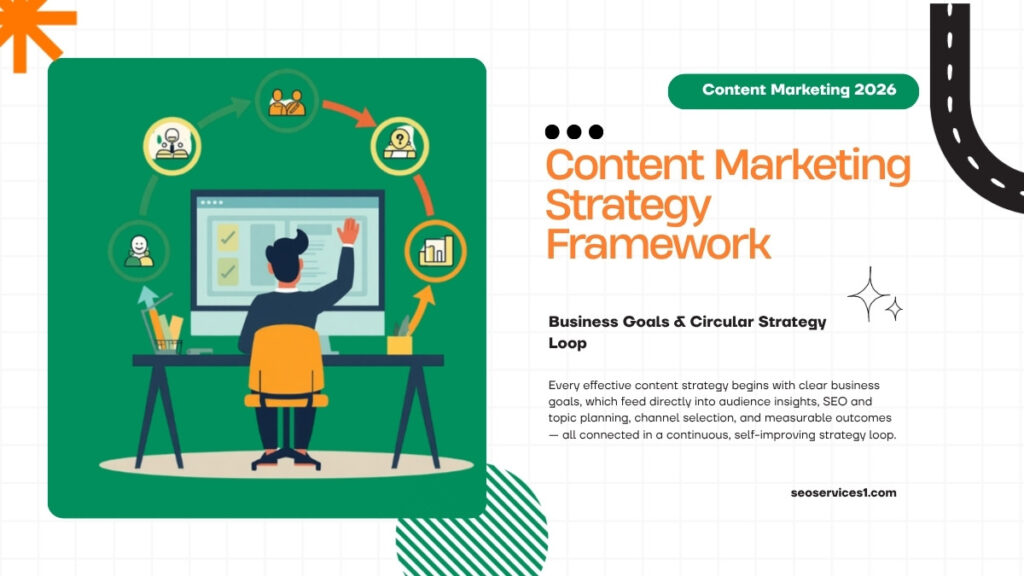
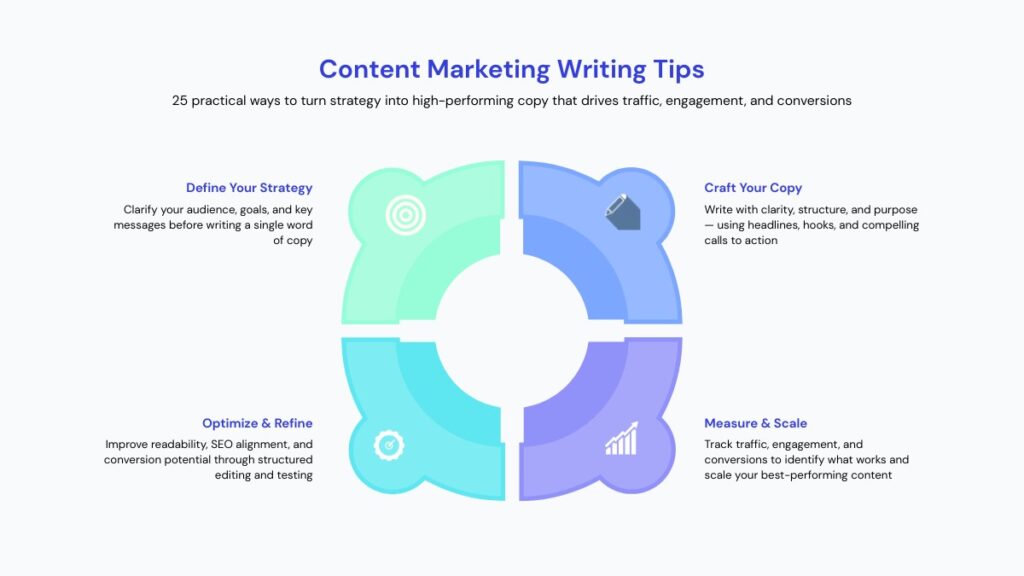
Image Description: A conceptual diagram showing business goals at the top, feeding into audience insights, SEO and topics, channels, and measurement, all connected in a circular strategy loop.
What Is a Content Marketing Strategy?
A content marketing strategy is a documented plan that defines how your organisation will use content to attract, educate, and convert a clearly defined audience in support of specific business goals. It specifies who you’re targeting, what you want them to understand or do, which topics you’ll cover, where content will live, and how success will be measured over time.
Content marketing strategy vs content strategy vs content plan
These terms sit in the same family, but they’re not interchangeable. Understanding the differences will prevent a lot of confusion later.
Content marketing strategy Focuses on marketing and growth outcomes such as lead generation, sales support, retention, and brand authority. Connects content directly to goals like “increase demo requests in EMEA” or “reduce onboarding friction for enterprise customers.”
Content strategy Takes a broader view across the entire organisation: website copy, product documentation, help centre content, in‑app messaging, and support articles, as well as marketing assets. Deals with governance, content lifecycle, voice, and consistency across every touchpoint, not just campaigns.
Content plan / editorial calendar Operates at the tactical level: the specific articles, emails, episodes, or videos you’ll publish in a given month or quarter. Answers “who is creating what, by when, and where will it be distributed?” based on the strategy, not on ad‑hoc requests.
If your team is stretched thin, start with a lean but explicit content marketing strategy. Once that is in place, you can design a more detailed content strategy and keep your editorial calendar tightly connected to both.
Core components of a content marketing strategy
A robust content marketing strategy typically includes:
Business goals and success metrics – what content is expected to change or support.
Target audiences and buyer personas – who you’re speaking to, including segments, roles, and regions.
Positioning and key messages – the narrative you want to reinforce and how you’re different.
SEO and topic architecture – keyword and topic clusters, pillar pages, and internal linking strategies.
Channel mix and content formats – which channels you’ll commit to and what kinds of content you’ll produce for each.
Editorial calendar and content planning – themes, campaigns, and publishing rhythm across weeks and months.
Resourcing model and workflows – in‑house roles, external partners, tools, and approval processes.
Measurement, reporting, and iteration plan – how you’ll track content performance and refine your approach.
Think of these as the minimum ingredients for a strategy that can survive first contact with reality. Without them, content efforts drift, stall, or struggle to prove value.
Why a Content Marketing Strategy Matters in 2026
A content marketing strategy matters in 2026 because buyers now move through long, self‑directed journeys that span search engines, social feeds, email, communities, and sometimes AI‑driven interfaces. They often form a strong opinion about your brand before speaking to anyone on your team.
Research into global marketing budgets shows that content marketing is not a side project; it’s one of the main vehicles for educating markets and differentiating brands. At the same time, industry studies repeatedly show that marketers who document their content strategy tend to outperform those who don’t, in both lead quality and overall content effectiveness. Having a strategy written down is not just a formality it is a differentiator.
What high-performing teams do differently
High‑performing content and marketing teams usually:
Document their content marketing strategy and treat it as a living document, revisiting it at least annually or after significant market shifts.
Anchor topics in buyer reality, using input from sales, customer success, and support to shape content ideas, rather than brainstorming in isolation.
Integrate SEO and content planning, so that content marketing strategy and content strategy are aligned around real search behaviour and topic clusters.
Use channels intentionally, with each channel (blog, email, social, video) assigned clear roles in the funnel instead of posting randomly.
Measure content performance beyond vanity metrics, connecting content to pipeline influence, win rate, average deal size, retention, or support cost reductions.
SEOSERVICES1 routinely sees performance step‑changes when a company moves from “we publish when we can” to “we’re executing a focused content marketing strategy and adjusting based on data.” The difference shows up in both marketing dashboards and sales conversations.
How to Create a Content Marketing Strategy (9‑Step Framework)
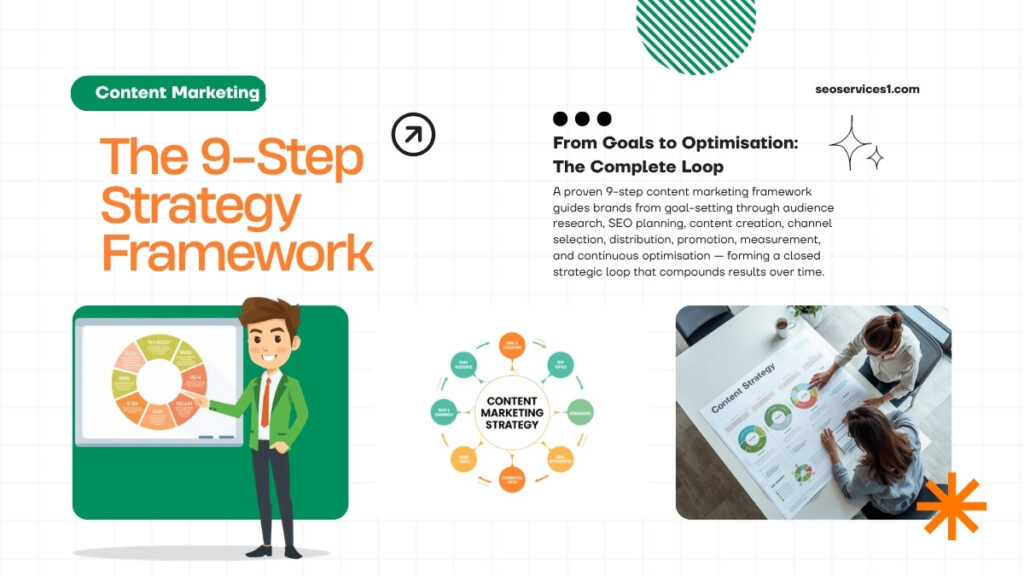
This 9‑step framework is a practical path you can follow over a focused 60–90 day period. It’s designed for global marketers, founders, and content teams who need to move from scattered content activity to a coherent, measurable program.
Quick overview of the 9 steps
Define business goals and success metrics
Understand your audience and markets
Gather insights and map buyer questions
Clarify positioning and strategic messages
Build your SEO and topic architecture
Choose channels and content formats
Plan your editorial calendar and publishing rhythm
Produce, distribute, and repurpose content
Measure performance and optimize
Step 1 – Define business goals and success metrics
Your content marketing strategy should start with a clear answer to one question: “What business outcomes do we expect content to support in the next 6–12 months?”
Common examples include:
Increasing qualified pipeline for a specific product line or region.
Generating more self‑serve signups or free trials for a SaaS product.
Educating a new market segment ahead of a product launch.
Reducing repetitive support requests by creating better self‑serve content.
Turn these into specific goals with numbers and timeframes, then decide which metrics will indicate progress. For instance, “grow content‑influenced demo requests by 30% in 12 months” might rely on KPIs like organic sessions on key content paths, demo form submissions from those paths, and contribution to closed‑won revenue.
Step 2 – Understand your audience and markets
Next, define the people and markets your content will serve. For global companies, this often means creating a simple segmentation model such as:
Primary industries or verticals (B2B SaaS, fintech, manufacturing, e‑commerce, etc.).
Company size bands (startup, SMB, mid‑market, enterprise).
This work becomes the foundation for both content planning and localization decisions.
Step 3 – Gather insights and map buyer questions
Rather than brainstorming in a vacuum, build your content marketing strategy around actual questions your buyers ask. You can gather these by:
Listening to sales calls and customer success check‑ins.
Reviewing CRM notes, chat logs, and support tickets.
Analysing search terms from your own site and external keyword tools.
Reading online reviews, forum threads, and social comments about your category.
Once collected, group these questions into logical buckets such as:
Cost and pricing (“What does this realistically cost?”)
Problems and risks (“What if it doesn’t work, or we can’t implement it?”)
Comparisons and alternatives (“Is solution A really better than B?”)
Implementation and change management (“How hard will it be to roll this out globally?”)
Outcomes and ROI (“How long until we see value, and how will we measure it?”)
Each bucket can later become a content cluster, with pillar content addressing the overall theme and supporting content tackling specific questions and use cases.
Step 4 – Clarify positioning and strategic messages
A content marketing strategy without a clear point of view tends to produce bland content. Clarify your positioning by answering:
What do we believe about this market that our competitors don’t articulate?
Which segments or problems are we uniquely positioned to serve?
What concrete evidence do we have that our approach works (metrics, customer stories, independent reviews)?
Turn the answers into 3–5 positioning pillars and a set of supporting proof points. For example, a global B2B SaaS brand might anchor its messaging around “fast deployment,” “enterprise‑grade security,” and “global support,” then back those up with case examples and data from different regions. These pillars should show up repeatedly in your content, especially mid‑funnel and decision‑stage assets.
Step 5 – Build your SEO and topic architecture
This is where strategy, content planning, and SEO meet. Instead of building isolated pages for every keyword, you design a topic architecture that supports both search visibility and content planning.
Start by identifying your core topics based on buyer questions and business priorities. For “content marketing strategy,” example subtopics might include:
“content marketing strategy examples”
“content marketing KPIs and metrics”
“content marketing strategy for SaaS”
“content marketing strategy for small businesses”
“content marketing strategy template”
Then, for each topic, define:
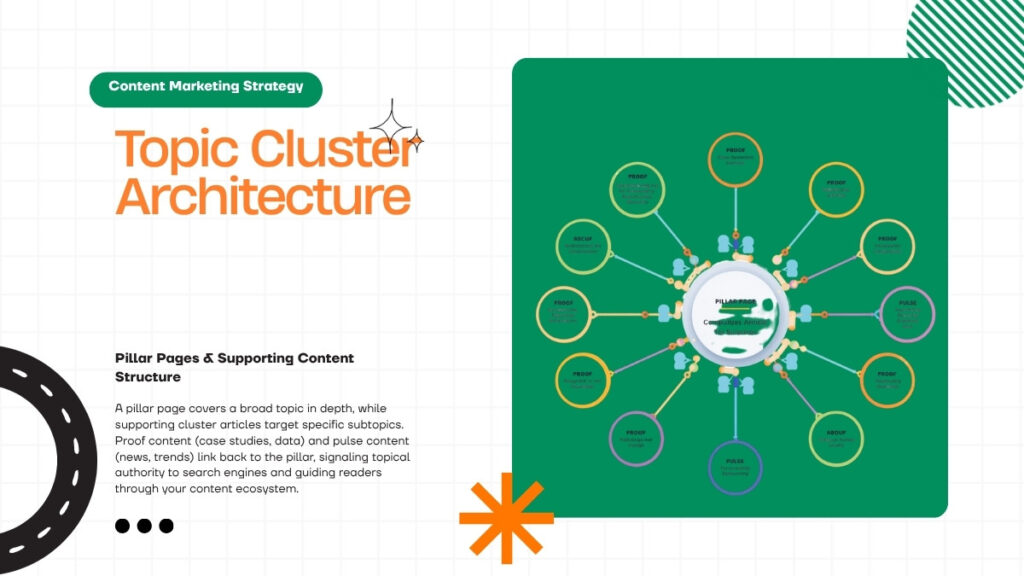
A pillar page – a comprehensive, evergreen guide that covers the topic in depth.
Multiple supporting pages – focused pieces answering specific questions, exploring variations by industry, or diving into individual steps.
A cadence of supporting or pulse content – updates, opinion pieces, or news‑driven content that keeps the topic current and signals ongoing relevance.
This structure improves your chances of ranking for a broad set of queries and gives your editorial calendar a clear backbone.
Step 6 – Choose channels and content formats
Now decide where your content will live and how your messages will take shape. Keep in mind that your audience might encounter you first on Google, then on LinkedIn, then via email, and finally via a webinar or demo.
Common channels and formats include:
Blog / Resource hub – long‑form guides, case studies, how‑to content, and thought leadership.
Email – newsletters, nurture sequences, onboarding flows, and renewal or expansion campaigns.
Social media – posts, threads, carousels, and short videos tailored to platforms like LinkedIn, X, Instagram, or TikTok.
Video and webinars – explainer videos, product walkthroughs, live Q&A sessions, recorded workshops.
Lead magnets – templates, calculators, checklists, ebooks, and research reports that warrant an email address.
Customer stories – written, audio, or video case studies showing results in specific contexts.
Your content marketing strategy should spell out which channels are primary for your brand, which are secondary, and what role each plays in the customer journey.
Step 7 – Plan your editorial calendar and publishing rhythm
With the building blocks in place, design an editorial calendar that your team can actually sustain. A calendar is more than dates it’s your operational plan for content planning, production, and distribution.
For example, a global mid‑market SaaS company might set a 90‑day calendar that includes:
One new pillar article per month, each tied to a strategic theme.
Two to four supporting blog posts per month, aligned with active clusters.
A monthly customer story or use‑case article.
A weekly newsletter featuring new content and curated industry insights.
Frequent social posts that highlight key insights, stats, or visuals from those pieces.
One webinar or live session per quarter based on the most important cluster.
For each item on the calendar, assign an owner, define the target audience and funnel stage, and outline where the content will be repurposed. That level of clarity prevents bottlenecks and “last‑minute content emergencies.”
Step 8 – Produce, distribute, and repurpose content
Production is where your strategy becomes real. To keep it manageable:
Create clear briefs for each piece, summarising the goal, target audience, angle, key points, and internal/external references.
Decide who is responsible for writing, editing, SEO checks, and approvals.
Standardise a checklist for on‑page optimisation (titles, meta descriptions, headings, internal links, alt text) so nothing is missed.
Distribution should be part of the plan from the start. When a major guide goes live, your distribution plan might include:
An announcement and summary in your next newsletter.
Several social posts, each focused on different insights or stats.
Internal enablement notes so sales, customer success, and partners know when and how to use the content.
Potential reuse in webinars, slide decks, or training resources.
AI tools can help with content planning, ideation, and repurposing such as transforming a long article into a social thread or webinar outline but keep human owners accountable for quality and brand integrity.
Step 9 – Measure performance and optimize
The final step is to build feedback into your content marketing strategy so it gets smarter over time.
At a minimum, you should:
Track key metrics by cluster, channel, and stage of the funnel.
Identify which topics and formats consistently perform well and which deserve a rethink.
Schedule time for content refreshes: updating data, refining structure, improving CTAs, and strengthening internal linking.
Many teams formalise this in a monthly performance review and a quarterly strategy session. SEOSERVICES1 often assists clients here by combining analytics, SEO tooling, and content expertise to recommend where to double down and where to change course.
Mapping Your Content Marketing Strategy to the Customer Journey
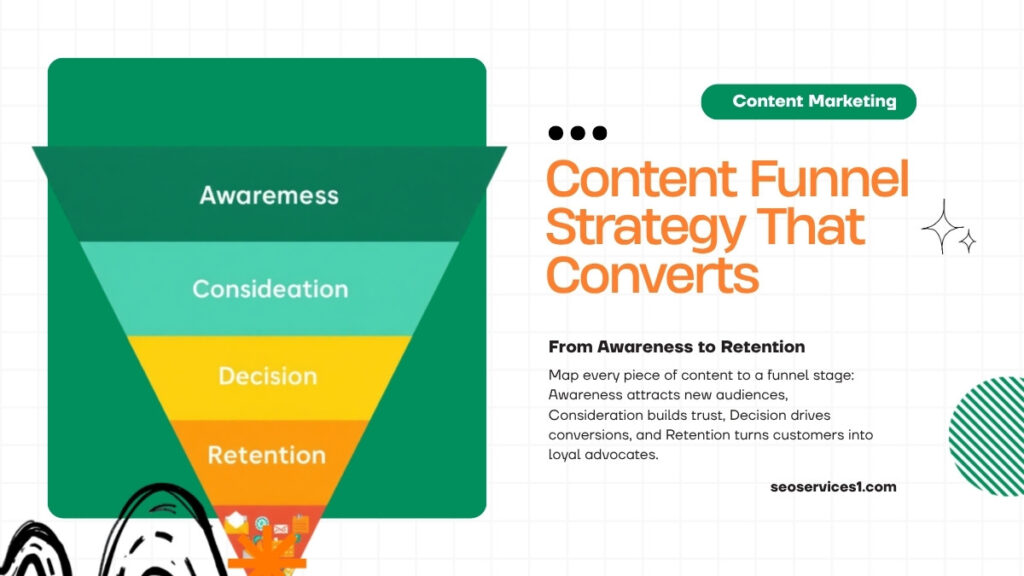
A strong content marketing strategy deliberately guides people through the buyer journey, rather than assuming one great article will do all the work. This means assigning your content marketing efforts to stages like awareness, consideration, decision, and retention or advocacy.
Journey stages and example content
Journey Stage
Buyer Questions
Example Content
Primary Channels
Sample KPIs
Awareness
“What’s going on?” “Do I have a problem?”
Educational blogs, explainer videos, industry primers, checklists
Blog, SEO, social, YouTube
Organic traffic, new visitors, scroll depth, engagement
Consideration
“What options exist?” “How do these approaches compare?”
“Why should we choose you?” “Will this work for us?”
Case studies, ROI breakdowns, product tours, testimonials
Blog, product pages, sales enablement content
Demo requests, trials, proposals, win rate
Retention & Advocacy
“How do we get maximum value?” “Who else should know?”
Onboarding series, advanced tips, user communities, success stories
Help centre, email, community, events
Expansion revenue, renewals, referrals, reviews
If you map a quarter’s worth of planned content against this table and find most of it in awareness, you’re likely under‑serving the later stages. Balance your content planning so that by the end of the quarter, each stage has assets you’re comfortable putting in front of your ideal customer.
Integrating SEO, Topic Clusters, and Content Architecture
Your content marketing strategy and SEO strategy should reinforce each other. Instead of treating SEO as an after‑the‑fact optimisation step, build it into your topic decisions and site architecture from the beginning.
From keywords to topics and clusters
Traditional keyword lists are useful, but they’re much more powerful when organised into topics that mirror how people think and search. For instance, the overarching topic “content marketing strategy” might include:
“content marketing strategy for SaaS / e‑commerce / small business” (vertical or size‑based)
“content marketing KPIs and metrics” (measurement)
Each cluster should have:
A pillar article covering the entire topic in depth.
Several supporting articles addressing narrower questions or use cases.
Tightly integrated internal links that help readers and search engines discover related content.
Pillar pages, proof content, and pulse content
Organise your library using three main content types:
Pillar pages – comprehensive, long‑term assets that answer a topic end‑to‑end.
Proof content – case studies, ROI analyses, customer interviews, and user reviews that prove your claims.
Pulse content – timely, shorter pieces responding to trends, new data, or industry shifts.
Your content marketing strategy can specify, for each priority topic, how many pillars you’ll maintain, how often you’ll create proof content, and how you’ll use pulse content to keep the topic alive in search and social.
Internal linking and search‑friendly information architecture
Internal linking is one of the simplest yet most overlooked parts of content planning. A search‑friendly information architecture will:
Link from supporting posts to their pillar using descriptive anchor text.
Connect related pieces within the same topic cluster to keep readers moving through the journey.
Point from educational content to relevant product, solution, or service pages when appropriate.
Over time, this architecture helps search engines better understand your topical authority and makes your content marketing strategy more effective by ensuring high‑value content is easy to find from multiple entry points.
Choosing Channels: Blog, Email, Social, Video, and Lead Magnets
Your content marketing strategy should explicitly state which channels you are committing to and how each channel supports the overall plan. This prevents your team from trying to be everywhere at once and burning out.
Channels vs primary goals
Channel
Primary Goals
Best For
Typical Starting Frequency
Blog
Awareness, consideration, SEO traffic
In‑depth education, rankings, internal linking, thought leadership
2–8 posts per month
Email
Nurturing, retention, expansion, re‑engagement
Building relationships, direct calls‑to‑action, lifecycle messaging
Weekly or bi‑weekly newsletter + automations
Social
Awareness, engagement, community, thought leadership
A small team might deliberately pick a blog‑plus‑email‑plus‑LinkedIn combination at first, then add video and additional networks later. A consumer brand might prioritise short‑form video and social first, with blog content supporting SEO and customer education.
Blog strategy and long-form guides
For many companies, the blog (or “resources” hub) remains the backbone of their content marketing strategy. A strong blog strategy:
Focuses on well‑defined pillar topics and clusters rather than isolated posts.
Provides deep, practical guides that can stand on their own as references.
Includes a mix of evergreen content and timely commentary to stay current.
Connects naturally to relevant service or product pages rather than forcing conversions.
Email nurture and lifecycle content
Email is one of the most controllable channels in your content distribution mix. Use it to:
Warm up new leads with onboarding sequences that introduce key concepts and assets.
Keep subscribers informed about new content that’s directly relevant to their segment or role.
Support existing customers with educational series that help them unlock more value from your product or service.
Even a modest but consistent email program can dramatically improve the ROI of your broader content marketing strategy by turning one‑time visitors into ongoing relationships.
Social amplification and thought leadership
Social platforms give your content reach and personality. Your strategy might specify that:
The company page focuses on curated content and company‑level announcements.
Subject‑matter experts and leaders share more opinionated takes and behind‑the‑scenes insights.
Core content is systematically repurposed: each big guide yields several short posts, infographics, or clips.
The goal is not just to broadcast links but to stimulate conversations and position your brand as a credible voice in relevant discussions.
Video, webinars, and short-form content
Video can make complex ideas easier to understand and can help global audiences connect with the people behind your brand. Within your content marketing strategy, video might support:
Awareness, via short explainer clips or animated explainers.
Consideration, via product walkthroughs, expert interviews, and recorded webinars.
Retention, via training videos or feature‑highlight clips for existing customers.
You don’t have to build a full‑scale video studio on day one. Start by recording solid webinar content and turning the best segments into shorter assets that can live on your website and social channels.
Lead magnets and gated content
Lead magnets give you a way to trade valuable content for contact information when it makes sense. Effective assets usually:
Save your audience time (templates, checklists, calculators).
Provide packaged insight (benchmark reports, research summaries).
Offer deeper, more actionable guidance than a standard blog post.
Your content marketing strategy should clarify which magnets you need for each key topic or campaign, and how those leads will move into relevant email sequences or sales workflows.
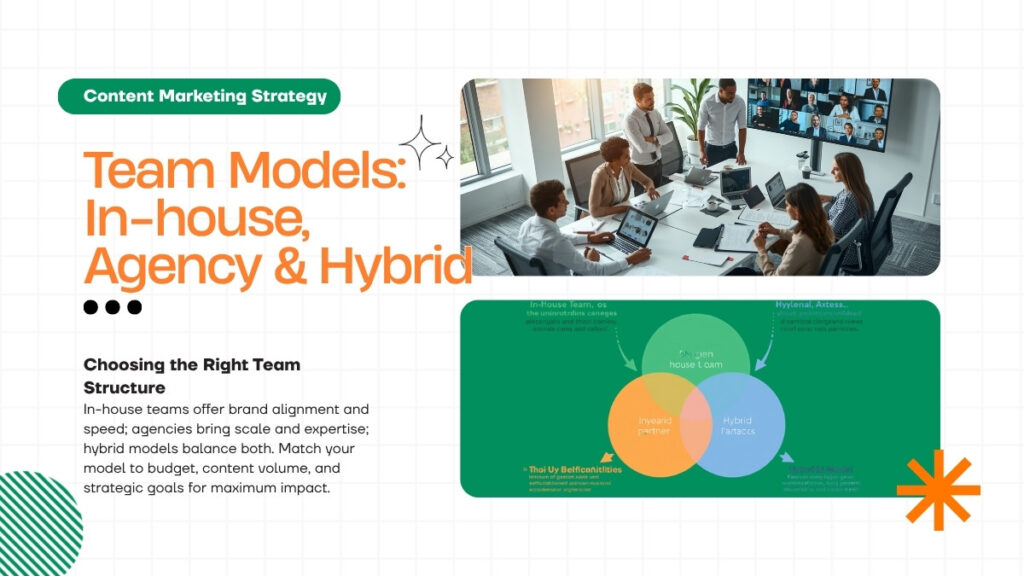
In‑House vs Agency vs Hybrid: How to Resource Your Strategy
Even the most elegant content marketing strategy will stall without the right combination of skills and capacity. The three primary models in‑house, agency, and hybrid each have trade‑offs your strategy should acknowledge.
Resourcing models compared
Model
Pros
Cons
Best For
In‑House
Deep brand and product understanding, faster context sharing
Requires hiring and retaining multiple specialist roles
Established teams with stable budgets and ongoing content needs
Agency
Access to varied expertise (SEO, strategy, writing, design)
Needs clear briefs and good communication to stay aligned
Organisations wanting to scale content without expanding headcount
Hybrid
Combines internal direction with external capacity
Requires strong process for who owns what
Growing companies building a core team while leaning on partners
In a hybrid model, your internal team might own the content marketing strategy, stakeholder relationships, and subject‑matter input, while a partner like SEOSERVICES1 handles SEO research, content planning, and a large share of long‑form content production. This arrangement is often ideal for global brands that need consistency across markets but also want local nuance and flexibility.
Content Marketing Strategy for Different Business Models
The same 9‑step content marketing strategy framework applies whether you’re selling enterprise software or running a multi‑location service business, but the emphasis shifts by model.
B2B SaaS
B2B SaaS content marketing strategies tend to:
Prioritise educational content that explains complex problems and solutions in accessible language.
Provide detailed comparison and integration content so buyers can see how the product fits their existing stack.
Support a consultative sales process, where content answers questions stakeholders will raise in internal meetings.
A global SaaS platform might build clusters around topics like “data governance strategy” or “multi‑region marketing analytics,” publish deep pillars and case studies for each, and then arm sales teams with those links for follow‑up and objection handling.
E-commerce and D2C
E‑commerce and D2C brands typically use content to:
Help customers discover products and imagine them in their own lives through guides, lookbooks, and user‑generated content.
Improve conversion with how‑to content, sizing guides, and clear explanations of benefits.
Retain customers via post‑purchase content that shows new ways to use or combine products.
For example, a global outdoor brand could run a content marketing strategy centred on “trip planning” guides, gear checklists for specific climates, and stories from real customers in different countries. These assets would support both SEO and email campaigns.
Professional and B2B services
Service businesses rely heavily on trust, expertise, and process clarity. Their content marketing strategies often:
Lead with frameworks that show how they think and what working with them is like.
Share detailed case examples and before/after scenarios.
Provide diagnostic tools or checklists that help prospects assess their own situation.
A consultancy specialising in global expansion might publish region‑specific guides, risk checklists, and interview‑style case studies that de‑risk the idea of engaging them.
Local and regional businesses
Local businesses may not need global content, but they do need a clear content marketing strategy tuned to local search and community behaviour. Their strategy usually:
Combines local SEO basics with educational content about services, pricing expectations, and process.
Highlights local stories, testimonials, and community initiatives.
Uses email and messaging to keep customers engaged between purchases or appointments.
Examples include law firms offering explainers of local regulations, clinics publishing treatment FAQs, and trades businesses sharing project spotlights from nearby neighbourhoods.
Measuring Your Content Marketing Strategy: KPIs, Reporting, and Iteration
Measurement is where your content marketing strategy either proves itself or reveals weaknesses. The goal is not just to report numbers but to learn which topics, formats, and channels are genuinely moving your business forward.
KPIs by funnel stage and channel
Funnel Stage
Example KPIs
Typical Channels
Awareness
Organic traffic, impressions, reach, engagement
Blog, SEO, social, video
Consideration
Email sign‑ups, lead magnet downloads, event/webinar registrations
Blog, landing pages, email, webinars
Decision
Demo requests, trial signups, proposals, close rates
Referrals, reviews, testimonials, community activity
Email, communities, social
As you implement your content marketing strategy, sanity‑check your KPIs regularly. If you’re seeing growing awareness metrics but flat decision‑stage metrics, you may need more middle‑ and bottom‑of‑funnel content or stronger calls‑to‑action.
Reporting cadence and dashboards
A sustainable reporting cadence helps everyone stay aligned without getting lost in spreadsheets:
Monthly reviews Examine performance by topic cluster and core channel. Highlight top‑performing content and identify why it’s working (topic, format, promotion). Flag under‑performers that could benefit from rewritten intros, stronger CTAs, updated data, or better internal links.
Quarterly strategy sessions Revisit business goals and ensure your content marketing strategy still supports them. Decide which topics to expand, which to pause, and which to consolidate. Align with sales, product, and leadership on upcoming launches or shifts that content should support.
Dashboards should be simple enough that stakeholders outside marketing can understand them at a glance ideally showing how content contributes to pipeline and revenue, not only traffic.
Iteration loops and experiment design
Finally, treat your content marketing strategy as a set of hypotheses you’ll test and refine:
Experiment with different content formats (e.g., turn high‑performing articles into short videos or interactive tools) and compare performance.
A/B test subject lines, headlines, and calls‑to‑action on high‑traffic pages and emails.
Run refresh projects on older content that still attracts traffic but no longer reflects your current offers or messaging.
Small, consistent experiments can reveal patterns your team can build on. Over time, this turns your content operation into a learning system rather than a one‑way production line.
Direct Answer Sections
How do you create a content marketing strategy?
You create a content marketing strategy by defining your business goals, understanding your audience, collecting real buyer questions, clarifying your positioning, designing an SEO‑driven topic architecture, choosing a focused channel mix, planning a realistic editorial calendar, and then executing and measuring consistently. The 9‑step framework in this guide offers a practical order to follow, which most teams can work through over 60–90 days.
What should a content marketing strategy include?
A sound content marketing strategy includes:
Business goals and KPIs
Target audiences and buyer personas
Positioning and key messages
SEO and topic cluster architecture
Channel mix and content formats
Editorial calendar and workflows
Resource model (in‑house, agency, or hybrid)
Measurement, reporting, and iteration plan
Each element links to the others so that the content you plan, publish, and optimise can be traced back to clear objectives.
How long does it take to see results from a content marketing strategy?
Most organisations begin seeing early signs of impact such as rising organic traffic, more engaged sessions, and growing email lists within about 3–6 months of consistent execution. More substantial changes in pipeline and revenue typically appear over 6–12 months, depending on factors like domain authority, competition, sales cycle length, and how much content you can produce.
FAQs: Content Marketing Strategy for Growing Businesses
How long does a content marketing strategy take to work? You should plan on a medium‑term horizon. It often takes several months to see steady growth in organic traffic and engagement, and one to two sales cycles to see clear influence on opportunities and revenue. That’s why leadership alignment and realistic expectations are critical upfront.
How often should we publish content? As a baseline, many teams see good momentum with 2–8 blog posts per month, a weekly or bi‑weekly newsletter, frequent social posts, and a few larger assets each quarter. The “right” cadence is the one you can sustain while keeping quality high and aligned with strategy.
What’s the difference between a content marketing strategy, plan, and calendar? Your content marketing strategy explains why you are creating content and how it will support business goals. Your content plan outlines what you’ll focus on in the next few months (themes, campaigns, key assets). Your content calendar breaks that plan into specific publish dates, owners, and channels.
Should we build our content marketing strategy in-house or partner with an agency? If you have strong strategic, SEO, and editorial skills internally, you can absolutely build your strategy in‑house and bring in extra help only for production. If you lack those capabilities or are under time pressure, partnering with an experienced SEO and content team like SEOSERVICES1 can help you move from idea to documented strategy and operational execution much faster.
How does AI change how we should think about content marketing strategy? AI tools change the “how” of content production more than the “why” or “what.” They can help with research, outlines, and repurposing, but they don’t replace clear positioning, real customer insight, and a coherent content architecture. Your strategy should assume AI will be in the toolkit, but keep human judgment at the centre of what gets published.
How do we get leadership buy-in and budget for content marketing? Link your strategy directly to revenue, cost savings, or risk reduction. Use market data to show how much brands are investing in content, highlight evidence that documented strategies perform better, and present a plan with milestones and clear metrics instead of just asking for “more content budget.” Bringing a specialist partner to the table can also reassure leaders that you have the expertise to deliver.
What should we prioritise if we’re starting from zero? Start small but strategic. Define your goals and audience, pick one or two core topics for pillar content, and commit to a realistic publishing cadence for the next quarter. As those pillars begin to perform, expand into more topics and formats instead of spreading yourself thin from day one.
How do we adapt a global content marketing strategy for different regions? Keep a unified global narrative and core pillars, but adapt examples, language, and sometimes offers for key regions. Involve local marketers or partners to check that content resonates culturally and complies with local norms, while using shared guidelines so your brand stays coherent worldwide.
Senior Search Strategist specializing in SEO, AEO, and Generative Engine Optimization (GEO). With over a decade of experience, Rick helps brands and applications (ASO) maximize their visibility across traditional search engines, AI answer engines, and app stores.