What Is Content Marketing and Why It Matters
Content marketing is a deliberate, long‑term approach to publishing useful, relevant material so that the right people discover you, learn to trust you, and eventually choose to buy from you. Instead of interrupting prospects with ads or cold messages, you meet them where they are searching, scrolling, and researching and give them information that genuinely helps.
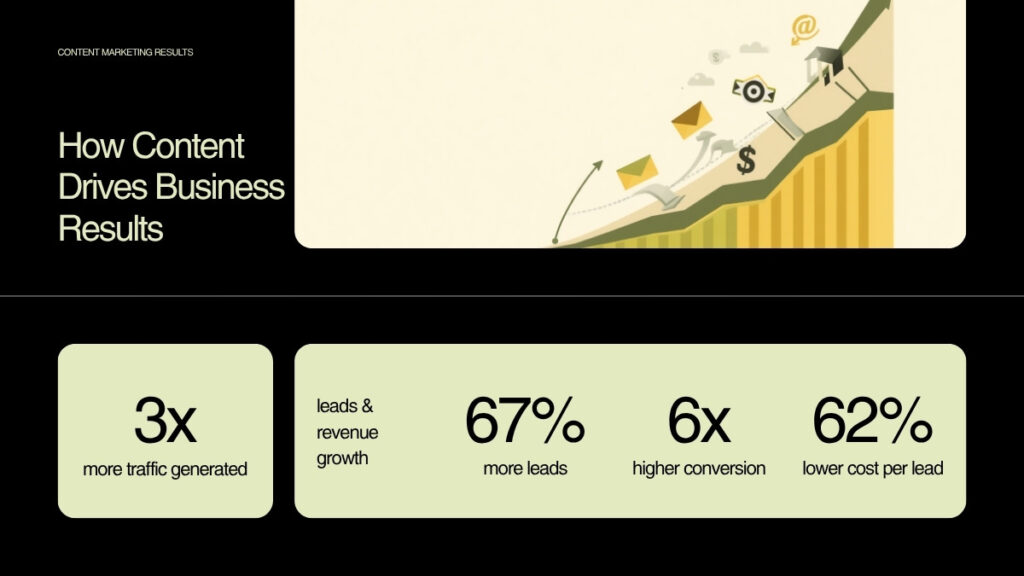
When this is done well, your articles, videos, guides, and emails become core business assets. They attract qualified visitors through search and social, warm those visitors into leads, support sales conversations, and keep customers engaged after the sale. Industry research from major platforms and institutes shows that companies who invest steadily in content often see more qualified organic traffic, more inbound leads at a lower cost, and stronger long‑term ROI than those who rely purely on short‑term campaigns.
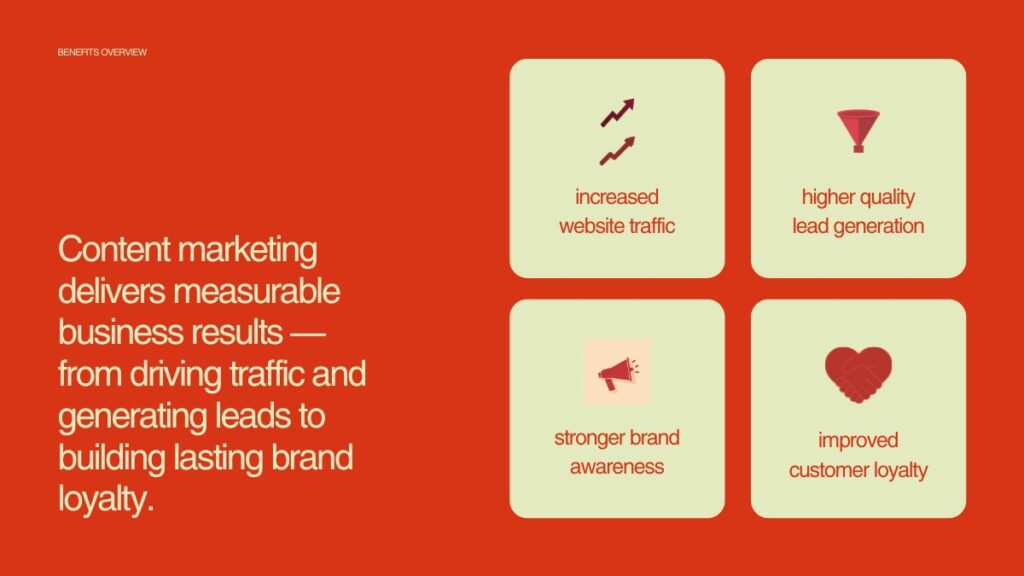
Top 10 Business Benefits of Content Marketing
The advantages of content marketing are broad, but they become much more concrete when framed in business terms: traffic, leads, sales, brand strength, and lifetime value. Below are ten major benefits, each tied to how real organisations experience them.
1. Increased Organic Traffic and SEO Visibility
A major benefit of content marketing is the steady growth of highly relevant organic traffic. Search engines need something substantial and meaningful to index; content marketing provides that substance. Without a strong content layer, even technically sound websites struggle to maintain rankings and visibility over time.
SEO‑oriented tool providers consistently show that high‑performing sites share a pattern: they publish deep, topical content that addresses real questions rather than thin, keyword‑stuffed pages. Over time, this kind of content strategy leads to more keywords ranking across the buyer journey, more clicks from non‑branded searches, and more branded searches as people start to look for you by name.
Micro case – local service business: A local home renovation company used to rely on flyers and directory listings. They start publishing detailed “how to budget for a kitchen remodel” and “what to know before renovating in [city]” guides. Within a year, they see organic traffic becoming their top source of website visits, with many inquiries coming from people who phrase questions the same way the articles are titled.
When this benefit is strongest vs weakest:
- Strong fit: businesses that sell solutions people research online (B2B, services, eCommerce, education).
- Weaker fit: highly impulse‑driven purchases or markets where search volume is minimal.
Key metrics to monitor:
- organic sessions to content pages;
- number of ranking keywords and positions for priority topics;
- growth in branded search volume.
Even simple dashboards in web analytics and search tools will show whether content is gradually lifting your organic footprint.
2. More and Better Leads at Lower Cost
Content marketing can be a powerful engine for both lead volume and lead quality. Well‑known studies shared by training providers and content platforms indicate that content‑driven programs often generate significantly more leads than pure outbound approaches while doing so at a lower cost per lead.
The mechanics are straightforward: you attract people who are actively trying to solve a problem you address; those people often engage with multiple pieces before they submit a form or book a call; and by the time they convert, they understand more about their own needs and how you might help.
Micro case – early‑stage startup: An early‑stage SaaS startup can’t match bigger competitors’ ad budgets, so they focus on content. They publish comparison articles, “how to” implementation guides, and templates that their target users search for. Within six months, a meaningful share of demo requests comes from a “content‑sourced” segment, and these leads move faster and close at a higher rate than cold outbound prospects. Their cost per qualified lead from content ends up lower than what they pay on paid search.
Key metrics to monitor:
- leads by channel or campaign (especially organic content and email);
- cost per lead by channel;
- lead‑to‑customer conversion rate for content‑influenced leads vs others.
By comparing these numbers across channels, you can quantify whether content is truly lowering your acquisition cost and improving lead quality.
3. Higher Conversion Rates and Sales Support
Content marketing doesn’t stop at the top of the funnel; it plays a huge role in whether deals convert. Buying decisions especially for B2B or considered purchases are rarely made after a single interaction. Prospects look for clear explanations, examples, and reassurance. Strong content gives them exactly that.
Authoritative sources repeatedly point out that buyers consume several pieces of content before speaking with sales or completing a purchase. If those touchpoints are yours, you shape how they think about the problem and criteria for choosing a solution.
Micro case – B2B company shortening sales cycles: A cybersecurity vendor realises prospects stall in evaluation because they don’t fully grasp the differences between “good enough” and “best‑in‑class” solutions. They create a set of assets: a risk assessment checklist, an “RFP questions to ask” guide, and a series of case studies. Sales begins to send these before and after demos. Over the next few quarters, they measure a reduction in average sales cycle length and an increase in win rate for opportunities that engaged with these specific pieces.
Key metrics to monitor:
- win rate for opportunities that engaged with at least one key asset vs those that did not;
- sales cycle length (from first qualified meeting to close);
- content usage in deals (tracked through CRM links or sales enablement tools).
This benefit is particularly important when marketing and sales are aligned and share clear processes for using content throughout the buying journey.
4. Stronger Brand Awareness and Authority
Consistent, high‑quality content raises your visibility and establishes your brand as an expert voice rather than just a vendor. The Content Marketing Institute often summarises content’s role in four business outcomes: increased sales, cost savings, better customers, and content‑driven revenue and loyalty. Brand awareness and perceived authority underpin all four.
Authority‑building content does more than chase keywords. It articulates your perspective on key issues in your market, showcases proprietary frameworks, data, or methodologies, and addresses topics at a depth that generic content cannot match.
Micro case – established brand reinforcing authority: An established HR software provider wants to be seen as more than a tool they want to be viewed as a thought leader on the future of work. They launch a content program featuring annual industry reports, long‑form guides on remote work, and expert interviews. Over time, their research is cited by other publications, and brand search volume increases. When competitors talk about the category, they often reference this company’s content as a benchmark.
Key metrics to monitor:
- brand search volume and direct traffic;
- mentions and backlinks from reputable sites;
- invitations to speak, collaborate, or contribute guest content.
These signals confirm that content is helping your brand occupy a stronger position in your market’s collective mind.
5. Greater Trust and Credibility with Buyers
Trust is an intangible benefit, but it has very real effects on pipeline and revenue. Educational content, transparent pricing explainers, and honest “who we’re not for” articles all send a message: this company is confident, candid, and aligned with our interests.
Benefit‑focused resources from marketing platforms highlight that buyers are more inclined to engage with and purchase from brands whose content they perceive as clear and helpful rather than purely promotional. In crowded markets, this kind of content‑driven trust can be a decisive factor.
Micro case – local service business building credibility: A local law firm publishes plain‑language explainers on topics like “what to expect if you’re involved in a minor car accident” and “when you do and don’t need a lawyer.” Some of that content explicitly tells readers when they probably do not need to hire a firm. Prospects who book consultations often say, “I chose you because your content felt honest and understandable.” Win rates for inbound inquiries increase, even though they have not changed their paid media budget.
Key metrics to monitor:
- qualitative feedback: how often prospects cite content as a reason for contacting you;
- review content: mentions of “helpful articles” or “useful resources” in testimonials;
- referral volume, especially referrals that mention content.
This kind of trust rarely shows up in a single metric, but when you hear the same story repeatedly “I’ve been following your content for a while” you know it is doing its job.
6. Better Customer Education and Self‑Serve Journeys
Buyers in 2024–2026 expect to self‑educate. They prefer to explore content on their own rather than sit through a generic sales pitch. Content marketing is the infrastructure for these self‑serve journeys.
Guides from platforms emphasise that buyers use content to understand the problem, the solution landscape, and your specific approach long before they submit a form or accept a meeting. Good content reduces friction for both sides: buyers feel more prepared, and your team spends less time re‑explaining basics.
Micro case – online educator warming and qualifying leads: An online coding school designs a learning path that starts with blog posts on “why learn Python,” progresses to beginner tutorials, and culminates in a free seven‑day email course. Prospective students who complete the free course see sample lessons, understand the teaching style, and have a realistic sense of the commitment required. Enrollment data shows these “content‑nurtured” leads convert at a much higher rate and are less likely to drop out than people who click a one‑off ad and enroll immediately.
Key metrics to monitor:
- average number of content pieces consumed before conversion;
- completion rates for educational series or mini‑courses;
- reduction in basic “how does this work?” support tickets.
When you see a meaningful share of customers coming through structured content journeys and arriving “pre‑educated,” you’re seeing this benefit in action.
7. Improved Customer Retention and Loyalty
Content marketing also strengthens the relationship after the sale, which is crucial for lifetime value. Educational follow‑ups, success stories, and ongoing best‑practice content help customers get more out of what they’ve already purchased.
Agency and platform resources highlight that content‑driven organisations often see lower churn and stronger loyalty because they continue to provide value beyond the core product or service.
Micro case – SaaS retention: A project management SaaS identifies patterns: customers who attend an onboarding webinar and engage with “advanced tips” articles are substantially less likely to churn in the first year. The company invests in a structured content journey for new accounts onboarding guides, “first 30 days” checklists, and a regular customer newsletter showcasing real workflows. Over time, retention in the “engaged with content” cohort climbs higher than in the non‑engaged group, and expansion revenue becomes more reliable.
Key metrics to monitor:
- churn and renewal rates segmented by content engagement level;
- product usage among customers who consume education content vs those who don’t;
- expansion and upsell revenue tied to content campaigns.
This benefit is particularly important for subscription‑based and services businesses where the bulk of profit comes after the initial sale.
8. Lower Customer Acquisition Cost (CAC) Over Time
Because content continues to perform without ongoing media spend, it can lower your blended acquisition cost as your library matures. Agency‑level resources and platform analyses often contrast content’s “asset‑like” behaviour with the “on/off” nature of paid advertising.
The relationship between content and CAC looks like this: your initial cost is front‑loaded strategy, creation, optimisation. As content begins to rank, get shared, and feed email lists, it generates leads without proportional incremental cost. Over time, a larger share of new customers come from these lower‑cost channels, pulling down overall CAC.
Micro case – eCommerce brand rebalancing CAC: An eCommerce skincare brand initially acquires customers mainly through paid social ads with a relatively high CAC. They then invest in in‑depth content: ingredient explainers, skin‑type guides, and “routine builder” content, alongside an email strategy. A year later, they find that a growing portion of first purchases originates from organic search and email flows that rely on this content. When they recalculate blended CAC, it has dropped even though they still run paid campaigns because of the rising influence of content‑driven channels.
Key metrics to monitor:
- CAC by channel (paid, organic, referral, etc.);
- the percentage of new customers with content touchpoints in their recorded journey;
- blended CAC trend line as content programs grow.
This benefit becomes most visible once content has had time to rank and recirculate across channels.
9. Higher Customer Lifetime Value (LTV)
LTV is where multiple benefits come together: better fit customers, stronger education, ongoing engagement, and more expansion opportunities. Content plays an important role at each step.
Content‑led brands often attract customers who are a better match for their offer, understand its value, and are more inclined to deepen the relationship.
Micro case – B2B analytics vendor: A B2B analytics company splits customers into two groups: those who regularly engage with their educational content (webinars, advanced tutorials, and case studies) and those who do not. They find that the engaged group not only renews at a much higher rate but also adopts additional modules faster. Over a few years, the LTV of the engaged cohort is significantly higher, and content is a key reason.
Key metrics to monitor:
- average LTV for content‑engaged vs non‑engaged customers;
- expansion revenue from content‑driven upsell campaigns;
- renewal rates tied to content consumption patterns.
Taken together, these data points show how content influences long‑term value, not just initial acquisition.
10. Long‑Term, Compounding ROI
The final benefit is that content marketing, when sustained, can produce returns that compound. Each new piece strengthens the value of the overall library.
Compounding happens because more content means more entry points for prospects to discover you, internal linking and topical depth improve search performance, and sales and customer success teams get more specialised content they can deploy in nuanced situations.
Micro case – multi‑year view: An established B2B company tracks content’s influence on opportunities over three years. In the first year, only a small slice of deals show any recorded content interactions. By the third year, after consistent publishing and tighter attribution, they see that a majority of closed‑won deals engaged with at least two pieces of content. The content program that once looked like “a cost centre” is now clearly a core driver of growth.
Key metrics to monitor:
- percentage of opportunities and revenue influenced by content;
- year‑over‑year growth in content‑driven traffic, leads, and pipeline;
- ratio of content‑influenced revenue to overall marketing investment.
This long‑view analysis is essential for making strategic decisions about content budgets and headcount.
Short‑Term vs Long‑Term Benefits of Content Marketing
Short‑term benefits from content marketing look different from what you see after a year or more. Understanding this keeps internal expectations realistic.
In the first 0–3 months, look for:
- early engagement signals (time on page, scroll depth, social interactions, email replies);
- first few rankings on long‑tail queries and branded searches;
- positive feedback from sales about new assets they can share.
From 3–12 months, you should start seeing:
- more organic sessions and a broader keyword footprint;
- recurring content‑sourced leads and opportunities;
- smoother sales conversations as more prospects arrive with prior knowledge.
Beyond 12 months, the focus shifts to:
- compounding traffic and inbound demand;
- improved blended CAC and rising LTV;
- content being used systematically across marketing, sales, and customer success.
This phased view helps everyone treat content marketing as a strategic asset rather than a quick test.
How Content Marketing Supports Each Stage of the Funnel
Awareness
At the awareness stage, content helps people recognise their problem and discover that you might have a solution.
- Purpose: put your brand on the radar of people who don’t know you yet.
- Best content: introductory blog posts, “what is” explanations, thought‑provoking social content, top‑of‑funnel videos and podcasts.
- Business impact: more relevant visitors at the very top of your funnel, more people who later recognise your name when they see it again.
Consideration
In consideration, prospects are comparing solutions, approaches, and providers.
- Purpose: help them decide how to think about the problem and what criteria matter.
- Best content: buyer’s guides, “how to choose” articles, detailed use‑case webinars, email nurture sequences.
- Business impact: better‑informed leads, fewer misaligned demos, prospects who come to sales with specific, grounded questions.
Decision
Near the decision point, content reduces perceived risk and clarifies exactly what customers can expect.
- Purpose: remove objections, demonstrate proof, and make it easy for stakeholders to say yes.
- Best content: case studies, ROI stories, implementation guides, pricing explainers, security or compliance documentation.
- Business impact: higher win rates, shorter cycles, fewer deals stalling due to uncertainty.
Retention and Advocacy
After purchase, content keeps the relationship alive and valuable.
- Purpose: ensure customers are successful, informed, and proud to be associated with you.
- Best content: onboarding flows, ongoing best‑practice articles, customer‑only webinars, community content and success stories.
- Business impact: higher retention, more referrals and reviews, smoother upsells and renewals.
A funnel‑aligned content plan makes sure you are not just filling the top, but supporting buyers all the way through to advocates.
Content Marketing Benefits for Different Business Types
Small and Medium‑Sized Businesses
SMBs often have limited budgets and small teams, making content marketing especially attractive when executed with focus.
- It can replace a portion of expensive outbound efforts with inbound inquiries.
- It helps the business punch above its weight in search and on social.
- It builds a bank of answers that owners or sales reps can share repeatedly instead of explaining from scratch.
For a local service provider or boutique agency, even a handful of strong, locally‑targeted articles and a monthly email can dramatically change the quality and volume of inquiries.
Enterprises and Complex B2B Sales
Enterprises face complex buying committees and long cycles. Content helps internal champions carry your story into rooms where your team isn’t present.
- It gives stakeholders role‑specific materials (technical guides for implementers, ROI stories for executives).
- It standardises messaging across regions and business units.
- It supports account‑based strategies where marketing and sales target specific accounts with tailored assets.
At this scale, content is often coordinated with sales enablement platforms and global campaign calendars.
B2C and eCommerce Brands
B2C and eCommerce businesses use content to stand out in categories where many products look similar.
- SEO content helps potential buyers discover products while researching “best X for Y” or “how to choose [product].”
- Lifestyle content builds affinity and keeps people engaged between purchases.
- Email content and product education help shoppers get the most from what they buy, leading to repeat purchases.
For these brands, blogs, videos, social content, and user‑generated content often work together to drive both new and returning revenue.
Service Businesses and Consultants
Service businesses and independent consultants rely heavily on reputation and perceived expertise. Content is often their primary proof.
- Publishing frameworks, detailed case breakdowns, and process explainers shows how they think.
- Content improves lead quality because prospects self‑select based on approach and philosophy.
- It supports referrals: existing clients can easily share an article or talk with colleagues using the language introduced in the content.
In many cases, a consultant’s or firm’s content is what convinces prospects they are dealing with genuine experts rather than generic providers.
Which Content Formats Drive Which Benefits?
Different benefits map naturally to different content formats.
| Benefit | Best-Fit Content Types | Primary KPIs |
|---|---|---|
| Organic traffic & SEO visibility | In‑depth blog posts, guides, resource hubs, pillar pages | Organic sessions, impressions, rankings |
| More & better leads at lower cost | Lead magnets, gated guides, webinars, email opt‑ins | Leads, cost per lead, lead‑to‑customer rate |
| Higher conversion rates & sales support | Case studies, comparison pages, FAQs, battlecards | Win rate, sales cycle, demo‑to‑close rate |
| Brand awareness & authority | Thought leadership, industry reports, guest articles | Brand search, direct traffic, referrals |
| Trust & credibility | Transparent explainers, “who we’re for/not for” posts | Reviews, sentiment, referral mentions |
| Education & self‑serve journeys | “How it works” content, tutorials, onboarding resources | Content consumption per user, support volume |
| Retention & loyalty | Customer newsletters, advanced playbooks, community | Churn, repeat purchases, LTV |
Use this mapping to design your content roadmap: if your priority is reducing CAC, for example, emphasise the formats tied to lead quality and conversion support.
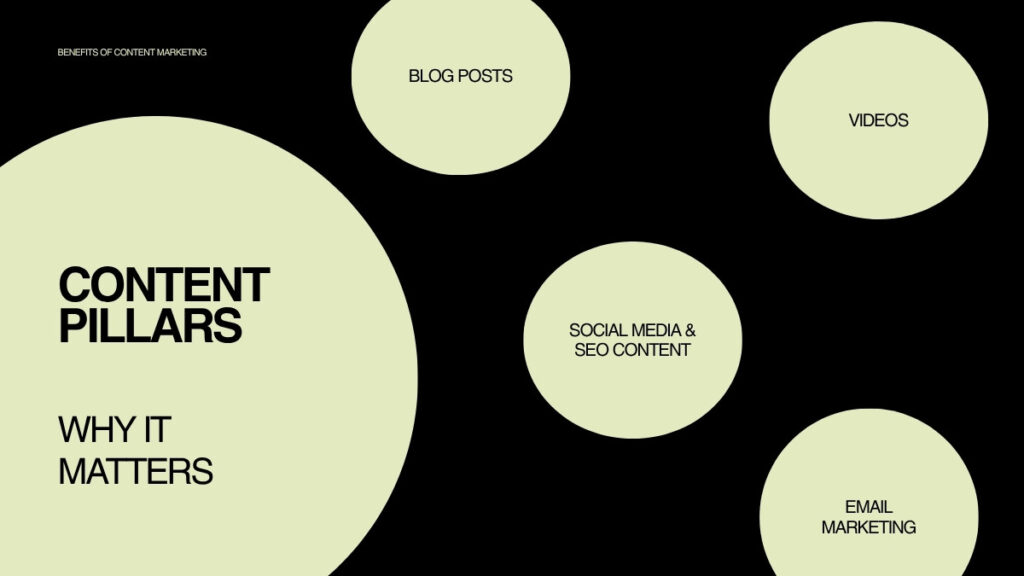
How Content Marketing Supports SEO, Social, Email, and Sales
Content marketing doesn’t sit off to the side; it powers your key channels.
- SEO: Search engines look for depth, relevance, and authority. Content marketing delivers the pages and internal linking structures needed to signal those qualities.
- Social: Posts that point to thoughtful content perform better than one‑off promotional blurbs. Robust content gives you an ongoing supply of ideas to share, remix, and discuss.
- Email: Without content, newsletters and nurture flows become repetitive. With content, they can educate, entertain, and move people toward key actions.
- Sales: Sales teams use content to answer questions, handle objections, and support proposals. A strong content library effectively scales your best salespeople’s explanations.
When you frame content as the shared resource underpinning these channels, it’s easier to align teams and justify budgets.
How to Unlock These Benefits: Strategy, Audience, and Distribution
Publishing alone does not guarantee benefits; the real gains come from aligning content with strategy, audience insight, and distribution.
- Clarify business objectives first. Decide whether the next 12 months are primarily about demand generation, market entry, brand repositioning, retention, or something else. That choice will influence which benefits you prioritise and what you publish.
- Deepen audience understanding. Go beyond basic personas. Use real conversations, support transcripts, and win/loss interviews to uncover the questions and concerns that actually drive decisions. Turn those into content topics and formats.
- Pick a realistic core mix of formats and channels. An early‑stage startup might choose blog + LinkedIn + email. A larger brand might add webinars, whitepapers, and an industry report. Focus on doing a few things well before spreading yourself thin.
- Put a process around consistency. Build an editorial calendar that aligns with campaigns, product releases, and seasonal topics. Agree on cadence and responsibilities so content production isn’t squeezed out by short‑term urgencies.
- Design distribution as part of creation. Plan from the start how each piece will be promoted: which email, which channels, which partners, which sales sequences. Avoid the “publish and hope” trap.
- Review performance and refine the mix. Use your KPIs to identify which topics, formats, and channels deliver the strongest benefits. Invest more where the data is clear; adjust or retire approaches that consistently underperform.
This approach gives content marketing a clear operating rhythm instead of leaving it as an ad‑hoc side project.
How to Measure Content Marketing Benefits
Measurement is what turns “content is important” into a discussion grounded in numbers.
Map Benefits to Metrics
For each benefit, pick a small set of metrics you can track consistently:
- Traffic & visibility: organic sessions, impressions, rankings, branded search volume.
- Lead generation: leads by content source, cost per lead, conversion rate from content‑driven leads.
- Sales support: win rate and sales cycle length for content‑touched opportunities vs others.
- Brand & trust: direct traffic trend, referrals, reviews mentioning content, NPS.
- Retention & LTV: churn, renewal rate, expansion revenue, LTV segmented by content engagement.
Build Simple Dashboards
Start with basic dashboards that list your top content pages and their traffic, engagement, and conversion metrics, show how many leads and opportunities can be attributed to content interactions, and track key brand and retention measures over time.
As maturity grows, you can add multi‑touch attribution and more advanced reporting, but even simple dashboards are enough to see trends.
Combine Quantitative Data with Stories
Metrics tell you what is happening. Stories explain why it matters. Capture comments from prospects who cite specific pieces as influential, examples where a case study or guide clearly unlocked a stalled deal, and instances where onboarding content clearly prevented churn.
Using both numbers and narratives makes it much easier to secure buy‑in and budgets.
Limitations and Risks of Content Marketing
A credible view of content marketing acknowledges when it is not the best fit or when expectations should be tempered.
Content marketing can be a poor fit when your target audience rarely uses search or online research to evaluate solutions, your sales cycle is extremely short and purely impulse‑driven, or your team cannot commit to a minimum level of consistent, quality output.
Even when it is a good fit, key risks include underestimating the time required to see measurable results, publishing generic content in crowded niches (which fails to differentiate), and ignoring distribution and measurement, leading to “random acts of content.”
Recognised authorities frame content as a long‑term, strategic investment that works best when integrated with the rest of the go‑to‑market plan. Treating it as a quick, isolated tactic is where many teams get disappointed.
How AI Is Changing the Benefits of Content Marketing
AI has reshaped how content is planned and produced, but it hasn’t changed the underlying benefits buyers seek.
Where AI is a lever:
- accelerates research and ideation, helping you discover topics faster;
- streamlines first drafts and repurposing, reducing time to publish;
- supports SEO and optimisation by suggesting related topics and structure.
Where AI introduces new demands:
- pushes you to be more distinctive; generic AI‑generated content is easy to spot and easy to ignore;
- requires strong editorial standards and brand guidelines to prevent off‑brand or incorrect output;
- makes measurement more important: you need to see what delivers impact, not just what’s easy to produce.
For serious content programs, AI becomes part of the toolkit, not the strategy. The strategy still revolves around understanding your audience, deciding which benefits matter, and building content that serves both.
Content Marketing Benefits FAQs
What are the main benefits of content marketing in simple terms?
At a high level, content marketing helps you attract the right people, turn more of them into customers, and keep those customers longer. It does this by answering their questions, building trust, and supporting them before and after they buy.
Is content marketing still effective in 2024 and beyond?
Yes. Major marketing platforms and analysts consistently report that buyers still rely heavily on online content to research problems and evaluate solutions. The bar for quality is higher, and channels have evolved, but helpful, relevant content remains central to how decisions get made.
How long does it take to see benefits from content marketing?
You can usually see early signals more engagement, better conversations, some ranking movement within a few months. More substantial gains in organic traffic, lead flow, and brand authority typically take 6–12 months or longer, depending on your starting point and competitive landscape.
How do I measure whether content marketing is working?
Connect your content to business metrics: traffic, leads, pipeline, revenue, and retention. Track which pieces and topics drive the most valuable actions such as qualified leads, sales opportunities, or renewals and look for growth in those metrics over time.
How do the benefits differ for B2B vs B2C businesses?
B2B companies generally use content to educate, build consensus among stakeholders, and support complex sales. B2C brands often focus on discovery, product education, and repeat purchases. The same core benefits apply, but the formats and emphasis differ (for example, case studies and reports vs lifestyle content and product guides).
How does content marketing compare to paid advertising in terms of ROI?
Paid ads can be great for quick spikes in traffic or testing offers, but performance often drops as soon as spend stops. Content marketing usually takes longer to ramp up, but it can deliver lower cost per lead and more durable ROI over time because assets keep working. Many teams see the best results by combining both: using paid to accelerate and content to build a sustainable foundation.
What are the main risks or downsides of relying on content marketing?
The biggest risks are misaligned expectations (expecting immediate results), under‑resourcing content production, and failing to differentiate your content in a noisy market. There’s also a risk in not measuring: without clear KPIs, it’s impossible to know whether your investment is paying off.
How can a small business with limited resources still get these benefits?
Small businesses can start by focusing on a narrow set of high‑impact topics and one or two formats. Answer the most important questions your best customers ask, publish consistently, and make sure each piece is shared through the channels you already use, such as email and one primary social platform. As you see what works, you can scale up strategically.
How SEOSERVICES1 Helps You Realise These Benefits
The organisations that get the most from content marketing don’t rely on luck. They design content programs around business goals, audiences, and measurable outcomes.
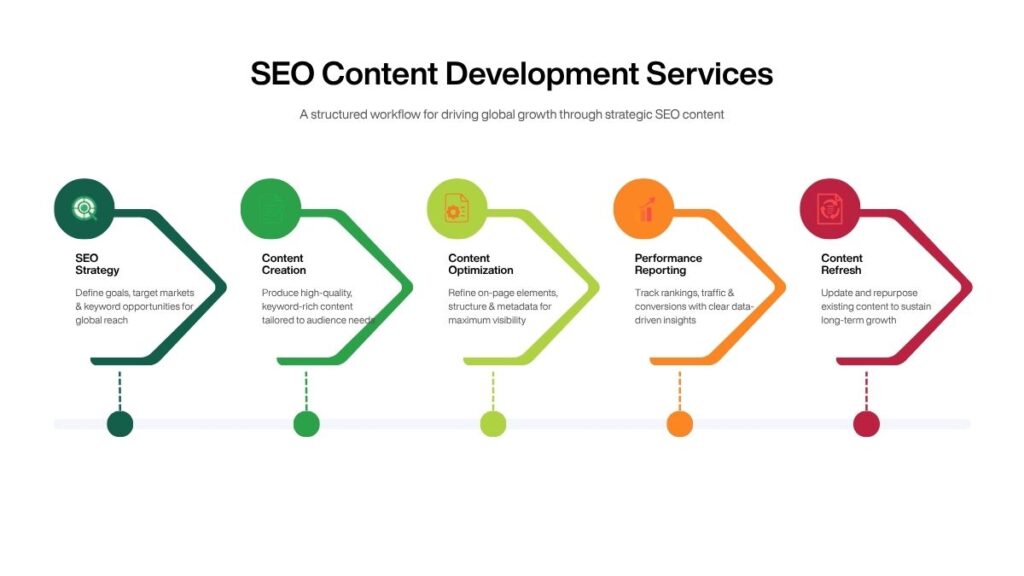
SEOSERVICES1 partners with you to clarify which content marketing benefits matter most for your current stage whether that’s more qualified inbound, stronger authority, better retention, or a mix; build a realistic content and SEO strategy that fits your team, market, and budget; create workflows that combine your internal expertise with smart tools and clear processes; and implement analytics and reporting so you can see, in concrete numbers, how content is moving the needle.
Whether you’re an early‑stage startup trying to reduce reliance on ads, a local service provider looking to generate steady inbound inquiries, or an established brand seeking to formalise content as a growth engine, SEOSERVICES1 can help you move from sporadic publishing to a disciplined, ROI‑driven content operation.