
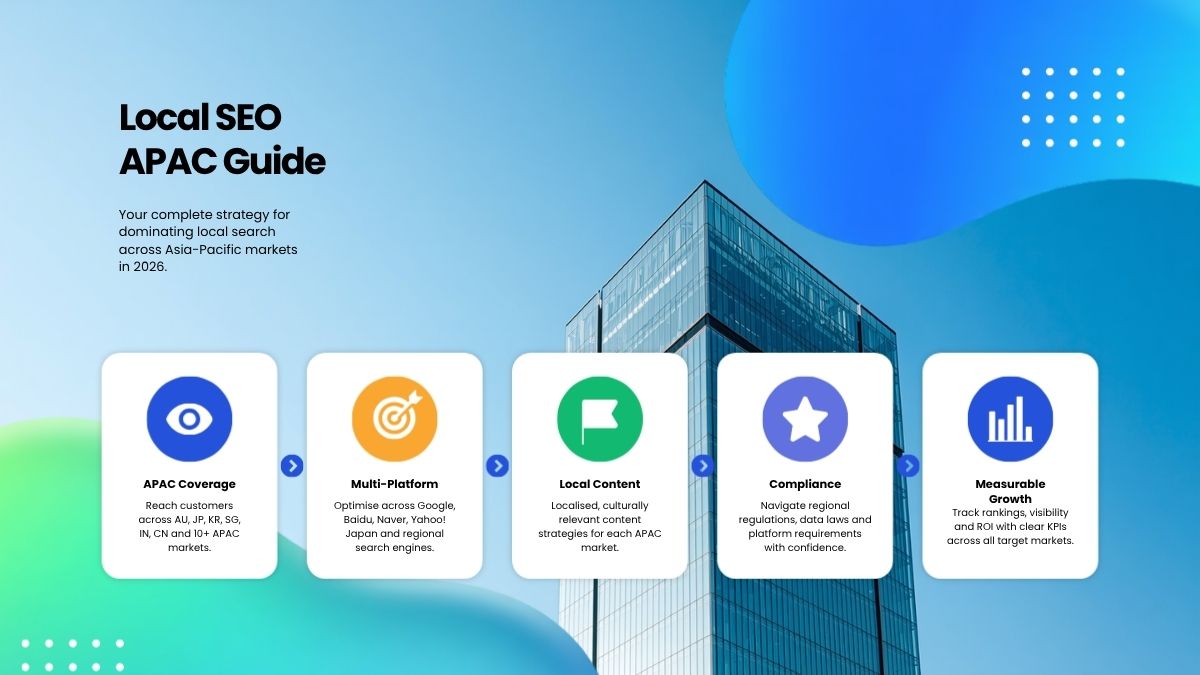
Instead of treating APAC as one market, effective programs prioritize specific countries and cities, adapt to Google-dominant versus local-platform ecosystems, and localize content for language, address formats, and mobile behavior. The result is not a single ranking trick, but consistent, accurate local presence where high-intent “near me” and “[service] in [city]” decisions happen.
What Is Local SEO APAC and How Does It Work?
Local SEO APAC is regional local search optimization across multiple Asia-Pacific countries, focused on map, local pack, and “nearby” results for each physical location.
It works by connecting three layers for every location you want to be found for:
- Discoverability: Claimed and complete profiles on the right search, map, and directory platforms for that market
- Credibility: Consistent name, address, and phone (NAP) data plus active review management and local photos
- Relevance: Location pages and localized content that match how people search in that city and language
Generic local SEO usually assumes one country, one language, and Google Search and Google Maps. Local SEO APAC assumes diversity from the start: different dominant platforms by country, multiple scripts and search behaviors, and dozens to hundreds of profiles that need centralized governance.
For a brand with locations in Singapore, Bangkok, Jakarta, and Tokyo, for example, the fundamentals are similar — accurate categories, hours, photos, and reviews — but the execution differs by market language, platform mix, and customer expectations.
Why APAC Cannot Use a Single-Country Local SEO Playbook
A single-country playbook fails in APAC because languages, platforms, address systems, and buying behaviors change at every border.
US teams expanding into the region often underestimate three factors:
1. Platform fragmentation In Singapore, Australia, New Zealand, Malaysia, and much of Southeast Asia, Google Search and Google Maps drive most local discovery. In mainland China, Baidu, AutoNavi (Amap), and Dianping-type ecosystems are central. In South Korea, Naver and KakaoMap shape local decisions. In Japan, Google coexists with Yahoo! Japan and vertical directories for dining, beauty, and healthcare.
A Google Business Profile (GBP)-only plan will underperform where customers start on a local app or portal.
2. Language and query variation Customers may search in English, Bahasa Indonesia, Thai, Vietnamese, Japanese, Korean, Simplified or Traditional Chinese, Hindi, or a mix. Transliteration, district names, landmarks, and “near me” phrasing vary widely. Direct translation of a US location page rarely matches local intent.
3. Operational and compliance differences Opening hours, holiday schedules, address formats, phone formats, service categories, and regulated categories such as healthcare, finance, and legal differ by market. Content, review responses, and data collection practices should be reviewed for local requirements. This page is not legal advice — have qualified local counsel review regulated listings and privacy workflows.
What this means for US headquarters teams
US headquarters needs central visibility without forcing every market into the same template. The practical model is centralized standards with localized execution: shared data rules, approval workflows, and dashboards, plus market-level language, platforms, and publishing.
What's Included in Our Local SEO APAC Services?
Our local SEO APAC services include market prioritization, profile management, citation cleanup, review operations, location content, and regional reporting for multi-location brands.
Core deliverables are scoped by number of locations, markets, and languages:
- APAC market and keyword prioritization: Which countries, cities, and districts to target first based on footprint, demand, and competition, plus mapped query types such as “[service] near me,” “[service] + city/district,” and map-app searches.
- Business profile setup and optimization: Claiming, verifying, categorizing, and completing profiles on Google Business Profile where relevant and on priority local platforms where needed. Includes names, categories, attributes, services, hours, photos, and localized descriptions.
- NAP and citation management: Audit and correction of name, address, and phone data across key directories and data sources. Standardized formats per market to reduce duplicates and customer confusion.
- Review strategy and response support: Review acquisition workflows, monitoring, multilingual response templates, escalation rules for negative or false reviews, and staff guidance. We do not post fake reviews or incentivize reviews in ways that violate platform policies.
- Location pages and local content: Search-friendly location hub and city/store pages with unique local information — services, transit access, service areas, staff, FAQs — in the appropriate language(s). No duplicated doorway pages.
- Technical support for multi-location sites: Hreflang and locale structure guidance, local business schema where appropriate, location finder usability, and mobile performance checks for map-driven users.
- Tracking and regional governance: Rank, profile interaction, call, direction-request, and website tracking by location and market, with a shared issue log for closures, moves, and hour changes.
All work is documented so internal marketing, operations, and regional partners can maintain accuracy after launch.
Which Platforms Matter for APAC Local Search?
The right platform mix depends on where your customers search, not where your HQ team searches.
Use this overview to plan coverage, then validate per city during onboarding:
| Market type | Example markets | Common discovery paths | Planning implication |
|---|---|---|---|
| Google-dominant | Singapore, Australia, New Zealand, Malaysia, Philippines, India metros | Google Search, Google Maps, Google local pack | Prioritize Google Business Profile, reviews, and English plus local-language location pages |
| Mixed Google + local verticals | Japan, Thailand, Indonesia, Vietnam, Taiwan | Google Maps plus local directories, food/beauty/medical portals, super-apps and ride/commerce apps | Add 1-3 priority verticals per market; localize photos, menus, and attributes |
| Local-ecosystem led | Mainland China, South Korea | Baidu / Amap / Dianping-type services in China; Naver / KakaoMap in Korea | Requires native-language profiles and separate content workflows; Google alone is insufficient |
Platform names and shares change over time. We confirm current usage per market before building profiles, rather than assuming last year’s mix still applies. Search volume and difficulty are not measured in this workflow; prioritization is based on your footprint, observed profile interactions, and Search Console and profile data as it accumulates.
Mobile and map-first behavior
Across dense APAC cities, local decisions are overwhelmingly mobile and map-driven. Customers scan distance, rating count, recent photos, concise categories, and open-now status before reading long copy.
That is why we prioritize scannable accuracy first: correct pin location, complete categories, current hours including holidays, clear service lists, and recent, representative photos. Long-form content supports relevance, but it does not replace a complete profile.
How We Run a Multi-Location APAC Program
We run local SEO APAC as a coordinated regional program with clear ownership for data, content, and changes across locations.
A typical engagement follows five stages:
1. Inventory and audit We inventory every location, profile, URL, and phone number. We flag duplicates, unclaimed profiles, wrong pins, inconsistent NAP data, missing categories, and thin or duplicated location pages.
2. Market blueprint We agree on priority markets, languages, platforms per market, naming conventions, and review response rules. Regulated industries get an additional compliance check with your legal team.
3. Fix foundations We claim and verify profiles, correct core data, merge or remove duplicates where platforms allow, and publish or rewrite core location pages. Quick operational wins — hours, categories, pins, photos — usually come first.
4. Build reputation and relevance We implement review request and response workflows, add localized FAQs and services, earn relevant local mentions, and expand to secondary directories only where they support discovery.
5. Measure and govern We report by location, city, and country: profile views, calls, direction requests, website actions, and supporting organic performance. A change log tracks opens, closes, relocations, and hour updates so profiles do not drift.
Governance for 10 to 500+ locations
Without ownership rules, multi-location data decays quickly. We define who can edit what, how new stores are launched in search, and how closures are handled, so marketing, operations, and local staff do not overwrite each other.
Who Is Local SEO APAC For — and Who Should Skip It?
Local SEO APAC is for location-dependent businesses with a real APAC footprint that need calls, visits, bookings, or direction requests from nearby customers.
Good fit if you:
- Operate physical stores, restaurants, clinics, gyms, hotels, auto centers, or service branches in two or more APAC markets
- Serve defined service areas, such as home services, logistics, or B2B field sales, in APAC metros
- Are a US or global brand localizing for APAC expansion and need centralized reporting with local execution
- Have operations support to keep hours, services, and photos current
Not a fit if you:
- Sell only nationally online with no local intent or service-area relevance
- Have a single APAC test location and no plan to maintain reviews and listings consistently
- Expect instant map rankings without fixing data accuracy, categories, and reputation basics
- Need Baidu or Naver paid media, app-store optimization, or offline directory registration only — those are separate workstreams
If you are unsure, start with an audit of your top 10 to 20 APAC locations. It will show whether data issues, reputation gaps, or content gaps are limiting visibility before you commit to a full regional build.
Timelines, Costs, and Realistic Expectations
Most APAC local programs need 3 to 6 months to stabilize foundations across markets, with ongoing gains as reviews, photos, and location content accumulate.
What to expect realistically:
- Months 1-2: Audit, verification, duplicate cleanup, core NAP and hour fixes, and priority profile completion. Early gains often come from corrected pins, categories, and open-hours accuracy.
- Months 3-4: Location page rewrites, review workflows, photo updates, and secondary platform coverage. Profile interactions such as calls and direction requests typically become more measurable.
- Months 5+: Market-by-market refinement based on performance data, expansion to additional cities, and steady reputation building.
Timelines vary by verification delays, number of languages, platform approval times, and how quickly locations provide accurate operational details. No agency can guarantee map-pack positions, and anyone who does should be questioned. Sustainable local visibility depends on accurate data, genuine reviews, competitive relevance, and proximity — factors no provider fully controls.
Scoping is based on location count, market count, language count, and current data quality. To get an accurate plan, prepare a current store list with addresses in local format, local phone numbers, primary categories, and contacts who can approve changes in each market.
To discuss scope for your footprint, contact SEOSERVICES1 with your APAC location list and priority cities.
Related work
Core SEO work that usually sits alongside a regional programme in APAC local SEO.
Local search
Local SEO services help US businesses appear clearly and consistently when nearby customers search in Google Search and Google Maps for services they need. For businesses that depend on calls, bookings, quote requests, and store visits, local SEO connects Google Business Profile optimization, accurate business data, relevant local pages, reviews, and technical foundations to measurable enquiry activity.
Technical audit
SEO Audit Services to help businesses with better clarity about what aspects of the website are supporting, restricting, or confusing search performance.
Content production
SEOSERVICES1 assists companies around the globe with crafting website content that is search-friendly, clear for customers, generates inquiries, and leads to transactions. We integrate planning, research, writing, optimizing, internal linking, and final proofreading so that each major page clearly defines its position to a customer journey.