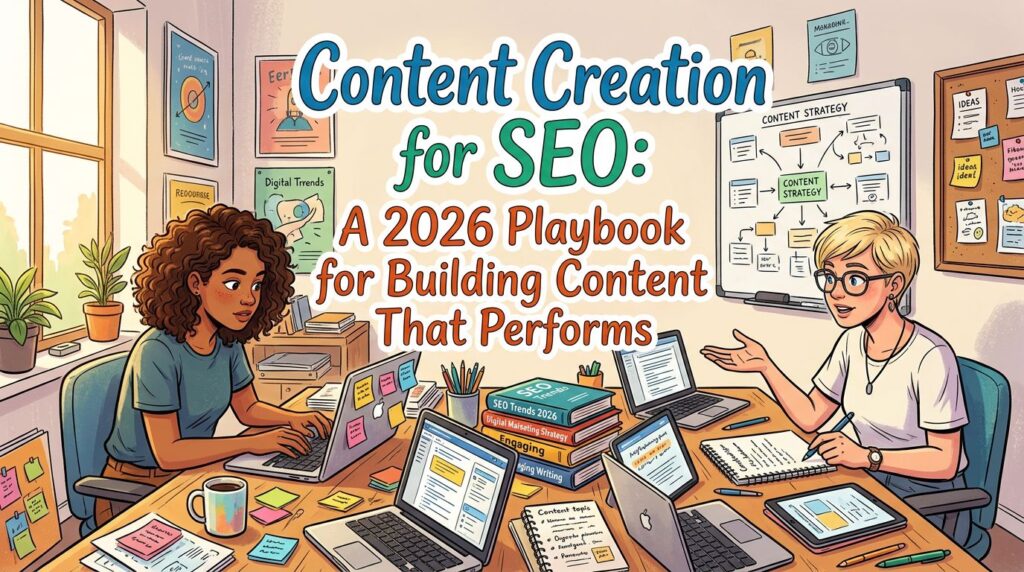
Most teams don’t run out of content ideas they run out of focus. There are more types of content marketing than ever, but only a handful will genuinely move the needle for your business at any given time. As of 2026, most marketing surveys still show the same pattern: blogs, email, video, and social are the backbone, while more advanced formats like interactive tools and communities sit on top of that foundation for teams with extra capacity.
This guide is for marketers, small business owners, and content managers who want to turn “we should create more content” into a clear, realistic plan. You’ll see the main types of content marketing organized into four practical groups, how each group supports different stages of the content funnel and business goals, and how to build a content mix that fits your resources whether you’re a solo operator or running a larger team.
What Are the Main Types of Content Marketing?
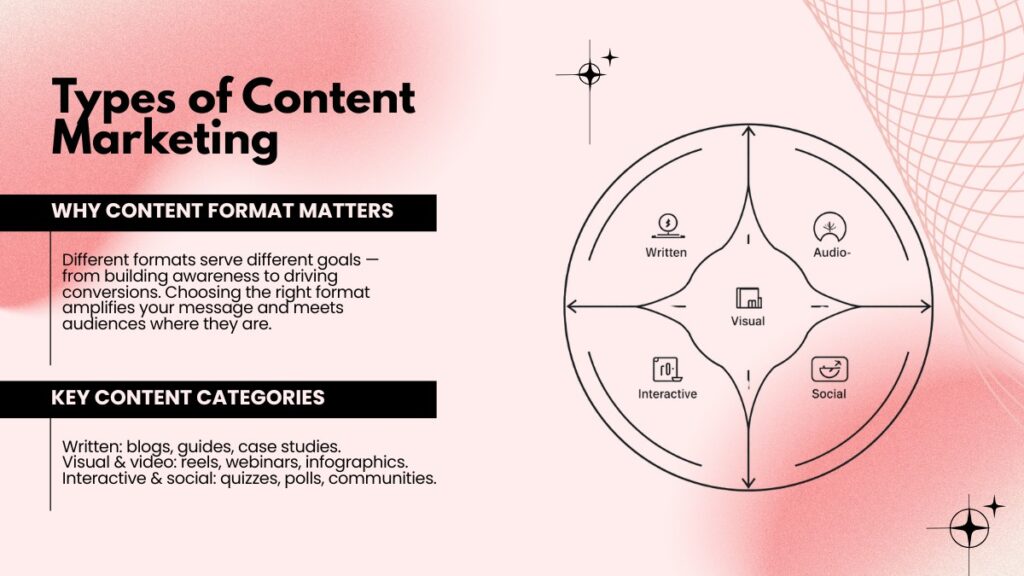
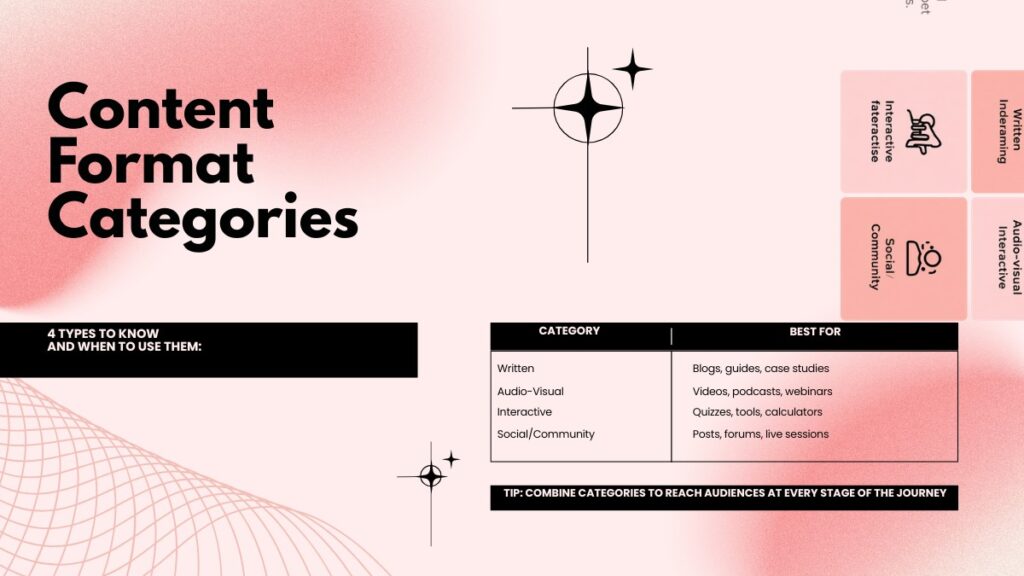
The main types of content marketing are the different formats and content channels you use to deliver value blog posts, long‑form guides, videos, podcasts, email newsletters, interactive tools, social posts, communities, and more. Underneath the long lists you see in most articles, these formats cluster into four big families: written content, audio‑visual content, interactive content, and social or community‑driven content.
In most studies and platform reports, written content and email remain the most widely used formats for search traffic and lead nurturing, while video and social content drive engagement and brand visibility. Interactive content and communities are still less common, but they tend to deliver strong engagement when teams have the time or budget to do them well. Thinking in these four groups stops you getting lost in a laundry list of 20 formats and helps you design a content mix with a clear job for each type.
In One Sentence: What “Content Marketing Types” Really Means
When we talk about “types of content marketing,” we’re talking about the set of content formats and channels you can pull from and combine to attract the right people, educate them, and guide them from first touch through to purchase and loyalty.
The Four Main Groups of Content Marketing Types
Grouping the types of content marketing into four families written, audio‑visual, interactive, and social/community gives you a practical map of your options. Each group comes with its own strengths, drawbacks, and typical outcomes.
Group 1 – Written Content Types
Written content types are text‑driven formats that usually live on your website, in documents, or inside email. They are still the backbone of most content strategies because they’re relatively affordable to produce, easy to search, and versatile to repurpose.
Common written content types include:
Blog posts and articles What they are: Short to medium‑length pieces that answer questions, comment on trends, or share how‑to advice. Why marketers choose them: They are the workhorse of search‑based content marketing formats and a key part of topic clusters. A well‑structured blog library can quietly handle a large percentage of your organic traffic and early‑stage education. Outcomes they support: Awareness, early consideration, SEO visibility, email list growth when paired with opt‑ins. Key metrics: organic traffic, impressions, time on page, scroll depth, internal link clicks, assisted leads or sales. Pros: Relatively low production cost, easy to iterate, flexible topics. Cons: Competitive, requires consistency, results build over months not days.
Long‑form guides and pillar pages What they are: In‑depth cornerstone pieces (often 2,000+ words) that comprehensively cover a theme such as “types of content marketing” or “B2B lead generation strategy.” Why marketers choose them: They anchor topic clusters, signal expertise, and give sales and success teams a substantial resource to share. For many brands, a handful of strong pillars drive a disproportionate share of organic pipeline. Outcomes they support: High‑intent traffic, lead generation via embedded CTAs, improved topical authority. Key metrics: rankings on core terms, visits from ideal audiences, conversions to key actions, appearance in opportunity journeys. Pros: Strong SEO upside, long shelf life, great repurposing source. Cons: Time‑intensive to create; needs periodic updating to stay current.
Ebooks and downloadable guides What they are: Packaged resources, usually offered in exchange for an email address or basic contact details. Why marketers choose them: They bridge the gap between “anonymous visitor” and “known lead,” especially valuable for demand gen and email‑centric funnels. Outcomes they support: Lead capture, nurture entry, segmentation (based on topic interest). Key metrics: download rate, lead quality, progression to sales conversations or product adoption. Pros: Good for campaigns and paid promotion, perceived as higher value. Cons: Can underperform if the value is vague or if the market is oversaturated with generic PDFs.
Whitepapers and reports What they are: More formal, research‑driven documents often used in complex B2B decisions. Why marketers choose them: They carry weight with senior stakeholders and technical buyers, especially when backed by original data. They’re common in industries where buyers expect a deeper analysis. Outcomes they support: Thought leadership, serious consideration, entry into RFP or shortlist conversations. Key metrics: downloads from target accounts, citations in sales calls, references in external content. Pros: Strong credibility for high‑stakes decisions; good PR and link‑building potential. Cons: Research and production can be costly; results depend heavily on perceived rigor.
Case studies What they are: Stories that show how a customer moved from challenge to outcome using your product or service. Why marketers choose them: Late‑stage buyers repeatedly say they want “proof from companies like ours,” and case studies are the clearest way to provide that. They also double as sales enablement content. Outcomes they support: Decision confidence, win rates, shorter sales cycles. Key metrics: views by active opportunities, frequency of use by sales reps, correlation with closed‑won deals, expansion outcomes. Pros: High impact close to the point of purchase; can be repurposed across multiple content channels. Cons: Requires customer cooperation, sensitive metrics, and careful storytelling.
Email newsletters and sequences What they are: Ongoing newsletters and automated sequences that deliver content directly into inboxes. Why marketers choose them: Email remains one of the highest‑ROI channels in most benchmarks when people opt in, they’re giving permission to stay in touch. Outcomes they support: Nurturing, repeat visits, product adoption, promotions, and community building. Key metrics: open rate, click‑through rate, reply rate, unsubscribes, revenue or pipeline influenced per email. Pros: Owned channel, low marginal cost, strong for relationship‑building. Cons: Requires consistent value; weak content can quickly drive unsubscribes.
Landing pages What they are: Focused pages built around specific offers downloads, demos, trials, consultations, etc. Why marketers choose them: Landing pages turn attention into action and give you clean data on which offers resonate with which audiences. Outcomes they support: Lead capture, sales inquiries, purchases, campaign measurement. Key metrics: conversion rate, cost per lead or sale (if combined with paid traffic), downstream pipeline. Pros: Highly measurable, directly tied to business outcomes. Cons: Depend heavily on clear messaging and alignment between traffic source and promise.
Beginner scenario (written‑first): Picture a solo marketer at a B2B consulting firm. They commit to one solid blog post per week answering client questions, create straightforward service landing pages, and send a monthly email roundup. Within 6–9 months, they see a consistent trickle of search traffic, more prospects referencing “that article you wrote,” and a growing list of subscribers that sales can work with. No fancy formats just written content types used intentionally across the content funnel.
Group 2 – Audio‑Visual Content Types
Audio‑visual content types video, webinars, live streams, podcasts, and visual explainers bring your message to life in a way text alone sometimes can’t. They typically require more effort, but they can dramatically increase engagement and help your brand stand out in crowded feeds.
Key audio‑visual content types include:
Videos (short and long‑form) What they are: Everything from 30‑second social clips to in‑depth product walkthroughs and recorded presentations. Why marketers choose them: Many buyers now treat YouTube and social platforms as search engines. Video is ideal for showing how your product works and giving a face or voice to your brand. Outcomes they support: Awareness (snackable clips), consideration (how‑to videos), and sales (demos or feature tours); they also assist onboarding when reused post‑sale. Key metrics: views, watch time, completion rate, click‑through to site or product, assisted conversions. Pros: High engagement, strong storytelling potential, good repurposing source. Cons: Higher production effort; sound/video quality expectations have risen, especially in B2B.
Webinars and virtual events What they are: Live or pre‑recorded sessions where you teach, demo, or host conversations, usually with a registration step. Why marketers choose them: People who register and actually attend a 30–60 minute webinar are often further along in their journey and open to follow‑up. Outcomes they support: Lead generation, mid‑funnel education, sales acceleration when integrated with outreach. Key metrics: registrations, attendance rate, engagement (questions, chat), meetings booked, opportunities and revenue influenced. Pros: High signal intent, strong for building authority and trust. Cons: Requires coordination, presenters, and promotion; low attendance can be demoralizing if expectations aren’t set realistically.
Live streams What they are: Real‑time sessions on platforms like LinkedIn or YouTube often more informal than webinars. Why marketers choose them: They create immediacy and show authenticity, especially for behind‑the‑scenes looks or recurring shows. Outcomes they support: Awareness, community engagement, and rapid feedback from the audience. Key metrics: live viewers, comments, replays, actions taken during or after the stream. Pros: Lightweight way to test topics; strong for building a recurring audience. Cons: Less polished; requires comfort with speaking live and handling unpredictability.
Podcasts What they are: Audio series people listen to while commuting, exercising, or working. Why marketers choose them: Podcasts build long‑term familiarity and trust, especially in niches where listeners value depth over quick tips. Outcomes they support: Thought leadership, brand affinity, and warm‑inbound conversations (“I’ve been listening to your show”). Key metrics: subscribers, downloads per episode, retention rate, mentions in sales or customer calls. Pros: Deep engagement with a loyal audience, strong for relationship‑driven industries. Cons: Requires consistent production and a point of view; harder to attribute directly to revenue.
Infographics and visual explainers What they are: Visually rich pieces that compress complex information into a graphic or series of slides. Why marketers choose them: They make dense content easier to digest and share, often performing well on social and in sales decks. Outcomes they support: Awareness, link‑building potential, better comprehension in guides or reports. Key metrics: shares, backlinks, time on page when embedded, usage in sales and presentations. Pros: Can dramatically improve engagement with written content; versatile across channels. Cons: Requires design skills; easy to produce generic visuals that don’t add real value.
Intermediate scenario (adding video): An e‑commerce brand has been relying on blog content, email promotions, and basic product pages. They decide to test audio‑visual types by creating simple product demo videos and styling tips, filmed on a phone but edited cleanly. They embed these videos on product pages and share them on social. Over a few months, they notice higher time on page, reduced product returns for items with videos (because expectations are clearer), and more sales attributed to visitors who watched at least one clip.
Group 3 – Interactive Content Types
Interactive content types invite your audience to click, type, or choose something, turning content from a one‑way broadcast into an experience. They take more planning but often yield better engagement and richer first‑party data.
Common interactive content types include:
Quizzes What they are: Short assessments or “find your fit” tools that end with a personalized result. Why marketers choose them: People like to learn about themselves; quizzes tap into that curiosity and can segment leads by needs, level, or use case. Outcomes they support: Lead generation, segmentation, early education (“here’s your situation and what it means”). Key metrics: quiz starts, completion rate, opt‑in rate, downstream performance of each segment. Pros: High engagement; can power personalized follow‑up content. Cons: Requires thoughtful logic and copywriting; poor alignment between quiz and offer can damage trust.
Calculators and ROI tools What they are: Simple tools where users input data and see estimated savings, revenue, or impact. Why marketers choose them: They help justify budget and timing decisions, especially for larger purchases. Sales teams often adopt them eagerly. Outcomes they support: Decision‑stage confidence, better business cases, stronger opportunities. Key metrics: usage volume, completion rate, number of leads generated, impact on close rate for deals where the tool was used. Pros: High perceived value; strong differentiation in crowded categories. Cons: Needs accurate assumptions and clear explanations; can be costly to build well.
Polls and micro‑surveys What they are: Quick questions embedded in blog posts, emails, or social posts. Why marketers choose them: They lower the barrier to participation and surface opinions or challenges you might otherwise miss. Outcomes they support: Engagement, content ideas, data to use in future reports or posts. Key metrics: response rate, number of responses, follow‑up actions taken based on insights. Pros: Easy to implement; can seed future content with real audience data. Cons: Limited depth; results can be skewed by small or biased samples.
Interactive infographics & mini‑apps What they are: Visual or functional tools where hovering or clicking reveals more content or personalized outputs. Why marketers choose them: They stand out compared with static content and can make complex topics easier to explore. Outcomes they support: Awareness, engagement, authority in technical or data‑heavy areas. Key metrics: interactions per session, time on page, shares, backlinks. Pros: Memorable experiences; strong link‑worthy assets if done well. Cons: Higher design/dev investment; must be genuinely useful to justify the effort.
Mature scenario (adding interactive): A mid‑size SaaS company already has a solid content marketing mix with blogs, webinars, email, and case studies. They notice that opportunities where prospects request custom ROI analyses close at a higher rate. To scale that, they build a simple online ROI calculator and a “readiness checklist” quiz. Marketing features these on relevant pages; sales links to them in follow‑up emails. Within a couple of quarters, they see that deals involving the calculator progress faster and close more often, so they invest more in interactive formats for other key use cases.
Group 4 – Social and Community‑Driven Content Types
Social and community‑driven content types rely on networks and relationships, not just your own publishing calendar. This group covers the content that lives in feeds, groups, and conversations, as well as content created by your audience.
Key social and community‑driven content types include:
Social media posts and threads What they are: Short updates, carousels, threads, or image posts on platforms such as LinkedIn, Instagram, TikTok, or X. Why marketers choose them: They’re ideal for distributing your other content, sharing quick insights, and building a visible presence where your audience already spends time. Outcomes they support: Awareness, early engagement, “light‑touch” relationship building. Key metrics: impressions among target followers, engagement rate (comments, saves, shares), clicks, follower growth. Pros: Fast feedback loops; good for testing messages before committing to bigger assets. Cons: Content shelf life can be short; algorithms can be unpredictable.
User‑generated content (UGC) What it is: Content created by customers or fans, such as photos, unboxing videos, testimonials, or posts about their experience. Why marketers choose it: People trust peer voices more than brand claims; UGC acts as social proof that your promises hold up in the real world. Outcomes it supports: Conversions, brand trust, community feel. Key metrics: volume and quality of UGC, use of branded hashtags, conversion rate influenced by UGC placements. Pros: Highly authentic; can be repurposed across your site, ads, and emails with permission. Cons: You can’t fully control what people post; gathering high‑quality UGC takes ongoing effort.
Influencer and creator collaborations What they are: Partnerships where creators talk about your product or co‑create content. Why marketers choose them: They give you access to established audiences and trust, particularly in consumer and niche B2B verticals. Outcomes they support: Awareness, credibility with niche audiences, and sometimes direct sales through tracked links or codes. Key metrics: reach among relevant audiences, engagement, tracked conversions, new followers, and list sign‑ups. Pros: Can accelerate growth in new segments; adds fresh voices to your narrative. Cons: Requires vetting and clear expectations; results vary widely based on fit.
Communities and groups What they are: Spaces like Slack/Discord communities, forums, or private groups where customers and prospects interact. Why marketers choose them: Communities create ongoing touchpoints, facilitate peer‑to‑peer support, and generate a steady stream of qualitative insights and content ideas. Outcomes they support: Retention, expansion, referrals, and product feedback. Key metrics: active members, participation rate, user‑generated threads, opportunities sourced or influenced. Pros: High loyalty and insight; content and discussion generated by members. Cons: Community health requires moderation, consistent presence, and clear boundaries.
Reviews and testimonials What they are: Written or video feedback from customers on third‑party platforms and your own site. Why marketers choose them: Reviews are often the last content type a buyer reads before making a decision especially in local, SaaS, and e‑commerce contexts. Outcomes they support: Decision confidence, reduced perceived risk, higher conversion rates. Key metrics: average rating, review volume, content of reviews (themes and keywords), conversion rate changes after adding visible proof. Pros: Essential trust drivers; often expected by buyers. Cons: Requires ongoing reputation management; negative reviews must be handled thoughtfully.
Growing‑brand scenario (adding community): A DTC brand selling wellness products already uses content formats like short video, UGC, and email to drive sales. To deepen loyalty, they launch a private community for customers with weekly Q&A sessions, user tips, and early access to new products. Over time, the community becomes a place where new buyers get reassurance from existing customers, and the brand sees a higher repeat‑purchase rate among members compared to non‑members.
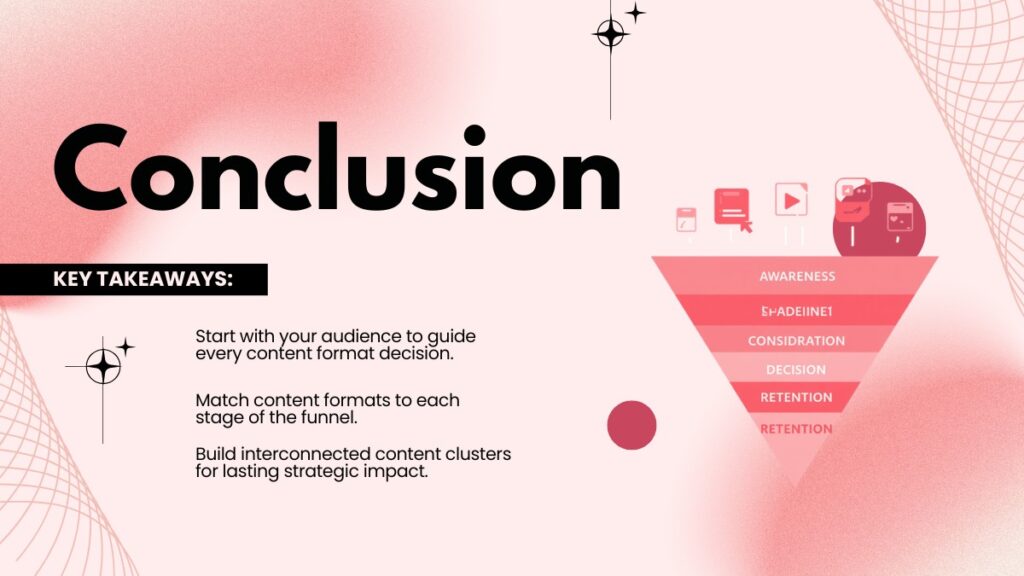
Content Types by Funnel Stage (Awareness, Consideration, Decision, Retention)
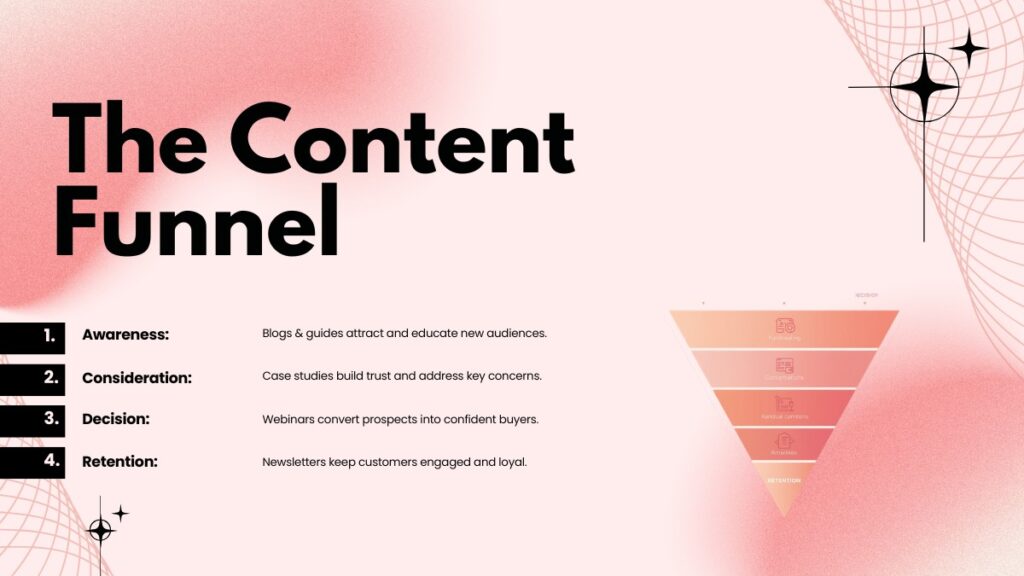
It’s much easier to justify time spent on different types of content marketing when you can point to their role in the content funnel. This section maps formats to awareness, consideration, decision, and retention so you can check for gaps.
Awareness (Top of Funnel) Content Types
Awareness content introduces your brand and helps people name their problem or opportunity. At this stage, your job is to show up where they’re already searching or browsing with something genuinely useful.
Strong awareness content types:
Educational blog posts and articles on core problems or questions
Short videos and explainers (especially on social and YouTube)
Infographics and visual one‑pagers that simplify complex concepts
Social posts and threads that share quick lessons or insights
Awareness metrics to watch: impressions, unique visitors, search rankings, video views, and new site visitors who later return or subscribe.
Consideration (Middle of Funnel) Content Types
Consideration content supports people who have acknowledged their problem and are exploring solution types and vendors. They’re willing to invest more time if they feel they’re learning something meaningful.
Strong consideration content types:
Long‑form guides and pillar pages that go deeper than basic blog posts
Consideration metrics to watch: guide downloads, webinar registrations and attendance, time on page for longer pieces, repeat visits, and new leads that move into sales conversations.
Decision (Bottom of Funnel) Content Types
Decision content helps buyers and their stakeholders answer “Why you? Why now?” It should remove friction, address risks, and make the path to a “yes” feel safe.
Strong decision content types:
Detailed case studies aligned with key segments
Product demo videos, on‑demand tours, and comparison walkthroughs
ROI calculators, pricing pages, and feature comparison tools
Focused landing pages that pair offers with proof
Reviews, testimonials, and UGC near conversion points
Decision metrics to watch: demo requests, trial sign‑ups, proposal requests, close rate, sales cycle length, and the presence of these assets in closed‑won journeys.
Retention and Advocacy Content Types
Retention and advocacy content helps existing customers succeed and gives them reasons to stick around and talk about you. In many models, this content has a higher long‑term ROI than net new acquisition.
Strong retention/advocacy content types:
Onboarding guides and help center content
Advanced playbooks showing “power user” workflows
Customer‑only webinars, office hours, and community events
Community threads that highlight wins and creative use cases
Expansion case studies and co‑marketing content
Retention metrics to watch: activation rates, feature adoption, engagement with help and education content, renewal rate, expansion revenue, and referral volume.
Content Types vs Funnel Stage (Quick Reference)
Content Type
Best Funnel Stage(s)
Blog posts
Awareness, early consideration
Long‑form guides
Awareness, consideration
Ebooks/whitepapers
Consideration
Case studies
Consideration, decision, retention
Webinars
Consideration, decision
Product demos
Decision
ROI calculators
Decision
Email newsletters
Consideration, retention
Social posts
Awareness, consideration
Communities
Retention, advocacy
Content Types by Marketing Goal (Awareness, Leads, Sales, Retention)
Beyond funnel stages, it helps to connect types of content marketing to specific objectives: brand awareness, lead generation, conversions, and retention or loyalty.
Best Content Types for Brand Awareness
If your priority is getting your name and ideas in front of more of the right people:
Educational blog posts and thought leadership pieces
Short videos and explainers optimized for social and search
Podcasts and interviews that live on platforms your audience already uses
Social threads and carousels that distill key ideas
Infographics that people want to share or reference
These formats are particularly useful in categories where prospective customers don’t yet know they have a problem, or haven’t heard of your solution type.
Best Content Types for Lead Generation
If your content funnel needs more qualified leads entering the pipeline:
Ebooks, checklists, and templates offered behind a simple form
Webinars with a clear promise and curated topic
Quizzes that deliver personalized answers and offer follow‑up content
High‑intent landing pages promoted via search and paid campaigns
Here, the combination of perceived value and friction level matters. The more time or information you ask for, the clearer the value needs to be in your messaging.
Best Content Types for Conversions and Sales
If your focus is converting engaged prospects into customers:
Case studies that mirror your ideal customers and highlight relevant metrics
Product demo videos, live demos, and guided tours
ROI calculators that quantify benefits in your buyer’s language
Decision‑oriented email sequences that address common objections
Reviews and testimonials at critical decision points
In complex sales, these formats often give champions inside the buying committee the tools they need to convince other stakeholders.
Best Content Types for Retention and Loyalty
If you want customers to stay, use more of what they’ve bought, and become advocates:
Onboarding content that shortens time to first value
Feature‑specific help content and advanced “playbooks”
Customer‑only webinars, Q&A sessions, and community events
Personalized product tips or training delivered via email or in‑app
Co‑created content with customers (case studies, webinars, community posts)
This side of content marketing is frequently under‑resourced compared with acquisition, even though improvements here directly influence lifetime value.
How to Choose the Right Types of Content Marketing for Your Business
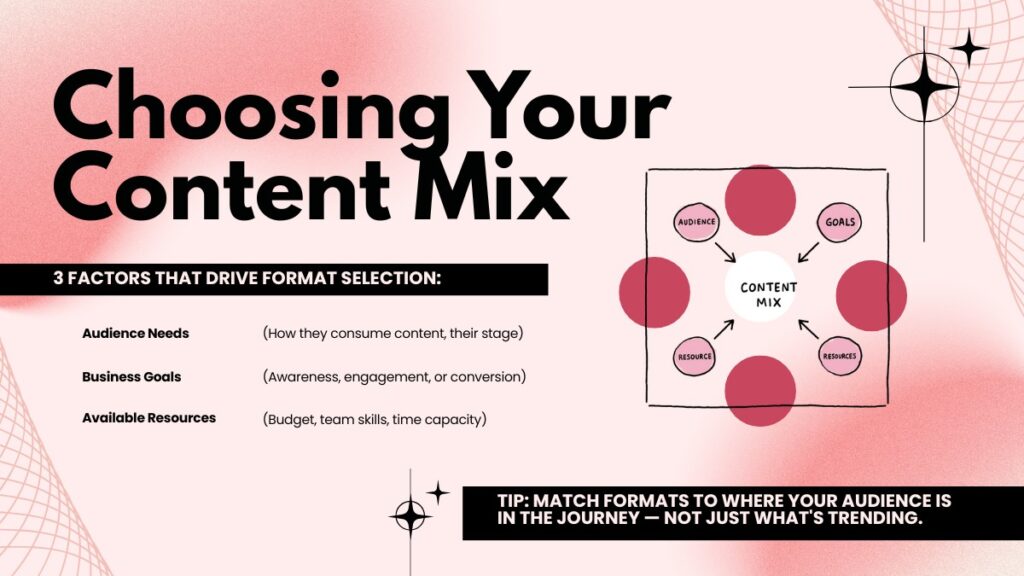
Choosing among the types of content marketing isn’t about ticking boxes on a master list. It’s about narrowing down to a content mix that matches your audience, your product, your team, and your most important goals.
Start with Audience and Industry
Begin by looking outward, not inward:
Where do your ideal customers go to learn search, YouTube, LinkedIn, industry newsletters, online communities?
Do they tend to consume long‑form content, prefer quick hits, listen to podcasts, or watch demos?
In your niche, what formats feel credible formal reports and webinars, or casual short‑form video and UGC?
For example, a B2B SaaS company selling to revenue leaders might get better results from long‑form guides, case studies, webinars, email, and LinkedIn posts than from trying to dominate Instagram Reels. A DTC brand, on the other hand, might lead with product video, UGC, and lifestyle email content because that’s how their buyers are used to discovering and evaluating brands.
Factor in Resources, Skills, and Budget
Next, sanity‑check your options against your capacity:
Solo operator: Start with 2–3 written types (website pages, blog posts, a simple email newsletter) and one social channel where you can realistically show up. Consider occasional webinars once you have a small list.
Small team (2–4 marketers): Add more long‑form guides, a regular webinar or live format, basic video content, and more systematic email sequences. You might also test a simple quiz or calculator if it’s closely tied to your offer.
Larger org: Layer on more advanced formats like a podcast, interactive tools, robust communities, and more developed video content while maintaining a strong written base and email program.
Each group of content types has a resource profile. Written content is generally cheaper but slower to build momentum; video and interactive content formats can move faster in the right hands but demand more specialized skills or budget.
Look at Where Your Audience Already Spends Time
Spend a few hours taking the journey your prospects would take:
Search your main topics and see which content formats dominate the first page.
Follow influencers or brands your audience already trusts and study their content mix.
Join the communities and follow the newsletters your buyers read.
Patterns will start to emerge if the top results and shared posts in your space are long‑form guides and in‑depth webinars, that points you one way; if the space is dominated by short video and community discussion, that points another.
Align Types with Your Immediate Goals
Finally, be clear on your priorities for the next 6–12 months and choose content types accordingly:
Need more awareness? Focus on educational articles, short videos, and consistently valuable social content.
Need more leads? Layer in webinars, lead magnets, and strong landing pages that capture interest.
Need more sales? Double down on case studies, demos, calculators, and targeted email sequences that address real objections.
Need better retention? Invest in onboarding and success content, and consider starting or nurturing a community.
Once you’ve mapped your audience, resources, and goals, you’ll likely see a shortlist of types of content marketing that make sense right now and others you can park for later. If you want support turning that shortlist into a structured content plan and content funnel, a partner like SEOSERVICES1 can help you design and execute it.
Turning One Asset into Many: Repurposing and Content Systems
A sustainable content strategy relies on repurposing. Instead of treating each content type as a separate project, you start with a core asset and spin it out into multiple formats and content channels. This is how you cover more ground without burning out your team.
Example: Repurposing a Long‑Form Guide
Imagine you create a 3,000‑word guide on “how to choose the right types of content marketing.” From that single asset, you can create:
3–6 shorter blog posts focused on specific subtopics (e.g., “written vs video formats,” “interactive content ideas”).
A live or recorded webinar walking through the framework in 45 minutes.
A series of short videos, each highlighting one key step or decision.
A set of social posts and carousels with the main diagrams or tables.
An email mini‑series that introduces each decision step and links back to the guide.
A one‑page checklist or printable version for readers who want a quick reference.
This approach turns one heavy lift into a whole content system across formats. It also ensures consistency: each piece reinforces the same core message in a different format.
Example: Repurposing a Webinar or Live Session
A well‑executed webinar is another excellent hub for repurposing across types of content marketing:
Publish the recording as an on‑demand resource with a lead capture form.
Write a recap blog post summarizing key points and embed the video.
Cut the recording into short clips for social and email, each with a specific takeaway.
Reuse slides or diagrams as standalone infographics or carousel posts.
Turn the Q&A section into an FAQ article or “ask the expert” email.
By planning this repurposing up front, you shift from creating one piece at a time to designing reusable content assets that feed your entire content mix.
Building a Sustainable Content System
To make repurposing a habit rather than an afterthought:
Design briefs that include “primary format + repurposed formats” from day one.
Standardize a few repurposing flows (e.g., guide → posts + social + email; webinar → replay + clips + recap + FAQ).
Track which derived formats perform best so you know what to prioritize next time.
Over a year, this tilt toward content systems usually results in more visibility, a richer content mix, and less stress on your team.
How Different Content Types Support SEO and Topic Clusters
Your choice of content types and your SEO approach are deeply intertwined. Written formats anchor your topic clusters, while audio‑visual, interactive, and social formats amplify those clusters and send positive engagement signals.
Search‑Focused Types: Blogs, Guides, and Landing Pages
Search‑focused content types are the core of most organic strategies:
Blogs and articles capture long‑tail questions and topical queries.
Pillar pages and long‑form guides target broader, higher‑value topics.
Landing pages align with commercial or transactional intent.
These formats help you:
Show up when prospects actively search for answers or vendors.
Build topical authority by covering interrelated topics across your site.
Create a solid internal linking structure that guides visitors through your content funnel.
For example, around the topic “types of content marketing,” you might create a pillar guide (like this one), supporting posts on each group (written, audio‑visual, interactive, social/community), and detailed pieces on repurposing and measurement.
Support Types: Video, Social, and Interactive Content
Other content formats might not be the main ranking assets, but they strongly support SEO performance:
Videos embedded in key articles can improve time on page and clarity.
Social content can drive bursts of traffic, brand searches, and occasional backlinks when posts go beyond your existing audience.
Interactive tools (like calculators) are often linked by other sites if they genuinely help users, which can boost your domain’s authority.
Search engines care about whether users stay, engage, and return. Support formats that make your pages more valuable can help on all three fronts, even if they don’t drive search traffic directly.
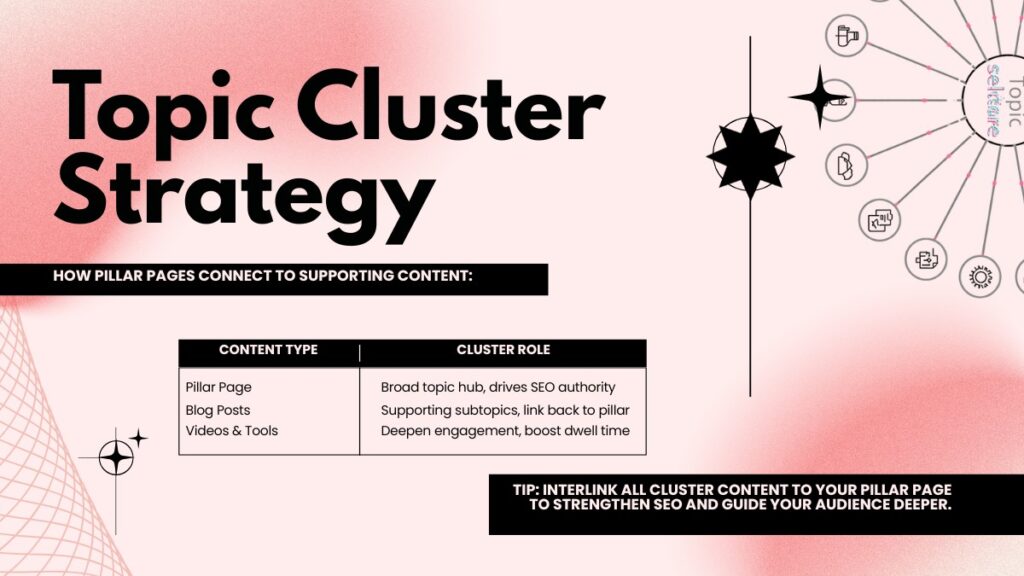
Using Content Types to Build Topic Clusters and Internal Links
To turn content types into a coherent SEO asset:
Pick a core topic that aligns with your offering (e.g., “B2B content strategy,” “subscription pricing,” “content funnel design”).
Create a pillar page that gives a complete overview.
Produce supporting content types articles, videos, tools around subtopics.
Use internal links and navigation to guide users from broad overview to specific answers and then to relevant offers.
This topic cluster approach improves user experience and makes it easier for search engines to understand your expertise. It’s also a natural way to integrate multiple types of content marketing without losing the plot.
You don’t need a perfect analytics setup to learn which content formats are working. You just need clear expectations for each group of content types, a few sensible metrics, and a habit of reviewing them together.
Core Metrics for Written Content Types
For blogs, guides, ebooks, and email, start with:
Visibility: impressions and organic traffic for key articles and guides.
Engagement: time on page, scroll depth, click‑through to other parts of the content funnel.
Conversion: forms filled, newsletter signups, demo or consultation requests, “contact us” actions.
Influence: appearances of specific content in the journeys of leads, opportunities, and customers.
If a small cluster of articles and guides shows up again and again in the paths of your best customers, that’s a strong signal that those written content types are pulling their weight.
Core Metrics for Audio‑Visual and Interactive Content
For video, webinars, podcasts, and interactive formats, focus on:
Interest: registrations, plays, and starts are people showing up?
Engagement: watch time, completion rate, interactions with tools and quizzes.
Action: clicks back to your site or product, signups immediately following the session or tool usage.
Pipeline: opportunities and closed‑won deals where these assets were engaged with along the way.
For example, if opportunities where someone attended a webinar or used an ROI calculator close at a notably higher rate than those that didn’t, you have a compelling case for keeping and improving those content formats.
Core Metrics for Social and Community Content
For social, UGC, and community content types, track:
Reach among the right audience: impressions filtered by audience profile where possible.
Engagement quality: meaningful comments and shares, not just likes.
Referral impact: traffic and leads from community links, profile links, and shared posts.
Relationship impact: mentions in sales calls (“I saw your LinkedIn post,” “I heard about you in that Slack group”), review volume, and sentiment.
Social and community content is often where you’ll see early signs of message resonance, even if attribution to revenue is messier.
Iterating on Your Content Mix
On a monthly or quarterly basis:
Look at performance by group and by specific types of content marketing.
Identify “power formats” (for example, case studies plus webinars) that consistently show up in healthy deals.
Decide which types you want to expand, which need improvement, and which you can pause without hurting your funnel.
This kind of review moves you from a reactive content calendar to a deliberate content strategy where each type has to earn its place.
Types of Content Marketing: FAQ
These common questions help clarify how to think about different content formats, the content funnel, and your overall content mix.
What are the main types of content marketing?
The main types of content marketing fall into four groups: written content (blogs, guides, case studies, email, landing pages), audio‑visual content (videos, webinars, live streams, podcasts, infographics), interactive content (quizzes, calculators, polls, tools), and social/community‑driven content (social posts, UGC, influencers, communities, reviews). Most effective content strategies combine formats from these groups instead of relying on just one.
Which types of content marketing are most effective?
Effectiveness depends on your goals and audience, but across many industries, written content (especially guides and case studies), email, webinars, and video consistently rank as top performers for leads and sales. Short‑form video, social posts, and thought leadership articles tend to shine for awareness, while formats like ROI calculators, demos, and testimonials are especially powerful near the point of purchase.
How many types of content marketing should you use?
A good rule is: start with as many types as you can do well and sustain usually 2–4 core formats for a solo marketer or small team. For example, you might start with “blog + email + one social channel” or “guides + webinars + LinkedIn,” then add other types such as video, interactive tools, or community content once your core mix is working and you have more capacity.
Which types of content marketing are best for small businesses?
For most small businesses, the most realistic starting mix is:
A search‑friendly website with clear pages and a small but growing blog.
An email list with a simple, useful newsletter.
One or two social channels where your customers already spend time.
From there, you can add case studies, short product videos, or occasional webinars as you see which formats resonate and what your content operations can handle.
Do you need to use all types of content marketing to see results?
No. You don’t need every type of content marketing you need a thoughtful content mix that fits your audience and resources. Many successful companies rely on a focused stack of three or four content formats executed consistently, rather than spreading themselves thin across every possible channel and medium.
How does budget and skill set affect which content types you should choose?
Budget and skills are practical constraints you can’t ignore. If writing is a strength and budget is tight, lean into written formats, simple visuals, and straightforward email. If you have budget or in‑house talent for video and design, you can layer on more advanced formats earlier. Reserve higher‑investment types like polished video series, complex interactive tools, and full‑scale communities for when you have proof they’ll support your goals.
What’s a good starting content mix for different business models?
B2B SaaS or services: blog posts, long‑form guides, webinars, case studies, email sequences, and LinkedIn content. E‑commerce or DTC: product pages, blog posts, email campaigns, short‑form video, UGC, and reviews. Local services: service and location landing pages, Q&A blog posts, Google‑friendly content, reviews/testimonials, and simple social content.
Each mix reflects how buyers in those models typically research and make decisions, and how they move through your content funnel.
How can you repurpose one piece of content into multiple types?
Start with a “pillar” asset such as a guide or webinar, then deliberately spin it out: break it into articles, slice it into social posts, record short video highlights, convert frameworks into checklists or infographics, and build an email series around the key ideas. Planning this repurposing before you create the content helps you squeeze more value out of each piece and cover multiple content formats without multiplying the workload.
How should you use AI tools for different types of content marketing?
AI tools are useful for tasks like brainstorming ideas, summarizing research, drafting outlines, and repurposing existing content across formats. For the more strategic or sensitive content types case studies, thought leadership, sales emails, and key landing pages it’s wise to keep humans firmly in charge of story, nuance, and final voice. Think of AI as a speed and support layer within your content operations, not a replacement for understanding your audience and market.
If I only remember three things about types of content marketing, what should they be?
First, you don’t need every content type pick a small set of formats that match your audience, goals, and resources, and execute them consistently. Second, map content formats to funnel stages and business objectives so every piece of content has a clear job in your content funnel. Third, treat big assets as hubs that can be repurposed into multiple types of content marketing, instead of constantly starting from scratch.
If you’re ready to move from “random acts of content” to a focused content mix and SEO strategy, SEOSERVICES1 can help you design your content system, choose the right types for your situation, and build topic clusters that support long‑term growth.
Senior Search Strategist specializing in SEO, AEO, and Generative Engine Optimization (GEO). With over a decade of experience, Rick helps brands and applications (ASO) maximize their visibility across traditional search engines, AI answer engines, and app stores.