Backlink exchange programs promise a steady flow of backlinks with minimal cost, which is exactly why so many site owners and SEOs consider them when growth feels slow. At the same time, these programs sit right on the line of what major search engines call link schemes, and that line has become much sharper as link spam detection has improved in recent years.
This article is for website owners, marketers, and SEO professionals who are weighing up backlink exchange programs or already joined one and now want a clear, practical view of the risks, the alternatives, and how to move towards safer, long‑term link earning. It also explains how SEOSERVICES1 supports you in getting out of risky patterns and building an ethical link strategy that can survive future algorithm updates.
What Are Backlink Exchange Programs?
Backlink exchange programs are structured systems where websites agree to give each other backlinks, usually with the main objective of boosting rankings instead of serving visitors. Rather than a one‑off, natural mention between two relevant sites, they formalise “you link to me, I link to you” into an ongoing, managed arrangement.
Simple definition of backlink exchange programs
In day‑to‑day terms, a backlink exchange program typically:
- Matches participating sites and tells them where and how to link to each other.
- Uses some form of tracking credits, points, or quotas to ensure everyone “gives” and “gets” roughly the same number of links.
- Measures success in terms of link quantity and ranking lifts rather than user satisfaction or content quality.
Picture a small SaaS company that joins a network of a few hundred blogs and business sites. Each month, the platform sends it a list of three domains to link to. In return, three different sites are instructed to link back to it. The content might be loosely relevant at best, but the system considers the month a success because the company’s backlink count has gone up. That kind of orchestrated, ongoing trading is what turns link exchanges from occasional collaboration into link schemes.
What is a link exchange in SEO?
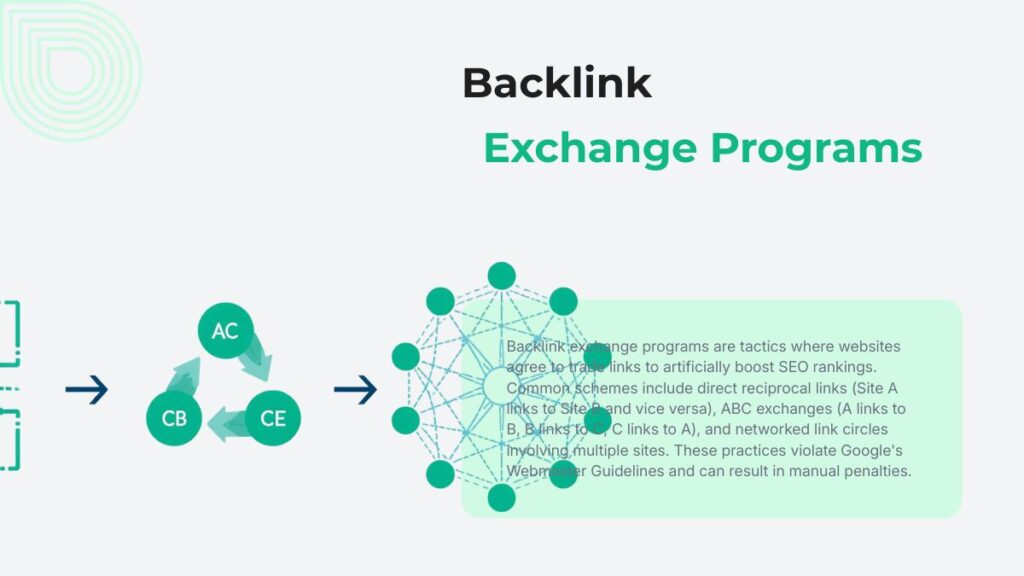
In SEO, a link exchange is any pre‑planned arrangement where two or more sites agree to place links for one another’s benefit. It can take several shapes:
- Direct reciprocal exchange: Site A links to Site B, and Site B links back to Site A, often within similar timeframes or on clearly traded pages.
- Three‑way or ABC exchange: Site A links to Site B, Site B links to Site C, and Site C links back to Site A, avoiding obvious A↔B reciprocity.
- Multi‑way exchange: several sites link to each other in more complex patterns, often coordinated via a private group, spreadsheet, or platform.
The appeal is obvious:
- You feel like you have more control over link growth than waiting for organic mentions.
- You can forecast link numbers per month and report them as progress.
- For newer or smaller sites, it seems like a way to “catch up” with bigger competitors.
However, once these exchanges become systematic especially when they are orchestrated by third‑party networks or tools the behaviour stops looking like normal editorial linking and starts resembling the kind of manufactured patterns that search engines are increasingly good at detecting.
Are Backlink Exchange Programs Safe or Allowed?
Backlink exchange programs are fundamentally high‑risk because they closely match behaviours that search engines describe as manipulative link schemes. Even when platforms advertise themselves as “Google‑safe” or “AI‑matched”, the basic question remains: are links being traded primarily to influence rankings rather than earned for their editorial value?
How search engines view link exchange schemes
For years, search engines have given examples of problematic practices such as “excessive link exchanges” and “partner pages created exclusively for cross‑linking”. That language covers:
- Large‑scale reciprocal linking agreements between sites.
- Networks of sites that exist mainly to link to one another.
- Any arrangement where links are conditioned on getting a link in return, especially when repeated at scale.
In modern SEO, detection goes beyond spotting basic A↔B patterns. Link spam systems use link graph analysis, pattern recognition, and machine learning to identify networks where:
- Groups of sites repeatedly link to each other in loops or triangles.
- Anchor text, topical focus, and timing look coordinated instead of organic.
- Many links originate from obviously low‑quality or highly similar domains.
That means “smarter” structures like ABC exchanges or dispersed networks are not inherently safe; they’re simply another pattern for algorithms to model. If your site becomes a visible node in one of these networks, you inherit the risk associated with it.
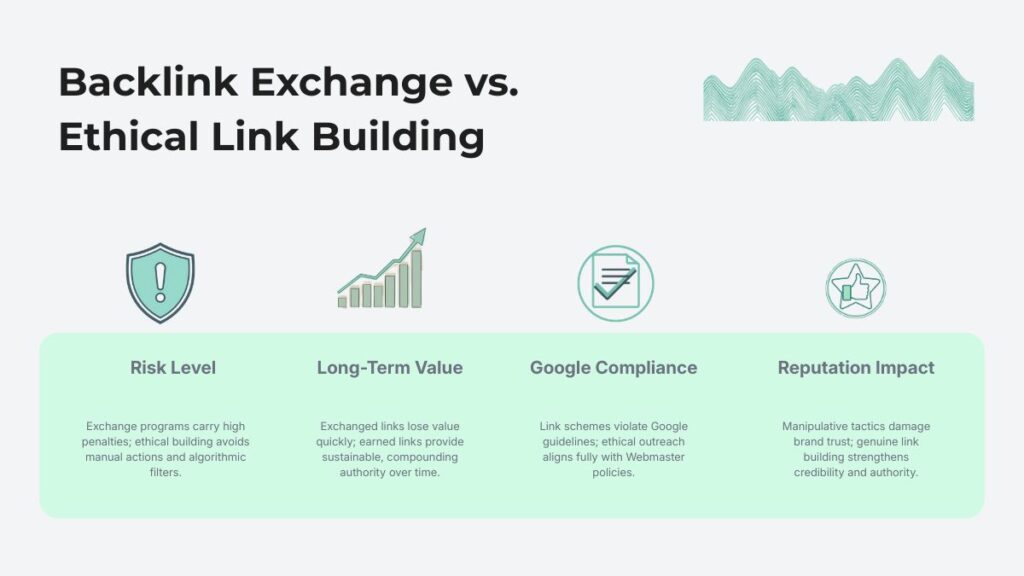
Risks of joining backlink exchange programs
When you sign up for a backlink exchange program, you’re effectively accepting a set of trade‑offs:
- Algorithmic devaluation
- Many of the links you gain might eventually be discounted or carry minimal weight, especially if patterns match known exchange footprints.
- You can end up with inflated backlink counts but little to show for them in terms of sustainable rankings or traffic.
- Manual actions and penalties
- In more serious cases, human reviewers may determine that your site is involved in a link scheme and apply manual actions that reduce your visibility until the issues are resolved.
- Lifting a manual action typically requires clear cleanup efforts, evidence, and time before trust is restored.
- Distorted link profile
- A profile dominated by exchange‑based links can make it hard to tell which links are genuinely helpful and which are liabilities.
- Future SEO work becomes more complicated, because you’re building on top of a shaky foundation.
- Wasted resources and opportunity cost
- The hours you spend placing links “because the program requires it” are hours you’re not investing in content, digital PR, or real partnerships.
- If the network gets hit or devalued, the value of those links can collapse quickly, leaving you with risk and no lasting asset.
If you’ve ever looked at a report showing dozens of new links from obscure blogs and directories but minimal movement in meaningful rankings, you’ve already seen some of these dynamics in action.
Types and Patterns of Backlink Exchange Programs
Although every program has its own branding and pitch, most exchange schemes can be grouped into a few familiar patterns. Recognising these patterns makes it much easier to evaluate offers and decide where your risk tolerance truly lies.
Simple one-to-one link swaps
The simplest pattern is the direct swap:
- Site A adds a link to Site B, often in a new blog post or resource.
- Site B adds a link back to Site A, sometimes on a different page but within a short timeframe.
On its own, a single mutual link between two relevant sites isn’t necessarily an issue. The problem emerges when:
- A site repeatedly engages in this kind of exchange with many different partners.
- There’s an informal or formal rule that “if we link to you, you must link to us.”
- Links appear in obviously forced contexts irrelevant posts, long lists of random domains, or pages that exist just to host partner links.
Imagine a marketing blog that has swapped links with 80 other blogs over two years. Every time it publishes a new article, it squeezes in an outbound link to the latest partner, and somewhere on the partner’s site, another article appears with a link back. Taken one at a time, the links might look acceptable. Taken together, they draw a clear picture of systematic swapping.
Three-way and ABC link exchanges
Three‑way or ABC exchanges were created to obscure direct reciprocal patterns:
- Site A links to Site B.
- Site B links to Site C.
- Site C links back to Site A.
From the perspective of any single pair, there’s no obvious “you link me, I link you” connection. But across the group, the pattern remains circular and deliberately orchestrated. Examples include:
- A small group of SaaS companies that take turns writing guest posts on each other’s blogs, always ensuring A links B, B links C, and C links A.
- Informal “pods” where three or four sites continuously rotate links in new content.
These setups are often marketed as “safe” because they avoid simple two‑way patterns. Yet when similar triangles and loops appear across dozens of pages, with similar anchors and timing, they still stand out in link graphs. The intent trading links to influence rankings hasn’t changed.
Link circles, networks, and PBN-like structures
Larger exchange schemes can start to look like link circles or private networks:
- Dozens or hundreds of sites participate, often with overlapping ownership or similar design and content patterns.
- “Partner lists”, sidebars, or footers are used to maintain a long list of participating domains.
- Some sites in the network may exist almost solely to post thin content and links.
These networks sometimes blur into private blog networks (PBNs), where an operator controls multiple domains and uses them to build links to clients. Once such networks are identified, the risk can extend to every domain receiving links, not just the ones hosting them.
Automated backlink exchange platforms and “guaranteed link” networks
Modern exchange platforms often operate like marketplaces or SaaS tools. Their marketing language may include:
- “AI‑powered matching based on topical relevance.”
- “Guaranteed X high‑quality backlinks each month.”
- “Three‑way matching that keeps you safe from penalties.”
Underneath the UI, the basic mechanism usually remains:
- Participants agree to place links in exchange for earning credits or points.
- The platform allocates links so everyone gives and receives roughly the promised volume.
- The network grows around this credit system, not around natural editorial decisions.
From a policy standpoint, trading credits for links is still trading value for links, and large‑scale mutual promotion inside a closed network looks very different from organic linking behaviour.
When a Reciprocal Link Can Be Natural
It’s easy to emerge from discussions about link schemes feeling like any reciprocal link is dangerous, but that isn’t the case. Real businesses collaborate, integrate, and cite each other’s work, and that naturally produces some mutual linking. The difference lies in whether the link exists because of genuine editorial value or because of a behind‑the‑scenes deal.
Genuine partnerships and citations
There are plenty of scenarios where reciprocal links make genuine sense:
- Integration and ecosystem pages
- Two software tools that integrate with each other may both have pages explaining how the integration works, each linking to the other’s setup guide.
- Co‑created assets
- Two brands collaborate on a research report or webinar and each hosts or promotes it, linking back and forth to give their audiences access.
- Scholarly or industry references
- Two niche sites that regularly publish original research might cite each other’s studies in a way that looks similar to academic citations.
In each of these cases, the link passes a simple test: it helps the end user by pointing them to relevant, related information. The fact that a link exists in both directions is a by‑product of genuine collaboration, not the main goal.
Editorial independence and user value
A practical way to gauge risk is to ask a few blunt questions about each reciprocal link:
- Would this link still be here if search engines didn’t use backlinks as a ranking factor?
- Did an editor or product owner decide to add this link because it improves the page, or because someone promised a link in return?
- Is there any system spreadsheet, platform, Slack group tracking who owes links to whom?
When editorial decisions are independent and user‑focused, occasional reciprocal links are expected and generally safe. As soon as those decisions become governed by obligation, quotas, or “you link to us and we’ll link back” deals, the same pattern starts to look like a link scheme.
How SEOSERVICES1 Approaches Links (No Spammy Exchange Programs)
SEOSERVICES1 takes a clear and conservative stance on link schemes: we don’t operate link exchange programs, we don’t sell backlinks, and we don’t plug clients into “guaranteed link” networks. Our work is built around link audits, sustainable link earning, and outreach and PR models that align with search engine guidelines.
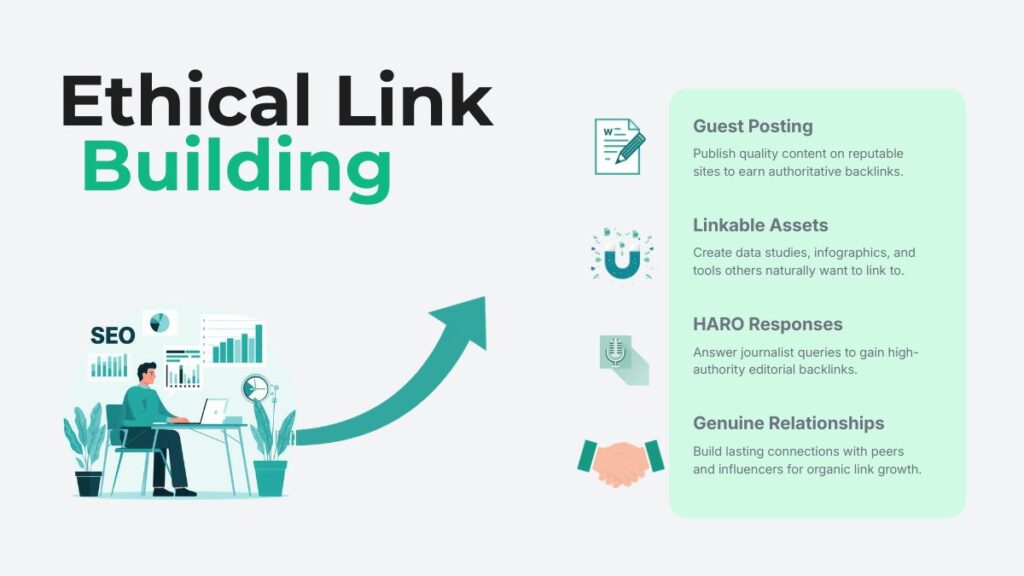
Content-led link earning
Our starting point is simple: the strongest links are those you earn because your content deserves to be referenced. To support that, we:
- Identify topics where your business has genuine insight, data, or experience that others lack.
- Turn that insight into high‑value assets comprehensive guides, frameworks, calculators, comparisons, or original research.
- Build supporting content around those assets so they have clear context, internal links, and a logical place in your site structure.
For example, instead of buying into a 500‑site link exchange, a B2B company might work with us to publish an in‑depth industry benchmark report. Over time, blogs, newsletters, and media mention that report because it’s the best available dataset, generating links that have nothing to do with reciprocal obligations.
Digital PR and outreach
We also run digital PR and outreach programs that focus on securing genuine coverage:
- Developing story angles, data‑driven narratives, or expert commentary that are interesting in their own right.
- Pitching those stories to relevant journalists, editors, podcasters, and creators who cover your space.
- Prioritising publications where even a single link can be more valuable than dozens of exchange links from low‑quality sites.
The difference from exchange schemes is that no one is obligated to link. Editors decide if they cover the story and whether they include a link, which keeps the relationship aligned with editorial standards and reduces the risk of links being treated as manipulative.
Partnerships, co-marketing, and resource links
SEOSERVICES1 helps structure partnerships so that links follow the partnership rather than drive it:
- Designing co‑marketing campaigns (webinars, joint reports, shared tools) where both parties bring something meaningful to the table.
- Creating partner and integration pages that explain how your solutions work together, and linking to each other where it genuinely helps users.
- Identifying high‑quality resource pages where your product, tool, or content is a natural fit and suggesting inclusion.
Because these links arise from collaboration that makes sense to users and partners, they look much more like normal web behaviour than a link‑for‑link exchange.
Link audit, cleanup, and remediation
For clients who have used exchange programs or similar tactics in the past, SEOSERVICES1 provides structured remediation:
- Backlink profile audit: we review your links to identify patterns associated with link schemes reciprocal clusters, obvious network sites, unnatural anchors, and footprints of exchange platforms or PBNs.
- Risk categorisation: links are grouped into risk tiers, so you can see which links are most likely to cause trouble and which are probably benign.
- Cleanup roadmap: we propose practical steps, including where to request removals, when to consider disavow, and which links are safe to leave alone.
- Replacement strategy: in parallel, we design a plan to earn higher‑quality links so your profile becomes stronger even as you reduce reliance on risky sources.
The aim is not to panic and nuke everything, but to show search engines and yourself that your site is moving away from manipulative patterns and investing in more durable link equity.
Safe Alternatives to Backlink Exchange Programs
If you’re tempted by exchange schemes, it’s usually because you feel stuck: your competitors seem to attract links easily, while your own outreach either falls flat or moves slowly. The good news is that there are several alternative strategies that can build authority without putting your site at the mercy of link scheme enforcement.
Creating linkable assets
Linkable assets are the backbone of sustainable link earning. Strong examples include:
- Actionable, in‑depth guides: content that walks readers step by step through complex tasks and becomes the go‑to resource in your space.
- Original data and industry research: survey results, aggregated performance data, or unique benchmarks that others want to cite.
- Tools, templates, and calculators: practical resources that people bookmark, share, and reference in their own content.
Once you have these assets, every outreach email becomes easier, because you’re offering something useful rather than asking for a favour. Links that come from people voluntarily referencing your work tend to age well and align with the idea of editorially earned backlinks.
Targeted outreach to relevant sites
Targeted outreach is the opposite of mass link swapping. It involves:
- Finding pages that already rank for topics related to your asset and where your content genuinely fills a gap or adds depth.
- Personalising outreach messages to explain why your asset improves that specific page or helps that site’s audience.
- Accepting that you don’t control the outcome; some people will say yes, some will say no, and some will ignore you.
Because there’s no promise of a link in return, and because the pitch is based on value, the links that result from this approach fit more naturally into the host site’s editorial logic.
Digital PR campaigns
Digital PR campaigns sit at the intersection of brand building and SEO:
- You develop stories that are newsworthy, counterintuitive, data‑rich, or especially timely for your industry.
- You package those stories with clear angles, quotes, and assets that make a journalist’s job easier.
- You measure success both in terms of coverage and in terms of high‑quality backlinks that often come with that coverage.
Although digital PR can require more upfront investment than an exchange subscription, it can produce fewer but much higher‑value links from publications that are hard to access through any other channel.
Resource page link building and co-marketing
Resource and “best tools” pages are still a staple of the web. Ethical approaches here include:
- Identifying high‑quality, topic‑relevant resource pages where your tool, guide, or product is a legitimate addition.
- Suggesting inclusion with a short explanation of what you offer and why it helps the page’s users.
- Offering to provide extra information or content updates that keep the resource accurate over time.
Co‑marketing can extend this further: joint webinars, shared landing pages, and co‑branded content can all lead to links that are clearly tied to collaborative value, not just exchanged goodwill.
Backlink exchange programs vs ethical link earning (comparison)
To see the trade‑offs clearly, it helps to compare exchange programs with more sustainable approaches:
| Approach | Typical pattern | Risk level | Control | Sustainability | Long‑term impact |
|---|---|---|---|---|---|
| Link exchange programs | Systematic 1:1/ABC swaps via networks | High | Short‑term, program‑driven | Fragile (dependent on schemes) | Risk of devaluation or penalties |
| Natural editorial links | Unsolicited mentions and citations | Low | Low (editor‑controlled) | High | Strong trust signals |
| Content‑led link earning | Links to guides/tools/data assets | Low | Medium (you control assets) | High | Compounding authority over time |
| Digital PR | Links from coverage and stories | Low | Medium (story planning) | High | Links plus brand awareness |
Most sites that make the shift away from exchange programs discover that while ethical link earning may grow more slowly at first, it builds a foundation that is far more resilient to changing algorithms and policy enforcement.
What If You’ve Already Used Backlink Exchange Programs?
If you’ve read this far and realised you’re already part of an exchange network or have a link profile full of obvious swaps, you are not alone. Many businesses arrived there through past advice, aggressive agencies, or a desire to move quickly. The important thing is to move thoughtfully from “this might be a problem” to “here’s our plan to fix it.”
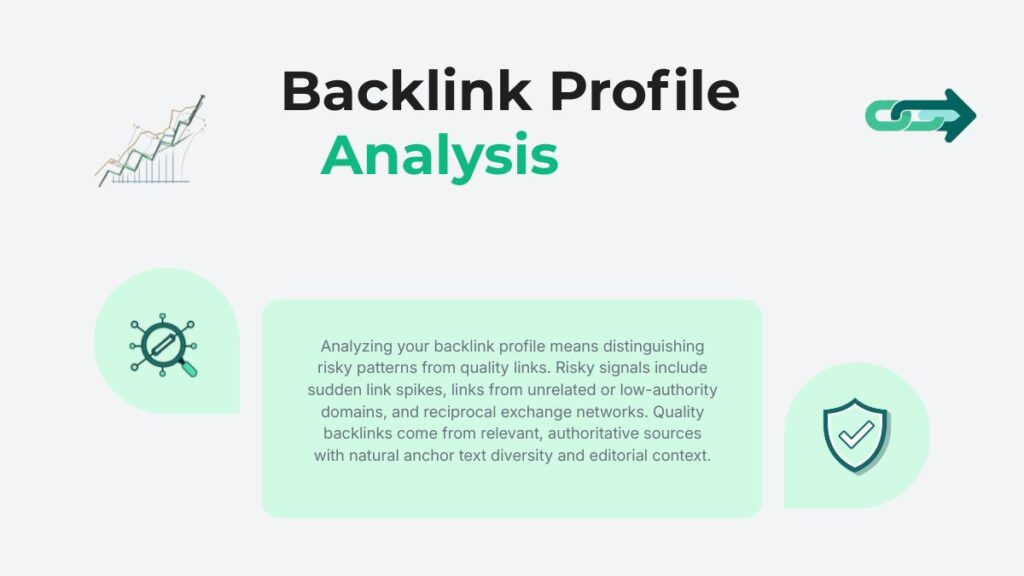
Link audits and risk identification
A structured link audit helps you understand the scale and nature of the issue:
- Start by exporting your backlink data from search console and reliable SEO tools.
- Scan for patterns such as:
- The same domains linking to you and multiple competitors in similar ways.
- Clusters of links from sites that appear on known exchange platforms or low‑quality directories.
- Sudden bursts of similar links that line up with past campaigns or program enrolments.
- Categorise links by source type (blog, directory, forum, platform), topical fit, and link context (in‑content vs footer vs random list).
This process turns a vague sense of “we’ve done some risky link building” into a clear picture of where the biggest issues lie.
Disavow and cleanup
Once you’ve mapped out high‑risk patterns, you can develop a cleanup plan that is firm but measured:
- For clearly manipulative links from obvious networks or spammy blogs, consider requesting removal where feasible.
- For links that you can’t remove or where the network is too large to contact individually using the disavow tool can signal that you no longer want those links evaluated for ranking.
- For borderline or medium‑risk links, you might decide to monitor rather than immediately disavow, especially if they sit alongside more natural signals.
Cleanup is rarely about zeroing out every questionable link; it’s about reducing exposure to the most dangerous sources and demonstrating a clear change in direction.
Transitioning to sustainable link earning
As you reduce reliance on exchange‑driven links, you’ll want to actively build a better profile in parallel:
- Invest in linkable assets and ethical outreach so that new, stronger links gradually outweigh legacy risk.
- Create or update internal policies so teams and external partners know you will not participate in link exchanges, PBNs, or “guaranteed link” packages.
- Track the evolution of your backlink profile over time, paying attention not just to counts, but to quality, relevance, and diversity.
SEOSERVICES1 can help coordinate this transition by combining technical audits, cleanup guidance, and link earning campaigns, so you’re not just cutting away risky links but actively building a more robust foundation.
How SEOSERVICES1’s Link Services Work
If you’re sceptical of exchange programs but still responsible for hitting organic growth targets, you need a link strategy you can explain to stakeholders and stand behind over the long term. SEOSERVICES1’s process is designed with that in mind.
Discovery and backlink audit
We begin with discovery so we don’t make assumptions about your situation:
- We analyse your backlink profile for signs of unnatural patterns reciprocal clusters, ABC loops, low‑quality networks, and obvious platform footprints.
- We align this with your business priorities: which products, services, or markets are most important to support with high‑quality links.
- We review your history with agencies or internal SEO, so we understand what tactics may have been used in the past.
This combined view informs both risk management and opportunity identification.
Strategy and prioritisation
From there, we build a strategy that balances clean‑up, protection, and growth:
- We determine how aggressive remediation should be, based on current stability and risk appetite.
- We identify key topics and angles where you can credibly produce best‑in‑class content or stories.
- We prioritise tactics and campaigns in a roadmap, so you know what we’re doing first and why.
The end result is a clear plan that you can share internally, showing how we’ll remove or neutralise risky links and what we’ll build instead.
Content and asset creation
With priorities agreed, we help you create or refine the assets that will power ethical link earning:
- Turn internal knowledge case studies, internal data, product insights into linkable resources.
- Organise your content architecture so important assets are supported and easy to access.
- Make sure your site is technically and structurally ready to capture the value of new links.
Stronger assets give outreach and PR something substantial to point to, which is essential if you’re not relying on link swaps.
Outreach, relationships, and reporting
Finally, we support the relationship‑building and reporting side of link work:
- Identify and prioritise targets: publications, blogs, communities, and partners where your content can genuinely contribute.
- Conduct outreach or support your team in doing so, with messaging that focuses on value rather than link trading.
- Track new links, their quality and relevance, and the downstream impact on rankings, traffic, and leads.
- Report in a way that ties link work back to broader SEO and business metrics, so you can see the return on investing in ethical practices.
If you want to explore this kind of partnership, a practical next step is to visit the SEOSERVICES1 homepage and request a conversation about your current backlink profile and growth goals.
FAQs About Backlink Exchange Programs and Ethical Link Building
1. Are backlink exchange programs legal?
Most backlink exchange programs do not break civil or criminal law, but they can be at odds with search engine policies on unnatural links and link schemes. In practice, that means you’re unlikely to face legal consequences just for participating, but you may see your organic visibility suffer if your link patterns look manipulative.
2. Are backlink exchange programs against Google’s rules?
Large‑scale backlink exchange programs designed primarily to manipulate rankings fall under what Google describes as link schemes. This includes excessive reciprocal linking, ABC‑style exchanges, and networks where links are traded as a form of currency rather than earned based on editorial value.
3. Can I ever swap links safely?
You can have reciprocal links that are natural outcomes of partnerships or citations, provided:
- The link helps users and makes sense in context.
- There’s no obligation, tracking, or quota driving the exchange.
- Reciprocal links make up a small, incidental part of your overall backlink profile.
What becomes risky is moving from “we sometimes mention each other when it’s relevant” to “we have a system for trading links as part of our SEO strategy.”
4. How long does it take to recover from bad link schemes?
Recovery time depends on the depth and breadth of the schemes. After you audit your profile and address high‑risk links through removals or disavow:
- You may see early improvements within a few months as search engines re‑crawl and reassess your profile.
- If your site was under a manual action, recovery typically requires a reconsideration process and can take several review cycles.
- Full confidence restoration especially after heavy reliance on link networks often takes longer and benefits from parallel investment in high‑quality, earned links.
There are no guaranteed timelines, but early, decisive action improves your chances and reduces the risk of further issues.
5. How long does ethical link building take to show results?
Ethical link building is best treated as a medium‑ to long‑term investment. In many cases:
- You may see early signs like improved impressions and ranking movement for key pages within 3–6 months.
- Stronger, more reliable gains, especially in competitive niches, tend to emerge over 6–12 months as your content base and link profile mature.
- The real advantage is that the gains you make are less likely to evaporate after the next algorithm update.
6. Does SEOSERVICES1 sell backlinks or participate in link exchange programs?
No. SEOSERVICES1 does not sell backlinks, manage link exchange programs, or plug clients into “guaranteed link” networks. Our work focuses on:
- Identifying and mitigating risky link patterns, including legacy exchange schemes and low‑quality networks.
- Designing and implementing content and campaign strategies that can earn links naturally.
- Running or supporting outreach and digital PR in ways that respect editorial independence and align with search engine guidelines.
If your priority is to buy links or join an exchange network, we’re unlikely to be the right partner. If you want to protect your site and build a more sustainable link strategy, that’s where we can add the most value.