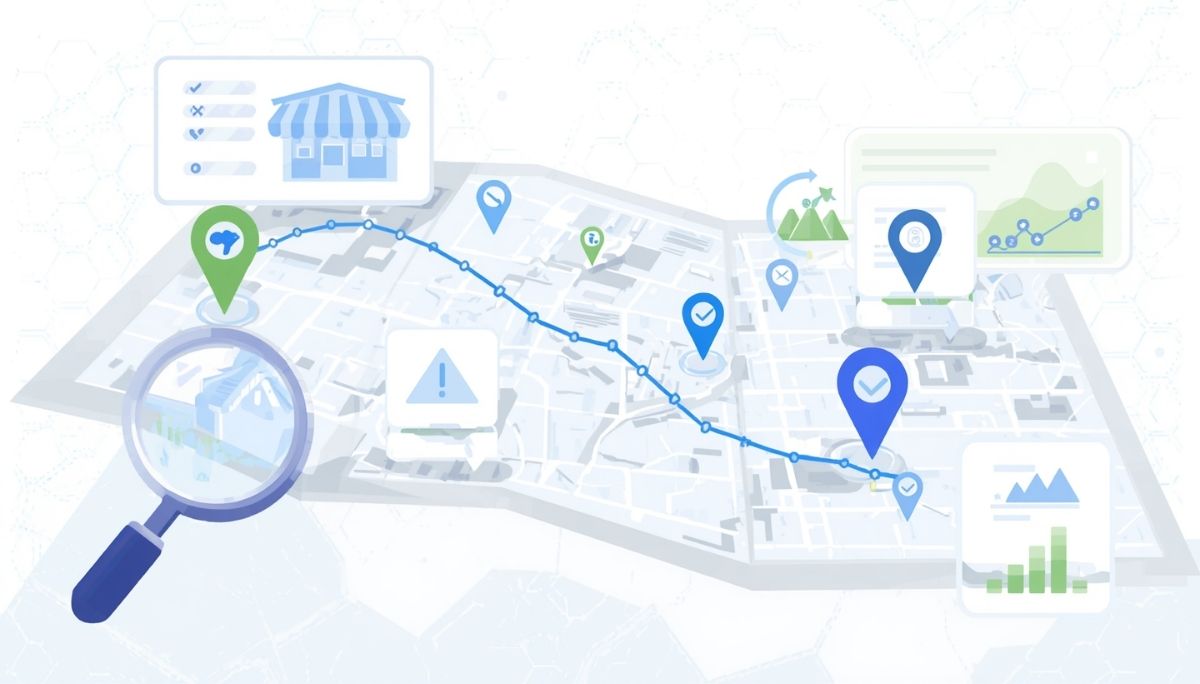
When I sit down with a franchisor or multi-location brand, I tell them this: the only reliable way to compare local SEO services for franchise locations is to judge every provider on how well they handle six things at scale—service scope, scalability, governance, reporting, rollout, and proof. If an agency can’t show you exactly how it manages Google Business Profiles, location pages, duplicate-content risks, reviews, approvals, and location‑level reporting for your whole network, they’re not a franchise SEO partner; they’re a local SEO vendor trying to stretch their offer.
That level of scrutiny is justified by the numbers. One franchise-focused SEO guide notes that close to half of all Google searches carry a local intent, and around 78% of mobile local searches end in an in‑store visit within a day. For a franchise, that means local search is not a “nice to have” channel; it’s the digital front door to every location. The question is not “Do we need local SEO?” but “Who is capable of running it properly for our entire network?”

What makes franchise local SEO its own discipline?
From experience, I’ve found that the biggest misconception is thinking franchise SEO is just “local SEO multiplied.” It isn’t. Once you go beyond a handful of locations, you’re no longer solving a single visibility problem. You’re solving a coordination problem.
Franchise-oriented SEO content highlights exactly that: you need optimized local pages for each location, consistent business information across directories, and a review strategy that supports every site in the network. On the agency side, franchise-specific evaluations emphasize that the right partner must deliver measurable results, be a good fit for scaling across locations, and adapt to your operating model. Those are not typical constraints for a single-location business.
Working definition
When I talk about “franchise local SEO,” I mean a designed system of pages, profiles, processes, and reports that makes each location visible in its own market while keeping the brand experience, data, and governance intact across the network.
To see why that matters, look at the contrast:
| Aspect | Single-location SEO | Franchise SEO |
|---|---|---|
| How many markets? | One | Many, often dozens or hundreds |
| Main assets | One site, one GBP | Shared site + many location pages, many GBPs |
| Governance | Often ad hoc | Needs explicit rules and approvals |
| Reporting | One set of numbers | Location, region, and brand views |
| Risk exposure | One owner | Every franchisee and the main brand |
If a provider treats your franchise as if it were a local plumber with “more listings,” you’ll feel that limitation as soon as you try to scale.
The six lenses I use to compare franchise SEO providers
When I evaluate providers for a franchise, I always come back to six lenses. They’re grounded in franchise‑specific guidance around evaluation criteria, technical structure, and procurement.
1. Service scope: what exactly do you get?
I first look for clarity. A serious franchise SEO provider can list what happens for each location and for the brand as a whole. At the location level, that means specific commitments around pages, GBPs, citations, reviews, and local content. At the brand level, it includes technical SEO, content strategy, reporting, and governance support.
If the proposal reduces everything to “monthly SEO work,” that’s a red flag. Franchise-oriented materials consistently stress the need for robust location pages, accurate listings, and structured review work, not just vague optimization.
2. Scalability: can the system handle your real footprint?
Second, I ask how the agency moves from auditing a small sample to rolling out improvements across, say, 50 or 200 locations. Mature providers talk about segmenting locations by priority, phasing rollout, and building templates that can be reused safely across the network.
This mindset echoes how serious franchise SEO guides describe their own process: start with a detailed audit, create a tailored plan, implement with internal teams, and then monitor and adapt as conditions change. If an agency can’t describe that kind of sequence, scaling will likely be painful.
3. Governance: who is allowed to change what?
In a franchise, governance is not bureaucracy; it’s risk management. I look for clear brand guidelines applied to pages and profiles, approval paths for content and major changes, and a defined space for local inputs like offers and local stories.
This aligns with franchise advice that stresses consistent business information and structured local content as a foundation for growth. Without governance, each location tends to improvise—and the brand as a whole pays for it.
4. Reporting: who sees which numbers?
I also examine reporting architecture carefully. Franchise‑specific agency guidance talks about dashboards that support real decision‑making and show outcomes, not just rankings. For a franchise, that means franchisees, regional leaders, and corporate all need views tailored to their responsibilities.
If the answer to “what will we see each month?” is “a keyword report and traffic chart,” that tells me the provider is not thinking at franchise scale.
5. Rollout: what does the first 90 days actually look like?
Realistically, you’ll learn more about an agency’s maturity from their rollout plan than from their sales pitch. Providers that work with franchises tend to describe a sequence from audit to plan, through pilot, into phased rollout, and then ongoing optimization.
If a provider promises to “start making improvements immediately” but can’t explain the steps, you’re being asked to gamble on process.
6. Proof: can they show it works for franchises?
Finally, I look for evidence. Franchise‑oriented agency roundups often spotlight retention rates and franchise case studies to show they can maintain performance across many units over time. That’s what you should expect as well: multi‑location stories, before‑and‑after snapshots, and data that spans more than one quarter.
The scorecard I recommend using
To avoid being swayed by whoever sounds most confident, I like to convert this into a simple scorecard you can fill out for each provider.
| Category | What a strong answer looks like |
|---|---|
| Scope & deliverables | Concrete tasks per location and centrally, not just buzzwords |
| GBP management | End‑to‑end process for all profiles, including updates and issue handling |
| Location pages & content | Clear rules for unique local content and avoiding duplication |
| Governance | Written approach to approvals, brand protection, and local inputs |
| Reporting & attribution | Layered dashboards with visibility and outcome metrics |
| Rollout & onboarding | Phased plan from audit to network‑wide rollout |
| Proof | Franchise or multi‑location examples, retention metrics, real numbers |
When you average these scores, it becomes obvious who has a system and who has only a pitch.
Under the surface: what you’re truly comparing
Once you strip away the marketing language, you’re really comparing how each provider handles a few non‑negotiables that matter more than any tagline or package name.
First, there’s data accuracy at scale. Can they keep your name, address, and phone details, as well as core business information, consistent across all listings as locations open, move, or change hours? Second, local relevance. Will every location page feel genuinely local, with specific details and proof, or will your website read like a template with city names swapped out?
Third, review and reputation processes. Is there a repeatable way for each franchisee to generate and handle reviews without “gaming the system”? Fourth, the technical foundation: templates, structured data, and internal linking that are designed for many locations instead of one. Finally, procurement fit: can the agency respond to a structured RFP, explain timelines, responsibilities, and outcomes in plain language, and tie their work back to your business goals?
Two proposals might list “technical SEO” and “local optimization,” but if only one can explain these underlying mechanics with real examples, I know which one I’d trust.
Deciding how SEO work should be organized
Before you even pick a provider, you need clarity on your own operating model: who should carry the weight—head office, local teams, or both? This is where many franchise SEO projects succeed or fail before work starts.
Centralized: brand‑first control
In a centralized structure, corporate and the agency manage strategy and most execution. Local teams mainly supply information, not full campaigns. This works well when you need tight brand control or when local marketing skills vary widely.
The trade‑off is speed. Local promotions or nuances may take longer to surface in search if every change depends on HQ approvals.
Hybrid: shared responsibility
In a hybrid setup, corporate defines the framework—templates, standards, baselines—while local operators add local flavor like offers, photos, and community highlights. This model offers a balance between consistency and local nuance.
The risk is confusion if rules are not clear. I look for agencies that can show which elements are locked at brand level and which are open for local input.
Location‑led: local teams in the driver’s seat
Here, local owners or managers lead most SEO activity, with light central guidance. It can be powerful when local teams are savvy and motivated, but it can also produce inconsistent branding and fragmented SEO if governance is weak.
When I compare providers, I always ask which model they recommend for the brand and how they’d support it in detail. Agencies that can’t answer that question usually haven’t actually operated inside a franchise environment.
Reporting, attribution, and governance: holding the system together
Let me put it bluntly: if your reporting doesn’t work, your franchise SEO won’t either. Franchise leaders need to see where the network is improving, which locations are lagging, and whether the investment is paying off in meaningful ways.
Franchise‑focused evaluations point to dashboards that show not just rankings and traffic, but also leads, calls, and other outcomes that matter to franchisors and franchisees. That’s the bar to set when you assess providers, not a monthly PDF of keyword positions.
Here’s how I think about reporting levels:
| View | Who uses it | What it should show |
|---|---|---|
| Location | Franchisees / local managers | Local visibility, interactions (calls, forms, directions), review trends, and recommended actions |
| Region | Area or regional leaders | Cross‑location comparisons and clear outliers |
| Brand | Corporate | Overall progress, risk areas, and estimated impact on leads or revenue |
Governance sits on top of this. It defines who approves changes to templates and major content, who is responsible for review responses and GBP edits, and how deviations from brand or SEO guidelines are handled. The franchise guidance that emphasizes consistent business information and strong location pages is really a case for governance; without rules, consistency is impossible.
Onboarding and rollout: where agencies show their real capabilities
In my experience, the first 60–90 days tell you almost everything you need to know about a provider. Do they treat your network as a system or as a collection of disconnected tasks?
Some franchise SEO service descriptions outline a cycle that starts with a full audit, moves into a tailored plan, then coordinated implementation with your internal team, followed by ongoing monitoring as search behavior and algorithms evolve. That kind of articulation matters—it shows they think beyond a list of generic deliverables.
A solid rollout plan usually includes mapping all locations and assets, grouping locations by priority or type, designing or refining templates and schema, piloting changes with a subset of locations, rolling out in phases with quality checks, and then continuing to optimize based on data and feedback.
If a provider can’t talk through onboarding and rollout with that level of clarity, you’re betting on improvisation.

A practical process you can follow to compare providers
Here’s the sequence I recommend when you’re choosing between local SEO services for franchise locations. It’s simple enough to run, but structured enough to reveal real differences between providers.
- Write down what matters. Start with the six lenses: service scope, scalability, governance, reporting, rollout, and proof. This becomes your evaluation checklist.
- Turn that into a brief or RFP. Spell out your business context, current SEO performance, goals, required services, budget range, expectations, evaluation criteria, and submission details. Add franchise‑specific information like location count, reporting requirements, and governance constraints.
- Score each proposal. Use the scorecard table and assign 1–5 scores for each dimension. The numbers will highlight clear leaders and weak fits.
- Run structured calls. Ask every provider the same questions about GBPs, duplicate content, location pages, reporting, governance, and rollout. Compare how concrete their answers are.
- Inspect proof. Look for multi‑location examples and longer‑term retention metrics that mirror what serious franchise agencies publish.
- Check model fit. Confirm they’ve worked within centralized, hybrid, or location‑led setups similar to yours and can describe how they’d integrate with your teams.
- Clarify asset ownership. Make sure expectations about who owns content, profiles, and data are written down and favor your brand.
- Compare price last. Once you’ve identified providers that fit structurally, compare fees in the context of what’s actually included and how they report success.
This approach turns “Which agency feels right?” into “Which agency can clearly support our network?”—a much safer question to answer.
Red flags I watch for when reviewing franchise SEO proposals
There are certain patterns I’ve learned to treat as warning signs when a franchise is evaluating SEO providers.
- The offer reads like any generic “local SEO package,” with no mention of franchise or multi‑location needs.
- There’s no explanation of how they’ll create unique, high‑quality location pages, even though franchise SEO guidance stresses their importance.
- Reporting is described as a single dashboard without separate views for locations, regions, and the brand.
- Onboarding is summarized with phrases like “we’ll start improving SEO right away” and no detail on phases, pilots, or QA.
- The contract is vague about who owns GBPs, content, and data if you part ways.
- The only success stories involve single‑location clients; there’s no proof they’ve delivered for multi‑location brands.
Any one of these is a reason to slow down and ask tougher questions. Several together are a strong signal to keep looking.

Final checklist: is this agency genuinely ready for franchise SEO?
When I reach the decision point, I boil everything down to a simple checklist. You can do the same to sanity‑check your shortlist.
- Do they explain clearly what they will do for each location and centrally?
- Can they describe a process for managing every Google Business Profile in your network?
- Do they have a plan to create and maintain unique, structured location pages?
- Have they spelled out how approvals and governance will work?
- Do they show how reporting will support franchisees, regional leaders, and corporate leadership?
- Can they walk you through onboarding and rollout as a phased project?
- Do they have evidence that they’ve done this for multi‑location brands before?
- Is it clear that your brand keeps control of key assets?
- Does their preferred execution model fit how your franchise operates today?
If most of those are “yes,” you’re likely looking at a provider that understands franchise SEO, not just local SEO. When you want a benchmark to compare against, you can always review SEOSERVICES1 and see how other agencies line up against the framework you now have.
FAQ
How do I compare local SEO services for franchise locations in a structured way?
The most reliable method is to define six comparison lenses—service scope, scalability, governance, reporting, rollout, and proof—then score each provider from 1 to 5 on each lens. Combine those scores with structured calls and a clear RFP so you’re comparing systems, not just personalities.
Why is franchise SEO harder than normal local SEO?
Franchise SEO is harder because you’re dealing with many locations, not one. That adds complexity around data consistency, local page quality, review management, and reporting across locations, regions, and the overall brand. A model that works for a single shop often collapses when you try to apply it to dozens of locations.
What should a franchise SEO provider include in its services?
At minimum, you should expect location-page strategy, Google Business Profile management, citation and directory work, review support, technical SEO, content support, clear reporting, and a scalable rollout plan. Providers who skip these fundamentals are not offering a complete franchise-ready service.
How much does franchise SEO usually cost?
Costs vary with location count, competition, and scope, but many franchise campaigns sit in a “few thousand to five-figure per month” range when you factor in multiple locations and full service. Rather than chasing the lowest number, compare what is included for that fee and how success will be measured.
What should be in a franchise SEO RFP?
A strong franchise SEO RFP explains who you are, how you’re currently performing, what you’re trying to achieve, what services you need, your budget range, expected timelines, and how you’ll evaluate responses. For franchises, add location counts, reporting needs, governance requirements, and asset-ownership expectations so agencies can respond in a comparable way.
Who should own our Google Business Profiles and local SEO assets?
Your brand should keep control or clearly defined rights over profiles, content, and performance data. If a provider wants to keep core local assets under their own accounts without a clear transfer path, treat that as a serious risk factor.
How can I tell if an agency understands multi-location technical SEO?
Ask them to walk through how they handle location-page templates, unique local content, structured data for each location, and internal linking. A provider that works with franchises will be able to talk about these topics in detail and show examples, not just speak in broad terms.