Outsourcing multilingual SEO means handing part or all of your international search strategy to outside specialists who already know how search works in different languages and markets. Instead of trying to stretch a single in‑house SEO across every locale, you bring in people who live in those languages, understand local search behaviour, and know how to structure global sites so the right version appears for the right user.
In practice, outsourcing multilingual SEO usually covers four pillars: international keyword research, localized content creation or SEO translation, technical international SEO (including hreflang and URL structures), and ongoing reporting by language and market. Many global providers report a similar pattern: brands first launch “translated” sites that underperform, then bring in multilingual SEO partners to redesign the strategy so those sites actually rank and convert.
What Multilingual SEO Is (and Why Translation Alone Fails)
Multilingual SEO Defined
Multilingual SEO is the discipline of making your website visible and competitive in organic search across multiple languages and countries. It combines classic SEO tactics with localization and technical configuration for each language version, so search engines can understand your structure and users see content that feels native.
Authoritative best‑practice guides consistently stress that multilingual SEO is not “SEO plus translation” but an ongoing system that aligns markets, keywords, content, and architecture. That system typically includes choosing and prioritizing target markets and languages, conducting local keyword research for each market, localizing content to match local intent and wording, implementing multilingual information architecture and hreflang, and monitoring performance by locale over time.
When you outsource multilingual SEO, you are effectively paying for this system to be designed and run by specialists who have done it before in multiple regions.
Localization vs Translation
Translation converts sentences; localization adjusts strategy. Global SEO and localization providers repeatedly warn that directly translating English keywords often misses the phrases real users type in local search engines. For example, an English “time tracking software” keyword might map to several different phrases in another language, each with different search volume and intent. Choosing the wrong one means targeting the wrong audience.
Localization includes replacing source‑language keywords with market‑specific terms that have verified search demand, adapting examples and calls‑to‑action to local norms, and re‑ordering or expanding content sections so they reflect how the topic is discussed in that market. Because of this, many multilingual SEO guides treat keyword localization and SEO translation as distinct, mandatory phases rather than optional extras.
Core Components of Multilingual SEO
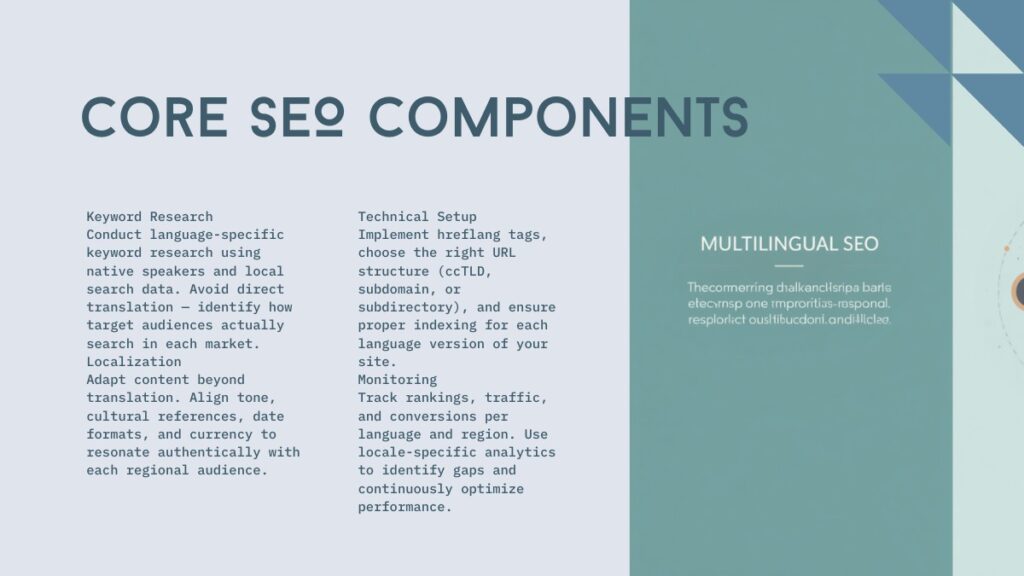
Across leading multilingual SEO and localization resources, the core components typically cluster around the same themes: market and language strategy, multilingual keyword research and mapping, localization and SEO translation, technical architecture and hreflang, on‑page optimization and internal linking per locale, and continuous monitoring and improvement.
Market and language strategy covers which regions and languages to tackle first. Multilingual keyword research and mapping ensures each market has its own keyword sets and page plans. Localization and SEO translation create native‑quality, search‑aligned content. Technical architecture and hreflang define how domains, subfolders, and language signals work together. On‑page work and internal linking tailor titles, headings, and navigation to each locale. Monitoring and improvement tie everything back to actual performance metrics. Outsourcing multilingual SEO means inviting external teams into each of these layers, not just asking them to “translate some copy.”
Should You Outsource Multilingual SEO?
Outsourcing multilingual SEO is usually worth considering as soon as your global ambitions extend beyond one or two new markets. International SEO and localization providers repeatedly note that internal teams often handle a first language expansion on their own, then encounter bottlenecks when they try to add more languages or complex architectures.
Signs You Should Outsource
You are a strong candidate for outsourcing multilingual SEO if you plan to launch or relaunch multiple language versions within the next 12–24 months and cannot realistically hire a dedicated SEO for each. You may already have localized sites that show weak organic traffic or conversions compared to your main market. Your team might have limited experience with hreflang, multi‑domain or multi‑folder setups, and international sitemaps. Your marketing and engineering teams could also be at capacity and unable to absorb multi‑market SEO work without sacrificing quality elsewhere.
Enterprise‑focused providers often describe clients who come to them after trying to patch international SEO in‑house, only to realize they lack the necessary capacity and regional insight. Outsourcing fills that gap with repeatable expertise.
When In‑House Still Works
In‑house multilingual SEO can make sense when you target a small number of strategically important markets and can employ native‑speaking marketers with SEO expertise. It can also work when your international portfolio grows slowly enough that you can invest in long‑term hiring and training, and when you already have robust localization and development functions that can implement international SEO recommendations with clear guidance.
For example, a B2B company focused on two European languages may find it cost‑effective to build a small internal team, then bring in specialist agencies only for occasional audits and architecture decisions. In those scenarios, outsourcing is more of a “second opinion” and capacity booster than a full operating model.
Hybrid Approaches
Most organizations with more than a handful of active markets end up with a hybrid model. A common pattern is a central in‑house SEO lead who defines the global framework and KPIs, one or more multilingual SEO agencies managing audits, keyword research, content, and technical rollouts across groups of markets, and localization partners and specialist translators who implement keyword localization and content updates under shared guidelines.
This mix allows you to retain strategic control, protect brand voice, and still rely on external teams for specialized or high‑volume work. In practice, many global teams adjust this mix over time as they expand, in‑house certain tasks, and outsource others.
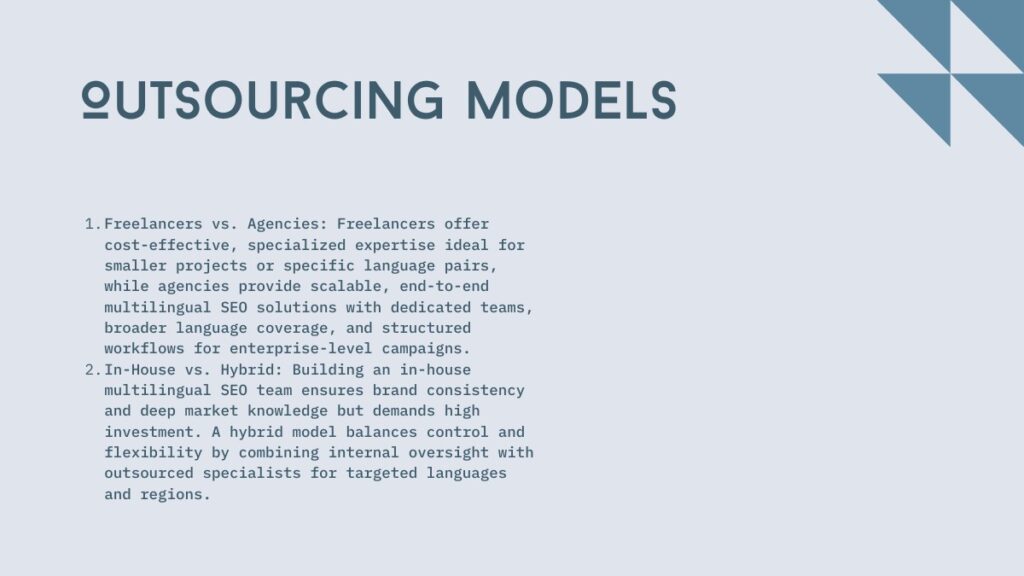
Outsourcing Models: Freelancers vs Agencies vs In‑House vs Hybrid
There is no single outsourcing model that fits every organization. The right setup depends on how many markets you serve, how complex your site is, and how much coordination you are willing to handle internally.
Provider Model Comparison Table
Model
Typical Cost Level
Expertise Depth
Scalability
Control & Coordination
Best For
Freelancers
Low–Medium
Strong in specific languages; narrow coverage
Limited beyond a few markets
High per person; you manage network
Small projects, one‑off language launches
Boutique multilingual agencies
Medium
Solid international SEO in selected regions
Good; regional or cluster focus
Shared; clear processes and points of contact
SMEs entering a few priority markets
Large/global agencies
High
Deep multi‑market SEO + localization services
High; many markets
Lower day‑to‑day control; robust governance
Enterprises with complex, multi‑region footprints
In‑house teams
Medium–High
Deep brand knowledge; SEO expertise varies
Limited by headcount
Full control; slower to scale
Companies with stable, long‑term target markets
Hybrid / platform models
Variable
Mix of curated external talent and internal lead
Flexible; scale per market
Shared; platform or agency manages operations
Teams needing flexibility without fully outsourcing strategy
This overview aligns with how hiring platforms, multilingual agencies, and enterprise providers describe their roles: freelancers offer flexibility but require you to coordinate and QA everything, while larger agencies and hybrid models emphasize multi‑market coverage, process maturity, and shared governance.
Most multilingual SEO partners offer a combination of strategic planning, implementation, and ongoing optimization. Service pages and best‑practice guides outline similar bundles even if they use different labels, which gives you a useful baseline for evaluating providers.
International SEO Audits
An outsourced international SEO audit usually evaluates how your current domains, subfolders, or subdomains support multilingual growth, checks hreflang implementation across languages and regions, identifies indexation and crawl issues affecting local versions, and reviews on‑page signals such as titles, headings, and internal links per locale.
Providers often report discovering duplicated English content on local domains and misconfigured hreflang tags that cause the wrong language version to appear in local SERPs. After restructuring architectures and fixing tags, they have documented significant ranking improvements in target markets, which underscores how foundational a proper audit can be.
Multilingual Keyword Research and Mapping
Multilingual keyword research and mapping usually begins with seed lists from your main language and performance data. External teams then use local keyword tools and SERP analysis to identify equivalent and related queries per market, map localized keywords to current and planned pages, and prioritize clusters by search volume, difficulty, and commercial relevance.
Specialist keyword localization services emphasize that this phase is not a nice‑to‑have; it is the backbone of effective multilingual SEO. Without it, localized content tends to target phrases that look correct linguistically but attract the wrong traffic—or no traffic at all.
SEO Translation and Native Copywriting
SEO translation is used to separate high‑quality, search‑aligned localization from raw translation. It typically means that translators receive localized keyword sets and guidance on how to integrate them naturally, native copywriters adapt headlines, calls‑to‑action, and examples for local audiences, and content passes both linguistic and SEO checks before publication.
The result is content that feels written for the local reader and, at the same time, aligns with how local users search. This combination is what most multilingual SEO agencies and localization providers position as their core value.
Technical Multilingual SEO and Hreflang
Technical international SEO services often include recommendations and implementation for domain and URL structures, setting up or fixing hreflang tags, aligning canonical tags and sitemaps with multilingual strategy, and collaborating with engineers or CMS owners to ensure changes are maintainable.
Multiple technical guides underline how misconfigured hreflang and inconsistent URL structures can undermine otherwise solid localization work, especially on large sites where small errors can scale into thousands of problematic URLs.
International PPC and SEA
Some multilingual SEO agencies also manage international PPC and SEA campaigns as part of a broader search strategy. In those setups, they use localized paid campaigns to test messaging and keywords before investing heavily in organic content, and align SEO and PPC plans so both channels support the same goals in each market.
This integrated approach is especially valuable for brands that need to prove traction in a region quickly while building the slower, but durable, organic presence.
Multilingual Keyword Research and Localization Workflows
Among all the tasks you can outsource, multilingual keyword research and localization is one of the most misunderstood and one of the most impactful. Getting it right often determines whether localized content ever gains traction.
Discovering Local Search Intent
A robust outsourced workflow follows a pattern that many multilingual SEO best‑practice resources recommend. First, teams collect base queries from your main market and analytics, then explore local search behaviour in each target market using native SERPs and local tools. They identify the dominant intent for each cluster—whether people want how‑to guides, comparison pages, or product listings—and create keyword clusters with suggested page structures per language.
These clusters are then shared as clear maps showing which pages to create or adapt for each locale. This process helps avoid the trap of building local pages around queries that are rarely used or misaligned with how local users think about your product or service.
Keyword Localization vs Direct Translation
Keyword localization often means choosing between multiple valid translations, each with different search signals. For instance, a direct translation might exist but have minimal search volume, while a colloquial term has higher demand yet requires more on‑page explanation. Different regions sharing a language—such as European and Latin American Spanish—might favour different phrasing entirely.
Specialist keyword researchers and local SEOs weigh these trade‑offs and select target terms that balance discoverability and relevance. That type of judgement rarely emerges from direct translation alone and is a key reason why many teams choose to outsource multilingual keyword research.
Deliverables from Outsourced Keyword Research
Typical deliverables from outsourced multilingual keyword research include language‑specific keyword lists annotated with volume and intent, page‑level or template‑level keyword mapping documents, recommendations for localized titles, headings, and internal linking per market, and notes on competitor pages and SERP features in each locale.
These deliverables act as shared references between your SEO, localization, content, and development teams, helping everyone pull in the same direction instead of guessing at what to localize next.
Technical Multilingual SEO (Hreflang, URL Structures, and Architecture)
Technical multilingual SEO is the silent backbone of a global site. Even the best‑localized copy will struggle if the underlying architecture sends confusing signals to search engines.
URL Structures (ccTLD vs Subfolders vs Subdomains)
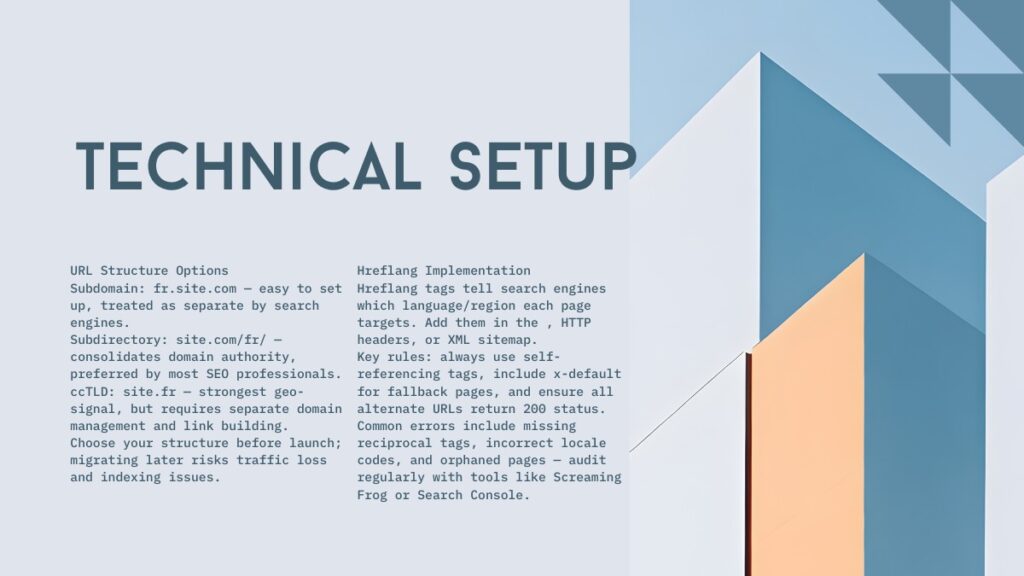
Technical guides and agencies usually frame URL decisions around three main options: country‑code top‑level domains (such as example.de or example.fr), subdirectories (such as example.com/de/), and subdomains (such as de.example.com). Each approach has pros and cons in terms of local branding, authority consolidation, and operational complexity.
The best structure depends on your history, resources, and regulatory environment, but many modern guides lean toward subdirectories for most scenarios because they make it easier to consolidate authority on one domain while still signalling language and region clearly. Enterprises often use different structures for different business units, which is another reason why external technical advice can be useful.
Hreflang Implementation in Outsourced Projects
Hreflang tags help search engines serve the right language and region variation to users, but they are easy to misconfigure. Experienced international SEO specialists treat hreflang as a dedicated workstream rather than a quick add‑on.
A typical outsourced hreflang project involves creating a comprehensive map of all language‑region variants for key URLs, implementing hreflang tags in HTML, sitemaps, or headers as appropriate, ensuring reciprocity so each page references its siblings and is referenced in return, and running checks to detect missing tags, incorrect language codes, or conflicts with canonical tags.
Case examples from enterprise providers show that fixing hreflang can move previously invisible localized pages into visible positions in local SERPs, which often translates into more qualified organic traffic and conversions in those markets.
Technical Audits and Ongoing Maintenance
International sites change constantly: you add new languages, new sections, redesigned templates, or content pruning initiatives. Each change can introduce unexpected multilingual issues if not monitored.
Long‑term multilingual SEO programs usually include scheduled technical audits to verify hreflang, sitemaps, and internal linking; governance rules for adding new languages and regions; and shared checklists for developers and content teams to prevent regressions. Outsourcing this maintenance to teams who specialize in multilingual architectures reduces the risk of small technical mistakes growing into large drops in traffic.
AI Translation, AI Content, and Human Localization
AI has become an unavoidable part of the multilingual content conversation, but it works best when treated as a tool rather than a replacement for human SEO and localization.
When AI Translation Helps
AI translation and AI‑assisted drafting can be valuable when you need to produce or test larger volumes of supporting content, when you want to accelerate the first draft phase for internal review, or when you are building templates and common structures across languages.
Modern multilingual SEO and localization guides note that AI engines can reduce turnaround time and cost for certain content types, provided that human reviewers and SEOs remain in the loop. This makes AI particularly attractive for documentation, long‑tail content, or internal reference material, while still leaving critical pages to human experts.
Where Human Localization Is Essential
Human involvement remains essential for high‑impact pages such as homepages, pricing pages, and crucial product or service pages. It is equally important in regulated or sensitive industries, where language mistakes can carry legal or reputational risk, and in markets where nuance in tone and wording strongly influences trust and conversion rates.
Professional linguists and local SEOs evaluate AI outputs, align them with keyword strategies, and adapt tone so the content feels trustworthy in each locale. This combination helps brands maintain authority while still taking advantage of efficiency gains where they make sense.
Hybrid Workflows in Practice
Hybrid workflows often follow a repeatable pattern. AI generates an initial translation or structural draft for a set of pages. Human linguists and SEO specialists then refine wording, inject localized keywords, and adjust examples and references. Technical teams integrate the content into the multilingual site with correct architecture and hreflang. Finally, performance is monitored and content is refined based on real user data.
Outsourcing multilingual SEO to providers who understand this balance allows you to gain AI efficiencies without undermining quality or search performance, and gives you clear visibility into where human expertise is applied.
Pricing Models and Example Budgets for Outsourced Multilingual SEO
Public pricing for multilingual SEO services is rarely detailed, but service descriptions and case discussions reveal common patterns in how providers structure fees. Understanding these models helps you budget realistically and choose agreements that match your roadmap.
Project‑Based Pricing
Project‑based engagements are typical when you need a one‑time international SEO audit and architecture plan, when you are launching one or two new languages with a defined set of pages, or when you want to migrate from one multilingual structure to another. In these scenarios, scope is clearly defined in terms of number of languages, number of URLs, and technical complexity, so fixed or estimated project fees are practical.
Providers often frame project work as a way to create a solid foundation: once audits, keyword maps, and initial localization are complete, you can decide whether to continue with a retainer or manage ongoing work internally.
Retainers and Ongoing Engagements
Retainers are more common when you operate in several languages and expect ongoing content and technical updates, when you want monthly or quarterly reporting and regular strategy adjustments, or when new markets and languages are added regularly.
International SEO agencies frequently describe retainers as the backbone of sustained global growth. Project‑style work—such as launching a new language or replatforming—sits on top of this base, but the retainer ensures that multilingual SEO is monitored and refined continuously rather than only during big projects.
Sample Budget Scenarios by Company Size
Without quoting specific numbers, it is useful to think in patterns. Smaller organizations often combine a focused project, such as an audit plus localization of core pages, with limited ongoing consulting. Mid‑size companies might plan multi‑month rollouts for a handful of markets, then maintain a moderate retainer for continued optimization. Large enterprises frequently fund multi‑market programs where SEO, localization, and technical teams collaborate under long‑term retainers and formal SLAs.
The critical step is aligning your chosen pricing model with your global roadmap so that funding does not run out halfway through expansion or leave core languages unsupported after launch.
Step‑by‑Step Process for Outsourcing Multilingual SEO
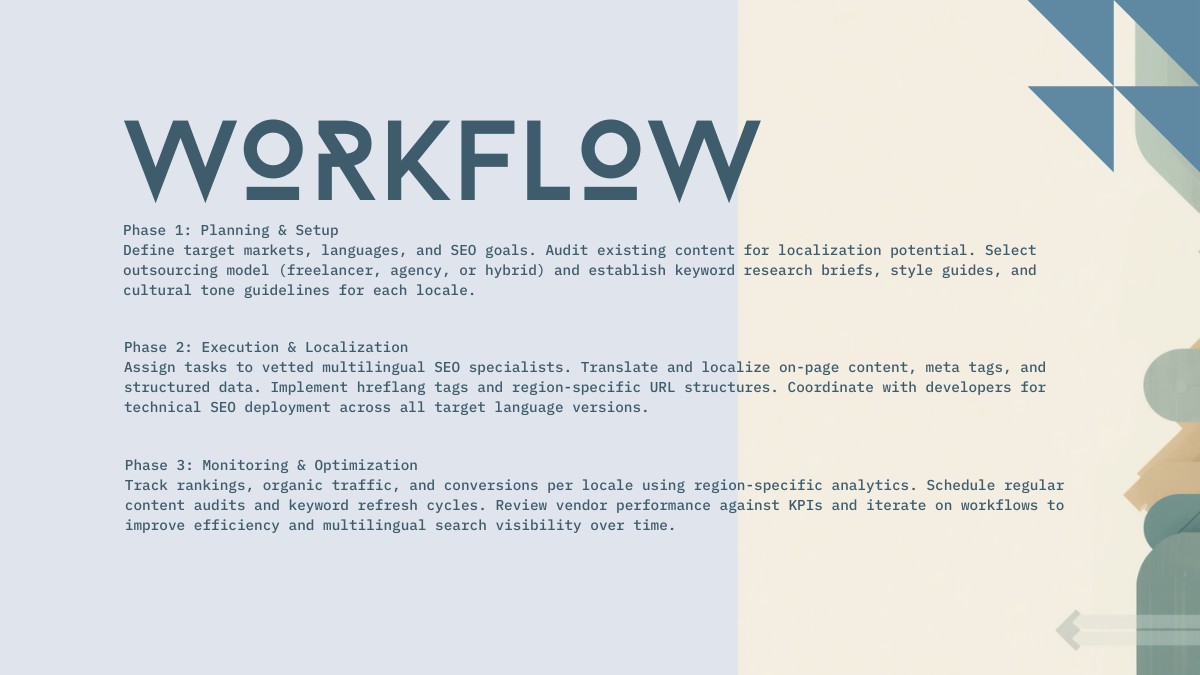
Treating multilingual SEO outsourcing as a structured process rather than an ad‑hoc task significantly improves outcomes. Process diagrams from best‑practice guides tend to follow a similar pattern, which you can adapt to your own context.
Step 1 – Internal Assessment and Scope
Start by clarifying which markets and languages matter most over the next one to three years. Review your current site, content, and analytics to identify gaps and strengths. Decide which tasks you want to keep in‑house and which you want to delegate, such as keyword research, content localization, technical implementation, or reporting.
Step 2 – Provider Shortlisting and Due Diligence
Decide which model—freelancer, boutique agency, global provider, or hybrid—matches your complexity and risk tolerance. Shortlist providers with demonstrable experience in your industries and target markets. Ask for example deliverables such as audits, keyword maps, and reports, and compare them against patterns described in trusted multilingual SEO resources. Check references or public case stories where possible to validate claims.
Step 3 – Pilot Project and Onboarding
Begin with a pilot focused on a limited number of languages and high‑impact pages. Use the pilot to test communication quality, response times, output quality, and process fit. Share brand guidelines, terminology lists, existing content, and access to necessary tools so the provider can work effectively.
Step 4 – Full Rollout and Technical Implementation
Expand to additional languages and sections once the pilot meets expectations. Implement the agreed domain and URL strategy and refine or correct hreflang configuration. Coordinate rollout with internal teams so SEO changes align with redesigns, CMS changes, or campaign launches rather than conflicting with them.
Step 5 – Monitoring, Reporting, and Optimization
Review regular reports that show rankings, traffic, and conversions by language and market. Track completed work—new localized pages, technical fixes, campaign launches—against performance metrics. Adjust budgets, priorities, and workflows as you learn which markets and tactics respond best.
This process gives you structured checkpoints to evaluate both the provider and the strategy before committing to broad, long‑term engagements, and helps turn outsourced multilingual SEO into a repeatable program rather than a one‑off project.
Quality Control, Reporting, and KPIs with Outsourced Teams
Long‑term success with outsourced multilingual SEO depends on how you define and monitor quality, not just on which vendor you choose. Clear expectations and metrics protect both sides.
Quality Assurance for Content and Localization
High‑performing providers typically rely on layered quality assurance. They maintain glossaries and terminology resources per language, conduct linguistic review by another native speaker or senior linguist, run SEO checks to confirm localized keywords and structural elements are correctly applied, and, where possible, involve client or in‑market reviewers for high‑impact pages.
If you lack in‑market staff, ask your provider how they simulate local feedback and what steps they take when feedback reveals misalignment with brand voice. The more explicit your quality expectations are up front, the smoother collaboration tends to be.
SEO KPIs (Traffic, Rankings, Conversions)
Clear KPIs help both sides measure progress. Common multilingual SEO KPIs include organic sessions and users segmented by language and country, rankings for prioritized keywords per market, conversion metrics such as leads, signups, or sales from localized organic traffic, and technical health metrics such as indexed pages by locale and hreflang error counts.
Enterprise‑level providers often share reporting formats that blend global summaries with market‑level details. This allows executives to see overall progress while regional teams track their own numbers and identify specific opportunities.
Governance, SLAs, and Communication Cadence
To prevent confusion and delays, governance should cover who approves strategies, content, and technical changes; how often you meet—for example, weekly check‑ins during rollout, monthly performance reviews, and quarterly roadmap sessions; and what SLAs apply to response times, deliverable turnarounds, and reporting.
International SEO providers frequently frame governance as a key differentiator. Mature clients often treat their SEO and localization partners as extensions of their internal teams rather than isolated vendors, which tends to improve transparency and outcomes.
Who Should Outsource Multilingual SEO? (SaaS, Ecommerce, Publishers, Marketplaces)
Different models of business encounter different multilingual SEO challenges. Understanding these patterns helps you choose the right outsourcing approach for your own context.
SaaS and B2B Companies
SaaS and B2B organizations often sell complex offerings that require nuanced explanation and trust‑building content across multiple markets. They rely on longer buyer journeys, where content must support awareness, consideration, and decision stages in each language.
Outsourcing is especially helpful when they need experienced partners to adapt solution pages, technical resources, and case studies to several languages while maintaining consistent positioning and lead‑generation funnels. External teams can bring structured processes for localizing each stage of the funnel while staying aligned with central messaging.
Ecommerce and Retail
Ecommerce brands usually manage large, frequently changing product catalogs and need localized category structures, filters, and product naming conventions that work across languages. They also must navigate different naming, labelling, and compliance requirements by country.
Multilingual SEO partners can help ecommerce teams design scalable category and URL structures, implement hreflang for product and category pages, and coordinate with localization teams to keep product details and metadata consistent and optimized as inventory changes.
Publishers and Media
Publishers produce high volumes of content and must choose which stories or sections to localize. They rarely have the capacity to localize everything, so they need prioritization strategies based on demand, long‑term value, or strategic focus.
Outsourced specialists often support them with keyword localization for key topics, templated multilingual structures, and technical guidance on archives and sitemaps. Editors retain control over editorial strategy while external teams ensure localized content is discoverable.
Marketplaces and Platforms
Marketplaces and platforms balance thousands or millions of listings across multiple countries. They need strong rules to avoid duplicate or conflicting localized content and must enforce consistent structures across many contributors.
International SEO and localization partners often work with marketplaces to define global patterns for listing structures, hreflang behaviour, and seller onboarding requirements, then support ongoing audits and optimization as the platform grows.
Common Risks, Objections, and How to Mitigate Them
Every outsourcing decision carries risk. For multilingual SEO, the most common concerns revolve around quality, control, and security. Addressing these early helps build a more resilient partnership.
Quality and Brand Voice Concerns
A recurring fear is that external teams won’t capture your brand voice or will produce inconsistent content across markets. To mitigate this, invest time in detailed kickoff workshops and sample reviews rather than relying solely on written briefs. Provide examples of on‑brand and off‑brand content in each language, and use phased rollouts where you review high‑impact pages before expanding to full site coverage.
Localization and SEO best‑practice resources emphasise that early collaboration and feedback loops are critical for long‑term quality. Once shared expectations are established, subsequent projects typically move faster and with fewer revisions.
Control and Transparency Issues
Another concern is losing visibility into what external teams are doing. You can address this by asking for written strategies and roadmaps, not just task lists; using shared dashboards for rankings, traffic, and content status; and clarifying which decisions remain in your hands and which are delegated.
Case examples from international SEO agencies show that clients who embed providers into their governance structures—inviting them to planning meetings, integrating them into reporting, and sharing internal priorities—experience fewer surprises and more predictable results.
Security, Compliance, and Data Handling
Security and compliance matter especially for regulated sectors. To reduce risk, include data protection clauses, NDAs, and access controls in contracts. Limit provider access to the tools and environments they truly need, and prefer partners with documented security practices and experience in your industry.
Large localization and SEO vendors highlight their security credentials precisely because enterprise clients demand them. Bringing this topic into early conversations helps both sides align on expectations before work begins.
How SEOSERVICES1 Supports Your Multilingual SEO Outsourcing
SEOSERVICES1 treats the decision to outsource multilingual SEO as a strategic move tied to your global growth roadmap, not just a quick way to ship more content. Rather than pushing a single template for every client, SEOSERVICES1 focuses on understanding your current international footprint, from languages already live to markets you plan to enter, the maturity of your SEO, localization, and development processes, and your internal strengths and gaps.
With that context, SEOSERVICES1 can help you design multilingual SEO architectures and workflows grounded in proven best practices, align keyword localization, content, and technical changes with your broader marketing and product plans, define realistic KPIs and reporting frameworks so you can see how multilingual SEO contributes to pipeline, revenue, or other outcomes, and integrate external agencies, translators, or platforms into a coherent ecosystem instead of managing a patchwork of disconnected vendors.
If you want a partner to help you decide how to outsource multilingual SEO in a way that fits your team, markets, and timelines, you can learn more about SEOSERVICES1’s approach and services by visiting their homepage.
Senior Search Strategist specializing in SEO, AEO, and Generative Engine Optimization (GEO). With over a decade of experience, Rick helps brands and applications (ASO) maximize their visibility across traditional search engines, AI answer engines, and app stores.