B2B content marketing, when treated as a core go‑to‑market lever, is one of the most reliable ways to build and close pipeline in complex sales environments. As of 2026, the teams that win are the ones that treat content like an owned revenue asset not a side project for “keeping the blog alive.”
This guide is written for B2B founders, marketing leaders, and demand gen or content leads who want their content to show up in CRM reports and sales calls, not just in Google Analytics. We’ll define B2B content marketing in modern, buying‑committee terms, walk through a practical 10‑step strategy framework, map content to the buyer journey, connect it with SEO and GTM motions, and dig into how to measure real pipeline and revenue impact.
What Is B2B Content Marketing?
B2B content marketing is the intentional use of seo content creation services to influence business buying decisions across long, multi‑touch sales cycles. Instead of publishing “whatever we have time for,” you plan and create assets that help real buying committees recognize a problem, understand the landscape, evaluate vendors, and feel safe choosing you.
In practice, that means your guides, case studies, webinars, comparison pages, and product stories are designed around the questions and objections that show up in actual deals not just around keywords or trends. When done well, those assets are used by your buyers, your SDRs, and your AEs.
In One Sentence: What B2B Content Marketing Does for Your Pipeline
B2B content marketing gives the right accounts the clarity, confidence, and proof they need at each stage of their journey, so more of your opportunities progress into qualified pipeline and closed‑won revenue.
How Is B2B Content Marketing Different from B2C?
B2B content marketing is different from B2C because you’re helping groups of people make expensive, high‑risk decisions over time, not nudging individual consumers to make quick, lower‑stakes purchases. You’re trying to align a buying committee, not just catch one person’s eye.
That difference impacts everything: what you publish, how deep you go, which channels matter, how long it takes to see results, and which metrics you care about.
Buying Committees and Longer Cycles
In B2B, the “customer” is a buying committee: a mix of champions, decision makers, influencers, and blockers. A typical group might include:
A champion who feels the pain day‑to‑day and pushes for change.
An economic buyer who owns the budget and cares about ROI and risk.
Technical or operational owners who evaluate feasibility and effort.
Sometimes procurement, legal, or compliance.
Each of these people has a different lens. A head of RevOps might be focused on forecast accuracy and process; the CFO wants predictable ROI; IT worries about security and integrations. Strong B2B content marketing ensures that each of them can find something credible that addresses their concerns and supports the internal case for choosing your solution.
Higher Deal Values and Risk Perception
Because B2B deals often represent six or seven figures over several years, the perceived risk is high. A wrong decision can hurt careers, not just campaigns. As a result, buyers actively look for:
Evidence that you’ve solved similar problems for similar companies.
Clear explanations of what implementation, training, and change management look like.
Realistic ROI and TCO stories, not just optimistic promises.
That’s why B2B content stacks deep assets detailed case studies, ROI breakdowns, implementation guides on top of more general educational pieces. Those deeper assets are what help a hesitant buying committee move from “This looks interesting” to “We can safely recommend and defend this to leadership.”
Channels and Content Types That Matter in B2B
B2C content can live heavily on impulse‑friendly channels like TikTok, Instagram, and short‑form ads. B2B content, by contrast, tends to perform where people go to understand and justify decisions:
Search‑optimized long‑form articles and pillar pages on your website.
LinkedIn posts and articles from your brand and subject‑matter experts.
Webinars, virtual events, and recorded demos that teams can watch together.
Deep product and technical content such as docs, playbooks, and integration guides.
The goal isn’t to “go viral” for a day; it’s to become the most trusted source buyers find when they research their problem, solutions, and vendors.
B2B vs B2C Content Marketing (Quick Comparison)
Aspect
B2B Content Marketing
B2C Content Marketing
Primary “buyer”
Buying committee (multiple stakeholders)
Individual consumer
Sales cycle
Longer, multi-touch, more friction
Shorter, fewer touches
Deal value
Higher ACV, multi-year contracts, renewals
Lower ticket, often one-off purchases
Key content formats
Guides, webinars, case studies, comparison pages, product tours
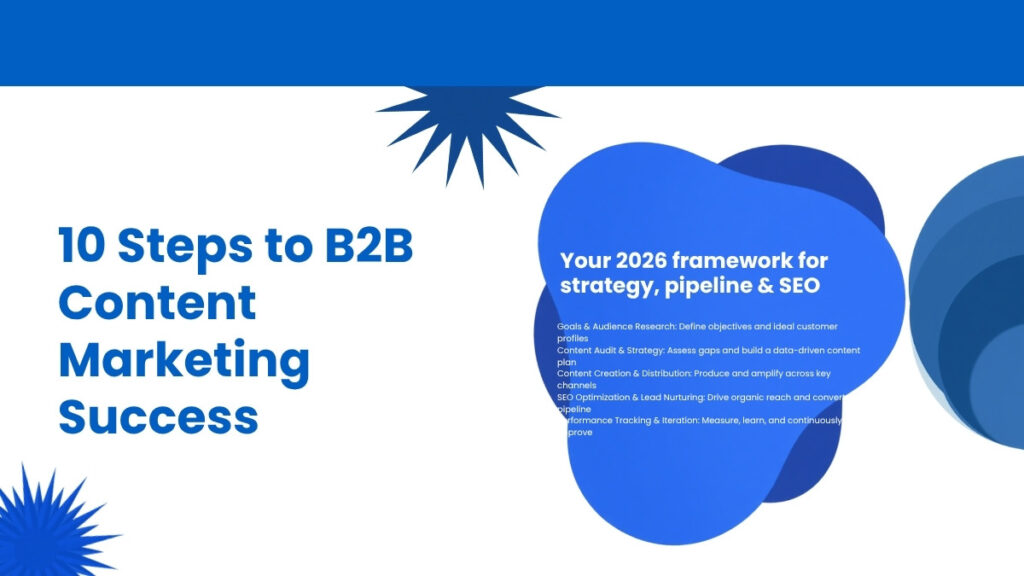
How Do You Create a B2B Content Marketing Strategy? (10‑Step Framework)
A B2B content marketing strategy is a documented plan for how content will support your GTM and revenue goals not just a backlog of topic ideas and publish dates. The teams that see consistent pipeline impact tend to follow a structured, repeatable framework.
Below is a 10‑step process you can adapt to your business.
Step 1 – Define Business and Revenue Goals
Start by answering a simple question: “If this content strategy works, what changes in our pipeline and revenue?”
Examples include:
“Generate additional qualified opportunities per quarter in mid‑market SaaS.”
“Support entry into a specific region or vertical with content that gets us onto shortlists.”
“Increase expansion pipeline from existing accounts by a clear percentage over the next year.”
Getting this specific forces you to prioritize segments, products, and GTM motions and avoids content that looks good on the blog but doesn’t move the business.
Step 2 – Map ICPs and Buying Committees
Once the business goal is clear, define who content is actually for. That means:
Narrowing down your ICPs by industry, company size, tech stack, and pain patterns.
Documenting the typical buying committee for each ICP: who champions, who signs, who blocks.
Capturing what each role cares about outcomes, risks, and red flags.
For example, a B2B billing platform might target a VP Finance at SaaS companies with usage‑based pricing. Their buying committee could include Finance, RevOps, and IT. Each role needs context and content framed around their specific responsibilities and worries.
Step 3 – Map Buyer Journey and Demand Stages
Next, map the journey from initial friction to long‑term customer. While real journeys aren’t perfectly linear, journey stages help structure your thinking:
Problem awareness: “We know something is off, but we can’t fully name it.”
Solution exploration: “We’re learning what types of solutions exist.”
Vendor evaluation: “We’re comparing real options and building a shortlist.”
Implementation and expansion: “We’ve chosen a vendor and now need to make it work and scale it.”
For each stage and each key role, list the questions they ask internally, in search, and on calls. Those questions become the backbone of your content roadmap.
Step 4 – Run a Content and Competitor Audit
Now look honestly at where you stand and how you compare.
Your audit should answer:
Which critical questions are we answering well with current content?
Where are there obvious gaps, thin content, or outdated assets?
Which competitor resources keep appearing in deals, on search results, or in “our prospects shared this” conversations?
Many B2B companies discover they’ve over‑invested in broad, top‑funnel articles and under‑invested in content that directly supports high‑intent buyers and sales teams comparison pages, deep case studies, and implementation playbooks. That’s where the earliest pipeline gains are often found.
Step 5 – Define Content Pillars, Themes, and Topic Clusters
Content pillars are your big, strategic topics the ones that sit at the center of your category story. Around each pillar, you build clusters of related content that cover questions and angles in more detail.
For a B2B content and SEO partner, pillars might include themes such as B2B content marketing strategy, SEO and content for B2B SaaS, or sales‑aligned content for complex deals.
Under each pillar, you might have:
Guides such as “How to Map Content to Your B2B Buyer Journey”.
Industry angles like “B2B Content Marketing for Manufacturing vs SaaS”.
Comparison and playbook content that speaks to specific decisions.
This approach makes it easier for buyers and search engines to see you as an authority on the topics that matter most to your GTM.
Step 6 – Choose Channels and Formats for Your Audience
You don’t need to be active everywhere; you need a coherent mix of channels that fit your ICPs and your team. In B2B, a common and effective core mix looks like:
Your website (blog, resources, documentation, and product pages) as the main content hub.
LinkedIn for distribution, narrative building, and personal authority.
Email (newsletters, nurture flows, customer broadcasts) for ongoing touchpoints.
Webinars and events for live education and deeper engagement.
A B2B SaaS company selling to revenue teams might bet heavily on search, LinkedIn, and webinars, while a manufacturer could lean more on search, email, and industry webinars in partnership with trade groups. The important part is aligning channels with where your buyers actually learn and make decisions.
Step 7 – Design Your Distribution and Promotion Engine
Most underperforming B2B content is not bad content it just never really got distributed.
A simple distribution engine might include:
Publishing a pillar or high‑value asset with clear positioning.
Internal enablement: a short explanation of what the asset is for and how sales and CS can use it.
Organic distribution via LinkedIn, relevant communities, and newsletters.
ABM and outbound use by layering content into outreach sequences for matching accounts.
Repurposing into smaller pieces such as snippets, slides, and short videos.
When a small B2B services company adopted this discipline, one strong case study quickly became their single most referenced asset in sales conversations, and they stopped cranking out disconnected blog posts “just because.”
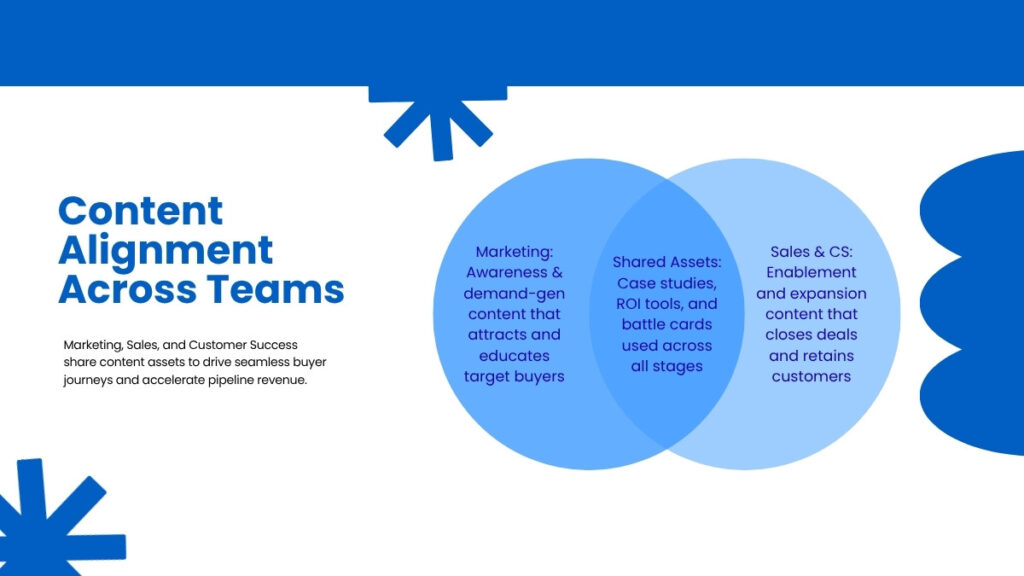
Step 8 – Align Content with Sales, Demand Gen, and ABM
B2B content marketing only becomes a revenue engine when it is jointly owned by marketing, sales, and success. That alignment looks like:
Quarterly or monthly working sessions to capture front‑line questions, objections, and stories.
Shared calendars where campaigns, launches, and content drops are planned together.
Common language around stages, personas, and play types so everyone knows which content fits where.
For ABM and outbound specifically, you can create content packages for priority plays, then give SDRs and AEs ready‑to‑use snippets, email angles, and call talk tracks tied to new content. This kind of collaboration turns content from “marketing’s thing” into part of the GTM operating system.
Step 9 – Set KPIs, Attribution, and Reporting
If you want ongoing support and budget, you need a reporting story that resonates with revenue leaders. That means:
Defining leading indicators such as engagement on strategic assets, content‑qualified leads, and account‑level content engagement.
Defining lagging indicators including opportunities and pipeline where content played a role, influenced revenue, and changes in win rate and cycle length.
Reports should be framed in terms of business questions such as which pillars drive pipeline and which content kits help close more mid‑market deals rather than purely content or traffic metrics.
Step 10 – Launch, Learn, and Iterate
A B2B content strategy is never “done.” You launch, observe, and adapt.
On a recurring basis, you can:
Review what content appears in the journeys of your best opportunities and wins.
Focus more of your effort on those patterns by expanding, updating, and supporting them with new formats.
Identify content that consistently draws the wrong audience or fails to show up in pipeline and decide whether to reposition, upgrade, or retire it.
Over 12–18 months, this iterative approach compounds. Your content library becomes sharper, more revenue‑aligned, and more useful for your sales and CS teams.
Mapping B2B Content to the Buying Journey
One quick way to audit your B2B content marketing is to walk through the buying journey and ask, “If I were the champion, the CFO, or IT at this stage, would I find something from us that actually helps me move forward?”
Here’s how content can support each phase.
Problem Awareness
In the problem stage, people feel friction but haven’t named it clearly yet. They’re asking early questions like “Why is this so hard?” and “Is this normal?”
Effective content here:
Names common problems and patterns.
Offers simple diagnostics or checklists.
Helps a champion explain the issue internally.
Examples might include a SaaS article on warning signs that revenue forecasting is guesswork or a manufacturing guide on quantifying the hidden cost of unplanned downtime. For pipeline, this stage fuels demand gen: you’re putting words to problems and pulling the right people into your world early.
Solution Education and Internal Consensus
Once a problem is recognized, teams explore how they might solve it. This is where they debate build versus buy, point solution versus platform, and timing.
Good content here:
Explains solution categories and trade‑offs.
Gives frameworks buyers can use inside their company.
Emphasizes “fit” rather than only features.
Examples could be frameworks for evaluating whether to build, buy, or outsource, or decision guides for comparing vendor categories. The best of these pieces often become unofficial internal memos for your champion as they align stakeholders.
Vendor Evaluation and Shortlisting
At this point, buyers are looking at specific vendors and narrowing down their shortlist. This is where content directly affects whether you make it onto that list and how you’re perceived against competitors.
Strong content here:
Shows how your product or service actually works in real‑world scenarios.
Provides credible, quantifiable proof in the form of before/after metrics and stories.
Reduces perceived implementation and adoption risk.
Detailed case studies, honest comparison pages, and implementation guides all contribute to pipeline by helping buyers justify putting you on (or keeping you on) the shortlist.
Post‑Sale Adoption, Expansion, and Advocacy
After the deal is signed, content still has work to do especially in subscription businesses where retention and expansion drive long‑term revenue.
Helpful content here:
Guides customers through setup, onboarding, and first wins.
Suggests new use cases and expansion paths.
Encourages advocacy, co‑marketing, and referrals.
Onboarding playbooks, expansion case studies, and customer‑only webinars can all help drive expansion pipeline and contribute to strong net revenue retention.
Content Types vs Goals and Funnel Stages
Not all content serves the same purpose. Mapping formats to clear goals and funnel stages helps you produce the right things instead of chasing every possible idea.
Awareness and Demand Generation Content
Awareness content attracts the right people and educates them about problems and opportunities in their world.
Examples include:
Opinionated thought leadership that articulates a clear point of view on your category.
Industry benchmarks and research reports that highlight gaps and opportunities.
Problem‑led webinars and panels with Q&A.
This content rarely gets full credit for deals, but it shapes perception and fills the top of your demand gen funnel with ICP accounts who now understand the problem in your terms.
Demand capture content makes sure you’re visible and compelling when buyers are actively looking for a solution.
Examples include:
SEO pillar pages that combine education with strong calls‑to‑action.
Comparison and “alternative” pages that rank for category and competitor queries.
Use‑case and vertical pages that show how you solve for different scenarios.
These assets often correlate directly with form fills, demo requests, free trials, and “contact sales” actions, making them especially important for inbound performance.
Sales Enablement Assets
Sales enablement content is built primarily for opportunities already in motion. It’s designed to help human sellers close gaps in understanding and reduce friction.
Examples include:
Persona‑specific one‑pagers that speak directly to CFOs, IT leaders, or operators.
Objection‑handling sheets that AEs and SDRs can use in conversations.
Business case templates and ROI or TCO explainers.
These assets give your sales team better answers when prospects say they need something to share with their CFO, IT team, or VP.
Retention and Expansion Content
Retention and expansion content supports customer success and account management teams trying to help customers get more value and expand usage.
Examples include:
Advanced strategies and best‑practice guides.
Playbooks for rolling your product out to new teams or regions.
Executive‑level summaries and reporting templates customers can reuse internally.
When done well, this content generates upsell, cross‑sell, and expansion opportunities by helping customers envision and justify “the next step” with you.
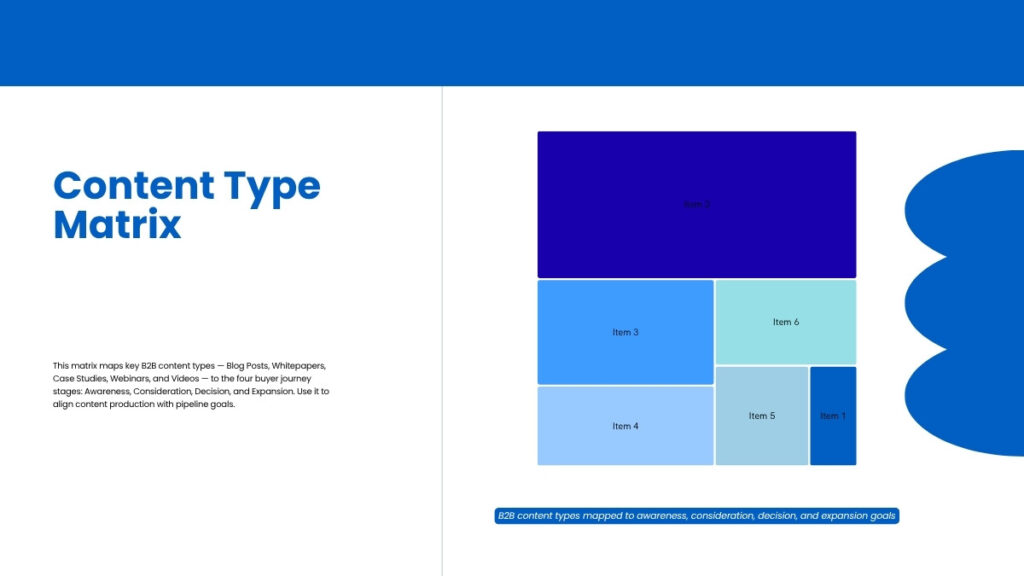
Content Types vs Goals vs Stages (Snapshot)
Content Type
Primary Goal
Best Stages
Blog/guide
Awareness, demand gen
Problem awareness, early education
Webinar
Education, lead gen
Awareness, solution education
Comparison page
Demand capture, sales enablement
Late education, vendor evaluation
Case study
Sales enablement, expansion
Vendor evaluation, post-sale
Product tour/demo
Demand capture, sales enablement
Vendor evaluation
Email sequences
Nurture, expansion
Mid-funnel, post-sale
LinkedIn posts
Awareness, amplification
Across stages, often top/mid funnel
How B2B Content Marketing Connects with SEO and Demand Capture
SEO is how your best content meets buyers at the exact moment they’re searching for help. In B2B, the goal isn’t to rank for every keyword it’s to rank for the right intent at the right stages of the journey.
Here’s how to connect your B2B content marketing with search and demand capture.
Topic Research and Search Intent
Start with the questions your ICPs actually ask, not just keyword volume. Group searches into three high‑level categories:
Problem‑aware queries such as “why is X broken” or “how to fix Y”.
Solution‑aware queries like “best category tools” or “[category] for [industry]”.
Product or vendor‑aware queries including “[your product] vs competitor” and “[competitor] alternatives”.
Then decide where you need problem‑led content to shape thinking and where you need product‑led or comparison content to capture demand.
Pillar Pages and Topic Clusters
Organize your content so it mirrors how buyers research:
Create pillar pages around core topics such as B2B content marketing strategy.
Build clusters of related content implementation deep dives, industry variants, comparisons, measurement guides around each pillar.
Link them intelligently so readers can move from broad understanding to specific, actionable guidance without leaving your site.
This structure helps search engines recognize your topical authority and helps buyers find the next relevant piece without friction.
Product‑Led vs Problem‑Led SEO Content
Both perspectives are essential:
Problem‑led content meets buyers earlier and shows empathy for their context.
Product‑led content connects that context directly to your solution, pricing, and differentiation.
In many B2B journeys, a prospect might first discover you through a problem article months before they return via a comparison page or product pillar. Treat those touchpoints as parts of one journey, not separate silos.
Updating and Refreshing High‑Value Assets
Markets, products, and buyer expectations all shift; your content has to keep up. Refreshing high‑value content usually delivers faster wins than starting from scratch.
Refreshing might mean:
Adding new examples and data that reflect current conditions.
Updating product screenshots, workflows, and messaging.
Tightening calls‑to‑action to align with your current GTM plays.
Teams that schedule regular reviews of their top assets tend to see more stable rankings, stronger engagement, and higher conversion rates from content that already has traction.
Aligning B2B Content with GTM, Sales, and ABM
Content is most powerful when it’s embedded in your GTM system. That means planning content alongside campaigns and sales plays, not after them.
Aligning B2B content with demand gen, ABM, and sales ensures that every major initiative has content support from awareness through close and beyond.
Content for Account‑Based Marketing Plays
In ABM, you target specific accounts or tightly defined segments, so your content should reflect that precision.
For example, you might create:
Industry‑specific landing pages and playbooks that match your target verticals.
Micro‑case studies or “story cards” tailored to similar accounts.
Executive briefs aligned with the strategic priorities of your top accounts.
Instead of sending generic blog posts, your ABM and sales teams share content that feels like it was built for that account’s context. That difference is often what gets you into the buying conversation.
Content for Outbound and SDR Teams
Outbound reps are far more effective when they can lead with value, not just “checking in.”
Arm SDRs with:
Short, sharp assets they can share as the reason for the outreach.
Talk tracks that draw on your best thought leadership and case studies.
Follow‑up content tailored to the typical objections they hear.
Done right, content turns outbound from cold interruption into “saw this and thought of you,” which shows up in reply quality and booked meetings.
Content for Product Launches and Campaigns
Campaigns and launches work best when content is built into them from the start.
For a major launch, you might:
Publish problem and trend content leading up to the announcement.
Release detailed feature explainers and “first steps” guides at launch.
Follow up with success stories and advanced use‑case content after early adopters see results.
This ensures your launch isn’t just a noisy moment; it becomes a set of assets you can keep using long after the initial push.
Resourcing Models: In‑House vs Agency vs Hybrid
How you staff B2B content marketing is a strategic choice. The right model depends on your growth stage, complexity, and tolerance for building versus buying expertise.
There is no single correct answer; instead, you need a model that matches your goals, internal strengths, and constraints.
When In‑House Makes Sense
Building in‑house content leadership usually makes sense when:
Content is central to your GTM, such as for product‑led growth or complex education‑heavy categories.
You want someone close to product, sales, and leadership who can shape narrative and priorities.
You’re ready to treat content as a long‑term capability, not a short‑term experiment.
In‑house teams excel at internal alignment, capturing institutional knowledge, and adjusting quickly to changes in strategy. The trade‑off is time and cost: strong content talent is in demand, and you may still need specialized external help for SEO, design, or major campaigns.
When to Bring in a B2B Content Agency
A B2B content agency becomes attractive when:
You don’t have the in‑house experience to design a coherent content and SEO strategy.
You need to ramp production or quality quickly.
You want exposure to what’s working across multiple clients and industries.
Agencies can bring frameworks, templates, and battle‑tested processes you don’t have to invent yourself, then tailor them to your GTM. The key is choosing a partner that understands B2B buying committees and pipeline, not just blog posts and keywords.
For many B2B companies, a hybrid model is the most realistic and effective approach:
A lean internal owner such as a head of marketing, demand gen, or content keeps strategy aligned with business goals and sales reality.
A specialist partner helps with strategy design, pillar and cluster planning, production, editing, and optimization for key assets.
This combination gives you strategic control and internal context, plus the scale, expertise, and execution capacity of a specialized B2B content and SEO partner. For teams that want this hybrid support, SEOSERVICES1 can fill that role while keeping pipeline, SEO, and sales alignment at the center of the engagement.
Measuring and Optimizing B2B Content Marketing for Pipeline and Revenue
If you want content funding to survive budget reviews, you need a clear story about how it drives pipeline and revenue. Traffic and engagement are important, but they’re only useful if they connect to commercial outcomes.
Effective B2B content measurement combines early engagement signals with clear links to opportunities, pipeline, and revenue influence.
Leading Indicators: Engagement and Content‑Qualified Leads
Leading indicators tell you whether your content is resonating with the right people before deals show up in the CRM.
Useful leading signals include:
Depth of engagement on strategic assets, including scroll depth, time on page, and return visits.
Increased consumption of key content by accounts on your target lists.
Content‑qualified leads whose behavior suggests serious interest, such as viewing comparison pages, case studies, and pricing or “talk to sales” pages in sequence.
These indicators help you see which pillars and themes are likely to deliver pipeline later and which need refinement or different positioning.
Lagging Indicators: Pipeline, Revenue Influence, and Velocity
Lagging indicators are where you prove impact to finance and leadership.
Look for patterns in:
Opportunities where contacts consumed specific content before or during the sales cycle.
The share of your pipeline and closed‑won revenue that passes through key pillars and campaigns.
Changes in win rate or sales cycle length after rolling out new sales enablement or buying‑committee content.
For example, if opportunities where prospects viewed a particular comparison page and a set of case studies close at a higher rate, that asset clearly merits further investment.
Attribution: Self‑Reported and Analytics‑Based
Attribution in B2B is inherently imperfect, but you don’t need perfection just enough clarity to make better decisions.
You can combine:
Self‑reported attribution from “How did you hear about us?” fields, which often surface content shared in private channels.
Analytics‑based paths that show typical content journeys before form fills or bookings.
Account‑level engagement in ABM tools that reveals which accounts engaged with which content before moving stages.
Treat attribution as a directional tool that highlights which content themes and formats are most often present in healthy deals, rather than a system that assigns exact credit for every touch.
Optimization Loops and Content Refresh Cycles
The point of measuring is to change behavior. Build a simple optimization loop to keep improving your B2B content marketing engine.
That might involve:
Identifying the content that repeatedly appears in high‑value opportunities and wins.
Improving and extending those assets and their supporting clusters.
Identifying content that attracts the wrong audience or stagnates and deciding whether to reposition, consolidate, or stop supporting it.
Over time, this shifts your content portfolio away from “lots of activity” toward “a smaller set of assets that demonstrably support the revenue engine.”
B2B Content Marketing FAQ
B2B content marketing raises predictable questions for founders, marketing leaders, and sales teams. This FAQ addresses the ones that most often affect buy‑in and execution.
What is B2B content marketing?
B2B content marketing is the structured use of content to attract, educate, and influence business buyers and buying committees across long, complex sales cycles. Unlike ad‑hoc blogging, it is anchored in GTM, pipeline, and revenue goals.
How is B2B content marketing different from B2C?
B2B content marketing addresses multi‑stakeholder buying committees making high‑value, high‑risk decisions, while B2C typically speaks to individual consumers making faster, lower‑risk purchases. That difference demands deeper content, more proof, and closer sales alignment in B2B.
How do you create a B2B content marketing strategy?
You create a B2B content strategy by starting from revenue goals, mapping ICPs and buying committees, understanding buyer journeys, auditing current and competitor content, defining pillars and clusters, choosing channels and formats, aligning with sales and demand gen, and setting up metrics and feedback loops. A documented 10‑step framework keeps all of that coherent and pipeline‑focused.
What content works best in B2B marketing?
The most effective B2B content is the content that shows up in real buying journeys: educational guides, webinars, detailed case studies, comparison pages, ROI explainers, and sales enablement assets. “Best” is less about format in isolation and more about whether the content helps real accounts move from confusion to clarity and then to commitment.
How long does B2B content marketing take to work?
Most organizations see meaningful early signals within a few months and clearer pipeline and revenue impact in 6–12 months, depending on their sales cycle. You can shorten the path by prioritizing high‑intent and sales enablement content early, rather than starting with awareness content alone.
How much budget do we need to see meaningful results?
There’s no universal number, but meaningful results usually require a consistent, multi‑quarter investment in both strategy and production. That might mean funding at least one strong internal owner plus a specialist partner, or a focused agency engagement, rather than trying to piece things together with sporadic freelancer work and leftover budget.
Should we build an in‑house content team, hire an agency, or use a hybrid model?
If content is central to your GTM and you have the resources, building in‑house leadership makes sense. Agencies can provide strategy and scale when you lack those internally. For many B2B teams, a hybrid model internal ownership plus a specialist partner offers the best balance of control, speed, and cost.
How do we align B2B content with demand gen, ABM, and sales?
You align content with GTM by planning it alongside campaigns and plays, not after the fact. That includes regular joint planning with sales and success, mapping content to specific ABM and outbound plays, and actively enabling SDRs and AEs with content kits and talk tracks tied to each major asset or campaign.
Which metrics really matter for B2B content marketing?
The metrics that matter most are those linked to revenue: content‑assisted opportunities, content‑influenced pipeline and closed‑won revenue, win rates, and sales velocity. Engagement metrics like time on page and downloads are important leading indicators but should be viewed in the context of how they contribute to those commercial outcomes.
How do we handle attribution when leads come from multiple touches?
Use self‑reported “How did you hear about us?” answers, analytics paths, and account‑level engagement together to build a sane, if imperfect, picture of influence. Focus on consistent patterns like certain pillars or formats showing up in healthy deals rather than trying to assign exact credit for every touch.
How often should we publish and refresh content?
For most B2B teams, a sustainable rhythm is a few high‑quality pieces per month, supported by regular refreshes of your most important assets each quarter. As your library grows, expect to spend a larger share of time maintaining and upgrading high‑impact content instead of only producing net new pieces.
How should we use AI in B2B content creation without losing quality?
Use AI to accelerate low‑risk steps such as brainstorming, research summarization, outlining, and repurposing, but keep humans in charge of strategy, narrative, nuance, and final editing. As of 2026, the most effective B2B teams treat AI as part of a disciplined content operations system, not as a replacement for people who understand your customers and market.
If you’re ready to turn B2B content marketing into a consistent driver of pipeline and revenue, rather than an occasional experiment, exploring a partnership with SEOSERVICES1 via their homepage can be a practical next step.
Senior Search Strategist specializing in SEO, AEO, and Generative Engine Optimization (GEO). With over a decade of experience, Rick helps brands and applications (ASO) maximize their visibility across traditional search engines, AI answer engines, and app stores.