A solid content marketing strategy only gets you halfway there. The other half depends on what actually ends up on the page. Even the most thoughtful editorial calendar, the most carefully researched buyer persona, and the most ambitious distribution plan will underdeliver if the writing doesn’t work if it doesn’t hold attention, answer the right question, and move someone to a next step.
That’s what this guide is about. Not writing in the abstract, not grammar tips or style guides, but the specific writing decisions that make content marketing assets perform: getting found, getting read, earning trust, and driving the actions that matter to your business.
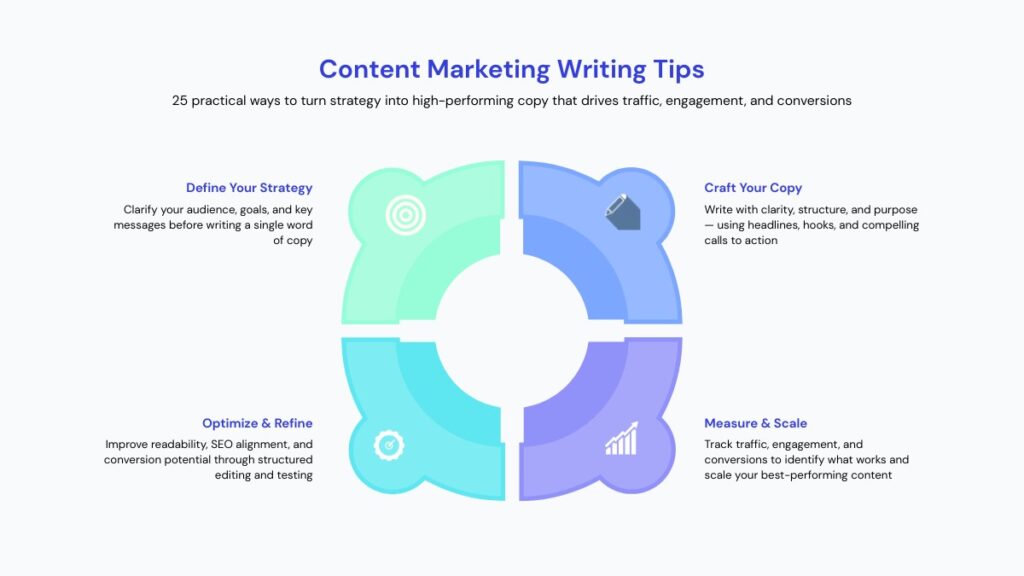
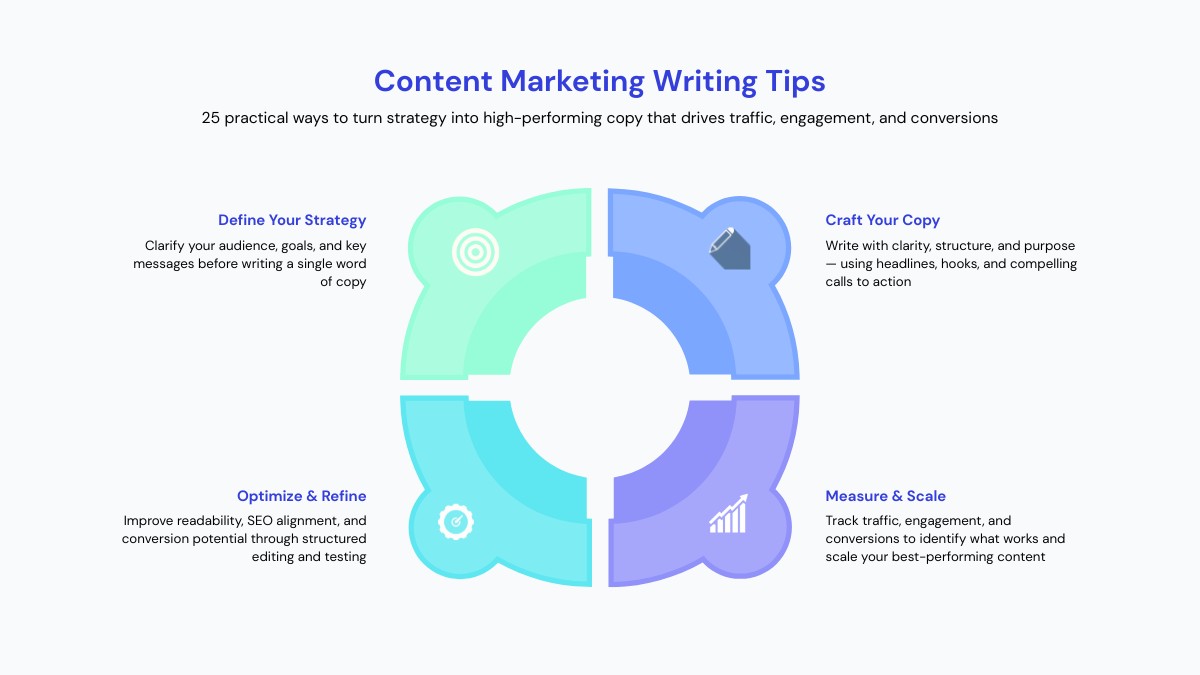
These 25 tips are organised into clusters so you can use them end‑to‑end when creating new content, or dip into a specific cluster when you’re stuck on a particular problem. Whether you’re working on a blog post for a global SaaS audience or an email sequence for a niche manufacturing brand, the principles apply the emphasis just shifts.
What Is Content Marketing Writing?
Content marketing writing is the craft of producing words that execute a content marketing strategy and move a specific audience along the buyer journey toward a business outcome. It is not purely editorial, not purely promotional, and not purely technical. It sits at the intersection of all three.
More precisely, content marketing writing:
- Starts from a business goal and a defined audience, not an open‑ended creative brief.
- Answers questions real buyers are actually asking, not questions you imagine they’re asking.
- Is built to be found, whether through search, email, social, or referral.
- Treats every reader interaction as a step in a relationship, not an isolated transaction.
- Points toward a clear, logical next step, even if that step is subtle.
That last point is often what separates content marketing writing from generic content writing. A well‑crafted general article informs. A well‑crafted content marketing piece informs and advances.
How It Differs from Generic Writing, Copywriting, and SEO Writing
The distinctions matter, because confusing these modes leads to writing that tries to do everything and ends up doing nothing well.
| Type | Primary Goal | Typical Format | Key Characteristics |
|---|---|---|---|
| Generic content writing | Inform, entertain, express | Blogs, articles, personal essays | Helpful, thematic, not always goal‑driven |
| Copywriting | Prompt immediate action | Ads, sales pages, email promotions | Punchy, benefit‑led, urgent tone |
| SEO writing | Rank for target queries | Web pages, articles | Keyword‑optimised, intent‑matched |
| Content marketing writing | Educate and guide buyers toward a business goal | Full content marketing asset library | Strategic, reader‑first, action‑oriented |
Content marketing writing draws from all three disciplines without being identical to any of them. It needs the depth of good content writing, the direction of copywriting, and the visibility of SEO writing all working together.
Where Content Marketing Writing Fits in Your Content Strategy
Your content strategy decides the “why, who, and where.” Content marketing writing is the “how” that makes those decisions real on the page.
If your strategy calls for a pillar article targeting awareness‑stage buyers in the mid‑market, content marketing writing is the skill that turns that brief into something those buyers will actually read, share, and return to. Without that craft layer, strategy documents stay strategy documents.
What Makes Good Content Marketing Writing?
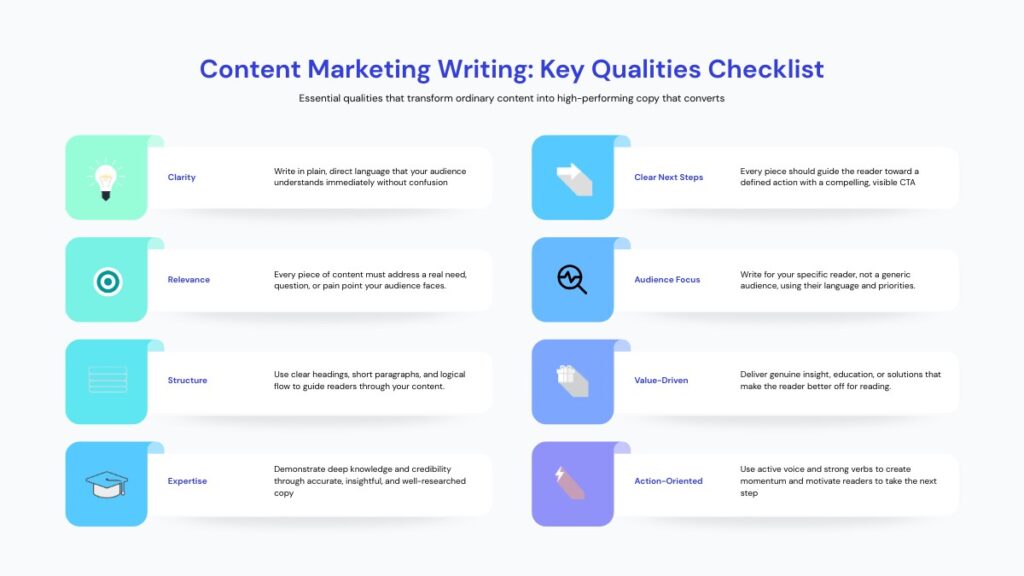
Good content marketing writing is writing that is clear enough to hold attention, relevant enough to build trust, and direct enough to generate a next step all in service of a defined marketing goal.
In practice, that means a piece works well when:
- It speaks to a specific reader in the language they’d use themselves.
- It answers the question implied by whatever brought them to the page.
- It feels easy to navigate, whether someone reads every word or just scans headings.
- It reflects genuine expertise, not padded generality.
- It ends with a natural next move, not a hard stop.
These qualities don’t happen by accident. They’re the result of the tips below applied deliberately, draft by draft.
Core Content Marketing Writing Tips (25 Practical Rules)
The 25 content marketing writing tips below are grouped into clusters so you can focus on the aspects that matter most for your current piece: audience and intent, planning, headlines and hooks, structure, clarity and style, SEO and discoverability, CTAs and conversion, and editing and optimization.
Tip Cluster 1 – Audience and Intent
Tip 1: Start every piece with a defined content goal
Before you write, be explicit about what this piece is supposed to achieve. Not “drive traffic” something specific. “Help IT directors understand the security implications of our integration model” or “Convert blog readers into free‑trial signups for the project management tool.” A vague goal produces vague writing. A specific goal gives every paragraph a filter to pass through.
If you can’t articulate the goal in one sentence, you’re not ready to write yet.
Tip 2: Write for one reader at a time
Broad audiences produce forgettable writing. “Marketing professionals in growth‑stage B2B SaaS companies dealing with increasing content complexity” is a more useful target than “content marketers.” When you write for one clearly imagined person, choices like vocabulary, examples, and tone become much easier.
If your content genuinely serves multiple segments, consider segmented versions or clear framing at the top (“This guide is aimed at early‑stage marketing teams…”). Trying to please everyone in a single undifferentiated piece usually means you resonate with no one deeply.
Tip 3: Match the piece to a single dominant intent
Most searchers and readers arrive with one primary need: they’re trying to understand something, compare their options, or decide what to do. If you try to serve all three modes in one piece, you’ll dilute the value of each.
Awareness articles should educate without heavy promotion. Comparison guides should be fair and thorough, not sales brochures with headings. Decision‑stage content can be more direct. Know which intent you’re serving before your first sentence.
Micro‑exercise:
Write one sentence before you draft anything:
“This piece is for [person] who wants to [understand / evaluate / decide X] so they can [achieve outcome Y].”
Keep it visible. Every paragraph that doesn’t serve that sentence is a candidate for deletion.
Tip Cluster 2 – Planning and Outlining
Tip 4: Outline before you draft
An outline is not just a structural map; it’s the moment you pressure‑test your argument before committing to prose. If you can’t fill out an outline for a piece, you probably don’t have enough material yet, or the angle needs rethinking.
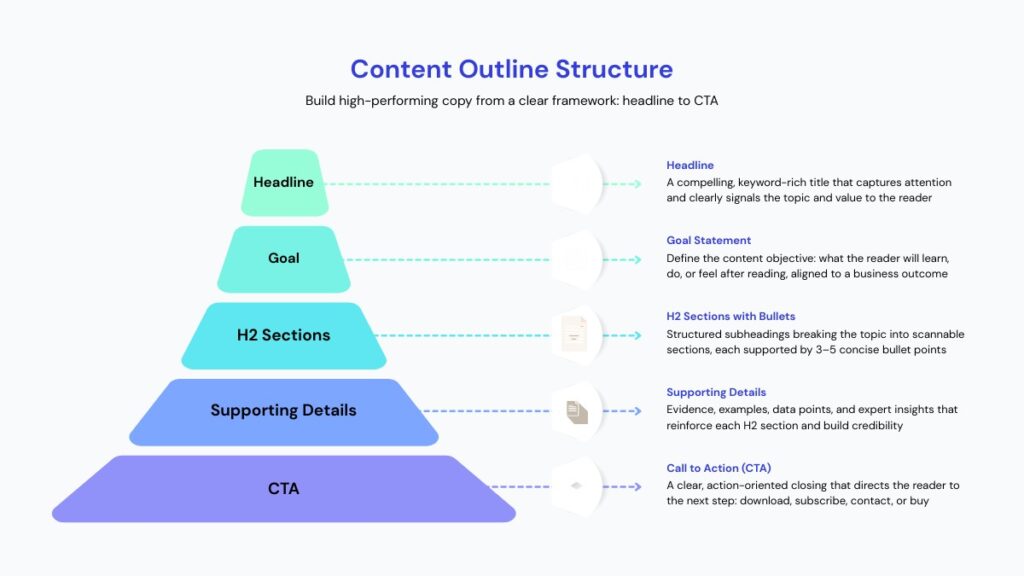
Your outline doesn’t need to be elaborate. For most content marketing pieces, you need a headline, a stated goal, four to eight H2 sections with a bullet or two under each, and a CTA. That’s enough to write from.
Tip 5: Use a simple pre‑writing framework
A reliable pre‑writing framework prevents structural confusion, especially for teams managing multiple writers:
- Goal – what business outcome does this support?
- Reader – who, specifically, is the primary audience?
- Core message – the single idea readers should leave with.
- Evidence or support – what examples, data, or arguments will you use?
- Outline – the four to eight sections needed to deliver that message clearly.
This framework works whether you’re writing a 400‑word email or a 3,000‑word pillar article. Scale the depth accordingly.
Tip 6: Design your structure for skimmers, not just committed readers
Studies of online reading behaviour consistently show that most people scan before they read. They check headings, the first sentence of sections, and pull‑out elements like bullet lists and tables before deciding whether to read closely.
Design your outline with that in mind. If someone reads only your headings, do they still understand the main idea? If someone reads only the first sentence of each section, do they get meaningful value? If the answer to either question is no, your structure needs work.
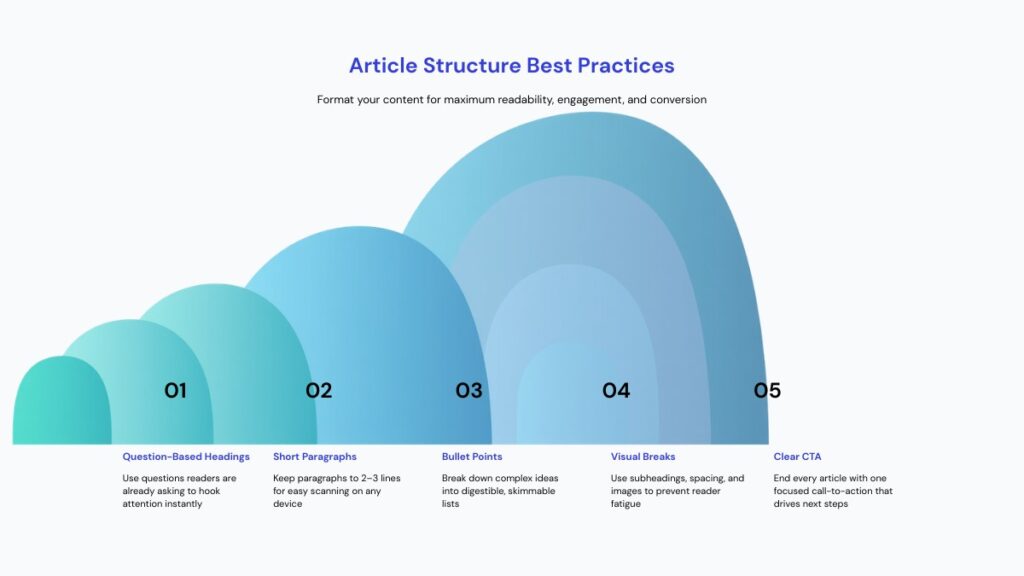
Image Description: A visual representation of a content outline showing a headline, goal, several H2 sections with bullets, and a CTA at the end.
Tip Cluster 3 – Headlines, Hooks, and Intros
Tip 7: Make headlines clear before clever
The purpose of a headline is to get the right reader to click and read. Clarity does that better than cleverness in almost every content marketing context. Clever headlines that require context or inference to decode lose people at the first hurdle.
Before publishing, ask: does someone who doesn’t know our brand understand exactly what this piece offers? If not, rewrite.
Weak vs. improved headlines:
| Weak headline | Improved headline | Why it works better |
|---|---|---|
| “Write Better” | “25 Content Marketing Writing Tips to Improve Every Asset You Publish” | Specific, outcome‑focused, keyword‑relevant |
| “SEO Content Advice” | “How to Write SEO Content That Ranks Without Sounding Like a Robot” | Addresses a real frustration, promises a clear result |
| “Thoughts on Content Strategy” | “How to Build a Content Strategy That Supports Pipeline, Not Just Traffic” | Stakes clear, audience‑relevant |
Try this: Take the last three headlines you published and apply the test: “Does this tell me who it’s for and what I’ll get?” Rewrite any that fail.
Tip 8: Hooks that connect to lived experience outperform hooks that state facts
The best content marketing hooks place the reader inside a familiar situation before introducing your solution or framework. This isn’t manipulative; it’s recognising that people engage with problems they recognise.
Compare:
- Fact hook: “Content marketing generates three times as many leads as traditional outbound.”
- Experience hook: “You’ve been publishing consistently for six months, traffic is growing, but the leads aren’t moving. The blog looks busy but doesn’t feel like it’s doing anything.”
The second option earns attention because it describes something real. The fact hook is fine, but it leads with data, not empathy.
Tip 9: Tell readers the payoff before they commit to reading
Don’t make readers scroll through four paragraphs to find out what they’ll learn. State the outcome or takeaway clearly in the first 100–150 words. If you’ve hooked them with a situation they recognise, follow immediately with what you’re going to do about it.
Tip Cluster 4 – Structure and Flow
Tip 10: One idea per paragraph
This is one of the most consistently ignored writing rules in content marketing, and one of the most important. When a paragraph contains two or three distinct points, readers have to do extra work to process them. They slow down, skim, or give up.
Test each paragraph: if you can summarise it with one clear sentence, it’s probably doing its job. If you need two sentences, it probably contains two paragraphs.
Tip 11: Turn abstract sections into question‑based headings
Headings like “Benefits” or “Key Features” are invisible to most readers because they’re predictable. Headings written as questions your audience actually asks “How do I write content that both ranks and converts?” or “What’s the difference between a content strategy and a content plan?” draw attention because they feel like a direct answer to a real concern.
This also benefits SEO: question‑style headings frequently match natural language search queries.
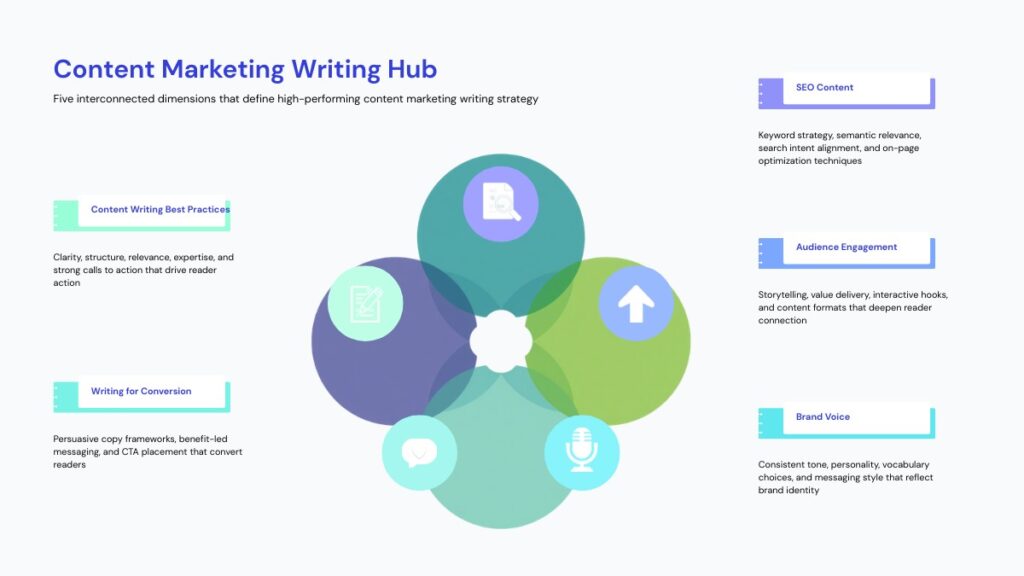
Tip 12: Use formatting as a service, not decoration
Bullet lists, tables, numbered frameworks, and pull‑quotes should earn their place. Each one is a signal to the reader: “This information is structured; you can process it efficiently.” Overuse dilutes that signal.
A useful rule: use formatting when it genuinely makes information easier to process, not when you want to break up a wall of text for visual reasons. If the ideas don’t naturally want to be a list, a short, clear paragraph usually serves the reader better.
Tip Cluster 5 – Clarity, Readability, and Style
Tip 13: Prefer plain language, not because simplicity is a virtue, but because comprehension is the goal
Complex vocabulary rarely signals expertise; it usually signals that the writer is more focused on sounding authoritative than on being understood. In content marketing writing, being understood is the job.
Swap “leverage” for “use,” “utilise” for “apply,” “in order to” for “to.” These aren’t stylistic quibbles. They’re friction reductions that keep readers moving forward.
Tip 14: Default to active voice, especially when writing for action
Passive constructions slow sentences down and obscure who is doing what. In content marketing writing, where you’re often trying to prompt a behaviour, active voice is almost always sharper.
Compare:
- Passive: “Results should be reviewed by your team each month.”
- Active: “Review your results every month.”
The active version is shorter, clearer, and more direct. There are cases where passive works complex technical writing, situations where the “who” genuinely doesn’t matter but in most content marketing contexts, active voice is the right default.
Tip 15: Show expertise through specificity, not assertion
Claiming that something is “important,” “crucial,” or “essential” without evidence is one of the most common ways content marketing writing loses credibility. It’s a habit worth breaking.
Replace assertions with observations, patterns, and examples:
- Assertion: “Brand voice is important.”
- Observation: “Most content that feels generic or boring turns out to be written without a clear voice decision the writer defaulted to ‘neutral’ and ended up with forgettable.”
The second version is more useful and more memorable, even without a citation.
Tip 16: Match tone to your brand voice without letting tone compromise clarity
Your brand voice might be informal, authoritative, technical, or conversational. All of these can work. What doesn’t work is letting voice choices create confusing sentences.
Do and don’t guide for brand voice in content marketing writing:
| Do | Don’t |
|---|---|
| Use your brand’s distinctive phrasing for familiar concepts | Use in‑jokes or cultural references your global audience won’t share |
| Keep sentences concise even if your register is formal | Justify long, tangled sentences by calling them “authoritative” |
| Define or briefly explain any jargon you use | Assume all readers know your product‑specific terminology |
| Write as a smart, informed peer, not as an advertisement | Let promotional phrases (“world‑class”, “best‑in‑class”) replace real description |
Tip Cluster 6 – SEO and Discoverability
Tip 17: Write for human intent, then refine for search terms
This is the most important SEO principle for content marketing writing in 2026, and it’s the one most often inverted. Many writers still start from a keyword and work outward; this produces stilted sentences and generic structures that serve neither readers nor search engines well.
Start instead from the real question your reader has. Write to answer that question clearly and completely. Then revisit your draft and check that the language you’ve used naturally includes the terms people would search for to find this piece. In most cases, it already does, because if you’ve answered the question well, you’ve used the vocabulary of the question.
Tip 18: Place keywords in high‑signal locations, not in every paragraph
Your main phrase (“content marketing writing tips,” in this case) should appear in:
- The H1 or headline.
- The first 100–150 words, naturally integrated.
- At least one H2, if it fits logically.
- The meta title and meta description.
That’s sufficient for modern SEO. Repeating it every 200 words adds nothing and often makes sentences clumsy.
Tip 19: Build semantic depth using related language
Search engines increasingly evaluate content based on topical authority, not just keyword frequency. If you’re writing about content marketing writing tips, you should naturally also be discussing content writing best practices, marketing copy, writing for conversion, editorial planning, content marketing copywriting, and related ideas because those are genuinely part of the topic.
Write comprehensively and you’ll achieve semantic depth as a by‑product. If your piece only repeats the primary keyword without exploring adjacent concepts, that’s often a signal that the piece is too thin.
Tip 20: Link strategically, not reflexively
Internal links that help readers find genuinely related content serve both users and SEO. External links to credible sources support trust. What doesn’t serve either purpose: linking to every concept mentioned, using links as padding, or adding links because “it’s best practice” without considering whether the destination adds value.
Ask for each link: “Would a thoughtful reader benefit from clicking this?” If the answer is uncertain, the link probably shouldn’t be there.
Tip Cluster 7 – CTAs and Conversion
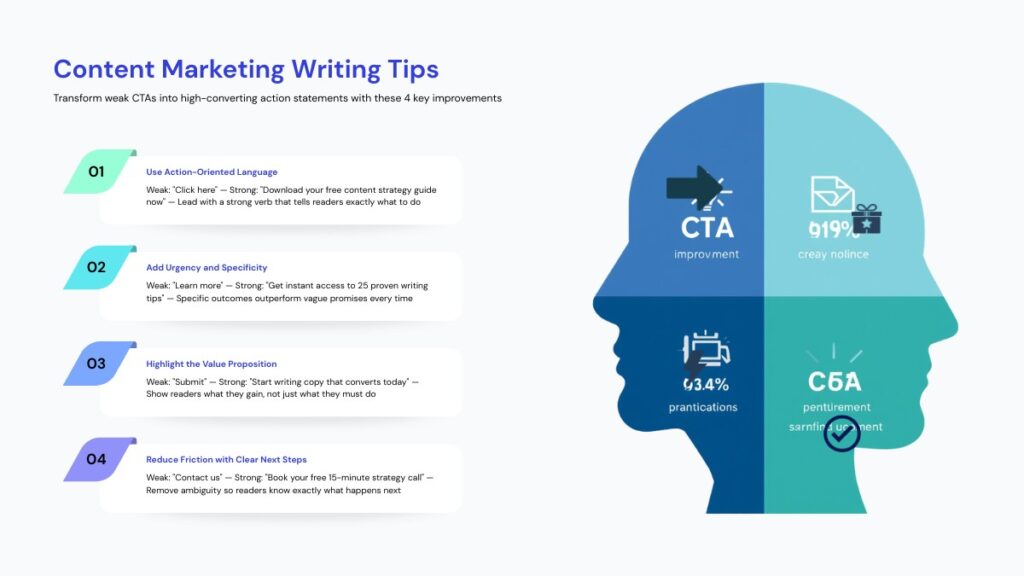
Tip 21: Every content marketing piece needs a clear, logical next step
This doesn’t mean every piece needs a “Buy now” button. It means you should decide, before writing, what the logical progression is for a reader who found this content valuable. A next‑step CTA at the awareness stage might be “Download this template” or “Read the follow‑up guide.” At the decision stage it might be “Book a demo” or “Start a free trial.”
Leaving this undecided leads to vague endings where the article just stops, or lazy CTAs that say “Contact us” without explaining what happens next or why it matters.
Weak vs. stronger CTA examples:
| Weak CTA | Improved CTA | Stage / Goal | What changed |
|---|---|---|---|
| “Click here” | “Get the free content brief template” | Awareness / lead capture | Specific, value‑clear, immediate |
| “Contact us” | “Book a 20‑minute content audit with our team” | Consideration / sales qualified lead | Concrete commitment, sets expectation |
| “Learn more” | “Compare content marketing plans and pricing” | Decision / evaluation | States exactly what comes next |
| “Subscribe” | “Get one practical content marketing tip every Tuesday” | Awareness / community | Specific format, specific cadence, lower perceived risk |
Tip 22: Root your CTA in the value of the piece, not just your offer
The most effective CTAs feel like a natural continuation of what the reader just learned. If your article walks through a content audit process, the CTA should offer something that extends that experience: an audit template, a related guide, or a conversation with someone who does audits. A generic “See how we can help” CTA, however, does not connect to anything.
This applies especially in B2B content marketing, where readers are often in research mode and will disengage quickly if they sense a premature sales push.
Tip 23: Use lower‑commitment CTAs for early‑stage readers
Asking a top‑of‑funnel reader to “Request a demo” is like proposing marriage on a first date. It’s not that the reader isn’t interested in your product; it’s that they’re not ready for that level of commitment yet.
Low‑friction CTAs that still support your marketing goals:
- “Save this guide as a PDF.”
- “Try the headline rewrite exercise with your next piece.”
- “Subscribe to get one content marketing tip each week.”
These keep the relationship warm and move people forward without creating the cognitive resistance that high‑commitment CTAs generate in early‑journey readers.
Tip Cluster 8 – Editing and Optimization
Tip 24: Treat drafting and editing as genuinely separate modes
The biggest editing mistake in content marketing teams is trying to do both at once. When you write, your job is to get ideas out clearly and completely, without self‑censorship. When you edit, your job is to ruthlessly clarify, tighten, and improve. These are cognitively opposite modes; doing them simultaneously means you do neither well.
A practical approach: write your first draft to completion, then wait at least an hour (preferably a day) before editing. When you return, read the piece from the reader’s perspective, not the writer’s. The question you’re answering isn’t “did I explain myself?” but “does this serve the reader clearly and efficiently?”
Tip 25: Run every draft through a 10‑minute editing checklist before publishing
Most content marketing assets go live underloved. A simple, repeatable checklist applied consistently does more for your overall content quality than expensive software or periodic “content audits.” Here is a reliable one:
- Headline: Can a stranger instantly tell who this is for and what they’ll gain?
- Intro: Does it connect to a real situation the reader recognises, then promise a specific payoff?
- Goal alignment: Is every section still serving the original content goal?
- Headings: Skimmed in order, do they tell a coherent story?
- Paragraphs: Is there any section where two or more distinct ideas share a paragraph?
- Plain language: Have you replaced complex vocabulary with simpler alternatives where possible?
- Evidence: Does every major claim have a specific example or observation supporting it?
- CTA: Is there one clear, specific, value‑oriented next step?
- SEO basics: Does the main phrase appear naturally in headline, intro, and at least one heading?
- Read‑aloud test: Read the piece at normal speaking pace. Mark every sentence where you stumble or rush to catch your breath. Those sentences need rewriting.
Apply this checklist to your highest‑value assets first your pillar articles, highest‑traffic pages, and lead‑generating landing pages. The compound effect of consistent quality is more powerful than occasional major rewrites.
How to Apply These Tips to Blogs, Landing Pages, Emails, and Social Posts
The 25 tips above are format‑agnostic by design, but the emphasis shifts depending on what you’re writing. Here’s how each format prioritises them.
Blog Articles
Blog articles in a content marketing program educate, build SEO authority, support sales enablement, and generate leads. They’re typically your most resource‑intensive format and your most durable asset.
For blogs, prioritise:
- Clear, benefit‑driven headlines (Tip 7).
- Structure built around the questions your reader actually asks (Tip 11).
- Specific examples and mini case anecdotes throughout (Tip 15).
- Contextual internal links that keep readers in your content ecosystem (Tip 20).
- A mid‑article or end‑of‑article CTA that feels like a logical next step, not a promotional insert (Tips 21–23).
Example:
A B2B SaaS company writing about “how to reduce churn in the first 90 days” would open with a scenario most CS leaders recognise (“You had a solid quarter of new signups, but 60‑day engagement is dropping and your first renewals are in jeopardy…”), structure the piece around the specific questions a VP of Customer Success would need answered, and close with a CTA to download a 90‑day onboarding checklist.
Landing Pages
Landing pages convert; everything else is secondary. The writing discipline required is tighter than for blog articles, because you’re competing directly with the reader’s scepticism and impatience.
For landing pages, prioritise:
- Immediate clarity in the hero headline: who this is for, what they get (Tip 7).
- Social proof and specific claims over vague superlatives (Tip 15).
- Very short paragraphs, sometimes single sentences (Tip 10).
- One primary CTA repeated in logical places, with a concrete description of what happens next (Tip 21).
- No tangential sections; every element should either explain the value or remove an objection.
Example:
A landing page for a content marketing agency shouldn’t open with “We help brands grow.” It should open with “We produce SEO‑driven content that fills your pipeline without you managing a freelancer roster.” Specific, direct, and immediately differentiating.
Email Newsletters and Nurture Sequences
Email is the most direct channel you control. When people subscribe, they’ve already demonstrated interest. The job of email writing is to deliver value in a format that rewards that interest and advances the relationship at a sustainable pace.
For email, prioritise:
- Subject lines that are honest about value inside (the email equivalent of Tip 7).
- First sentence hooks that earn the continue‑reading decision in two seconds (Tip 8).
- One main idea per email; nothing more (Tip 3).
- Conversational, direct language that sounds like a person wrote it (Tip 14).
- Low‑friction CTAs in nurture sequences (Tip 23); save hard CTAs for decision‑stage sends.
Example:
A subject line like “5 content marketing writing tips (quick read)” will outperform “Our latest update” because it promises specific value, sets expectations on time investment, and gives the reader a reason to open now. The email itself delivers on that promise in 250 words or less.
Social Captions and Threads
Social content supports distribution, earns attention, and drives traffic to longer assets but it lives in an environment of relentless competition for a few seconds of notice. Writing for social is about compression: your best insight, in its most memorable form, in the fewest words.
For social, prioritise:
- Hook in the first line, before the “See more” cut (Tip 8).
- One insight or takeaway per post; not a summary of five (Tip 3).
- Conversational language, shorter sentences than you’d use in any other format (Tip 13).
- Light CTA that creates a conversation or drives to a related resource (Tip 23).
Example:
Instead of “We’ve published a new guide on content marketing writing tips. Check it out!”, write: “Most content marketing writers focus on SEO before they’ve chosen a real goal for the piece. Start from the goal. Everything else gets easier.” Then link the guide for those who want more. The insight‑first format earns shares; the link captures clicks from people who are ready.
Quick Reference: 10 Rules for Content Marketing Writing
These are the principles underpinning all 25 tips. You can use this table for team briefs, onboarding documents, or editorial guidelines.
| Rule | Why It Matters | One‑Line Example |
|---|---|---|
| 1. Write for one reader with one clear intent | Broad audiences produce unfocused writing | “This is for a VP Marketing reviewing SaaS analytics tools” |
| 2. Start from a business goal, not a vague topic | Goals align writing decisions and measure success | “Goal: get CS leaders to book a product demo via organic traffic” |
| 3. Make headlines benefit‑clear and audience‑specific | Clicks come from relevance, not cleverness | “How to Cut Churn in 90 Days: A Guide for B2B SaaS CS Teams” |
| 4. Structure for skimmers as much as committed readers | Most readers scan first, read second | Headings that read as questions; bullets for multi‑part answers |
| 5. Use plain language as a default | Comprehension is more persuasive than complexity | “use” not “leverage”; “start” not “commence” |
| 6. Active voice keeps sentences direct and clear | Passive constructions slow readers down | “Review your results monthly” not “Results should be reviewed” |
| 7. Show expertise through specifics, not assertions | Specificity builds trust; assertions borrow it | “We consistently see intros fail when they lead with brand history” |
| 8. Write for people first, then optimise for search | Intent‑matched content ranks better and converts better | Draft the answer fully; add keyword phrasing in your edit pass |
| 9. Every piece needs a clear, relevant CTA | Without a next step, content is a dead end | “Download the brief template” not “Contact us to learn more” |
| 10. Draft first, edit separately | Mixed modes produce mediocre writing and slow editing | Write to completion; wait; then return with fresh, reader‑first eyes |
The 10‑Minute Content Marketing Writing Checklist
Use this before any piece goes live. It is especially valuable for your highest‑traffic pages and lead‑generating assets.
- Headline check: Would a stranger immediately know what this is about and why it’s for them? If not, rewrite with audience + benefit explicit.
- Intro check: Does the opening mirror your reader’s situation and promise a specific payoff in the first 100–150 words?
- Goal alignment check: Is every section still serving the original goal? Delete anything that isn’t.
- Structure check: Read only your headings in sequence. Do they tell a coherent, logical story?
- Paragraph check: Are there long, dense blocks you can split into two? Apply the “one idea per paragraph” rule.
- Language check: Mark any phrase you wouldn’t use in conversation. Rewrite with simpler, more direct language.
- Evidence check: Does each major claim have a specific example, pattern, or observation behind it?
- CTA check: Is there exactly one primary CTA, and is it specific, value‑focused, and appropriate for this stage?
- SEO check: Does your main keyword phrase appear naturally in the title, intro, and at least one heading?
- Read‑aloud test: Read the piece out loud at a normal pace. Rewrite any sentence where you stumble or run out of breath.
Ten minutes applied consistently across your content library compounds quickly. A checklist like this will do more for overall content quality than sporadic large rewrites.
FAQs: Content Marketing Writing for Marketers and Founders
How long should content marketing articles be?
Long enough to answer the question thoroughly and lead the reader to a logical next step nothing more. For most B2B topics, this ends up between 1,500 and 3,000 words, but depth and clarity matter more than any specific word count. If a topic can be covered well in 900 words, padding it to 2,000 helps no one.
How often should we publish?
Consistently, at a cadence your team can maintain without sacrificing quality. For many small to mid‑size content teams, two to four substantive pieces per month plus regular updates to existing top performers produces better long‑term results than publishing daily at lower quality. Frequency matters less than the compound value of a growing library of strong, targeted content.
How do I write for both SEO and humans without sounding robotic?
Write your first draft entirely for humans, with no thought about keywords. Then edit for SEO: check that natural, relevant language appears in your headline, intro, and at least one subheading. If you add a keyword phrase and the sentence sounds forced when you read it aloud, rephrase it until it doesn’t. That test can I say this out loud without cringing? is reliably good.
How do I make my content less boring?
Start later (cut the first paragraph in most pieces and you’ll find the real opening underneath), get specific faster, and add at least one concrete example per section. Abstract points disengage readers; examples re‑engage them. Also ask yourself, “Would I share this with a colleague?” If the honest answer is “no, probably not,” that’s your signal to sharpen the point of view or add something more useful.
How should I adapt these tips for different formats?
The principles stay the same; the emphasis and proportions shift. On landing pages, lean harder on clarity, specificity, and CTA strength; remove anything tangential. In email, compress ruthlessly and use one idea per message. On social, lead with the hook, not with context. In long‑form blog articles, invest in structure and examples over wordsmithing individual sentences.
How can I quickly improve an existing piece before publishing?
The 10‑minute checklist above is the answer. If you have five minutes, prioritise headline, intro, CTA, and the read‑aloud test. Those four changes alone will improve most drafts more than any other single investment of time.
Should teams use AI tools for content marketing writing?
Yes, but with discipline. AI tools are genuinely useful for generating first‑draft outlines, converting interview transcripts into structured notes, repurposing long‑form content into shorter formats, and testing alternative headlines. They’re much less reliable for original industry insight, accurate claims about your own products, and tone that matches a specific brand voice. Treat AI output as raw material that a skilled human writer shapes, not as a finished draft.
How do I know if my content marketing writing is actually working?
Look at the metrics most connected to your stated goals, not just traffic. If your goal was leads, track form fills and contact submissions from specific pieces. If it was pipeline support, track whether influenced opportunities close at a better rate when buyers engaged with your content. If it was onboarding, track feature adoption or time‑to‑value among users who engaged with education content. Traffic is a proxy; these are the real measures.