When someone types “automotive SEO services” into a search engine, they are usually not browsing out of curiosity. They want a direct answer to a practical question: “How can search bring me more buyers, more service bookings, and more parts sales?”
Automotive SEO services exist to bridge that gap between search visibility and real-world revenue. These services take the familiar building blocks of SEO on-page optimization, local visibility, technical foundations, and content and rework them around the realities of vehicle inventory, service bays, and large parts catalogs. Modern automotive SEO frameworks for 2025–2026 treat dealerships, workshops, and parts eCommerce as distinct use cases, each with its own playbook instead of one generic template.
SEOSERVICES1 is built on that idea. Automotive SEO Services are not a generic SEO package with a different label; they are purpose-built programs for global automotive businesses operating across cities, regions, or entire markets, with clear structures for local visibility and for the AI-era search environment where AI Overviews and “AI citations” can influence discoverability.
What Are Automotive SEO Services?
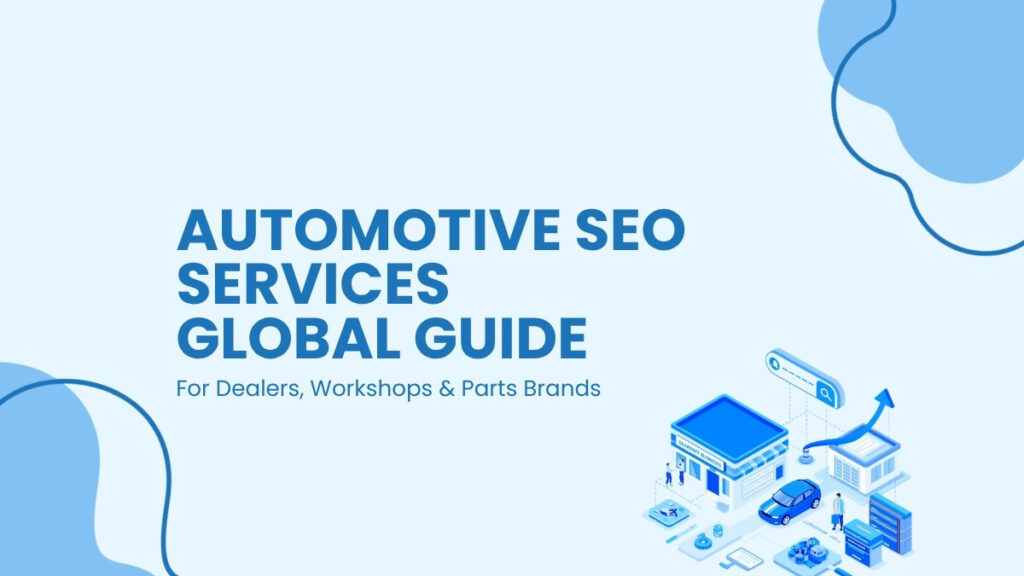
Automotive SEO services are specialized SEO programs designed to grow qualified traffic, leads, and sales for automotive businesses by aligning SEO tactics with automotive-specific structures and behaviors. In practice, that means adapting SEO to cope with SRPs (Search Results Pages), VDPs (Vehicle Detail Pages), service-line content, and fitment data rather than treating an automotive website like a simple brochure.
Recent automotive SEO playbooks divide the market into four main models dealerships, repair shops, parts eCommerce, and multi-location automotive brands and show that each model has different architecture, keyword sets, and KPIs. Automotive SEO services mirror that segmentation. A program for a dealer group targeting SRP and VDP performance looks very different from a program for a chain of workshops whose goal is to fill service bays from “near me” searches.
Typical automotive SEO services include:
On-page optimization tuned to SRPs, VDPs, service pages, and parts/product pages
Local SEO programs designed around each location’s Google Business Profile (GBP) and local landing page
Technical SEO that understands faceted navigation, inventory churn, and schema for vehicles and parts
Content and link strategies that follow modern guidance on topic clusters, AI Overviews, and AI citations
The end goal is simple: treat search as a consistent demand channel, rather than a byproduct of running a website.
Who Needs Automotive SEO Services?
Any automotive business that considers search a serious acquisition channel rather than an afterthought stands to gain from Automotive SEO Services.
Car Dealerships and Dealer Groups
For car dealerships, SRPs and VDPs are effectively the online counterpart of the vehicle lot and showroom. Automotive SEO services help these pages show up for the queries that buyers actually use, such as specific make/model combinations, trim levels, or even feature-focused searches.
Common issues seen in dealership sites include duplicate or thin VDPs, SRPs generating too many low-value filter combinations, weak finance or trade-in page visibility, and under-optimized dealer and brand pages. Automotive SEO services for dealers are built to address those issues directly.
In practice, this means prioritizing:
Make/model, trim, and finance-intent keyword coverage
Clean SRP and VDP templates with structured data and strong calls to action
Dealer pages that rank for brand and location-based searches
Sustainable reporting around SRP/VDP sessions, calls, test drives, and finance applications
For dealer groups with multiple rooftops, multi-location coordination and avoiding internal competition become core success factors.
Auto Repair Workshops and Service Centers
Workshops operate in a different environment. Their business is highly local, and search queries focus on problems and services rather than on inventory. A typical customer might search “brake repair near me,” “air conditioning service,” or “engine diagnostic [city].” If those queries lead to a single generic “services” page, performance is usually underwhelming.
Modern automotive SEO guidance for workshops recommends dedicated service pages for each major service line, GBP profiles with accurate categories and service lists, strong review pipelines, and clear booking flows.
Automotive SEO services for workshops turn these recommendations into a repeatable system. Every key service gets its own SEO-focused page, tied to its GBP entry and optimized for real-world service queries and booking behavior.
Automotive Parts and Accessories eCommerce
Parts and accessories brands live in a long-tail world. Customers search using part numbers, compatibility combinations, or symptom-based queries such as “brake pads for [model/year]” or “air filter [engine code].” Catalogs can stretch to tens of thousands of SKUs, easily overwhelming naive SEO approaches.
Automotive SEO services for parts and marketplaces focus on clean taxonomy and filter structures, standardized product templates, and fitment content. They help brands capture long-tail demand that generic strategies often miss, especially when combined with careful control over which filter combinations are indexable.
Analytics-focused resources show that when these elements are implemented, parts retailers often see measurable gains in organic product sessions and revenue, particularly in long-tail queries and high-value SKUs.
Multi-Location and Global Automotive Brands
Global and multi-location brands add another layer of complexity: central teams must ensure coherence without suffocating local differences. Common failure patterns include inconsistent GBP setups, mismatched location pages, and a lack of comparative reporting across regions.
Automotive SEO services for multi-location brands address this by defining standardized templates for location landing pages and GBPs, setting global guidelines for NAP consistency, photos, posts, and reviews, and building dashboards to compare performance across locations and regions.
The aim is not to flatten every branch into a single mold but to ensure every branch follows a proven, measurable baseline.
What’s Included in SEOSERVICES1 Automotive SEO Services?
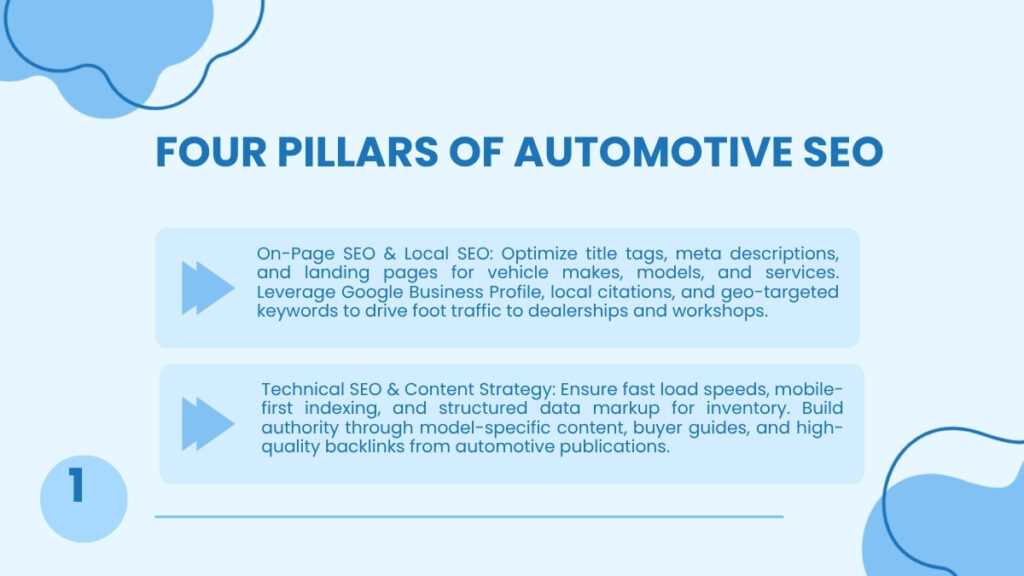
SEOSERVICES1 structures its Automotive SEO Services around four core pillars: on-page optimization, local SEO, technical SEO, and content & link strategy. These pillars align closely with how leading automotive SEO guides organize their recommendations, but they are packaged as a coherent service for automotive businesses operating globally.
On-Page SEO for Automotive Sites
On-page SEO is where search intent gets translated into page-level decisions. In an automotive context, that translation has to be more precise than simply “add more keywords.”
SEOSERVICES1’s Automotive SEO Services include:
Automotive keyword mapping – Distinguishing between make/model queries, dealer and brand searches, service-intent queries, and parts/SKU-based searches.
Page-type templates – Building and refining templates for SRPs, VDPs, service pages, category pages, and product pages, including descriptive titles, structured headings, and internal links.
Content alignment – Ensuring each page genuinely answers the questions implied by its primary queries.
The result is an on-page framework that reflects how modern automotive SEO resources recommend organizing content by intent and page type.
Local SEO and Google Business Profile Optimization
Local SEO ties online visibility to physical locations. For automotive businesses, this means treating each dealership or workshop as a localized presence within a larger brand.
SEOSERVICES1 focuses on:
GBP optimization at scale – Configuring Google Business Profile entries for each location with accurate categories, services, photos, posts, and Q&A.
Location landing pages – Building or improving pages that bridge GBP listings and the core website with clear CTAs and localized context.
Review and reputation systems – Implementing repeatable processes to request reviews, monitor feedback, and respond promptly.
This approach reflects the “GBP as micro-brand” concept, where each location profile is treated as a strategic asset rather than a static listing.
Technical SEO for Inventory-Heavy Websites
Technical SEO is where automotive sites often diverge most from other industries. Vehicle and parts inventory change constantly, and poorly controlled filters can generate a huge volume of low-value URLs.
SEOSERVICES1 addresses technical issues by:
Auditing SRP and VDP URL structures, internal links, and index coverage
Defining canonical and parameter rules to prevent index bloat and duplicate paths
Designing processes to handle vehicles or parts that are sold or discontinued
Improving Core Web Vitals for media-heavy inventory pages
Implementing structured data for vehicles, services, and products
This technical foundation supports both conventional organic search and AI-assisted experiences, which rely heavily on clear structure and signals.
Automotive Content and Link Strategy
Content and links are how an automotive website demonstrates expertise and earns authority. Recent guidance emphasizes building content clusters tailored to buyers, owners, and parts shoppers, rather than publishing isolated blog posts.
SEOSERVICES1’s content and link strategy typically includes:
Buyer-focused content such as model comparisons and financing guides
Owner-focused content including maintenance schedules and troubleshooting tips
Parts-focused content such as fitment guides and installation resources
FAQ, definition blocks, and comparison tables designed for AI Overviews and AI citations
Links from relevant automotive directories, media, and associations
These elements keep sites informative, trustworthy, and aligned with current expectations for topical depth.
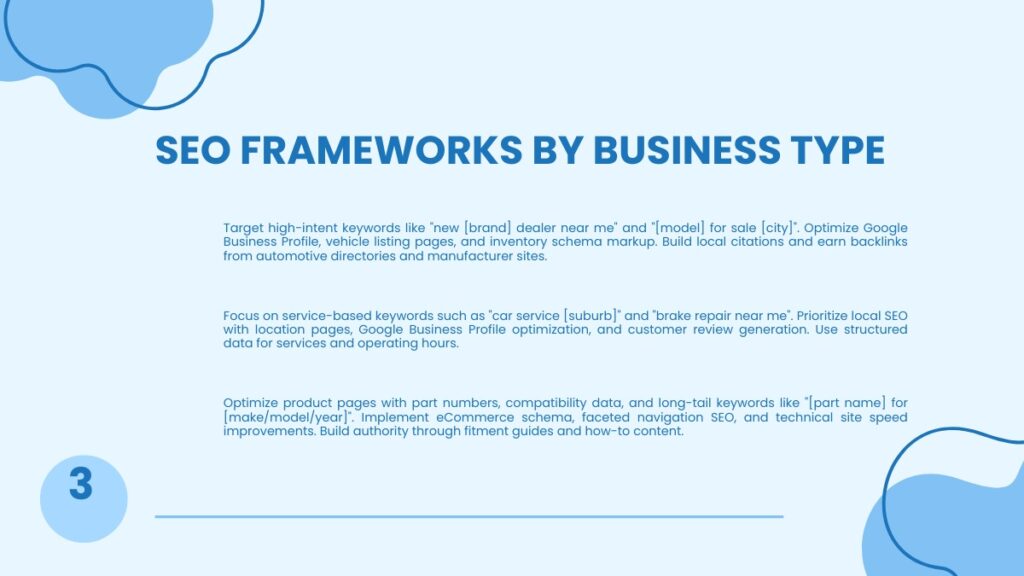
Automotive SEO Frameworks by Business Model
To align with segmented automotive SEO guidance, SEOSERVICES1 uses distinct frameworks for different business types rather than one generic checklist.
Dealership SEO Framework
A typical dealership SEO engagement unfolds through several stages:
Technical and index audit – Review SRP, VDP, and key landing pages to identify crawl issues, index bloat, and duplicate patterns.
Keyword and intent clustering – Group keywords by make/model intent, dealer and brand intent, finance queries, and local discovery searches.
Template overhaul – Refine SRP and VDP templates, adding structured data, adjusting headings, and clarifying calls to action.
Local rollout – Implement GBP and location page improvements across all rooftops on a consistent playbook.
Content cluster deployment – Publish model overview pages, comparison content, and FAQs aligned with identified intents.
Measurement loop – Track SRP/VDP sessions, calls, test-drive bookings, and finance applications to refine the roadmap.
This structure mirrors how dealer-focused SEO frameworks orchestrate technical, content, and local work over time.
Auto Repair & Workshop SEO Framework
For workshops, the emphasis shifts from inventory to service capacity:
Service inventory and keyword mapping – List major services and align them with common problem and solution queries.
Dedicated service pages – Create pages dedicated to each major service, with detailed explanations, FAQs, and booking prompts.
Local alignment – Ensure GBP services and categories reflect the service pages and that citations reinforce accuracy.
Review process – Implement steps to request reviews after completed jobs and respond to feedback quickly.
Educational content – Add articles addressing common maintenance questions and repair concerns.
Service-focused KPI tracking – Monitor organic service page visits, calls, bookings, and GBP actions.
These steps result in a service-line focused framework tailored to how workshop customers search and book.
Automotive Parts & Marketplace SEO Framework
For parts and marketplaces, the framework is tuned to catalog scale and long-tail search:
Taxonomy and navigation assessment – Evaluate how categories, subcategories, and filters align with search behavior.
Product template standardization – Apply consistent patterns to product titles, metadata, descriptions, and structured data.
Faceted navigation controls – Decide which filter combinations deserve indexable pages and which remain non-indexed.
Fitment and DIY content build-out – Produce guides that explain compatibility and installation for different kinds of users.
Commerce KPI reporting – Track organic sessions, add-to-cart rates, and revenue to validate improvements.
This approach helps parts and marketplace sites connect catalog decisions to measurable business outcomes.
Automotive SEO Pricing and Packages
Pricing for Automotive SEO Services is shaped by scope and complexity rather than a single flat rate. Market comparisons of automotive SEO providers show that the most highly rated agencies emphasize clear pricing models and value explanations, even when exact numbers are handled via custom proposals.
Monthly Retainer Models
Most Automotive SEO Services engagements are delivered via monthly retainers. This reflects how automotive SEO work actually unfolds: technical issues emerge as vehicles, services, and parts change, content and AI-era features require ongoing refinement, and local and multi-location performance must be monitored over time.
Retainer size typically scales with:
Number of locations or regions supported
Inventory volume and site complexity
Scope of content, local, and AI-era optimization work
Performance-Linked Components
In some cases, brands want more visible linkage between investment and outcomes. SEOSERVICES1 can integrate performance-related elements such as milestone-based bonuses, scoped expansion at certain KPI thresholds, or shared experiment budgets into retainer structures.
This approach reflects the broader move toward KPI-driven SEO contracts.
Starter, Growth, and Enterprise Packages
To support evaluation and internal discussions, SEOSERVICES1 presents three broad package archetypes:
Starter – For single-location dealers or workshops and smaller parts brands; focuses on core technical work, essential on-page updates, GBP optimization, and foundational content.
Growth – For growing brands with multiple locations or expanding catalogs; adds deeper local coordination, more content coverage, and expanded reporting.
Enterprise – For complex, multi-region or marketplace operations; includes extensive technical architecture support, AI-focused content, experimentation frameworks, and tailored dashboards.
These tiers mirror how external comparison sites categorize “best for small businesses,” “best for multi-location,” and “best for enterprises,” while grounding those labels in specific scope differences.
Local SEO Dominance for Automotive Brands
Local dominance is about consistently winning “near me” and geo-modified searches across all regions where you operate, not just outranking a competitor in one city. Automotive SEO content for 2026 underscores that GBP and location pages have become mandatory components of local strategies for dealers and workshops.
SEOSERVICES1’s Automotive SEO Services pursue local dominance by:
Defining a standard GBP configuration for each location, including categories, services, media, and review prompts
Building location landing pages that offer more than basic contact details, with clear value propositions and calls to action
Rolling out review programs to create a steady flow of feedback and close the loop on issues
For multi-location brands, this framework allows central teams to compare local performance and identify locations needing extra support, while preserving local nuance.
Technical SEO for SRPs, VDPs and Fitment Pages
Technical issues in automotive sites often hide in plain sight. Common problems include infinite SRP URL combinations, duplicate VDPs across multiple domains, and misconfigured canonicals that dilute relevance.
SEOSERVICES1’s technical work centers on:
Structured audits of SRP and VDP paths, parameters, and canonical signals
Clear rules for indexable and non-indexable filter combinations
Template updates that include vehicle schema and consistent calls to action
Fitment-focused improvements for parts and accessories pages
This keeps crawl budgets focused on high-intent pages and ensures that search engines can recognize and rank the most valuable inventory and fitment content.
Conversion and Lead Generation Funnels
Automotive SEO Services only fulfill their purpose when they feed real-world funnels sales pipelines, service calendars, and order volumes. Analytics resources stress that the full path from search to outcome must be modeled, not just the ranking or traffic stage.
SEOSERVICES1 maps distinct funnels for each business type:
Dealership funnels – From SRPs, VDPs, model overview pages, and buyer guides to calls, showroom visits, test drives, and finance applications.
Workshop funnels – From service pages and GBP entries to calls, quote requests, online bookings, and “directions” clicks.
Parts funnels – From category pages, product detail pages, and fitment guides to add-to-cart events, completed orders, and repeat purchases.
These funnels form the lens through which SEO performance is evaluated, ensuring that technical and content decisions can be traced back to concrete business results.
Reporting, KPIs and Automotive SEO ROI
Reporting is where Automotive SEO Services become tangible. Without clear KPIs and dashboards, SEO can feel opaque and difficult to justify. Automotive analytics references argue for reporting that links technical and content work to metrics that matter for each business model.
SEOSERVICES1 builds reporting around:
Dealership KPIs – Organic SRP and VDP sessions, calls, test-drive bookings, finance applications, and AI Overview visibility where measurable.
Workshop KPIs – Service page visits, calls, bookings, and GBP interactions such as calls and directions.
Parts KPIs – Organic product sessions, add-to-cart rates, order conversions, and organic revenue contributions.
Monthly reporting and quarterly reviews provide a steady rhythm for analyzing trends, testing new ideas, and aligning ongoing work with business goals.
DIY vs Automotive SEO Agency vs Generic SEO Provider
Businesses exploring Automotive SEO Services typically weigh three options: handling SEO in-house, hiring a generic SEO agency, or partnering with a specialized automotive SEO provider.
DIY vs Automotive SEO Agency
DIY approaches give internal teams full control and can be effective for basic tasks such as publishing updates or managing simple pages. However, automotive SEO often involves SRP/VDP architecture, faceted navigation, multi-location GBP setups, and AI-era content, which can be difficult to manage without experience and dedicated resources.
An automotive SEO agency like SEOSERVICES1 brings:
Experience across multiple automotive business types and markets
Patterns and checklists shaped by current automotive SEO guidance
Dedicated technical and content resources focused on automotive issues
DIY remains useful for day-to-day tasks, but a specialized framework reduces the risk of costly structural mistakes.
Generic SEO Agency vs Specialized Automotive SEO Agency
Generic SEO agencies often bring strong generalist experience and can deliver results in less complex verticals. Yet when general approaches are applied to automotive sites, common pitfalls include over-indexed filter pages, fragmented content, neglected GBP configurations, and limited attention to SRPs and VDPs.
A specialized automotive SEO agency offers:
Frameworks aligned with dealer, workshop, and parts-specific playbooks
Built-in consideration for AI Overviews, AI citations, and structured content formats
Reporting tuned to automotive KPIs rather than generic metrics
For global automotive brands, this specialization often shortens the time between implementation and measurable business results.
Frequently Asked Questions About Automotive SEO Services
1. What are Automotive SEO Services?
Automotive SEO Services are structured SEO programs designed specifically for automotive businesses dealerships, workshops, parts brands, and multi-location networks to increase search visibility, local presence, and revenue. They combine on-page, local, technical, and content work that aligns with automotive architectures and search behavior.
2. How are Automotive SEO Services different for dealerships and repair workshops?
Dealership programs focus on inventory visibility and sales funnels through SRPs and VDPs, multi-location coordination, and finance-related queries. Workshop programs emphasize service-intent queries, local “near me” searches, GBP optimization, and booking flows. These scenarios differ significantly in page types, intents, and KPIs, so they require distinct playbooks.
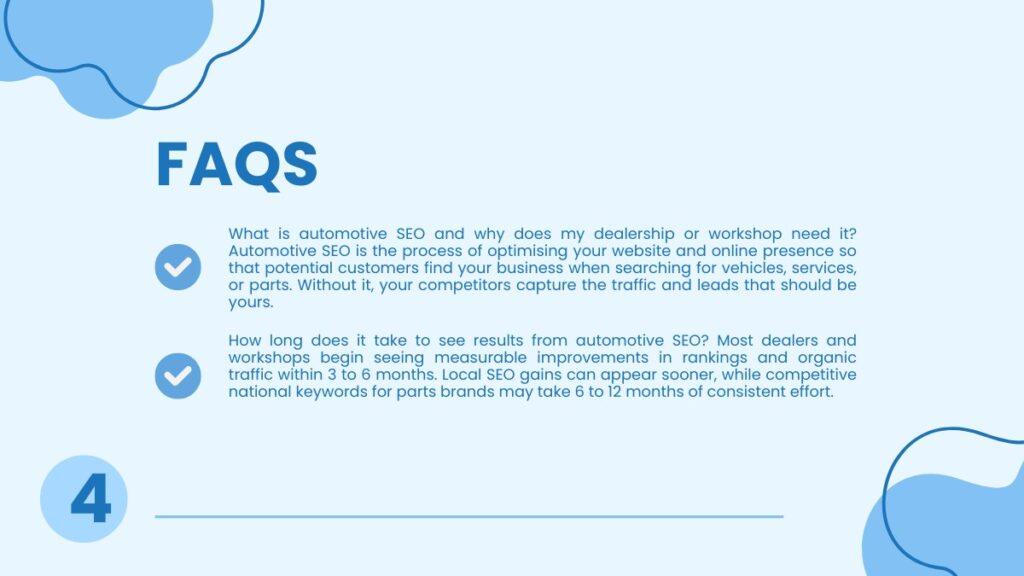
3. How long does it take to see results?
Timelines vary by starting point and scope, but local and service-focused improvements often show initial gains within a few months once GBP, service pages, and local signals are aligned. Larger technical and content programs for complex inventories typically require 4–6 months to produce substantial uplifts in organic sessions and revenue.
4. What is included in a typical Automotive SEO Services package?
A typical Automotive SEO Services package includes a technical audit, on-page optimization, local SEO and GBP work, content planning and execution, and structured reporting. The exact mix depends on whether the client is a single-location workshop, regional dealer group, or global parts marketplace.
5. Do Automotive SEO Services help with AI Overviews and AI search?
Yes. Modern automotive SEO emphasizes AI-ready content, including clear definitions, structured FAQs, comparison tables, and robust schema. SEOSERVICES1 integrates these patterns into Automotive SEO Services so AI systems can more easily extract and cite content in AI Overviews and related features.
6. Can Automotive SEO Services scale across multiple locations and markets?
Automotive SEO Services are designed to scale. Multi-location frameworks use standardized location templates, shared GBP guidelines, and central dashboards that compare performance across branches or regions, allowing global brands to coordinate efforts while leaving room for local nuances.
7. How do you measure ROI from Automotive SEO?
ROI is measured by connecting SEO actions to business KPIs such as SRP/VDP sessions, calls, bookings, “directions” clicks, add-to-cart events, and organic revenue. Dashboards and regular reporting cycles are used to track trends and tie them back to specific technical and content changes.
Why SEOSERVICES1 for Automotive SEO Services?
SEOSERVICES1 is built on the same principles that underpin modern automotive SEO playbooks: segmented frameworks, technical rigor, local and multi-location awareness, and AI-era content structures.
In practical terms, SEOSERVICES1 provides:
Dedicated Automotive SEO Services for dealers, workshops, parts brands, and multi-location networks
Technical expertise in SRP/VDP architecture, fitment, and inventory churn
Local SEO playbooks that treat every GBP and location page as a strategic asset
Content and schema patterns geared for AI Overviews and AI citations
Reporting that speaks the language of automotive KPIs and ROI, not just rankings
If you’re evaluating Automotive SEO Services and want a provider whose methods align with industry guidance and the realities of global automotive operations, SEOSERVICES1 offers a structured, evidence-informed path forward.
To see how Automotive SEO Services fit within the broader capabilities of SEOSERVICES1, you can explore the homepage at https://seoservices1.com/.
Senior Search Strategist specializing in SEO, AEO, and Generative Engine Optimization (GEO). With over a decade of experience, Rick helps brands and applications (ASO) maximize their visibility across traditional search engines, AI answer engines, and app stores.