Content creation for SEO is the discipline of turning real search behavior into content that attracts the right people and moves them closer to working with you. It’s not about posting more articles for the sake of it; it’s about building a consistent system that connects search intent, expert insight, and measurable business outcomes.
If you’re leading marketing, running an SEO program, building an agency, or steering a growing business, this guide is designed to help you treat content creation for SEO like an operational asset. You’ll see how to structure the work, decide who should do it, and understand how it pays off over time so you can make confident decisions instead of guessing.
What Is SEO Content Creation?
A Practical Definition You Can Use
SEO content creation is the process of planning, producing, and optimizing content specifically to show up for the searches your potential customers are already making and then helping them take a logical next step.
You don’t start from “we need a blog about X because it sounds interesting.” You start from “people are searching for solutions to problem Y in these ways” and then design pages that speak directly to those searches with clear, useful information.
Under that definition, content creation for SEO always includes understanding target topics and search intent, creating content that genuinely answers the key questions for those topics, structuring and optimizing pages so search engines can recognize their relevance and quality, and keeping that content up to date as your market, product, and competitors evolve.
SEO Content vs Generic Marketing Content
It’s useful to contrast SEO content with generic marketing content so you can see why some pages perform and others quietly disappear into the archive.
Generic content often focuses on what the company wants to talk about, leans on broad statements such as “we’re innovative” without proving it, and ignores how people actually search or what information they need to make decisions.
SEO content, by design, begins with search intent and specific keyword clusters, answers concrete questions like “how do I choose?” or “what does this cost?”, uses structure headings, internal links, FAQs, tables to make information easy to find, and demonstrates real knowledge and experience instead of vague claims.
If a piece of content doesn’t give a searcher clear value and doesn’t align with how they look for information, it will struggle to perform as SEO content, even if it looks visually polished.
Why Content Creation for SEO Matters for Rankings and Revenue
How Search Engines Use Your Content
Search engines rely on your content to figure out what your business covers, how deep your expertise goes, and which topics you should be seen as a credible answer for.
Modern guidance from search platforms emphasizes helpfulness, relevance, and trust over short‑term tricks. Thin or generic content might get indexed, but it rarely earns strong rankings or stable traffic.
A structured content creation for SEO program ensures that important topics are covered in depth instead of being mentioned briefly, that each page has a clear role within your overall site, and that you steadily increase the amount of genuinely useful information you provide.
Why It Matters Beyond More Traffic
The obvious benefit of SEO content is more organic traffic. But the real value shows up when that traffic is better qualified, better prepared, and more confident.
Better qualified visitors actually care about the problems you solve. Better prepared prospects have already had foundational questions answered by your content. More confident buyers have seen proof, examples, and clear explanations before they talk to you.
That’s when content creation for SEO starts affecting sales cycles, demo quality, and long‑term brand perception not just top‑line visitor counts. Treating content as part of how you sell, not just how people find you, is what separates superficial blogging from a serious SEO content program.
The Core Ingredients of Effective SEO Content
Strategy and Search Intent Come First
Strong SEO content is never an isolated piece; it sits inside a strategy that answers which topics matter most to your ideal customers, what they are trying to accomplish when they type those queries, and which page types on your site are responsible for answering which intents.
For example, informational intent such as “how does content creation for SEO work?” might be served by a guide like this one, while commercial investigation queries such as “should I outsource SEO content creation?” are better answered by comparison pages or case studies, and transactional intent like “content creation for SEO services” belongs on focused service or solution pages.
When you respect these distinctions, content creation for SEO stops being random and starts becoming a mapped system where each page has a defined job, and the whole site works together to support the buyer’s journey.
Keyword Clusters and Topical Authority
Instead of chasing individual keywords, effective programs think in terms of topic clusters groups of related queries and angles that all sit under a broader theme.
For content creation for SEO, typical cluster themes might include strategy and workflows, service models such as outsourcing or white‑label content, and tooling and operations around content production.
You plan several pages around each cluster guides, service pages, FAQs, and case examples and interlink them. This shows search engines that you’re treating the subject as a focus area, not just experimenting with a single post.
Over time, that layered coverage builds topical authority. Once a cluster is established, new pages within the same topic often rank faster and more reliably because the site is already recognized as a serious source on that subject.
On‑Page Optimization and Trust Signals
On‑page optimization is the technical and editorial glue that connects your content to both search engines and readers.
It covers titles and meta descriptions that clearly reflect intent and benefit, headings that break content into logical sections for skimming and deep reading, internal links that guide users to related pages and establish a clear site structure, and clean formatting that keeps reading comfortable.
Alongside these mechanics, trust signals matter. Real case examples, clear process explanations, and consistent, coherent advice show that you’ve done the work you describe. SEO content services that feels like it was written by practitioners tends to perform and convert far better than content that reads like generic commentary.
A Real‑World SEO Content Creation Workflow
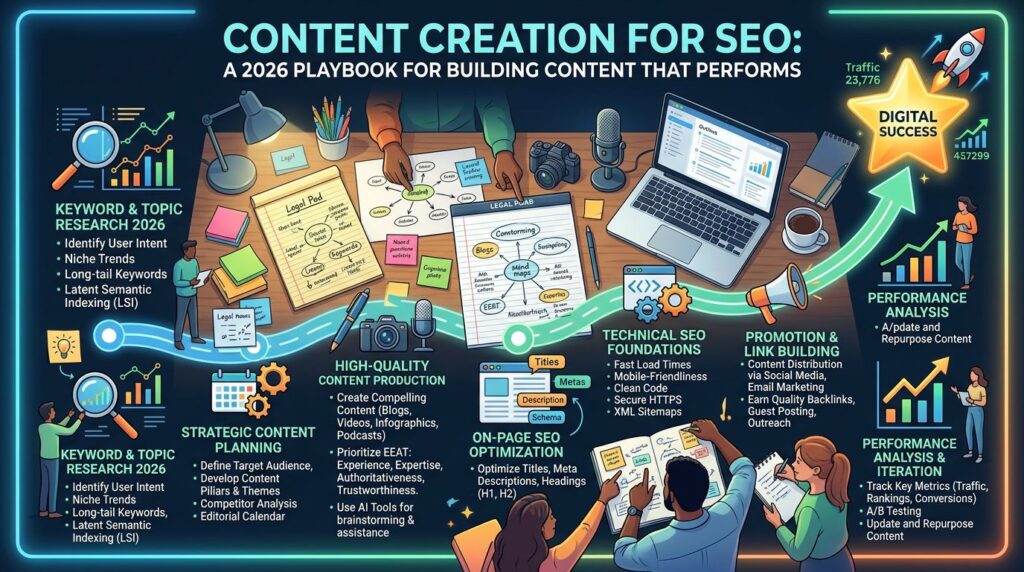
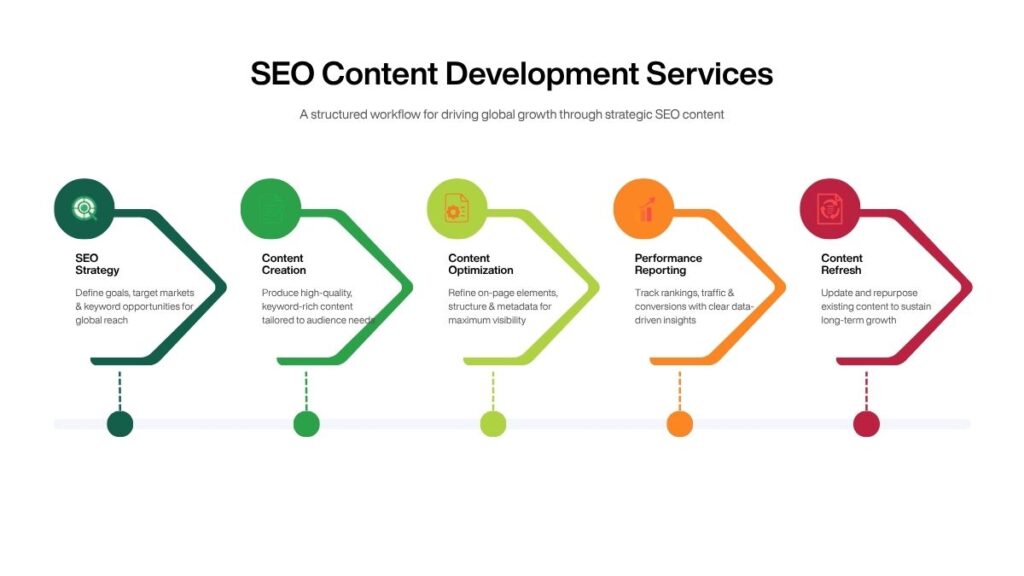
Turning content creation for SEO into a repeatable workflow is what makes it sustainable and scalable. Here is a practical model you can adapt to your own team or partners.
Step 1: Research Topics and Study the Current SERPs
Every page starts with topic research and a close look at current search results. You collect keywords and questions related to your cluster, examine the top pages already ranking for those queries, and note their strengths and weaknesses in terms of depth, examples, structure, and any missing information.
This step gives you a concrete sense of what’s expected to compete and helps you avoid re‑publishing slightly weaker versions of content that already exists. Instead, you plan how to make your page more helpful, more structured, or more current than what is already available.
Step 2: Build a Detailed SEO Content Brief
A strong brief is the backbone of predictable content quality. For each page, you define the primary topic and target queries, the audience and core search intent, a working title and angle, the sections and headings you expect the content to cover, specific questions, objections or examples that must be addressed, and key internal links and external references.
When briefs contain this level of detail, writers and editors can focus on insight and clarity instead of guessing what should be included. Over time, consistent briefs make your content library feel coherent and easier to maintain.
Step 3: Draft With Human Oversight (and Optional AI Help)
Drafting can be handled in different ways: human experts writing from scratch, writers using AI tools to produce outlines or rough drafts before refining heavily, or hybrid workflows where AI supports structure and humans own message and nuance.
Whatever the mix, drafting should bring the main answer to the front of the page, provide context and explanation that feel specific to your audience, include concrete scenarios or observations, and avoid repeating the same sentence structure and phrases throughout.
AI can accelerate work on routine sections, but readers quickly sense when content feels generic or disconnected from real experience. Keeping human judgment at the center protects both quality and trust.
Step 4: Edit for Clarity, Accuracy, and SEO
Editing is the safeguard against publishing content that might confuse, mislead, or underperform. Editors and SEO leads check clarity whether someone unfamiliar with your brand can follow the logic easily alignment with the brief, completeness of promised questions and comparisons, and optimization details like headings and internal links.
This stage is where you catch vague sections and replace them with sharper explanations or better examples, and where you ensure the content matches your standards for tone, depth, and usefulness. It is also the last chance to confirm that the page genuinely serves its intended search intent.
Step 5: Publish with Correct Structure and Internal Links
Publishing is an operational step with direct SEO impact. You ensure the URL slug is descriptive and aligned with the topic, titles and meta descriptions are live and written for both humans and search, headings are properly tagged, and internal links point to and from other pages in the cluster.
For FAQ or Q&A sections, you clearly mark questions and answers so they’re easy to scan. That makes those segments more useful to readers and easier for systems that surface answer‑style results to interpret.
Step 6: Monitor, Learn, and Iterate
Once content is live, monitoring turns your pages into a feedback loop. You follow impressions and clicks for target queries, watch how visitors behave on the page, see which internal links are actually used, and check whether the page contributes to leads, sign‑ups, or other goals.
Those findings help you decide which pages should be expanded with new examples, FAQs, or tables; which pages need structural changes, such as moving key answers higher; and where you have gaps that warrant new content in the cluster. Iteration turns content creation for SEO into a compounding program rather than a series of one‑off publishing efforts.
Human‑Written vs AI‑Assisted SEO Content in Practice
Where AI Makes the Process Easier
In many teams, AI tools play a supporting role in content creation for SEO. They can suggest outlines or alternative structures based on your brief, help rewrite individual sentences or sections for clarity, and generate variations of titles and meta descriptions that stay aligned with your topic.
Used in this way, AI saves time on repetitive or mechanical tasks and allows human experts to focus on diagnosis, examples, and strategic framing. It becomes part of the writing toolkit rather than a replacement for expert judgment.
Where Human Judgment Must Lead
Human oversight becomes non‑negotiable whenever the content carries high stakes, such as legal, financial, or health‑related topics, or needs to reflect deep experience and nuanced opinions.
It is also essential when your brand reputation and positioning could be harmed by errors or oversimplification. In those cases, AI can still assist, but final drafts should come from people who understand the audience and the consequences of what’s being published.
That balance AI for speed and support, humans for decisions and trust is the safest way to keep quality high without ignoring the efficiencies that new tools offer.
Choosing Between In‑House, Agency, and Hybrid Models
Different organizations solve the content creation for SEO problem in different ways. The right answer for you depends on how much control you need, how quickly you want to move, and what kind of internal capacity you already have.
Side‑By‑Side View of Common Models
| Model | Pros | Cons | Best For | Cost Pattern | Internal Load |
|---|---|---|---|---|---|
| In‑House | Deep brand understanding, tight collaboration | Hiring, training, and retaining talent | Established brands with ongoing programs | Salaries, benefits, tools | High (you own the whole workflow) |
| Agency | Specialized expertise, built‑in processes | Less direct control, agency margins | Teams wanting faster, turnkey execution | Retainers or scoped projects | Moderate (strategy and oversight) |
| Hybrid | Strategic control, flexible production | Coordination between team and partners | Growth‑stage companies and agencies | Shared between staff and vendors | Shared (strategy in, production out) |
Thinking in these terms keeps the decision from collapsing into “who is cheapest.” You’re choosing an operating model for content creation for SEO, not just a writer.
When an In‑House Team Is the Right Call
An in‑house content and SEO team tends to be the right choice when your topics are complex and require internal subject‑matter expertise, when you want content woven closely into product development, support, and sales, and when you expect to run content programs for years and want to build a long‑term capability.
This path involves more responsibility and cost up front but can create a strong, integrated engine once the team is established and aligned around a shared content strategy.
When External Partners Make More Sense
Bringing in external help agencies or white‑label partners is often sensible when you need to ramp up content volume quickly, lack time to recruit and manage multiple content roles, or want access to structured workflows and proven processes without building them from scratch.
In many cases, a hybrid approach works best: you keep strategy and approvals in‑house and partner externally for production and operational support, combining internal knowledge with external capacity.
Making Sense of SEO Content Creation Costs
Understanding the Levers Behind Pricing
Pricing for content creation for SEO is influenced by several practical levers: how many pieces you expect per month or per quarter, how difficult those topics are to research and explain correctly, whether the work includes strategy, brief development, optimization, and reporting, and how tight your timelines are.
Recognizing these levers helps you understand why two proposals with similar numbers of articles can differ significantly in price. You’re not just paying for words; you’re paying for planning, execution, and ongoing improvement.
Looking Beyond Cost Per Article
It can be tempting to reduce everything to cost per article, but that metric misses important context. Instead, ask who chooses the topics and maps them to search intent, who owns the brief template and ensures consistency, who handles optimization, internal linking, and follow‑up improvements, and who is accountable for reporting on results.
A slightly higher investment that includes these strategic and operational layers will typically produce stronger outcomes than a lower price that covers only draft‑level writing. Evaluating proposals through this lens keeps you focused on value rather than headline price.
Designing Your SEO Content Operations
Defining Responsibilities Clearly
Operational clarity is essential. A basic content creation for SEO program needs people responsible for choosing and prioritizing topics and clusters, turning those topics into useful briefs, writing, editing and refining drafts, and monitoring performance while recommending changes.
Even if the same person wears multiple hats, you still need to know which tasks exist and who is accountable for each. That structure helps you avoid content getting stuck without a clear next step or ownership.
Simple SOPs That Keep Work Moving
You don’t need complex binders of documentation to improve operations. Start with a brief checklist that defines what information must be present before someone is asked to write, an editing checklist that outlines what must be checked before publishing, a publishing checklist covering URLs, meta tags, headings, and internal links, and a review cadence for looking at performance data and adjusting priorities.
These small rules dramatically reduce ambiguity and make it easier to run content creation for SEO like a process instead of a series of ad‑hoc tasks, especially as your team or partner network grows.
Keeping Your SEO Content Fresh and Useful
Why Refreshing Content Is Part of the Job
Publishing a page is the beginning of its life cycle, not the end. Over time, search patterns change, competitors update or expand their content, and your product, pricing, or positioning evolves.
If your content doesn’t keep pace, it slowly drifts out of relevance even if it once performed well. A refresh plan for your most important SEO content should include reviewing whether the main angle and examples still feel current, updating sections that rely on old data or outdated scenarios, tightening structure where the page has become cluttered, and adjusting internal links to reflect new content in the cluster.
Repurposing Strong Pages Across Channels
Effective SEO content doesn’t only live in search. You can repurpose high‑performing or high‑value pages into short explainer videos or webinar topics, email series that walk subscribers through key concepts, social threads that break out individual insights or FAQs, and sales enablement assets such as one‑page summaries or talking points.
This multiplies the impact of your investment and keeps your messaging aligned across channels and touchpoints, making your content program feel more cohesive and efficient.
How to Measure the Impact of Content Creation for SEO
Focused Metrics That Reflect Reality
To see whether your content creation for SEO program is doing its job, focus on metrics that connect to your goals: organic traffic to the pages in your clusters, rankings for your priority queries and related terms, engagement indicators such as time on page and scroll depth, and conversions tied to content visits or informed by content consumption.
Tracking these regularly gives you a clearer view of which topics resonate, which formats work best, and where expansion or refinement is most likely to pay off.
Thinking in Time Horizons, Not Overnight Wins
SEO content rarely changes everything overnight. It tends to deliver small but encouraging early signals on less competitive topics, show more meaningful impact as clusters fill out and internal links strengthen, and become a significant contributor over a one‑year horizon when you publish and refresh consistently.
By measuring in realistic timeframes and clusters rather than single pages, you reduce pressure for short‑term spikes and focus instead on building durable visibility.
A Practical Example of an SEO Content Program in Motion
Imagine an established service business that wants more qualified inbound leads without relying exclusively on paid campaigns. They identify several topic clusters related to their services, including content creation for SEO, and map each cluster to specific page types.
They set up a workflow with defined roles someone chooses topics, someone writes briefs, someone writes and edits, and someone monitors performance. They publish a mix of guides, service pages, FAQs, and case‑style narratives, then refresh high‑value pages based on data.
Over the following quarters, they notice more relevant search queries driving visitors to their site, prospects arriving with a clearer understanding of what they do, and a steady share of leads referencing specific content pieces in conversations.
In this scenario, content creation for SEO has turned into a predictable channel for feeding the pipeline, not just an occasional blog post initiative.
FAQs About Content Creation for SEO
Should I build an in‑house SEO content team or hire an agency?
If your topics are complex and long‑term, investing in an in‑house team usually makes sense because you gain direct access to expertise and tight collaboration with other departments. If you’re more focused on speed and don’t have capacity to manage multiple content roles, working with an agency or using a hybrid setup can be a better fit.
How much does SEO content creation usually cost?
Costs depend on volume, topic difficulty, and whether you’re paying for strategy and measurement as well as writing. It’s more useful to compare what’s included briefs, optimization, reporting than to compare only price per article, because these elements drive long‑term value.
What skills and roles do I need internally?
You need someone who understands SEO strategy, someone who can own content quality, and people who can write and edit consistently. Depending on your size, one person may take on more than one role, but the responsibilities should still be clearly defined so gaps are visible.
Where should AI tools sit in my workflow?
AI fits well in ideation, outlining, and drafting support. Final judgment on what gets published facts, examples, tone should remain with humans who understand your audience and the stakes of the topic, ensuring quality and trust remain intact.
How long until I see results from SEO content?
Expect early indicators over weeks and more meaningful impact over months. Significant, stable gains typically show up as you build and refine clusters, not from a single page alone, so keep expectations tied to the program rather than one asset.
How often should I refresh my SEO content?
Plan to revisit key pages a few times a year, prioritizing those that drive the most traffic or conversions. Refresh more often for fast‑moving topics or markets where information changes quickly and outdated examples could harm trust.
How do I avoid content cannibalization when scaling?
Keep a simple map of your content clusters and ensure each page has a defined primary intent. If two pages begin competing for the same queries with similar angles, consider merging them or repositioning one to serve a different purpose, such as focusing on a narrower audience.
How SEOSERVICES1 Fits Into Content Creation for SEO
For organizations that would rather plug into an established SEO content system than build everything from scratch, SEOSERVICES1 focuses on designing and running content programs rather than just delivering isolated pieces.
That work typically includes clarifying topic clusters and priorities, building repeatable content briefs and workflows, using hybrid human and AI support where it makes sense while keeping expert oversight in place, and monitoring performance while recommending refreshes and expansions over time.
If you’re exploring how content creation for SEO could become a core growth channel rather than an occasional activity, the SEOSERVICES1 homepage is the best starting point for understanding that approach and whether it fits your situation.