If your law firm is invisible in search results, you are handing cases to competitors every single day. Law firm SEO services exist to fix that — not with tricks or shortcuts, but with a structured, performance-driven system that improves how search engines and AI platforms discover, trust, and rank your firm.
Many firms have the website. Many have the content. But organic search still underperforms. The gap is almost always structural: weak site architecture, thin practice area pages, inconsistent local signals, underoptimized attorney profiles, and trust indicators that do not hold up under scrutiny.
SEOSERVICES1 builds legal SEO campaigns around the outcomes that matter most to law firm owners and managing partners: stronger visibility, more qualified consultation opportunities, and a legal brand that earns trust before the first call.
What Are Law Firm SEO Services?
Law firm SEO services are specialized search engine optimization solutions built for legal websites, attorney brands, and practice area growth. Unlike general SEO, legal SEO must operate inside a high-trust, YMYL-classified environment where credibility, accuracy, and E-E-A-T signals directly influence rankings and conversion.
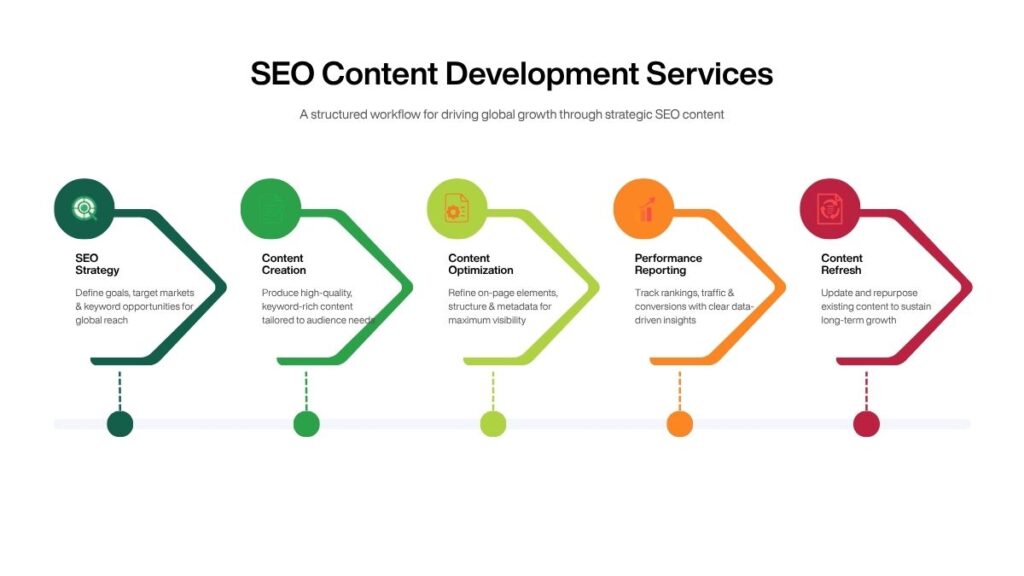
A complete law firm SEO program typically includes:
Technical SEO — crawlability, indexing, page speed, mobile UX, and site health
Local SEO — map pack visibility, Google Business Profile optimization, citation accuracy, and location relevance
Content SEO — practice area pages, service clusters, and search intent alignment
On-page SEO — title tags, headings, internal links, schema markup, and entity clarity
SEO analytics — traffic quality, rankings, consultation attribution, and lead-source performance
Understanding what separates strong legal SEO agencies from generic providers helps firms make better investment decisions. For broader context on what the top agencies currently deliver, review this overview of top law firm SEO companies and strategies.
What a Modern Legal SEO Campaign Covers
SEO Area
Core Focus
Business Impact
Technical SEO
Crawlability, indexing, site speed, mobile usability
Better search visibility and cleaner site performance
Local SEO
Google Business Profile, map pack relevance, citations, reviews
More discovery from nearby legal searches
Content SEO
Practice area pages, topic clusters, supporting content
Better credibility and higher conversion confidence
Analytics
Search Console, GA4, lead tracking, call tracking
Clearer attribution and smarter campaign decisions
Why SEO Matters for Law Firms
Legal search is high-value and high-intent. When someone searches for an attorney, a practice area, or a legal solution, they are often close to making a decision. The firm that appears with clarity, credibility, and local relevance at that moment captures the consultation opportunity. The firm that does not, loses it.
For most law firms, the real goal is not just rankings. It is consultation growth from the right practice areas and the right markets. That requires content aligned with search intent, site architecture that supports discovery, and a conversion flow that makes next steps easy.
SEO also compounds over time. A well-optimized legal website improves visibility across main service pages, attorney profiles, local landing pages, FAQs, and supporting resources. That creates a more durable, scalable lead-generation foundation than any single paid or outreach channel can provide.
Why Legal SEO Is Different
Navigating YMYL and E-E-A-T Guidelines
Legal websites are classified as YMYL — Your Money or Your Life — which means Google applies stricter quality signals to legal content than it does to most other industries. That is not a barrier. It is an advantage for firms that build their SEO on substance rather than surface.
Legal SEO is not a template campaign. It requires deliberate trust architecture, stronger content standards, and a strategy that reflects who the firm actually serves and where.
Local SEO for Lawyers
Most legal searches carry location intent — even when the user does not type a city name. Google regularly interprets queries like personal injury attorney or divorce lawyer as local by default. That means your map pack visibility, proximity signals, and local entity footprint can determine whether a firm shows up or goes unnoticed.
For solo attorneys, boutique practices, and multi-location firms alike, effective local SEO connects the website, Google Business Profile, legal directories, and review ecosystem into one consistent, authoritative local presence.
A strong resource on this process is LawRank’s guide to local SEO for lawyers, which covers the fundamentals of location-based authority for legal websites.
Google Business Profile Optimization
Your Google Business Profile is one of the most direct drivers of local pack visibility. Optimization includes accurate business categories such as personal injury attorney or family law attorney, consistent NAP data, updated hours, service-area clarity, photo freshness, and active review management.
Key local SEO priorities for law firms:
Consistent NAP across the website, directories, and all external profiles
Unique, well-optimized location pages for each office
Reviews that reflect genuine client experience and practice relevance
Local backlinks from bar associations, chambers, community organizations, and legal directories
Location-specific internal links connecting city pages to practice area pages
Technical SEO for Law Firm Websites
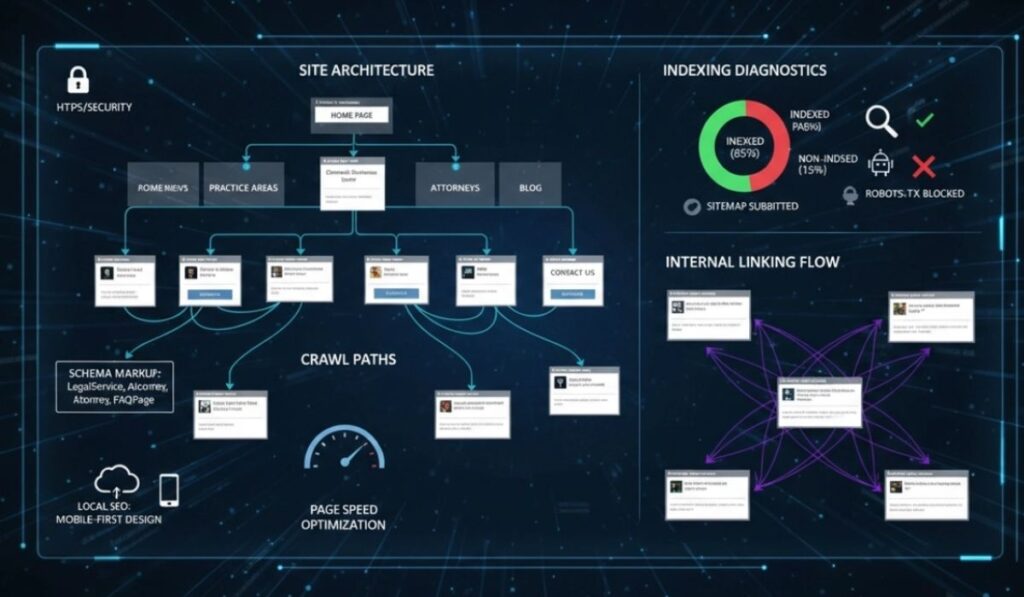
A law firm’s website can have excellent content and still underperform. Technical SEO issues — crawl blocks, slow page loads, redirect chains, indexing gaps — quietly suppress visibility long before a firm notices the impact.
For legal websites, technical SEO should address mobile experience, crawl depth, Core Web Vitals, indexing control, duplicate-content management, redirect hygiene, structured navigation, and page-template consistency. Firms that expand rapidly with new practice pages, attorney bios, blog content, and location pages tend to accumulate hidden technical debt over time.
Website Structure Optimization
Strong legal site architecture makes it easier for users and search engines to understand the firm’s services, attorneys, and markets. Core pages should flow logically from top-level practice hubs to sub-service pages, attorney bios, location pages, FAQs, and contact paths.
An effective legal site structure includes:
Primary navigation built around major practice areas and firm information
Supporting sub-pages for specific case types and service variations
Attorney bios tied to relevant practice areas and office locations
Location pages connected to the correct market and office
Clear conversion touchpoints on every strategic page
Internal Linking Strategy
Internal linking is not just a technical exercise — it is a semantic and conversion tool. For law firms, internal links should reflect topic relationships, local relevance, and the user journey toward consultation.
A personal injury hub page, for example, should link to motor vehicle accident pages, attorney bios, office location pages, FAQ sections, and contact forms. That structure improves semantic relevance, supports crawlability, and helps Google understand how the firm’s services, attorneys, and locations relate to each other.
Content SEO for Practice Area Pages
Practice area pages are where law firms compete for the highest-intent searches in organic search. If those pages are thin, templated, or disconnected from supporting content, they will rarely reach their potential — regardless of how strong the brand is.
Effective legal content optimization focuses on depth, clarity, intent alignment, and real-world relevance. A strong practice area page explains what the service is, who it is for, how the process works at a high level, what the firm’s approach is, and how to take the next step — without making guarantees or providing legal advice.
SEOSERVICES1 uses a hub-and-spoke content model for practice area growth. A primary hub page targets the core service keyword, while supporting pages address related case types, city-specific variations, FAQ topics, and semantic subthemes.
This model builds topical authority, expands keyword coverage, and creates structured internal linking across practice clusters, attorney bios, blog resources, and local landing pages.
Attorney Profile Optimization
Attorney bios are frequently underused SEO and conversion assets. When done well, they reinforce trust signals, entity clarity, and brand authority by including experience highlights, jurisdictions served, practice concentration, credentials, recognitions, publications, and speaking or media references where appropriate.
Well-crafted attorney profiles also directly support conversion. Prospective clients — especially those facing serious or high-stakes legal matters — often read bios carefully before contacting a firm. A credible, clear attorney profile removes doubt and moves the user forward.
Advanced Ranking Strategies: Semantic SEO & GEO
Keyword targeting alone cannot sustain competitive rankings in modern legal search. Law firms need semantic relevance, entity clarity, and content ecosystems that allow search engines to map topic relationships across an entire website.
Semantic SEO Strategy
Semantic SEO helps a law firm rank beyond individual keywords by establishing strong contextual relevance across interconnected topics. That means aligning practice area pages, supporting blog content, attorney bios, location pages, FAQs, and internal links around a shared topic universe.
A family law cluster, for example, might include pages on divorce, child custody, child support, mediation, post-decree modifications, and local court procedures. Together, those pages signal topical authority and help the firm compete across a broader range of legal search queries.
GEO Optimization
Generative engine optimization extends SEO into AI-powered search environments. It prepares a law firm’s content to be discovered, cited, summarized, or featured in tools like Google AI Overviews, ChatGPT, and other answer engines.
For legal marketers, GEO means producing structured, entity-rich content that AI systems can interpret accurately and reference with confidence. FirmPilot’s guide on GEO strategies for AI tools provides useful context on how this shift is reshaping legal search visibility.
AI Visibility Optimization
AI search visibility for law firms depends on more than one page ranking. It depends on whether the firm’s entire online presence communicates clearly who the attorneys are, what the firm handles, where it operates, and why it is credible.
To improve AI visibility, law firms should:
Build topic depth across all practice clusters
Strengthen entity optimization for firm name, attorney names, and location signals
Use structured headings and FAQ blocks for AI answer extraction
Maintain consistent information across the website, GBP, and legal directories
Support trust through reviews, recognitions, and accurate profile content
Building Authority: Reviews, Reputation, and Trust Signals
Trust is not a finishing touch in legal SEO. It is core infrastructure. Reviews, attorney credentials, experience summaries, professional awards, affiliations, and consistent brand information all contribute to how search engines and prospective clients assess a law firm.
For legal websites, reputation signals must be visible, verifiable, and current. That means integrating reviews properly, adhering to testimonial compliance standards, maintaining active bar and professional memberships, and creating content that reads as credible rather than promotional.
Understanding how E-E-A-T requirements apply in YMYL legal environments is essential. CUSG offers a practical breakdown of E-E-A-T and YMYL that supports the case for strong trust architecture across legal websites.
Our SEO Audit Process
Strong legal SEO starts with honest assessment. SEOSERVICES1 begins every engagement with a structured audit that maps current performance against real growth opportunities — not assumptions or generic checklists.
A law firm SEO audit typically covers:
Technical review — indexing, crawlability, page speed, template issues, schema, redirects, and site structure
On-page review — keyword mapping, heading logic, title tags, duplicate content, and intent alignment
Local review — Google Business Profile, citation accuracy, reviews, location pages, and map pack opportunities
Content review — practice area depth, attorney bios, FAQs, internal links, and topical gaps
Performance review — Google Search Console, Google Analytics, lead paths, top landing pages, and priority growth areas
The result is a clear, prioritized roadmap — not a 90-page PDF full of generic recommendations.
SEO Tools & Analytics We Use
Effective law firm SEO combines execution with measurement. SEOSERVICES1 tracks performance across Google Search Console, Google Analytics, Google Business Profile Insights, Bing Webmaster Tools, Semrush, and Ahrefs to monitor search visibility, keyword movement, traffic quality, and site health.
These platforms help answer the questions that matter to firm leadership:
Which practice area pages attract the most qualified traffic?
Which location pages need stronger local relevance?
Where are indexing gaps limiting visibility?
Which content clusters are driving consultation growth?
How are users moving from landing pages to contact actions?
Tool
Primary Use
Why It Matters
Google Search Console
Queries, indexing, CTR, coverage
Connects visibility to real search demand
Google Analytics
User behavior, engagement, conversion paths
Shows how traffic turns into action
Google Business Profile
Local visibility and profile engagement
Supports local pack performance
Semrush / Ahrefs
Keyword research, content gaps, link review
Uncovers competitive growth opportunities
Bing Webmaster Tools
Supplemental search visibility
Adds broader cross-platform insight
Pricing and Investment
Law firm SEO pricing depends on market competitiveness, practice area scope, current website condition, content needs, and local footprint. A solo attorney in a single market has different requirements than a multi-location firm competing across several high-value practice areas.
SEOSERVICES1 does not offer rigid, one-size-fits-all packages. Scope is aligned with your firm’s actual goals, site maturity, and realistic growth opportunity.
Law firm SEO services are specialized optimization services that improve a legal website’s visibility in search engines and AI-driven search environments. They typically include technical SEO, local SEO, content optimization, site architecture improvements, attorney profile optimization, and performance tracking.
Why is SEO important for law firms?
SEO helps law firms increase visibility where potential clients are already searching. It supports local discovery, strengthens legal brand authority, and improves the consistency and quality of consultation opportunities from organic search.
How long does law firm SEO take?
SEO is a long-term growth channel. Technical fixes and local profile improvements may show early movement. Stronger organic growth from content clusters and authority building typically takes longer. Timelines depend on competition, market size, current website condition, and campaign scope. Realistic expectations are part of every SEOSERVICES1 engagement.
What is included in legal SEO?
Legal SEO typically includes technical audits, on-page optimization, keyword mapping, practice area page improvements, location SEO, Google Business Profile optimization, internal linking, content development, analytics setup, and reputation-support strategies.
Can SEO help generate more legal consultations?
When content quality, local SEO, and conversion flow work together, SEO can meaningfully improve the visibility and structure that leads to more consultation opportunities. It does not guarantee case volume or rankings — but it can significantly improve how often qualified prospects find and engage with your firm.
Why choose SEOSERVICES1?
SEOSERVICES1 builds law firm SEO services around real outcomes: stronger search visibility, cleaner site performance, better local discovery, and higher-quality lead opportunities. The approach combines technical SEO, semantic SEO, GEO, trust-building, and conversion strategy into one coordinated legal marketing workflow — designed specifically for the demands of modern legal search.
Conclusion: Start Growing Your Law Firm Today
Your competitors are investing in legal SEO. The question is whether your firm is building the visibility, authority, and trust infrastructure that earns the consultation — or leaving it to chance.
SEOSERVICES1 delivers law firm SEO services built for how legal search works in 2026 and beyond. From technical SEO and local optimization to practice area content, attorney profile trust signals, and AI visibility strategy, the goal is straightforward: help your firm become easier to find, easier to trust, and easier to contact.
Explore our full range of SEO services and find out how a performance-driven legal SEO strategy can support your firm’s growth goals.
Senior Search Strategist specializing in SEO, AEO, and Generative Engine Optimization (GEO). With over a decade of experience, Rick helps brands and applications (ASO) maximize their visibility across traditional search engines, AI answer engines, and app stores.