What Are AI Marketing Tools?
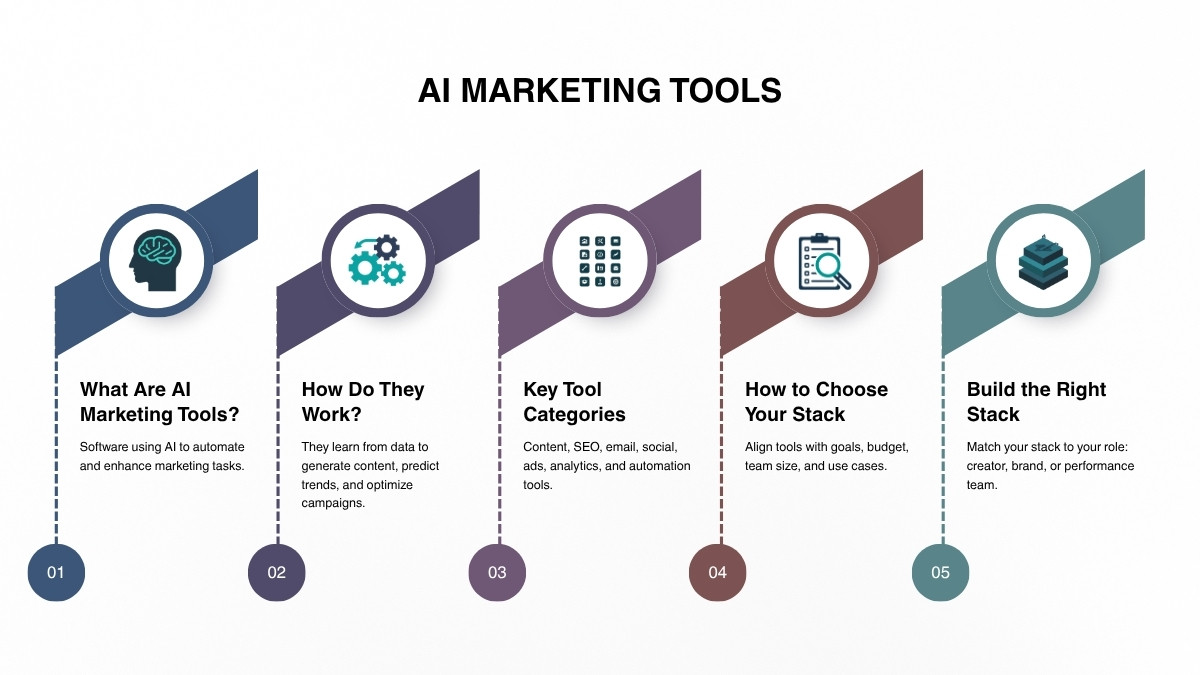
AI marketing tools are software applications that use artificial intelligence to take on a share of the research, planning, creation, and optimisation work inside your marketing team. Instead of doing every task manually, you can delegate parts of the workflow like drafting copy, clustering keywords, scoring leads, or summarising performance to systems that learn from data and generate suggestions in seconds.
Under the hood, these tools rely on techniques such as machine learning, natural language processing, and predictive analytics. Some specialise in a single task, for example generating ad copy or building SEO briefs. Others act more like a control centre, combining orchestration, reporting, and AI assistance across multiple channels. The common thread is that they sit inside your existing stack and help you execute smarter, faster, and with more consistency.
Why AI Marketing Tools Matter in 2024–2026
Productivity, Scale, and Personalisation
Between 2024 and 2026, marketing has become more demanding on almost every front: more channels, more content formats, more data, and higher expectations for personalisation. Yet most teams have not doubled their headcount. AI marketing tools are one of the few ways to keep up without burning out your team.
Recent AI tool comparisons and adoption surveys consistently describe a similar pattern: teams that adopt AI for seo content creation services and analysis report shorter production cycles and more experiments shipped per quarter; marketers use AI to increase content output or ad variants while keeping human review in place for quality control; and companies that connect AI to their audience and performance data see better targeting and more relevant campaigns.
Take a small consultancy that used to publish an article once a month. After adding an AI content assistant and SEO brief generator, they are able to publish once a week: AI handles outlines, first drafts, and meta data, while the human team focuses on examples, stories, and quality. The result is more surface area in search and social without adding full-time writers.
Where AI Marketing Tools Deliver the Biggest Impact
AI tends to shine wherever the work is repetitive, data-heavy, or scale-dependent:
- Repetition – writing multiple variations of headlines, product descriptions, or ad copy; turning one in-depth article into half a dozen shorter assets.
- Data overload – trying to interpret performance across many channels, campaigns, and segments without an analyst on call.
- Personalisation at scale – tailoring emails, recommendations, or journeys for thousands of people, each with slightly different behaviour and needs.
Modern AI marketing guides show teams using AI for everything from drafting long-form content and clustering keywords, to scoring leads, predicting churn, and generating campaign insights in human-readable language. When you pair those capabilities with a clear strategy and guardrails, you get leverage not a gimmick.
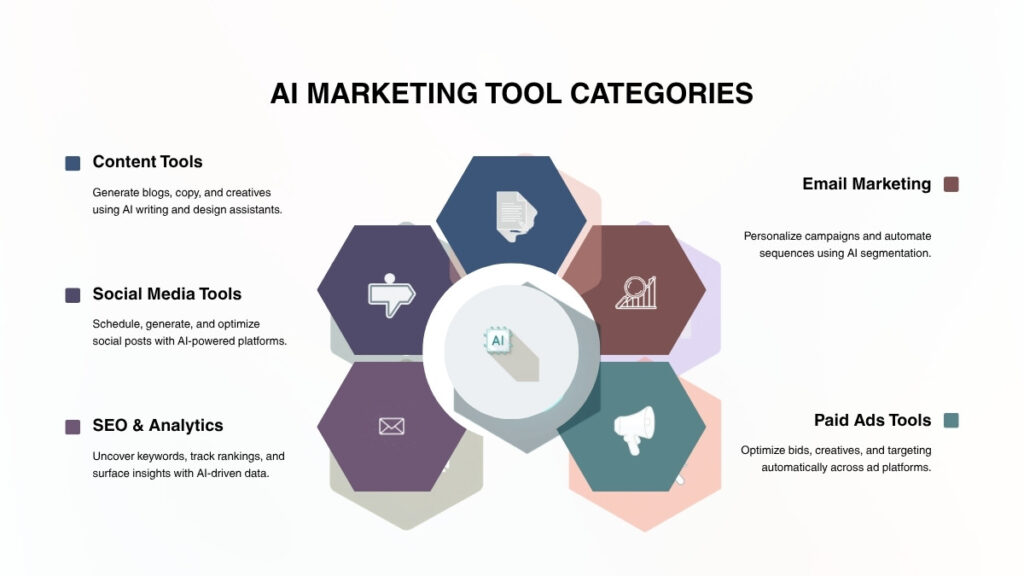
Core Categories of AI Marketing Tools
Instead of thinking about “AI” as one monolithic thing, it’s more useful to think in terms of categories. Each category maps to specific jobs in your marketing organisation.
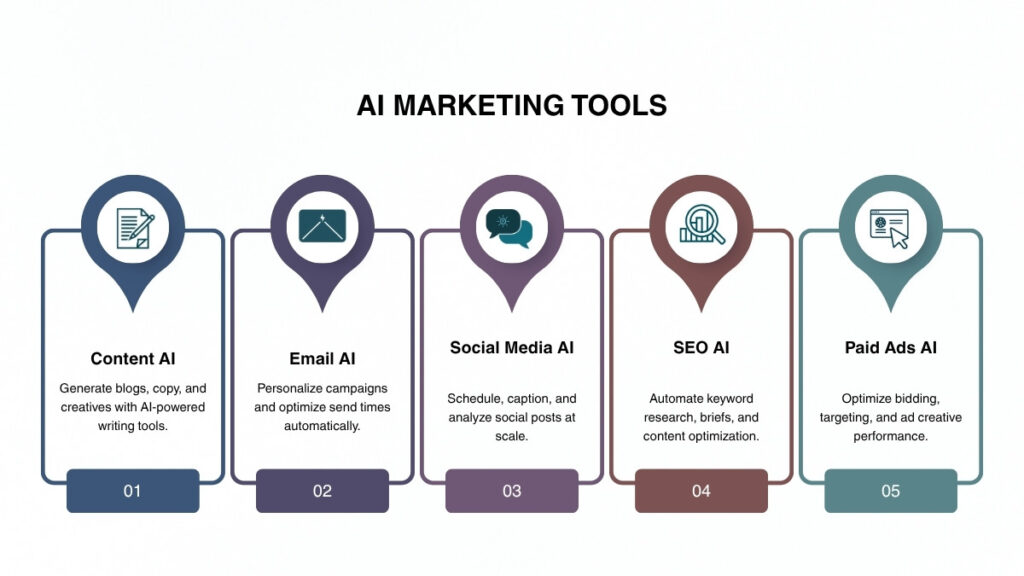
AI Tools for Content and Copywriting
Content and copywriting tools are the entry point into AI for many teams. They help you move from blank page to solid draft much faster.
You can use them to:
- draft blog posts, landing pages, and product descriptions based on briefs or prompts;
- generate and refine ad copy and social captions for different platforms;
- repurpose long pieces (for example, turning a webinar transcript into articles, emails, and posts);
- adjust tone and reading level to fit your brand voice and audience.
Typical features include:
- ready-made templates for common content formats;
- custom “brand voice” or style training so the AI remembers how you sound;
- SEO-aware guidance on headings, keyword usage, and structure;
- collaboration and approval features so writers and editors can work together.
Content-focused tools feature prominently in recent AI tool roundups because they offer visible time savings and are easy to trial on a single campaign before scaling up.
AI Tools for Social Media and Scheduling
Social media AI tools support both content creation and distribution. They reduce the manual work of keeping a consistent presence on multiple platforms.
They are commonly used to:
- brainstorm social post ideas and hook angles;
- draft platform-specific captions and suggest hashtags;
- schedule posts at times when your audience is most likely to interact;
- monitor performance and highlight posts worth boosting or repurposing.
You’ll typically find:
- calendar and queue views across channels;
- AI caption suggestions and content “remix” options;
- send-time optimisation based on your own historical data;
- cross-platform analytics dashboards.
In tool comparison articles, social scheduling tools are often recommended for small teams that need to stay visible on LinkedIn, Instagram, or TikTok without checking each app all day.
AI Tools for Email and Personalisation
Email and lifecycle marketing tools increasingly embed AI directly in the platform. The goal is to send fewer, more relevant messages rather than more broadcasts.
Common use cases include:
- generating subject lines and testing variants;
- drafting nurture sequences and campaign emails;
- personalising content blocks for different segments or behaviours;
- predicting optimal send times and suggested frequency for each contact.
Key features often include:
- AI copy assistants within the email editor;
- dynamic content rules that adapt to user data;
- send-time optimisation models;
- predictive scoring of leads or customers based on engagement and fit.
Many CRM and marketing automation vendors position AI features as a way to get more value from the data you already have; comparison guides often treat these AI capabilities as a differentiator between platforms.
AI Tools for SEO and Content Optimisation
SEO-focused AI tools zero in on helping you create and optimise content that aligns with search intent and competitive pages.
They are used to:
- research keywords and cluster related queries into topics and content hubs;
- generate SEO briefs that reflect what top-ranking pages cover;
- score drafts against target keywords and suggest improvements;
- surface content gaps or linking opportunities on your site.
Typical features:
- keyword clustering and difficulty metrics;
- suggested outlines pulled from top results and semantic analysis;
- content scores that guide revision priorities;
- workflows that integrate with your CMS or writing tools.
These tools show up consistently in “best AI marketing tools” comparisons for content-heavy brands because they streamline the research-and-briefing stage, which traditionally consumes a lot of strategist time.
AI Tools for Analytics and Reporting
Analytics-oriented AI tools help you make sense of large volumes of campaign and customer data. They shrink the distance between raw numbers and clear stories.
They are used to:
- combine data from multiple channels into unified dashboards;
- generate plain-language summaries and insights;
- detect anomalies like a sudden drop in a key segment;
- forecast likely outcomes and suggest tests.
Common capabilities include:
- AI-generated commentary layered on top of charts;
- predictive models for conversion, churn, or revenue;
- segmentation and cohort analysis features;
- integrations with existing analytics and data sources.
Research-centric companies and expert practitioners highlight these tools as particularly valuable for marketing leaders and operations teams who need to make decisions quickly without doing manual analysis for every question.
AI Tools for Paid Ads and Optimisation
Paid media is another area where AI plays an increasingly central role. These tools sit alongside or on top of ad platforms to help you test and optimise more aggressively.
They assist with:
- generating numerous variants of ad copy and creative assets;
- recommending audiences and targeting setups;
- automatically adjusting bids and budgets based on performance;
- organising multivariate tests across channels.
Typical features:
- AI creative suggestions tuned to specific platforms;
- smart bidding and pacing algorithms;
- alerts when campaigns perform outside expected ranges;
- connectors to Google Ads, Meta, and other major networks.
Performance-focused guides often show case examples where AI-driven optimisation helps teams run significantly more experiments, leading to better-performing campaigns over time provided humans still set strategy and guardrails.
AI Tools for Automation and Orchestration
Lastly, orchestration tools bring everything together. They focus on coordinating workflows rather than executing a single task.
You might use them to:
- trigger actions across tools when specific events happen (for example, when a lead hits a score, or when content crosses a performance threshold);
- synchronise data between systems;
- manage cross-channel campaign logic from a central place.
They usually offer:
- visual workflow builders and rule engines;
- AI “recommend next step” suggestions in journeys;
- unified reporting across connected tools;
- integrations with CRM, CMS, ad platforms, and analytics.
High-level “AI marketing stack” guides often distinguish between passive helpers that sit inside single tools, and more active orchestrators that coordinate tasks across your stack. Both have a role, but orchestration becomes increasingly important as your stack grows.
AI Marketing Tool Categories at a Glance
| Category | Main Use Cases | Typical Features | Example Roles Best Served |
|---|---|---|---|
| Content & copywriting | Blogs, landing pages, ads, social copy, product descriptions | Templates, brand voice controls, SEO suggestions | Content marketers, copywriters |
| Social media & scheduling | Social calendars, captions, posting, engagement analysis | Multi-channel scheduling, send-time optimisation, analytics | Social media managers |
| Email & personalisation | Campaigns, nurture flows, lifecycle messaging | AI subject lines, dynamic content, send-time optimisation | Email / lifecycle marketers |
| SEO & content optimisation | Keyword research, briefs, on-page optimisation, content gaps | Content scoring, competitor analysis, cluster mapping | SEO specialists, content strategists |
| Analytics & reporting | Dashboards, insight generation, forecasting | AI summaries, anomaly detection, predictive models | Marketing operations, analysts |
| Ads & optimisation | Ad copy generation, experimentation, bid and budget optimisation | Creative variants, smart bidding, performance recommendations | Performance marketing teams |
| Automation & orchestration | Cross-channel workflows, trigger-based campaigns, stack integration | Workflow builders, orchestration, cross-channel reporting | Marketing leaders, RevOps |
This table is intentionally tool-agnostic. It is designed to help you think in terms of capabilities and roles rather than chasing brand names.
How to Choose the Right AI Marketing Tools
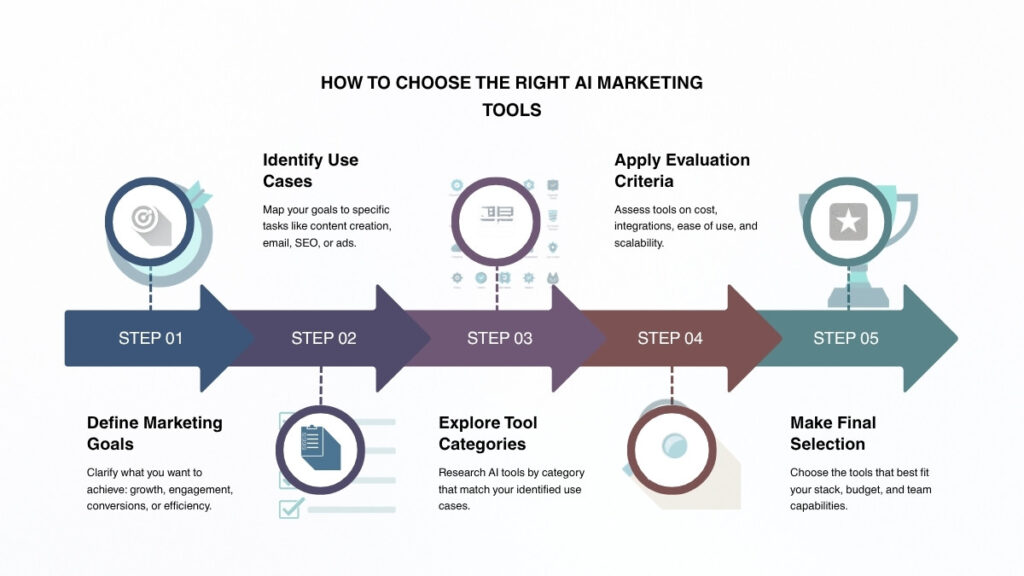
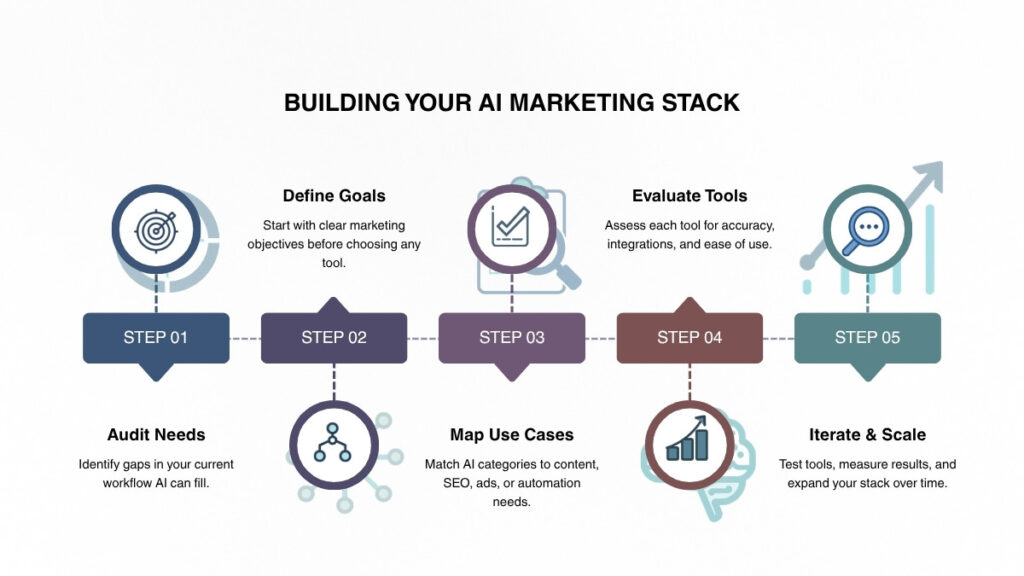
Start with Your Goals and Constraints
The most effective AI stacks are built backwards from business goals to tools, not the other way around. Before you sign up for anything new, write down your top three marketing outcomes for the next 6–12 months (for example, “increase qualified leads”, “publish twice as much content”, “improve ROAS”), the channels that actually matter for those outcomes, and any constraints around budget, compliance, or technical support.
This exercise changes the conversation from “Which tools are hot?” to “Which parts of our workflow genuinely need help?”. A solo founder might discover that consistent content and basic SEO are the priority. A regional eCommerce team might realise that email personalisation and predictive product suggestions will move the needle most. A large enterprise might decide that better analytics and cross-channel orchestration are the highest leverage.
Expert comparison guides repeatedly recommend this goal-first approach because it keeps teams from building sprawling stacks that look impressive but deliver little measurable value.
Evaluating Features, Integrations, and Data Practices
Once you know what problems you want to solve, you can evaluate tools with a more critical eye. A simple evaluation checklist could include:
- Does this tool directly support one of our top goals? If not, it probably belongs later in the roadmap.
- Are the core features deep enough? For example, if your main need is SEO planning, you want robust research and briefing capabilities, not a light add-on buried in a general tool.
- How well does it integrate with what we already use? Look for native integrations with your CMS, CRM, email platform, and ad accounts. If integration requires custom development or manual exports, factor that into your decision.
- What is the vendor’s approach to data and privacy? Read their docs on data storage, training, and compliance. Some guides specifically flag the importance of checking how tools handle prompts and outputs, especially in regulated industries.
- Can our team realistically learn and maintain this? A powerful tool people don’t understand is effectively a waste. Consider ease of onboarding and ongoing use.
- Is the pricing aligned with expected value? Compare trial and starter tiers to your expected usage and potential impact; look for plans that let you start small and scale.
Structured comparison articles which often present side-by-side tables of features and pricing can be a good reference point for what to pay attention to when you construct your own internal scorecards.
Free vs Paid Plans and Learning Curve
Free tiers are useful for exploration, but they can tempt teams into signing up for more tools than they can meaningfully use. A more intentional approach might look like this:
- Pick one workflow to improve. For example, “weekly blog + newsletter” or “monthly performance campaign optimisation”.
- Select one or two tools that fit that workflow, ideally with trials or free tiers.
- Set specific evaluation criteria such as “reduce drafting time by 40%” or “increase number of ad variants tested per campaign from 3 to 10”.
- Review after a few cycles, comparing time, output, and results against your baseline.
If a tool clears that bar, upgrading or expanding usage becomes a straightforward business decision, not a hopeful gamble.
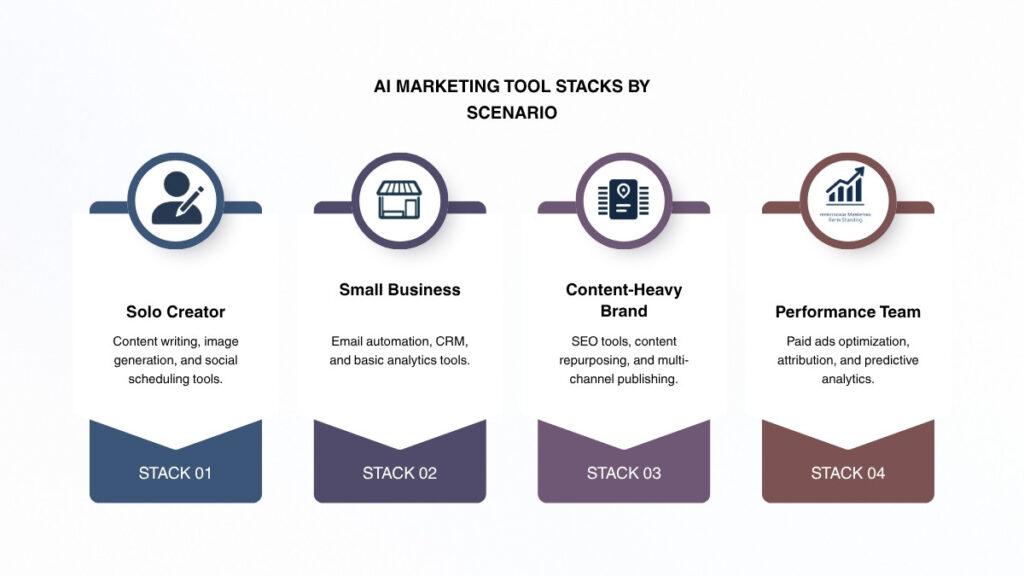
Example AI Marketing Stacks for Different Teams
The right stack for a solo founder looks very different from the stack used by a global enterprise. Below are illustrative patterns inspired by how teams in various AI marketing guides structure their toolsets. They are frameworks, not prescriptions.
Solo Creator or Freelancer
A solo creator is responsible for strategy, content, distribution, and often client work as well.
Typical priorities: be visible, publish consistently, and preserve time for billable or revenue-generating work.
Practical starting stack:
- one content and copywriting assistant,
- one social scheduling tool with basic AI caption suggestions,
- optionally, a lightweight SEO assistant.
Mini case:
Sara is a freelance marketing consultant. She decides to publish one blog and three social posts per week to attract clients. Before using AI, she spent half a day drafting each article and often skipped social posts when client work got busy.
After adopting a content assistant and social scheduler:
- she spends about 90 minutes per article (outline and first draft from AI, then her edits),
- repurposes each article into three LinkedIn posts suggested by the tool,
- pre-schedules social content for the week in one sitting.
This shift frees up several hours a week while actually increasing her content output. The AI tools didn’t replace her expertise they made it easier to express it consistently.
Small Business or Lean Marketing Team
Small marketing teams often juggle campaigns, content, and reporting for the entire organisation.
Typical priorities: generate leads, nurture prospects, and show clear results to the business with limited people and budget.
Practical starting stack:
- content and copywriting tools,
- email and personalisation features (often inside an existing CRM/automation platform),
- social scheduling,
- basic analytics/insight capabilities.
Mini case: a small business using AI for weekly content
A three-person marketing team at a SaaS startup commits to a weekly blog post, a weekly newsletter, and 4–5 social posts related to that week’s theme.
They use:
- an AI content/SEO combo to generate topic ideas and outlines aligned with search demand;
- the same tool to draft first versions of the blog and newsletter;
- AI capabilities in their email platform to suggest subject lines and personalise intro paragraphs based on segment;
- a social tool to create and schedule multiple captions from the blog content.
After three months, they notice their publishing cadence is steady, their organic traffic and email engagement are trending upward, and the time required to plan and execute each week’s content has dropped.
Content-Heavy Brand or In-House Content Team
A content-heavy brand may run a blog, knowledge base, resource library, and multiple campaigns simultaneously.
Typical priorities: maintain high volume without losing quality, protect brand voice, and win in search on strategic topics.
Practical starting stack:
- advanced content tools with brand training options,
- SEO and content optimisation system,
- analytics tuned for content performance,
- optional workflow and orchestration layer.
Mini case:
A mid-sized B2B brand has a team of writers and editors producing dozens of pieces per month. Before AI, strategists spent days each month compiling keyword research and competitor analysis into briefs. Writers then produced drafts from scratch.
With AI SEO and content tools in place:
- strategists generate topic clusters and briefs in hours instead of days;
- writers use brand-trained AI assistants to produce detailed first drafts that already reflect the correct tone and structure;
- editors focus on nuance, storytelling, and quality rather than fixing structural issues;
- analytics tools flag high-performing topics and underperforming pieces, feeding back into planning.
This combination AI for planning, drafting, and measuring allows content teams to manage larger editorial calendars without proportionally increasing headcount.
Performance Marketing Team
Performance marketing teams are responsible for turning spend into measurable revenue. Their work is naturally experimental.
Typical priorities: improve ROAS, run more experiments, and make faster optimisation decisions.
Practical starting stack:
- ad and optimisation tools,
- analytics tools,
- optional content assistant for creative variants.
Mini case: marketing team using AI analytics to refine campaigns
A growth team runs paid campaigns on Google, Meta, and LinkedIn. Previously, they manually built reports weekly and could only test a handful of creative variations per ad group.
After integrating AI ads and analytics tools:
- they generate a much larger set of copy and creative ideas for each experiment,
- let AI-driven bidding and budgeting adjust within pre-defined constraints,
- use AI analytics dashboards that highlight winning and losing combinations in clear language,
- meet weekly to review recommendations and decide which ideas to scale or retire.
Teams that adopt this kind of workflow typically see an increase in testing velocity and more learnings per unit of spend, provided someone remains accountable for strategy and guardrails.
Limitations, Risks, and Human Oversight
Hallucinations, Bias, and Brand Voice
AI models generate language based on patterns in data, not on a built-in understanding of truth or brand nuance. That means they can invent names, statistics, or “facts” that sound right but are wrong; they can reproduce biases or stereotypes from training data; and they often default to generic phrasing unless guided carefully.
If you publish AI outputs without critical review, you risk undermining trust or sounding like everyone else. Teams that get good results with AI marketing tools tend to define what AI is allowed to draft and what must be human-written from scratch, train writers and editors to treat AI suggestions as raw material, not as final copy, and maintain up-to-date brand guidelines and sample content for the tools to learn from.
Expert-level guides repeatedly warn against “fire-and-forget” content generation and instead recommend keeping humans in the loop at every important step.
Data Privacy, Compliance, and Vendor Risk
Any AI tool that touches customer data, behavioural logs, or internal documents introduces a new risk surface. Beyond marketing performance, you must consider where data is stored and processed geographically, how long it is retained and for what purposes, whether your content and prompts can be used to train shared models, and how the vendor documents compliance with frameworks relevant to your markets.
Comparison guides aimed at mid-market and enterprise buyers often dedicate entire sections to data handling and compliance questions, especially for tools that integrate with CRMs or data warehouses. Adding legal, security, and privacy stakeholders to your evaluation process for these higher-risk tools is not overkill it’s responsible governance.
Designing Internal Guidelines and Review Processes
To manage these risks and maintain quality, it helps to formalise how your organisation uses AI marketing tools. Practical guidelines might cover:
- Allowed use cases – for example, “AI can be used for ideation, outlines, first drafts, translations, and summarisation, but not for legal disclaimers or financial statements”.
- Review standards – who must review AI-assisted content before publishing and what they must check (facts, tone, bias, alignment with brand and legal requirements).
- Prompt hygiene – what types of information staff should never include in prompts (for example, sensitive customer data, internal secrets).
- Logging and learning – how you record wins, failures, and lessons so everyone benefits from experience.
Teams that treat AI adoption as a change in operating model, rather than just a collection of tools, tend to avoid the worst pitfalls and see steadier gains over time.
Integrating AI Tools into Your Existing Stack
AI is most useful when it enhances the systems and workflows you already rely on. If each new tool lives in its own silo, you gain little more than extra logins.
Connecting AI Tools to Your CMS, CRM, and Automation
A practical integration strategy starts by mapping your core platforms and identifying “AI attach points”:
- In your CMS, you might connect SEO tools that send briefs or optimisation suggestions directly into the editing interface, or content assistants that live inside the editor.
- In your CRM, you can use AI to score leads, suggest next-best actions, and generate tailored follow-ups based on activity and attributes.
- Within your marketing automation, AI can refine subject lines, adjust content blocks, and propose new journey paths.
- In your analytics layer, AI can summarise multi-channel performance, saving your team from manually stitching together data.
Stack-focused comparison resources emphasise that successful teams usually build around a few primary platforms (CMS, CRM, automation) and then choose AI tools that integrate cleanly with those systems. That approach reduces friction and makes it easier to keep data consistent.
Avoiding Tool Sprawl and Overlap
Tool sprawl happens quietly. One team experiments with a content tool, another tests a different SEO assistant, someone else subscribes to an analytics product, and after a year you have overlapping subscriptions and fragmented workflows.
To keep control:
- maintain a shared inventory of AI-related tools, including owners and use cases;
- regularly review usage data and business impact for each tool;
- consolidate where multiple tools serve the same purpose;
- create a simple approval process for new AI tool trials, so experiments are coordinated rather than hidden.
Analysts and practitioners writing about AI stacks repeatedly point out that the cost of unmanaged sprawl both in money and operational complexity can quietly offset many of the time savings AI promised in the first place.
AI Marketing Tools FAQs
1. What exactly are AI marketing tools?
AI marketing tools are applications that apply artificial intelligence to marketing tasks such as planning, content creation, personalisation, and performance analysis. They behave like specialised assistants that help you get more done with the same or fewer manual steps.
2. Are AI marketing tools worth it for small businesses?
For many small businesses, carefully chosen AI tools are worth the investment because they reduce the time spent on content, social, or reporting while improving consistency. The key is to start with one or two tools tied directly to a major bottleneck and prove value before expanding your stack.
3. How many AI marketing tools should I start with?
Starting small is usually smarter. Most teams see better results when they adopt one to three tools that support a well-defined workflow and then grow deliberately from there. This keeps learning manageable and makes it simpler to pinpoint which tool is responsible for which result.
4. Will AI marketing tools replace human marketers or copywriters?
AI marketing tools are unlikely to replace marketers any time soon. They are very good at generating options, summarising data, and performing repeatable tasks at scale. They are not good at owning strategy, understanding context, or building nuanced stories on their own. The teams that do best treat AI as an enhancement to human skill, not a substitute.
5. How do I avoid generic, off-brand AI outputs?
You can significantly improve output quality by giving AI systems rich, specific inputs clear prompts, brand guidelines, and examples of high-quality content. Many tools allow you to define a brand voice or upload reference material. Combining these features with consistent human editing is the most reliable way to avoid bland, “AI-sounding” content.
6. How do I measure ROI from AI marketing tools?
To measure ROI, define what you hope to improve time to launch, content volume, engagement, conversion rates, or some mix. Capture a baseline, adopt AI with a limited scope, and compare before and after over a meaningful period (for example, one or two quarters). Multiple industry comparisons suggest that teams who approach AI as a measured experiment, rather than an open-ended add-on, are more likely to see clear returns.
7. What are the main risks of using AI in marketing?
The biggest risks include incorrect or biased outputs, erosion of brand voice, over-automated communication that feels impersonal, and data/privacy issues. Managing those risks requires a combination of human review, clear usage policies, thoughtful vendor selection, and collaboration with legal and security teams for higher-risk tools.
8. How do I choose AI tools that fit my existing tech stack?
Start by mapping your current systems and main workflows. Then look for AI tools that either have native integrations with those systems or expose robust APIs your team can work with. Involve both marketers and technical stakeholders in the evaluation process so you don’t adopt tools that look good on paper but are hard to connect in practice.
How SEOSERVICES1 Helps You Build a Practical AI Marketing Stack
AI marketing tools can either become a genuine advantage or just another layer of complexity. The difference lies in how thoughtfully you select, integrate, and govern them.
SEOSERVICES1 works with organisations at different stages of AI adoption from solo marketers who want a focused starter stack, to mid-size teams seeking to scale content and campaigns, to larger enterprises looking to rationalise and orchestrate their existing tools. We help you identify where AI can genuinely move the needle in your current marketing processes, design stacks that align with your goals, channels, and compliance requirements, integrate AI tools into your content, SEO, email, and performance workflows, and establish the guidelines, training, and review cycles needed to keep AI-assisted work accurate, on-brand, and measurable.
Instead of chasing every new AI product launch, you get a clear roadmap and a partner focused on outcomes. With SEOSERVICES1, AI marketing tools become part of a deliberate, data-driven operating model not just another set of tools your team has to manage.