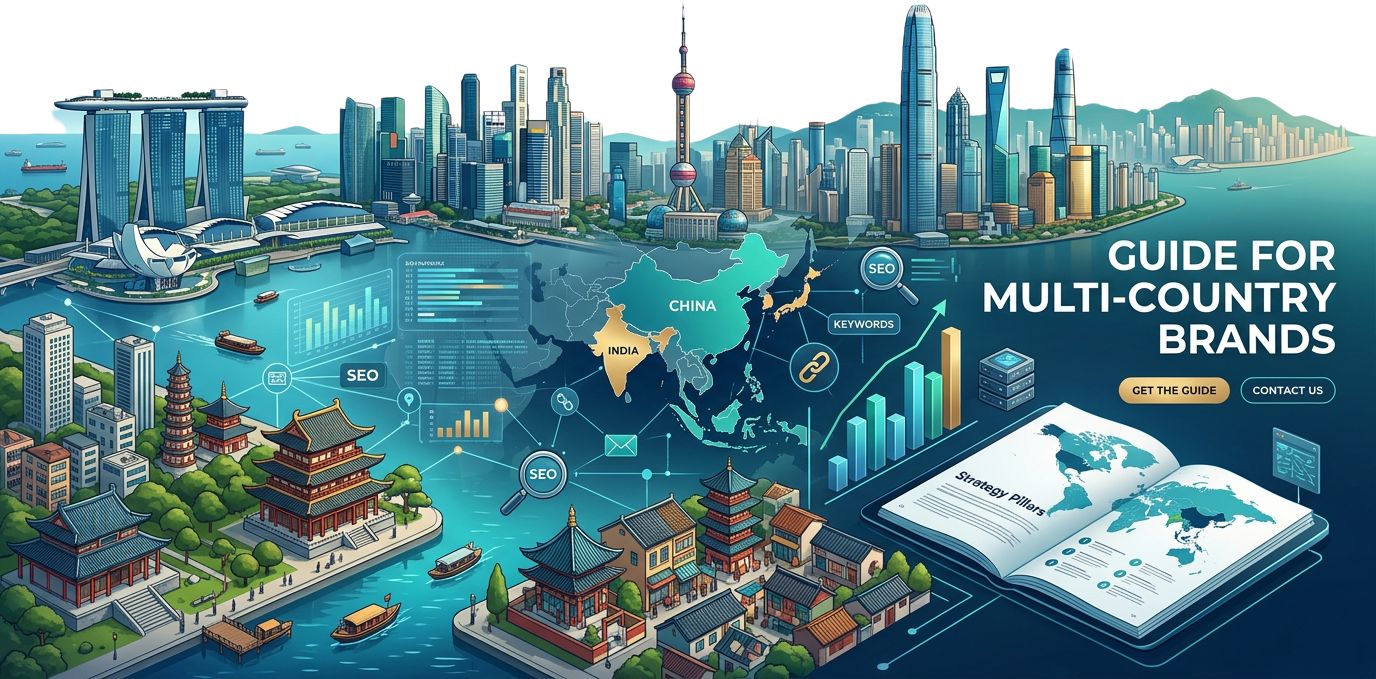
If your organisation serves customers across Asia, website seo asia isn’t just a technical task it’s a strategic discipline that influences how people first encounter and judge your brand. When someone in Singapore, Jakarta, Tokyo, or Mumbai searches for your services, the way your site is structured, translated, and surfaced in search results can decide whether you make their shortlist or disappear in the noise.
Modern SEO guidance emphasises three pillars for any site: strong technical foundations, relevant and trustworthy content, and clear signals of authority. Those same pillars apply in Asia, but the region’s diversity makes them harder to coordinate. You might see one country site outperforming while others remain invisible, not because the brand is weaker there, but because architecture, language handling, and platform assumptions were built around a single market.
A region‑aware website seo asia approach accepts that Asia is a mosaic of different search behaviours, languages, and expectations. Rather than tacking on “Asia” to a global plan, you start by asking which markets matter, how people search there, which languages they use, and what infrastructure is needed to serve them well. SEOSERVICES1 helps teams make those decisions calmly and systematically, turning Asia’s complexity into a workable roadmap instead of an ongoing source of frustration.
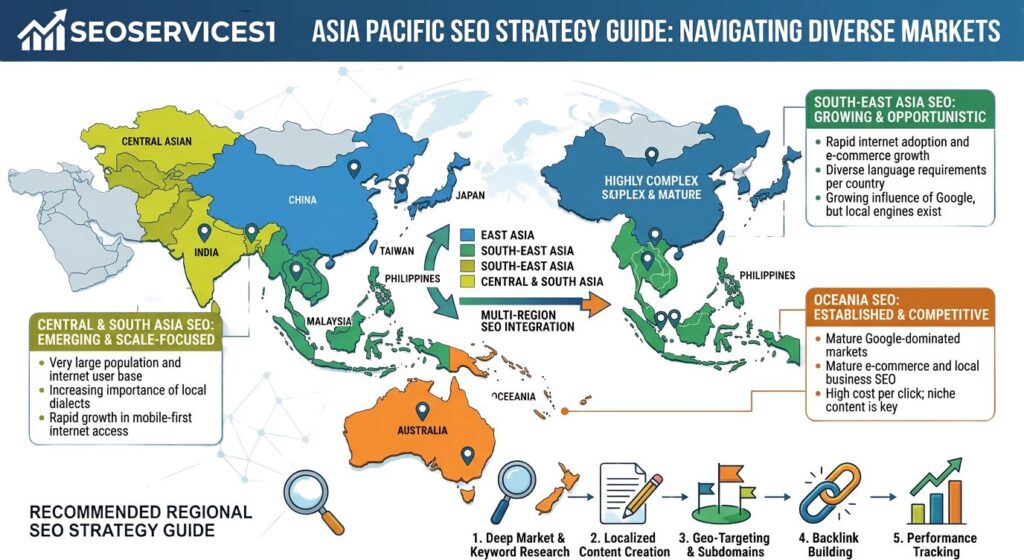
What Is Website SEO in Asia?
Website SEO in Asia is the structured optimisation of websites that target multiple Asian markets and languages, using recognised SEO principles while adapting them to Asia’s specific conditions. It covers the same core components you’d expect technical SEO, content and localisation, off‑page signals, and measurement but they are all tuned to multi‑country, multi‑language realities.
At a practical level, website seo asia means you:
- Decide which Asian markets and subregions your sites should explicitly target, rather than assuming “Asia” as one block.
- Design domains, subdomains, and subfolders so search engines can see which content is meant for which country and language.
- Apply technical best practices crawlability, indexability, performance, mobile UX with an eye on how users across Asia access and experience your site.
- Build content that reflects local search intent and cultural norms, instead of relying on direct translation of global copy.
- Shape off‑page signals, such as links and mentions, so they support the right regional and language variants of your site.
- Report performance by market, site, and language, enabling you to see where you’re winning, where you’re flat, and why.
What sets website SEO in Asia apart from generic “international SEO” is the way it centres Asia itself. Rather than treating Asian traffic as a side effect of global changes, you plan the region intentionally: you recognise that the mix of languages, platforms, and device habits in Asia requires its own decisions about how your web presence is put together.
Asian Subregions and Website SEO Differences
Trying to run one identical SEO plan for all of Asia is a common trap. The region shares some broad patterns high mobile usage, growing online economies but individual subregions have distinct languages, platforms, and expectations that affect how you design and optimise websites.
Website SEO in Southeast Asia
Southeast Asia covers markets such as Singapore, Malaysia, Indonesia, Thailand, Vietnam, and the Philippines. In many of these countries, Google plays a central role in search, and smartphone use is widespread. For website SEO in Southeast Asia, you typically need to:
- Make mobile experience a baseline metric, not an afterthought, since users frequently interact with sites on their phones.
- Decide how English and local languages will coexist on your site for example, English for certain segments, Bahasa Indonesia or Thai for others.
- Research local queries and topics so content addresses what people in each market actually search for, not just global themes with local keywords sprinkled in.
Website SEO in East Asia
East Asia includes markets like Japan and Korea, where local search engines and portals remain important. Users may rely on ecosystems like Yahoo! Japan or Naver alongside, or sometimes more than, Google. Website SEO here often requires:
- Understanding how those local engines interpret site structures, metadata, and content layouts.
- Handling Japanese and Korean scripts in titles, descriptions, URLs, and body copy with care, to avoid issues with legibility or indexing.
- Adapting UX patterns and information hierarchy to fit local expectations for instance, how much detail users expect on a page and how they prefer to navigate.
Website SEO in South Asia
South Asia, including India and neighbouring markets, often features English alongside local languages on the same sites. Competition for key queries can be high in certain sectors, especially in India’s dynamic online economy. Website SEO in this context typically focuses on:
- Segmenting content for multilingual audiences, often combining English with widely used local languages.
- Balancing broad “head” terms with more specific queries that reflect how local audiences search for services and products.
- Ensuring performance and resilience across different connection qualities so pages remain usable for a wide range of users.
Asia-Pacific Extensions Within an Asia Portfolio
Australia and New Zealand often appear in Asia‑Pacific portfolios managed by the same teams that handle Asian sites. These markets are primarily English‑language and Google‑centric, and while they are culturally distinct, they can act as reference points for technical and content standards. When you design website seo asia, it’s useful to understand how relatively straightforward ANZ sites compare to more complex Asian sites in the same portfolio.
Breaking the region into these subregions doesn’t mean you need four entirely separate strategies. Instead, it lets you decide where one shared approach is sensible and where particular countries or clusters deserve tailored treatment.
Search Platforms Across Asian Markets
Understanding where people search both in the classical search engine sense and within broader digital ecosystems is a core part of website SEO in Asia. If your strategy only considers one platform, you can easily miss how users in another market discover and revisit your site.
In many Southeast Asian countries and in South Asia, Google Search remains a primary avenue for website discovery. This aligns directly with the technical and content practices described in foundational SEO guidance: ensuring pages are crawlable, indexable, fast, and helpful for users. At the same time, directories, industry portals, and superapps play supporting roles, often acting as referers that send users to your site after initial discovery.
In East Asia, local engines such as Yahoo! Japan and Naver still command attention. They may have different default expectations around page layout, content structure, or how metadata is used, which can influence how you present information. If you treat Japan or Korea as “just another Google market,” your site may be less visible than it could be.
Beyond traditional search engines, superapps and vertical platforms such as regional commerce or travel portals also shape how people encounter and navigate to websites in Asia. They can’t be managed in the same way as search engines, but they influence which websites people remember and how often they return.
A mature website seo asia plan acknowledges this mix. SEOSERVICES1 helps organisations map the platform reality for each target market, then decide how technical and content work should support visibility and user journeys across these environments.
Technical Website SEO for Asia
Technical SEO often feels abstract until you see how it affects real users. In Asia, where performance, device types, and infrastructure vary by country, getting the technical layer right is essential. It ensures that search engines can understand your site and that users can actually use it.
Key technical considerations for website seo asia include:
- Designing a site structure that clearly signals which content belongs to which country and language, so search engines can return the right version to the right user.
- Applying recognised best practices for crawlability and indexability: clear internal linking, sensible sitemaps, and unambiguous directives in robots files.
- Implementing hreflang annotations properly, so language and regional variants don’t compete against each other or send mixed signals about relevance.
- Optimising performance on mobile devices across networks, given that many Asian users browse on smartphones and may experience varied connection speeds.
- Choosing hosting and CDN setups that minimise latency for users in your key Asian markets, rather than hosting everything far from the region.
For example, a single domain that serves English, Japanese, and Korean content needs logical URL patterns and precise hreflang configuration so search engines can align each language version with its intended audience. Guidance on hreflang and international architectures offers clear rules, but those rules must be applied with Asia’s language mixes and user behaviour in mind.
SEOSERVICES1 works with organisations to align their technical foundations with these principles, then refine details such as which domains or subfolders to use and how to handle redirects based on current assets and regional growth goals.
Multi-Language Website SEO for Asia
For many organisations, multi-language websites are central to their presence in Asia. They might serve English alongside Thai, Bahasa Indonesia, Vietnamese, Hindi, Japanese, Korean, or other languages, often within the same site. Handling that complexity gracefully is a core part of website seo asia.
Effective multi-language website SEO involves:
- Choosing languages and scripts for each site or section based on actual audience needs, not only on internal preferences.
- Deciding how languages appear in URLs for example, using language-specific paths, subdomains, or completely separate domains and ensuring those structures are clearly signalled to search engines.
- Aligning translations with local keyword research, so content feels natural and matches what people search for in each language.
- Designing navigation and language selectors that help users find their preferred version quickly, without confusion.
Consider a site that serves both English-speaking visitors and local Thai audiences. The English pages may emphasise global messaging and high-level value propositions, while Thai pages may need more specific, locally oriented information. If the site doesn’t clearly differentiate these segments from URL structure through to metadata and page content search engines may show the wrong version in each market, and users may struggle to find what they need.
SEO SERVICES 1 uses recognised international SEO and localisation practices to help clients build robust language strategies, then adapts those strategies to the actual language mixes, literacy patterns, and search behaviours they see in different Asian markets.
Cross-Border Website SEO in Asia
Cross-border behaviour is a defining feature of many Asia organisations. A single brand may sell or provide services in multiple countries at once, using one or several websites. Website SEO in Asia needs to account for the patterns of movement and demand between those countries.
Core cross-border questions include:
- Whether to centralise content and structure in a single regional site, or to run multiple country-specific sites that share certain templates and assets.
- How global and regional pages should relate to country-level pages, so they reinforce each other instead of competing for the same queries.
- How to coordinate country and language targeting via site architecture and hreflang when users move between countries or languages.
- How to manage off‑page signals such as links and mentions so they flow to the right site versions and support cross-border goals.
For instance, a brand using one Asia site with multiple language sections may eventually find that certain markets justify standalone country sites, while others remain best served by shared infrastructure. The timing and manner of that change can strongly influence SEO outcomes.
SEOSERVICES1 helps organisations review their current setups and long‑term plans, then shape website seo asia strategies that balance centralised control with local flexibility. The aim is to support cross-border activity without creating unnecessary complexity or fragmentation.
Website SEO Asia Service Packages and Pricing Logic
Website SEO needs differ between a single-country site, a multi-country regional site, and a large portfolio spanning many brands. SEOSERVICES1’s service packages for website seo asia reflect those differences, making cost drivers visible rather than opaque.
Example Website SEO Asia Packages
| Package Type | Best Fit | Markets | Sites / Variants | Languages | Core Inclusions | Pricing Logic (Indicative) |
|---|---|---|---|---|---|---|
| Single-Country Asia | Organisations focused on one Asian country with one primary site | 1 Asian country | Single site, possibly multi-language | Local language and/or English | Discovery and market analysis, technical and architecture assessment, key on-page optimisation, language and content recommendations, basic off-page strategy, country-level reporting | Influenced by site size and number of languages handled |
| Multi-Country Asia | Brands operating across several Asian markets with regional or country sites | Multiple Asian countries | Regional site plus sections, or multiple country sites | Multiple languages and scripts | Multi-country discovery, subregion and platform mapping, architecture and hreflang planning, content frameworks per market, guidance on off-page and digital PR per region, multi-country reporting dashboards | Scales with number of markets, site variants, and language combinations |
| Enterprise Asia Portfolio | Organisations with multi-brand, multi-site portfolios spanning Asia | Extensive Asia coverage | Multiple brands, domains, and site variants | Broad language and script mix | Portfolio strategy and prioritisation, detailed technical and content audits for key sites, governance and playbook development, cross-border content and link strategy, layered reporting at portfolio, region, and site levels | Reflects brand count, site count, markets, languages, and governance complexity |
Understanding these tiers helps teams see how website seo asia investment grows as complexity increases. A single-country site may require focused technical and content work, while a multi-country portfolio demands more architecture planning, language strategy, and reporting.
Website SEO Asia Workflow and Implementation
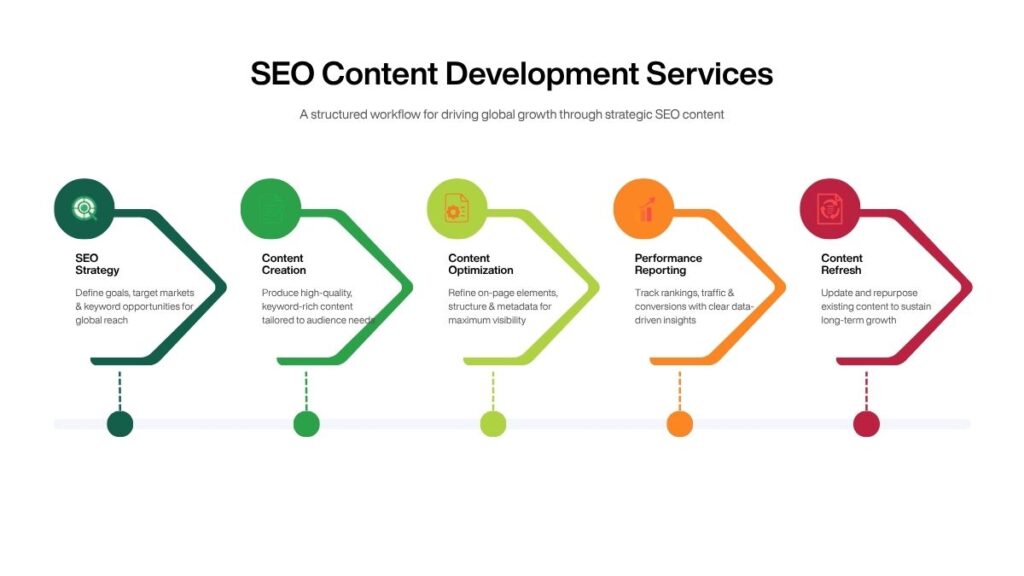
Website SEO in Asia delivers value more reliably when it follows an organised workflow. SEOSERVICES1 uses a staged approach that aligns with widely accepted SEO process models while adapting them to multi-country and multi-language realities in Asia.
Stage 1: Asia Website SEO Discovery and Market Selection
We start by getting a clear picture of your footprint. This often includes:
- Cataloguing sites, domains, and language variants that are currently live or planned.
- Identifying priority markets and subregions based on business strategy, existing presence, and growth opportunities.
- Discussing success criteria: increased organic visibility, qualified leads, online revenue, or other measurable outcomes in specific markets.
At the end of this stage, everyone involved has a shared view of which parts of your Asia presence matter most for website seo asia work.
Stage 2: Research and Architecture for Asia Websites
Then we examine how your current structures and content align with search behaviours and technical guidance. Typical activities:
- Reviewing search patterns and topics in your target markets to understand what your audience is looking for.
- Analysing existing site structures, URL patterns, language handling, and internal linking.
- Recommending or refining architectures that support clear country and language targeting, using internationally recognised best practices as a guide.
This stage produces an architecture and language plan that forms the backbone of your Asia website SEO strategy.
Stage 3: Content and On-Page Implementation Across Markets
With architecture clarified, attention turns to strengthening content and on-page signals. Work at this point can include:
- Updating or creating pages that matter most in each market: homepages, key category pages, product or service pages, and critical informational content.
- Refining titles, meta descriptions, headings, and internal links to reflect search patterns and language nuance.
- Ensuring content aligns with localisation decisions so it feels natural to each audience rather than forced.
This is where users begin to experience tangible improvements in relevance and clarity, and search engines receive clearer signals about what your pages offer.
Stage 4: Off-Page, Links, and Digital PR in Asia
Off-page signals support trust and authority. For website seo asia, off-page work may include:
- Identifying relevant regional, national, and industry sites that could link to or feature your brand.
- Planning outreach, content partnerships, and digital PR activities that align with regional objectives and constraints.
- Monitoring link profiles and mentions to ensure off-page signals support the right sites and language versions.
These efforts help build the external authority your Asia websites need to compete, especially in more mature or competitive markets.
Stage 5: Reporting, AI Visibility, and Iteration
Finally, website SEO in Asia becomes a continuous improvement cycle. Reporting and iteration cover:
- Establishing dashboards that show performance by country, site, and language, along with portfolio-level summaries.
- Tracking metrics such as organic traffic, visibility, engagement, and conversions across markets.
- Reviewing how structural, content, and off-page changes affect results and adjusting the roadmap accordingly.
Because markets and competitive landscapes change over time, this stage ensures your website seo asia efforts don’t stagnate after initial improvements.
Website SEO Asia Use Cases and Case Vignettes
Seeing how website SEO in Asia applies to real organisations can help you gauge what it might look like in your context.
Ecommerce Brand Expanding Across Southeast Asia
An ecommerce brand moves from serving one Southeast Asian market to several neighbouring countries. It keeps a single regional site and adds country sections, each with its own language. Over time, global category pages outcompete local ones, and users in some countries land on generic pages rather than tailored experiences.
By revisiting architecture, implementing precise hreflang, and aligning content with market-specific search queries, website SEO Asia work helps each country section claim its space. Search engines begin returning the appropriate pages for each audience, and users encounter more relevant information, which supports conversions and repeat visits.
SaaS Product Targeting East and South Asia
A SaaS provider wants to grow in Japan, Korea, India, and parts of Southeast Asia. It uses one domain and hosts English, Japanese, and Korean content, but metadata and internal links are inconsistent. Japanese pages occasionally rank for English queries, and vice versa.
With a website seo asia engagement, the company seo assesses how its language variants are structured, refines hreflang signals, and adjusts page content and metadata to better match local queries. As the changes roll out, each language set gains more stable visibility for relevant terms, and reporting begins to show clearer patterns between markets.
Travel Brand Serving Multiple Asian Source Markets
A travel brand targets travellers from several Asian markets but initially relies on a single global site with minimal localisation. Competition intensifies, particularly for destination-related queries, and generic content struggles to stand out.
By segmenting content into market-focused sections, adapting pages to reflect local interests and trip patterns, and improving performance for users across key source markets, the brand gains more precise organic visibility. Website SEO Asia work clarifies which content serves which audience and makes it easier to measure results per market.
These scenarios demonstrate that website SEO in Asia is less about abstract theory and more about carefully aligning architecture, language, and content with the realities of multi-country demand.
Reporting and Analytics for Website SEO Asia
Insight drives better decisions. For organisations running multiple sites or country sections, having a clear view of website SEO performance across Asia is non-negotiable.
A well-structured website seo asia reporting setup usually includes:
- Market-level views that show organic traffic, rankings, and conversions per country or region.
- Site- and language-level metrics that highlight how individual domains or sections are performing.
- Comparative charts or tables that reveal where certain markets are growing faster, struggling, or responding strongly to specific changes.
- Portfolio summaries that roll data up for regional leadership, giving a concise overview of Asia-wide performance.
With this level of visibility, you can spot patterns such as a country that responds quickly to content improvements or another where technical issues are suppressing gains. That knowledge makes your roadmap more purposeful: you can direct resources where they will have the most impact instead of spreading efforts thinly across all markets at once.
SEOSERVICES1 designs reporting frameworks with these layers built in, so operational teams and leaders both have the information they need to steer website SEO initiatives across Asia.
Common Challenges and Objections in Website SEO Asia
Stepping into region-wide website SEO often raises practical concerns inside organisations. Addressing them openly makes the work feel less risky and more manageable.
Some of the most common challenges include:
- Budget allocation: Multi-country SEO can appear expensive at first glance. A phased approach starting with key markets and building from proven results often helps organisations invest sensibly while still moving forward.
- Internal bandwidth: Teams may worry they lack enough SEO or content resources to support Asia. Clarifying which tasks are central, which can be handled by local partners, and which can be automated makes the workload more realistic.
- Language and cultural expertise: HQ teams may not speak all target languages or fully grasp cultural nuances. Combining central SEO guidance with local language and culture input turns this from a barrier into a collaborative strength.
- Ownership ambiguity: When multiple business units or regional offices own different sites, responsibilities can become blurred. Documented governance who owns strategy, who implements, who approves reduces confusion.
- Risk and compliance: In regulated sectors, teams may fear that SEO changes could conflict with local rules. Coordinating website SEO plans with legal and compliance teams helps ensure that optimisations stay within acceptable boundaries.
SEOSERVICES1 works with organisations to map these concerns and build them into planning, so website seo asia efforts feel like a series of informed decisions rather than a leap into the unknown.
Website SEO Asia FAQs
1. What is website SEO in Asia and how is it different from global SEO?
Website SEO in Asia is SEO for websites targeting multiple Asian markets and languages. It differs from global SEO by putting Asia’s language combinations, platform ecosystems, and user behaviours at the centre of the strategy, rather than assuming one global template will fit the region.
2. Which Asian markets can SEOSERVICES1 support for website SEO?
SEOSERVICES1’s website seo asia services can support sites targeting markets such as Singapore, Malaysia, Indonesia, Thailand, Vietnam, the Philippines, India, Japan, Korea, and other Asian countries, depending on your portfolio. We work with both regional sites and country-specific sites across this footprint.
3. How do website SEO strategies change between Google-centric markets and markets with strong local engines?
In markets where Google is dominant, we focus heavily on aligning with its technical and content expectations. In markets with strong local engines or portals, we adapt strategies to factor in how those platforms handle site structures, metadata, and content formats, ensuring your site is understandable and useful in each environment.
4. How should multi-language Asian websites be structured for SEO?
Multi-language Asian websites should use clear URL patterns and appropriate hreflang annotations, with language and region targeting defined in a way that both users and search engines can follow. Whether you use separate domains, subdomains, or subfolders depends on your current setup, future plans, and resource levels.
5. What does a typical website SEO Asia engagement include?
A typical engagement includes discovery and market selection, technical and architecture planning, content and on-page optimisation, off-page and PR guidance, and reporting setup with multi-country views. The exact mix of services will vary depending on whether you are a single-country, multi-country, or enterprise portfolio client.
6. How is pricing structured for website SEO across multiple Asian markets?
Pricing usually scales with the number of markets, sites, and languages in scope, and with the depth of strategy and reporting involved. A single-country site with one language requires less work than a regional portfolio spanning several markets and multiple language variants, and the pricing reflects that difference in complexity.
7. What regulations and cultural factors affect website SEO in Asian countries?
Each Asian country has its own regulatory landscape and cultural context. For example, rules around claims in healthcare, finance, or education can vary, and content tone may need adjustment to match local expectations. We integrate these considerations into website SEO recommendations in collaboration with your internal teams.
8. How long does it usually take to see website SEO results in Asia?
Website SEO is a gradual process. Organisations often see early improvements in visibility and engagement a few months after structured changes, especially when technical issues or confusing architectures are resolved. More stable growth in organic traffic and conversions tends to appear over six to twelve months, influenced by competition and scope.
9. How do you report performance for multi-country Asia website SEO campaigns?
We design reporting so you can see performance by market, site, and language, along with consolidated views for Asia as a whole. That means dashboards showing key metrics per country or site variant, plus summaries for regional leadership and planning.
10. How do you collaborate with HQ, regional offices, and local teams in Asia?
Collaboration models are tailored to your structure. Typically, HQ defines strategy and standards; regional offices adapt and coordinate; local teams handle language and market-specific tasks. SEOSERVICES1 works across all three layers to keep website seo asia efforts aligned and sustainable.
Why Choose SEOSERVICES1 for Website SEO in Asia
Choosing a partner for website seo asia means entrusting them with how your brand appears in some of the world’s most dynamic, diverse markets. SEOSERVICES1 combines structured process, recognised SEO fundamentals, and region-aware thinking to help you navigate that complexity.
We focus on:
- Treating Asia as a set of distinct markets, each with its own language mix, platform ecosystem, and user expectations.
- Designing multi-language and multi-site architectures that fit both your organisational realities and SEO best practices.
- Building workflows and governance that ensure HQ, regional, and local teams understand their responsibilities and can collaborate effectively.
- Creating reporting structures that make performance in each market visible, and link those insights back to global strategy.
By approaching website SEO in Asia as a disciplined program rather than a series of ad-hoc tweaks, SEOSERVICES1 helps organisations make steady, transparent progress in how their sites serve and grow Asian audiences.
How to Get Started with Website SEO in Asia
If you’re ready to explore website seo asia more seriously, the best next step is a structured review of where you are and where you want to go.
A typical starting path includes:
- Initial conversation: We talk through your current sites, target Asian markets, and priorities, and surface constraints and opportunities.
- Baseline review: We analyse your existing architecture, technical health, and content coverage across key markets, looking for quick wins and deeper issues.
- Proposal and roadmap: You receive a plan outlining suitable package types, phasing, and reporting approaches for your Asia portfolio.
- Kickoff and implementation: We align on governance and collaboration, then work through the website SEO Asia workflow from discovery and architecture to content, off-page work, and reporting.
To learn more about SEOSERVICES1 or begin that conversation, you can visit our homepage. From there, we can design a website seo asia programme that matches your markets, sites, and growth ambitions.